Why doesn’t a spinning top fall over?
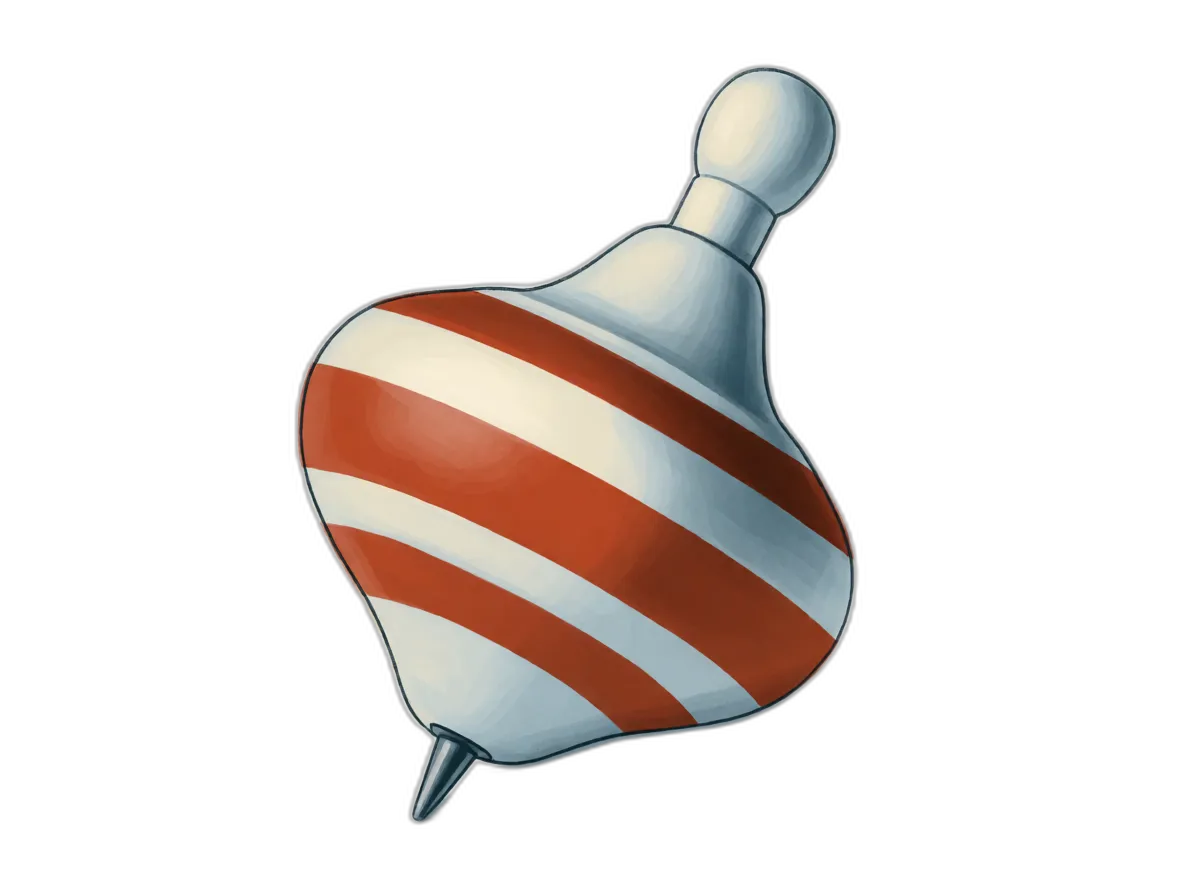
Set a top spinning on the kitchen table and watch what happens. It leans over — really leans, at an angle that would flatten a pencil instantly — and then simply stays there, drifting round in a slow circle. Nothing props it up. Nothing pulls it upright. So what stops it falling?
Nothing stops it. Gravity is hauling that top downward exactly as hard as it hauls everything else on the table, and gravity is winning. What changes is the direction the falling comes out in.
A lean is really a twist
Stand a pencil on its blunt end, tip it slightly and let go. Five seconds, and the whole puzzle is in front of you: it went over the way it leaned, immediately.
Every object has a center of gravity, the single point where you can treat all its weight as pulling from. On a top it sits in the fat part of the body, well above the metal tip.
Gravity pulls downward there. The table pushes upward at the tip. The two pushes are equal in size. They act in different positions, though — one up in the body, one down on the tabletop.
Stand a top perfectly upright and the two pushes line up, so there is no twist. Only a lean makes one.Two equal pushes that miss each other like that produce a torque: a twist. It is what your hand applies to a perfectly ordinary doorknob or jar lid, and it has exactly one job. It makes things rotate.
Now the part that sounds like a trick. Falling over is rotating. Your pencil turned about a horizontal line on the tabletop, swung through a quarter circle, and met the wood.
So gravity never shoves anything flat. It applies a twist, the twist produces rotation, and that rotation is what you call falling. Everything depends on what the object was already doing when it arrived.
Spin has a direction, and a twist steers it
A spinning top is rotating enormously already, about its own axis — the line running up through its middle from the metal tip to the handle.
That rotation has a proper name. Physicists call it angular momentum: how quickly a thing revolves, and how difficult it would be to stop. Call it the spin.
The spin also points somewhere: along the axis, so a leaning top has a leaning spin. Rotation is never simply an amount. It is an amount aimed in a particular direction, and that direction can be altered on its own.
Think about riding your bicycle along a straight path. You have a speed and a heading. A friend running alongside knocks your handlebars sideways. You do not stop, and your speed hardly changes. Your heading does: you veer off, still traveling exactly as quickly as before.
Gravity’s twist does that to the top’s spin. It does not press down and crush it. It arrives from the side and steers it, so the spin keeps its whole size while its direction swings over.
And the spin’s direction is the axis. Steer the spin and you have swung the top’s axis somewhere new. That sideways swing is precession, and a leaning top does nothing else for as long as it lasts.
So gravity’s twist never tips the top over. It steers the spin sideways and the top follows its axis around. Which leaves one obvious complaint: nobody pushed it sideways.
The push arrives a quarter turn late
Sideways is not a decision the top makes. It follows from the rim being in motion, and a bicycle wheel shows it best.
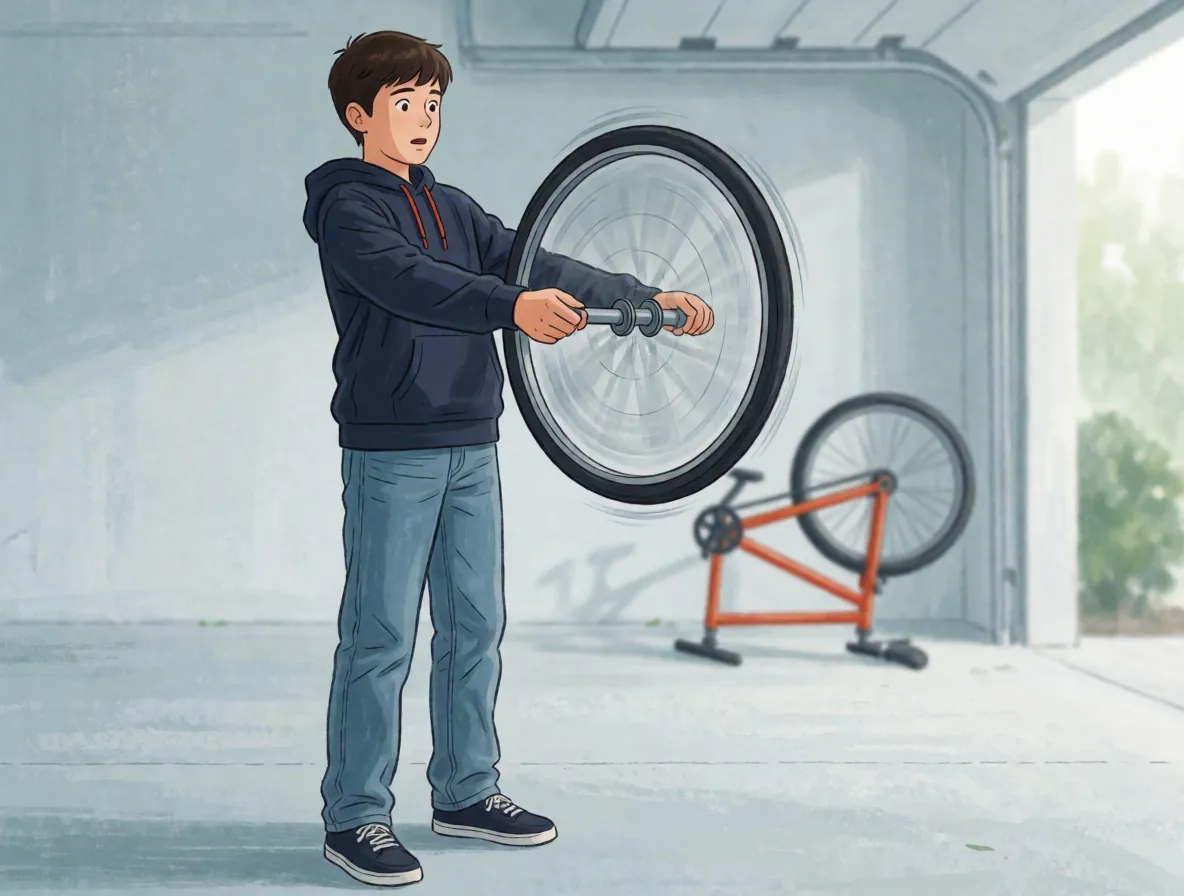
Take a front wheel off a bicycle, hold it by both ends of the axle, and get somebody to spin it hard. Now try to lay the wheel over to the left. It refuses, and escapes in a direction you never pushed, hard enough to turn your shoulders.
Follow one piece of the rim and the explanation appears. Laying the wheel over means pushing the top of the rim one way and the bottom the opposite way. The piece at the top receives a shove, and carries that shove on around the wheel.
A push does not become movement instantly; it takes a moment. During that moment the piece of rim travels a quarter of a revolution and arrives at the side of the wheel. That is where the movement finally appears: perpendicular to your hand, a quarter turn away.
Push a spinning wheel and it moves a quarter turn from the push. Gravity pushes a leaning top continually, so the top keeps stepping a quarter turn sideways, then another, and never reaches the floor.
Fast spin, slow circle
How quickly a top laps that circle depends entirely on how much spin there is to steer.
The twist supplies the same quantity of steering every second, whatever the top is doing. Steering a small spin swings its direction a long way. Steering an enormous spin barely nudges it. So a top going flat out creeps around its circle, while a tired one races round.
You have watched this happen and probably read it as the top getting worse at its job. Fresh off your fingers it stands nearly vertical and turns one slow, lazy lap. Seconds before the end it suddenly leans hard and whips round like something panicking. Gravity has not begun trying harder. There is simply less spin left for the same twist to steer.
A tired top does not go over because gravity finally beat it. It goes over because there is hardly anything left to steer.
The speed of the lap is therefore a measurement of how much spin remains. A slow lap means plenty, a rapid lap almost none. So something has been quietly removing the spin the entire time.
Ten minutes was not long enough
In 1851, long before your great-great-grandparents were born, Léon Foucault hung a pendulum from the roof of the Panthéon in Paris. Its swing turned slowly, because the building was revolving underneath. Foucault felt people had misunderstood the demonstration.
So in 1852 he and the instrument maker Paul-Gustave Froment built something plainer: a bronze wheel hung inside two pivoting brass rings, free to aim wherever it liked. A cord round its spindle spun it up.
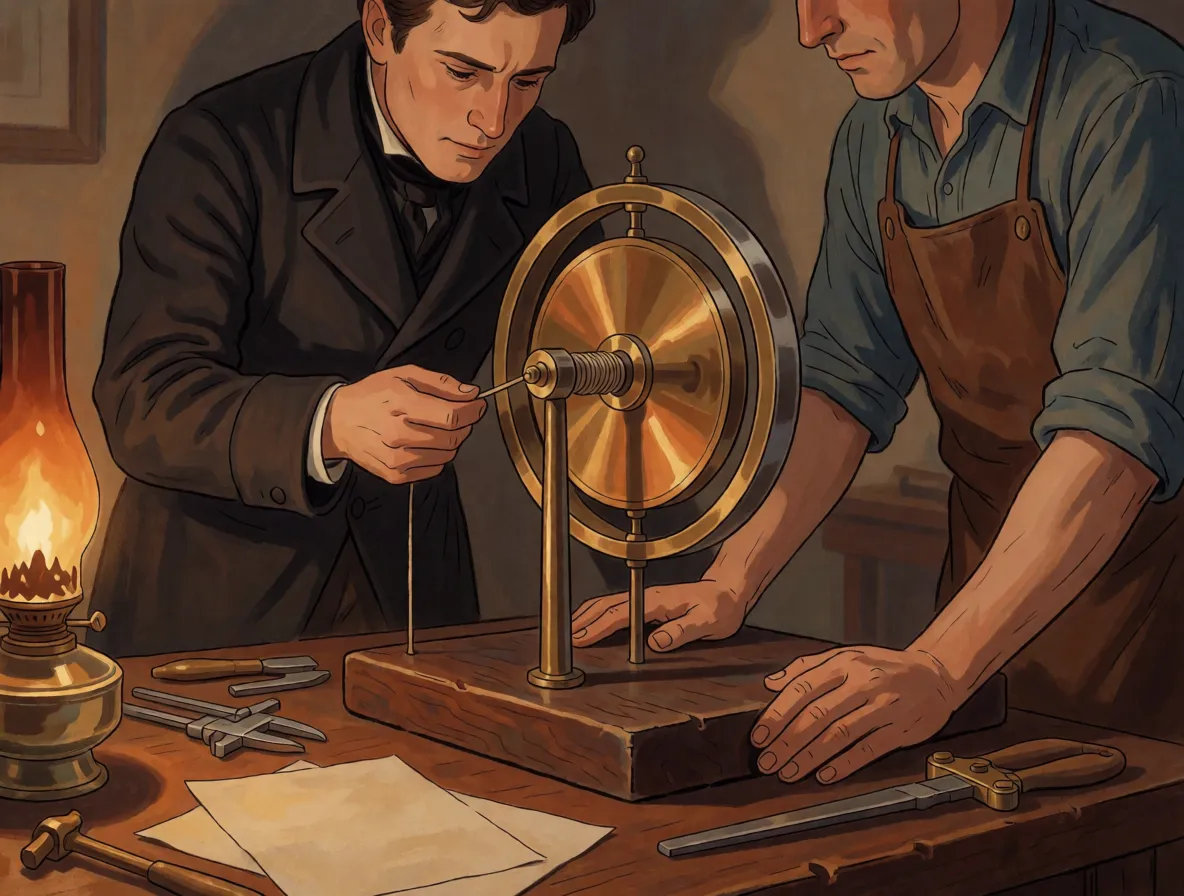
Twelve thousand revolutions a minute is two hundred every second.
Rotating like that, the wheel held its axis aimed at one distant place while the room and the planet revolved beneath it. Foucault named the apparatus a gyroscope, from two Greek words meaning to see the turning.
Then it wound down. Rubbing in the bearings consumed the spin, and he had roughly ten minutes of observation before it stopped. That is generous for a lecture and useless for navigating anywhere. For half a century the gyroscope stayed a curiosity to show an audience.
What eventually rescued it was an electric motor. Hermann Anschütz-Kaempfe was an art historian planning a submarine expedition to the North Pole. Up there a magnetic compass is close to useless: the needle tries to point almost straight down into the ground. In 1908 his answer passed its tests: a gyrocompass, a gyroscope kept spinning steadily all day by a motor.
The gyroscope became useful only when somebody stopped the spin running out. Your top has no motor, which turns its circling into a countdown you can time.
Time your own top’s circle
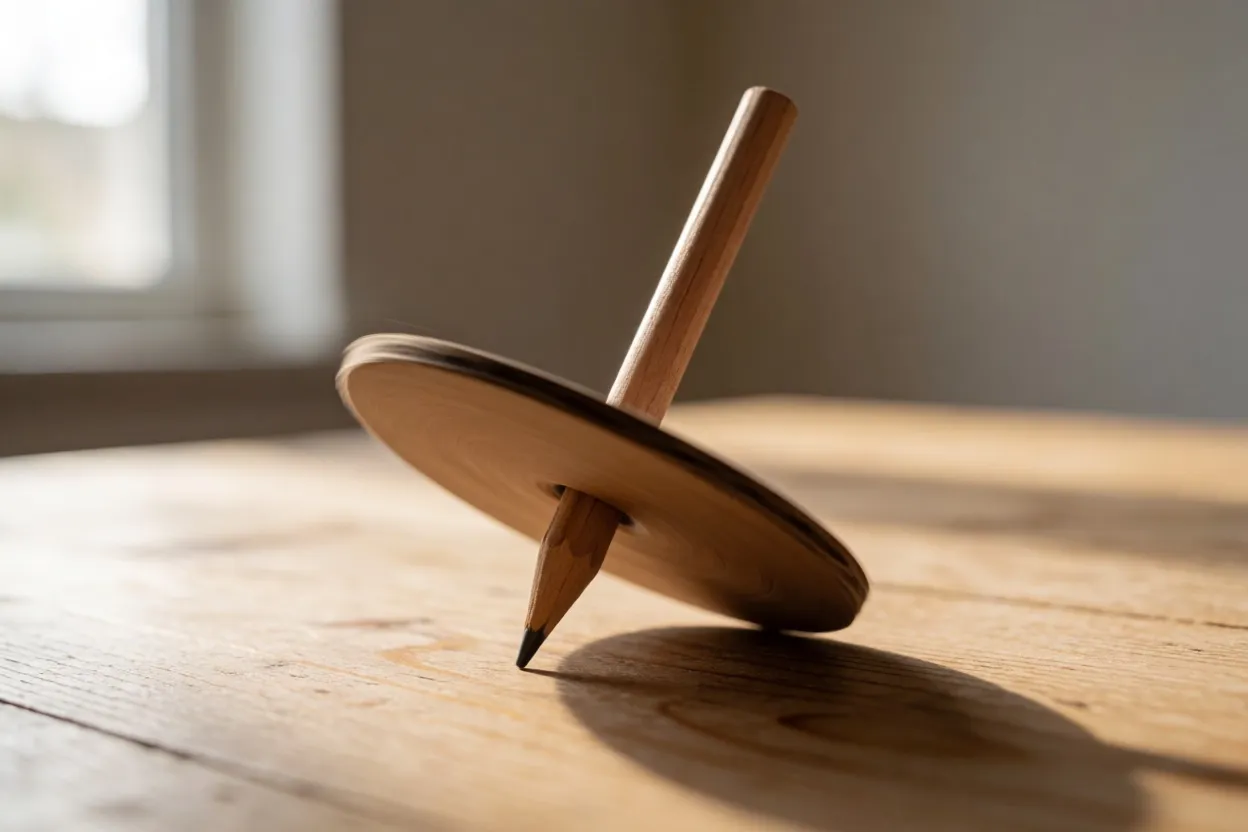
The prediction is that the high top laps faster, and it does, every time. Nothing about the spin changed; only the position of the circle did. Sliding it upward moved the center of gravity further from the point, widening the gap between gravity’s pull and the tray’s push. A wider gap makes a bigger twist, and a bigger twist steers harder.
Those final seconds are the same arrangement running backward. The lean opens out, the laps tighten, and the top finally goes over — the one thing it refused to do all along.
The wobble was the answer all along
Every top you have ever spun was showing you this, and it resembles failure so closely that nobody watches it. That slow lean and drift is the whole of gravity’s effort, arriving sideways. It is the reason the top is upright at all.
The top does finish on its side, of course. Friction, the dragging between two surfaces sliding across each other, helps itself to the spin at the tip and in the air. It is the same thief that ends the spin on a bicycle wheel you turn by hand. As the spin gradually drains away the steering grows, the laps tighten, and one of those widening leans lays the top on the table.
So nothing was ever holding your top up, and nothing needed to. Gravity pulled on it from the first second to the last and got its way in the end. It simply had to go round in circles to get there.