Why does toast land butter-side down?
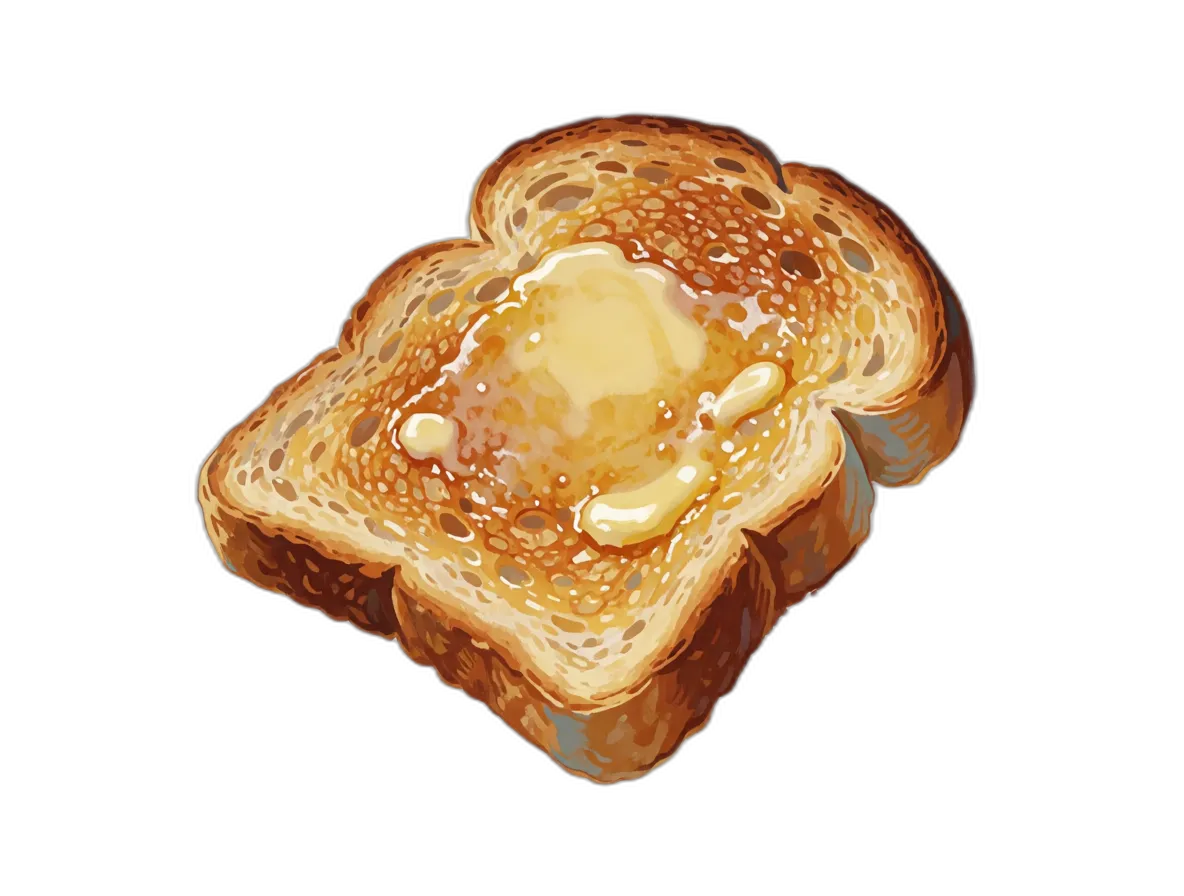
Your elbow catches the plate, the toast goes over the edge, and it lands butter down on the kitchen floor. Everybody says the same thing, and everybody assumes it is a joke about bad luck. It is not a joke. A thousand schoolchildren once dropped nearly ten thousand slices to check, and the toast is genuinely cheating. The strange part is what it is cheating with.
The slice never simply falls. It turns as it goes over the edge, and your table is almost exactly the wrong height.
Going over an edge is not the same as falling
Drop a slice flat from shoulder height and it flutters down more or less level. Nothing makes it turn over, so it lands whichever way up it started, and the whole business really is fifty-fifty.
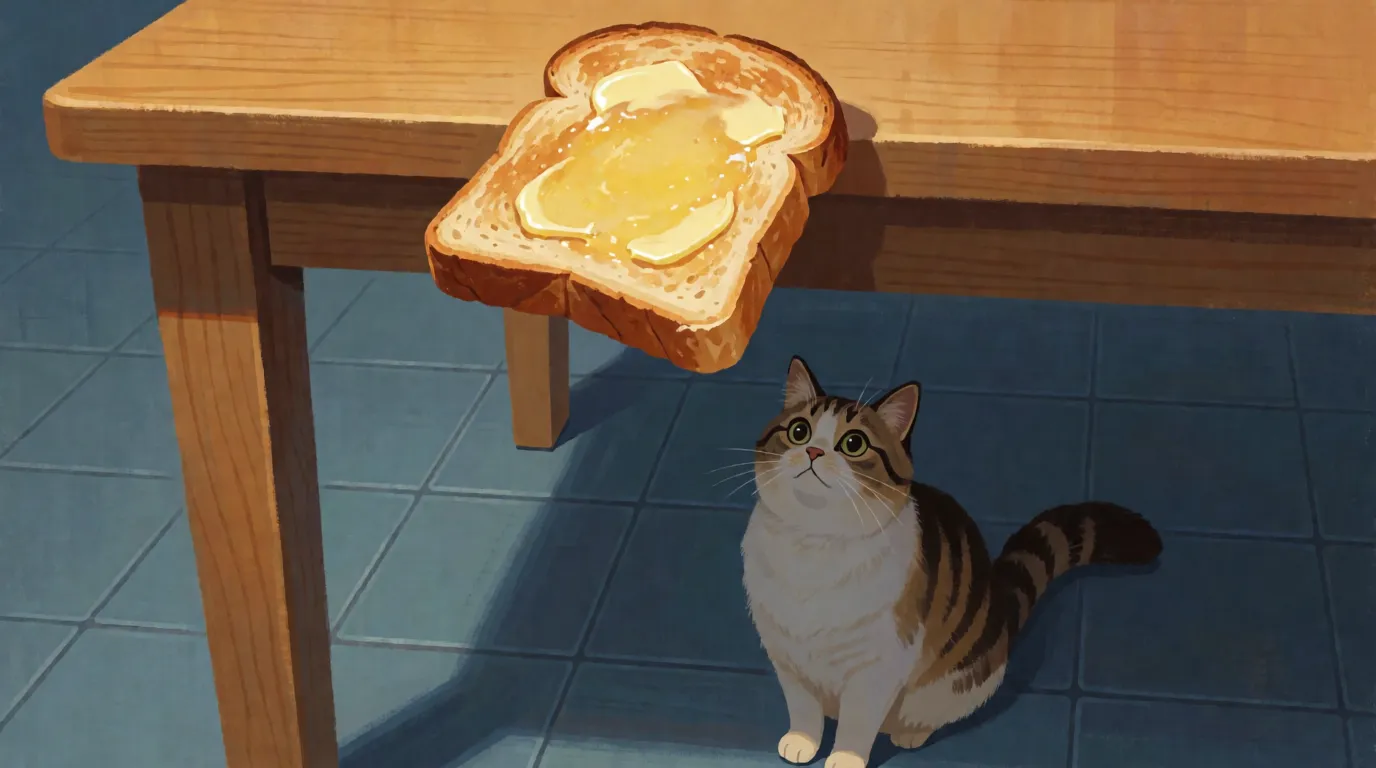
Sliding off a table is a completely different event. The slice does not depart all at once. Its leading edge travels out over nothing while the remainder is still supported, and gravity immediately begins hauling that overhanging portion downward.
The table edge becomes a pivot: a fixed line that something turns about. Gravity pulling on one side of a pivot produces a torque, meaning a twisting push, and a twisting push is precisely what starts a rotation.
By the time the rear of the slice clears the table it is already turning, and nothing in the surrounding air is going to interrupt it.
That is the entire mechanism, and it explains the one thing everybody has noticed: toast knocked off a table misbehaves, while toast dropped flat does not.
The fall is too short for a full turn
Now the arithmetic that decides your breakfast. A slice departing a table is rotating at a fairly modest rate, determined by how far it overhung beforehand. The balance point of the slice — its center of mass — has to travel past the edge before it can leave at all.
An ordinary kitchen table stands about 75 cm(30 in) high, so the toast has a little over a third of a second in the air. In that time it manages roughly half a turn.
Half a turn is the worst possible amount. The buttered face was pointing up when it left, so half a turn puts it face down, and it arrives with no time left to carry on to a full rotation.
Calculate how tall a table would need to be to complete the rotation and you get an uncomfortable answer: approximately 3 m(10 ft). A table that high would require a ladder, so no kitchen has ever possessed one.
Toast is not unlucky. Human beings are simply the wrong height, and we build our tables to match.
Everything about that chain is ordinary. People are the size they are, tables come up to about hip height so we can work at them, and a slice pivoting off hip height has time for half a rotation. Nothing in it is about luck.
The butter is not the reason
The butter does one real thing, and it is not physics. It makes the outcome matter. Nobody remembers the times a dry slice landed the wrong way up, because a dry slice landing either way is just a slice on the floor.
A physicist, a table, and ten thousand slices
The claim that dropped objects go wrong deliberately has a name and a birthday. In 1949, roughly when your great-grandparents were young, an engineer called Edward Murphy lost his temper at a California air base over sensors that had been wired in backward.
What he said became Murphy’s Law: the principle that anything capable of going wrong eventually will. For fifty years everybody treated it as a joke about human carelessness.
Then in 1995 Robert Matthews, a British physicist, decided to investigate whether its most famous example was genuinely true. He worked through the tumbling of a slice of toast properly, with mechanics rather than opinions.
His conclusion was that toast really does land butter-side down, for the reason above. He went further: a creature tall enough to own a three-meter table could not be built from the chemistry we are made of. The paper is entirely serious and reads like a comedy.
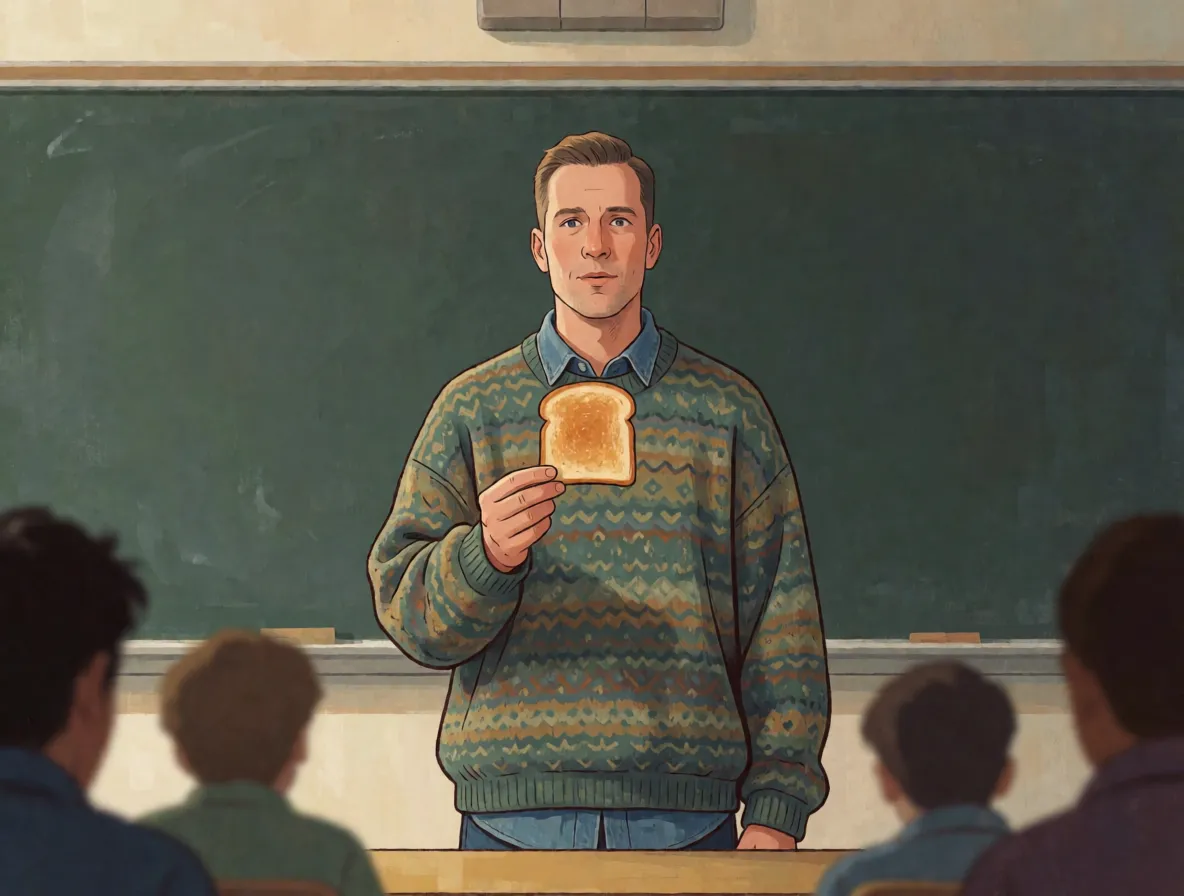
It won him an Ig Nobel Prize, an award established in 1991 by Marc Abrahams for research that makes people laugh and then makes them think. Winners collect it personally, and most of them are delighted.
The experiment that tested the wrong thing
There had already been a famous attempt at settling the question, and it went wrong instructively. A television science program tossed slices of toast into the air, recorded how they landed, obtained a tidy fifty-fifty result, and declared the entire business a myth.
Tossing is the wrong experiment. A tossed slice never encounters an edge, so nothing establishes a controlled rotation, and naturally it lands randomly. They had carefully investigated the one situation where the effect cannot occur.
Matthews settled it properly in 2001 by recruiting about a thousand schoolchildren to knock toast off tables and report their results.
The result of the schools experiment: butter-side-down landings out of the total number of drops.
Sixty-two out of a hundred is not a small effect. It is the difference between a fair coin and a bent one, produced by nothing more sinister than the height of a kitchen table.
Prove it on your own floor
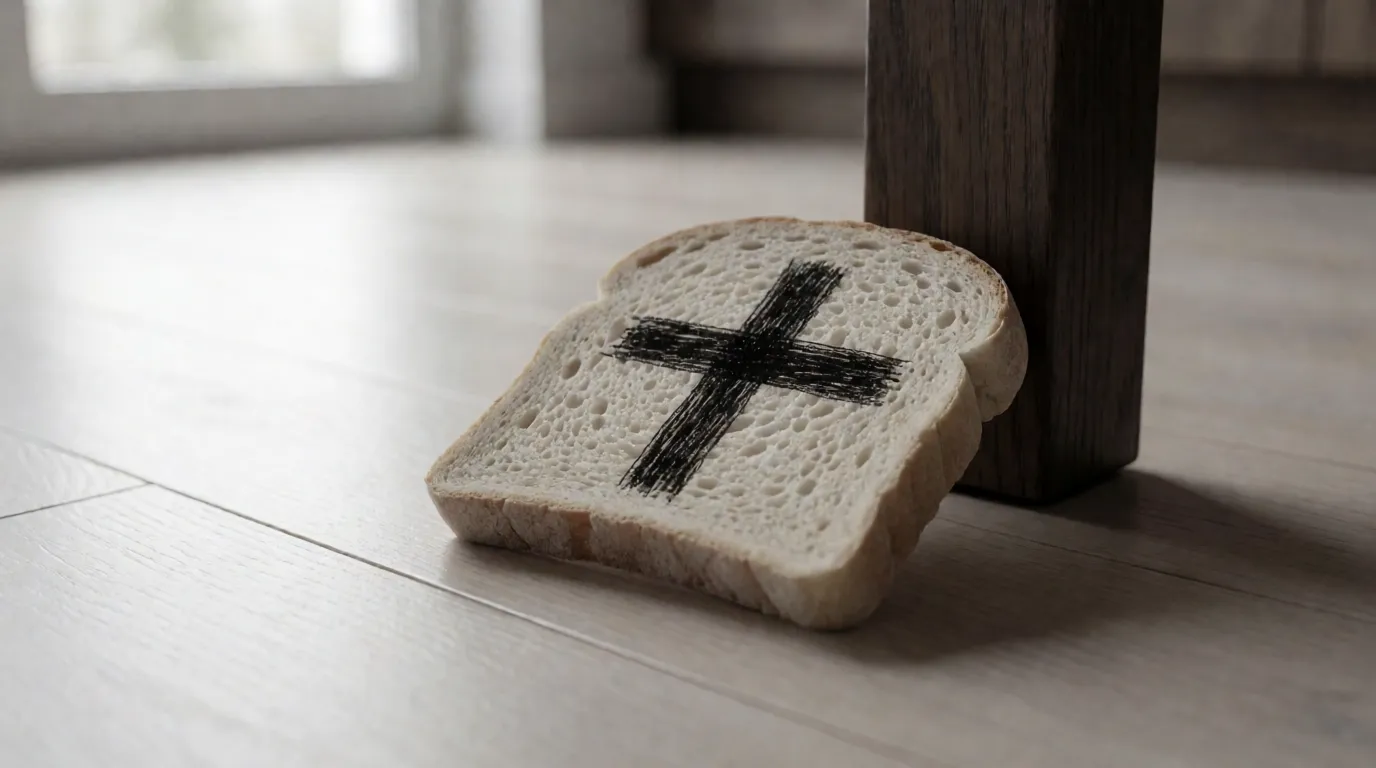
The table drops land cross-down most of the time. The high drops come out much closer to even, and some of them make it all the way round.
You will also notice the second variable straight away: how far the slice overhangs before it goes. Push it further out and it leaves the edge turning faster, which changes everything. Try a set with only a corner overhanging and a set with half the slice off.
The unluckiest height in the house
There is nothing wrong with your kitchen and nothing wrong with your toast. The slice is obeying the least surprising rules there are, and it would behave perfectly well from a shelf at head height.
What makes it feel like a curse is the coincidence underneath. The one height where the rotation goes badly is the height humans build tables at, and we chose that for reasons entirely unconnected with breakfast.
So the next slice that goes over the edge is not making a point. It is reporting, accurately, how tall the people in your house are.