Why does a bicycle stay up?
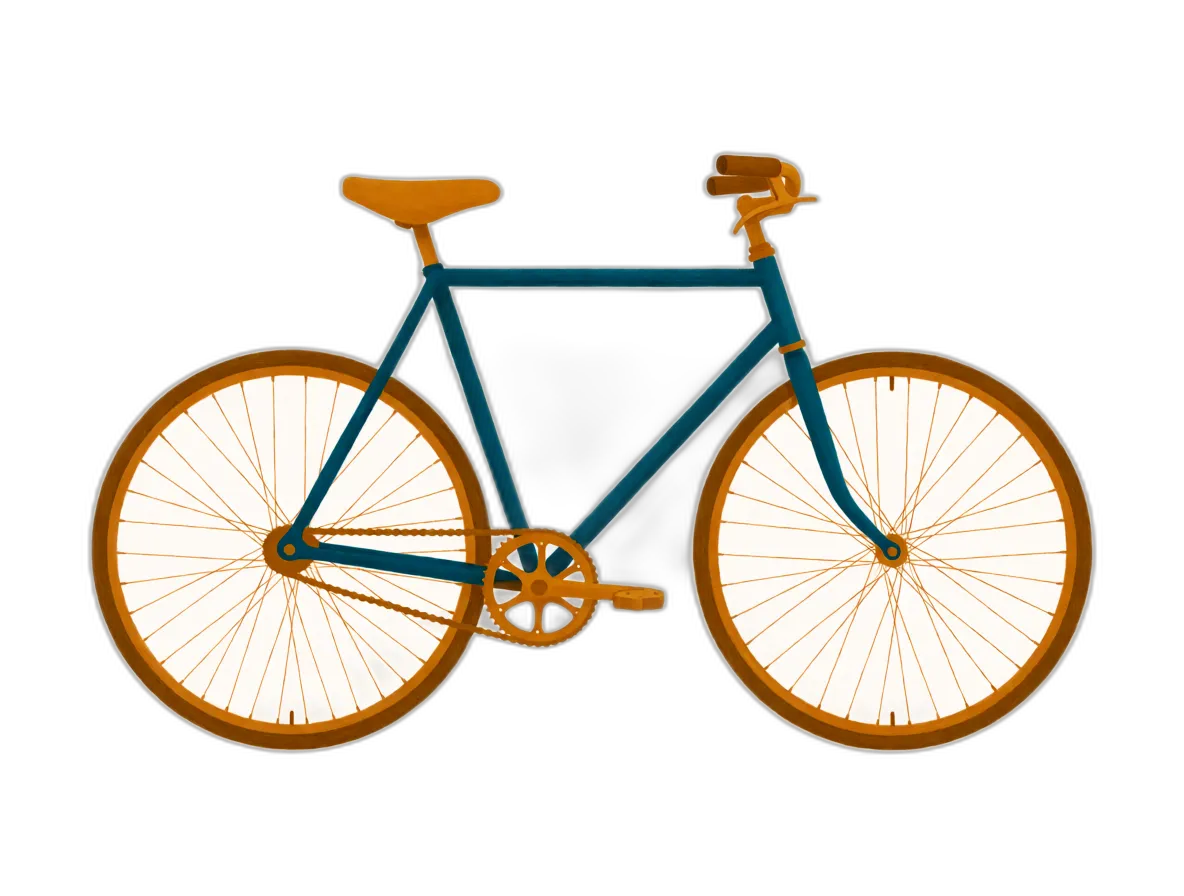
Stand a bicycle up in the playground, let go, and it falls over immediately. Give the same bicycle a hard shove and it will run twenty meters across the grass by itself, upright the whole way, wobbling and correcting like something alive. Nobody is on it. Nothing is holding it. The only difference between the two is that one of them is moving.
A rolling bicycle does not resist falling over. It falls, notices, and drives itself back underneath.
Balancing is not holding still
Stand up and balance a broom on your palm. You do not hold your hand steady — that fails within a second. You watch which way the broom is tipping and move your hand under it, over and over.
Every balancing act works like that. You cannot stop something tall from toppling; you can only keep putting the bottom back under the top.
The place where a bicycle and rider would balance perfectly, if you could hang them from a single string, is called the center of mass. It sits around your belly button, roughly a meter above the ground, and gravity pulls straight down through it.
If that point drifts sideways from the two contact patches where the tires touch the road, gravity gets a lever and the bike starts turning over. This is a torque, meaning a twisting push, and it grows as the lean grows.
So the bicycle needs some way of hurrying the wheels sideways to catch up. It has exactly one: the front wheel can steer.
Steering into the fall is the whole trick
Watch what happens when a rolling bicycle tips to the left. The front wheel turns left. The bike now travels along a curve to the left instead of a straight line.
Anything traveling around a curve experiences a push toward the outside of that curve. You have felt it in the back of a car and on every roundabout you have ever cycled. Scientists call it inertia: the stubbornness that keeps a moving object heading in a straight line unless something forces it sideways.
On a leftward curve the outside is the right, so inertia shoves the wheels rightward across the ground. They travel out from underneath the leaning bicycle and back into position beneath the center of mass. The lean stops growing, then reverses, and the machine straightens itself.
Then it overshoots slightly, tips the other way, and the whole correction runs again in the opposite direction. That is the wobble you can see in a bicycle crossing a field alone.
A bicycle is never balanced. It is falling constantly, in whichever direction it has not yet corrected.
Which raises the obvious question: with nobody on board, who is turning the handlebars?
The bike steers itself, for two ordinary reasons
Look at a bicycle from the side and notice that the front forks are not vertical. They slope backward, and the wheel sits ahead of where that sloping line would meet the ground. That gap is called the trail, and it is usually around 6 cm(2½ in).
Trail makes the front wheel behave like the swiveling wheel on a shopping cart. It is dragged rather than pushed, so it automatically swings around to follow, and when the frame leans the entire assembly flops in the direction of the lean. Engineers call this arrangement a caster.
There is a second reason, and it is the one everybody has heard of. A spinning wheel resists being tilted, and when you tilt it anyway it responds by turning sideways instead. That behavior is called precession, and on a leaning bicycle it steers the front wheel into the lean, which is exactly what is wanted.

So a bicycle carries two separate mechanisms that both steer into a fall, and either of them would do. Which is a comfortable story, and it turns out to be wrong about both.
The unrideable bicycle that nobody could make unrideable
Trail survived that round, so for forty years the explanation became caster rather than gyroscopes. Then in 2011 a team including Andy Ruina and Arend Schwab removed both at once.
They built a small strange machine with counter-rotating wheels, cancelling the gyroscopic effect completely, and with negative trail, so the caster effect worked backward. By the old account it should have collapsed instantly.
Shoved along and knocked sideways, it steered into its own fall and recovered. Neither mechanism is necessary. Both help on an ordinary bicycle, and neither one is what makes balancing possible.
What their machine still had was mass arranged so that a leaning frame makes the front end swing toward the lean. That, and forward motion, is the whole requirement. Everything else is a way of achieving it.
What the rider is actually doing
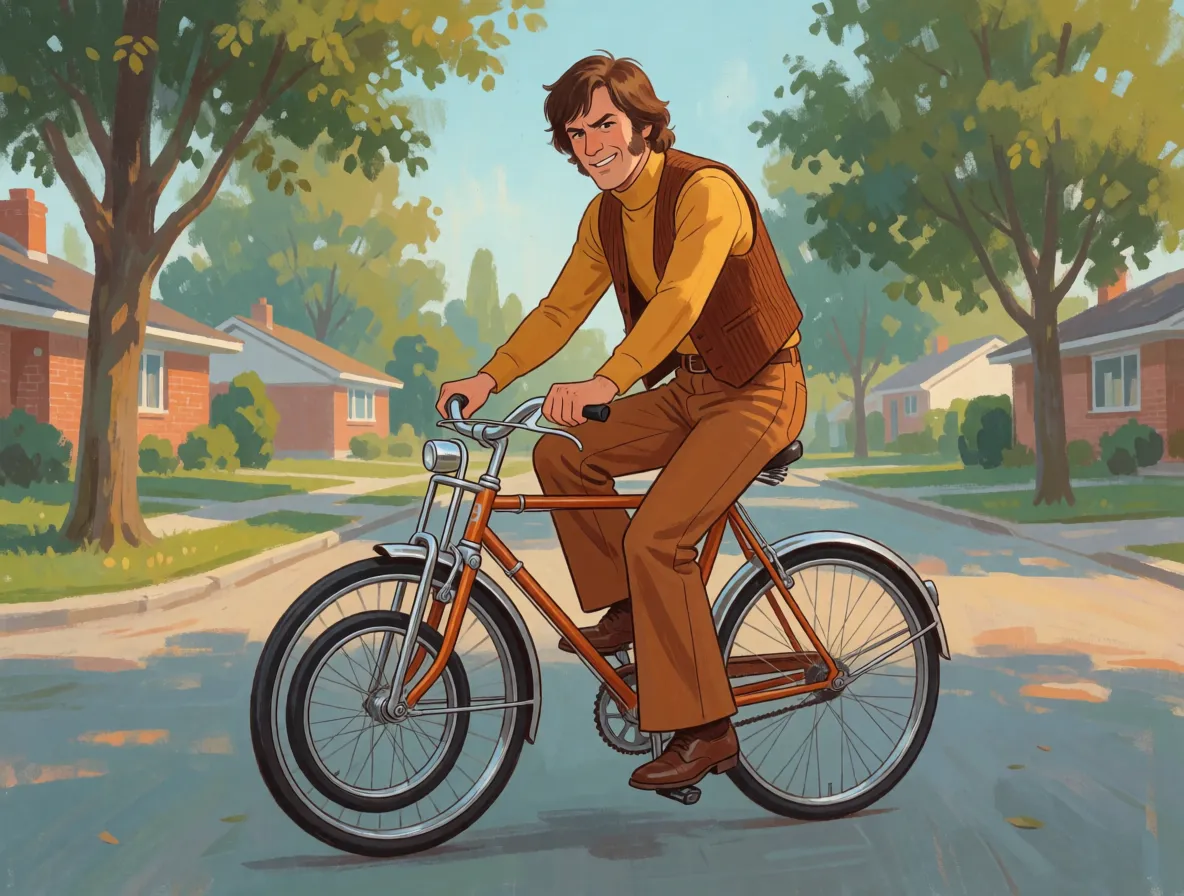
A person on a bicycle is doing the same job the machine does, faster and better. You are steering into every fall, dozens of times a minute, with corrections far too small to notice.
Here is the proof, and you can feel it on your next ride. To turn right, you must first push the right handlebar gently forward, steering momentarily left. That tips you rightward, and only then does the turn begin.
Every cyclist alive does this, and almost none of them know it. Ask an adult who has cycled for thirty years which way they push to turn right, and they will get it backward.
Somebody noticed all this remarkably early. William Rankine, a Scottish engineer, wrote in 1869 that a rider stays upright by steering toward the side they are falling toward. That is essentially the modern explanation, published over a hundred and fifty years ago.
Find the speed where it holds itself up
Turning a speed in meters each second into an everyday speed in kilometers an hour.
Most bicycles need somewhere around 4 m/s(9 mph) before they hold themselves up, which is a decent jogging pace. Below that they fall over, because the curve they can steer into is too gentle to bring the wheels across in time.
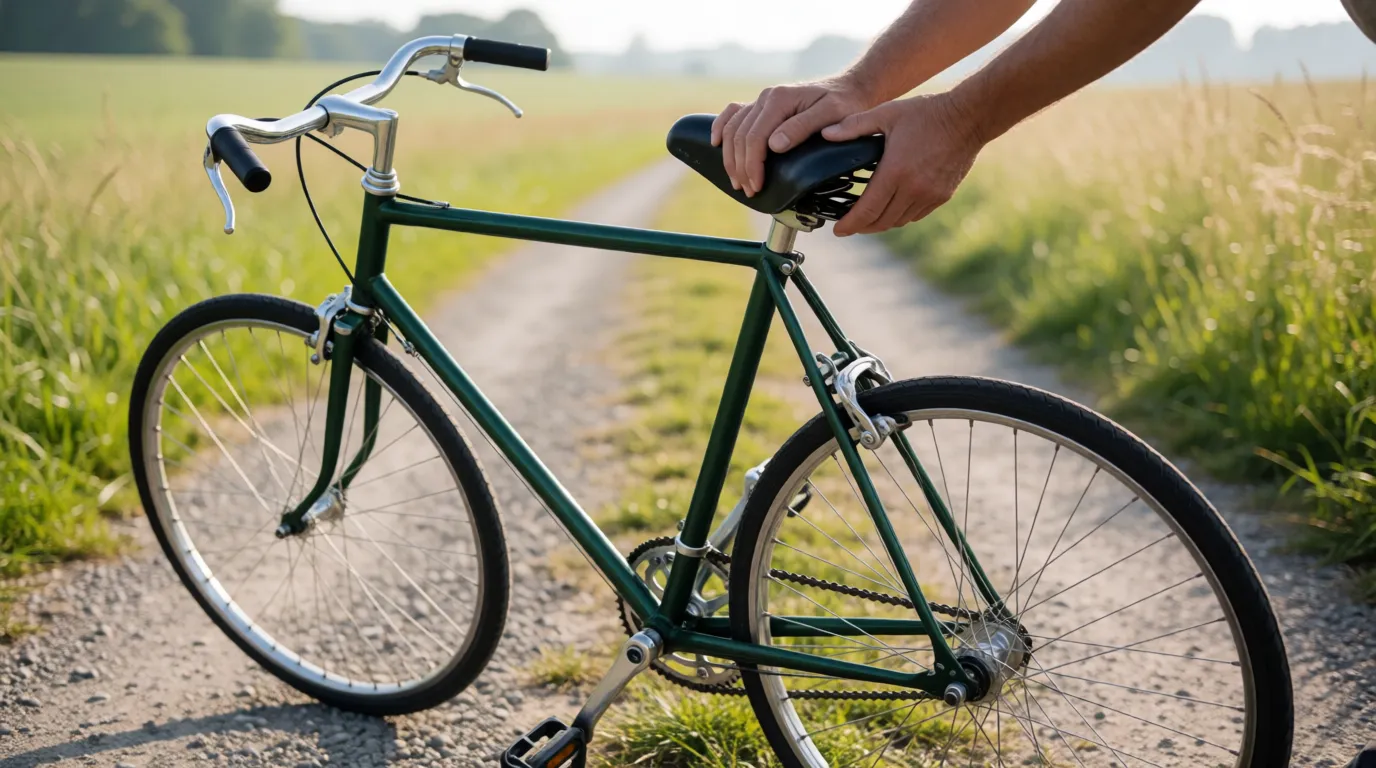
The saddle test is the one worth doing first. Lean the bike and the bars swing by themselves, with your hands nowhere near them, which is the entire mechanism happening in your hands at walking pace.
Falling, forever, in a useful direction
Nothing about a bicycle is stable in the way a table is stable. Every moment you spend riding is a moment of falling that gets caught.
That is why learning to ride feels impossible and then suddenly does not. You are not learning to hold still, which cannot be done. You are learning to steer toward the ground you are heading for, which is the exact opposite of what your nerves want.
And it is why the bicycle gets easier as you accelerate. Faster means a tighter correction from a smaller flick of the bars. The entire business of staying upright demands less and less of your attention, until you can manage it one-handed while eating an apple.