Why does a spinning coin whirr before it stops?
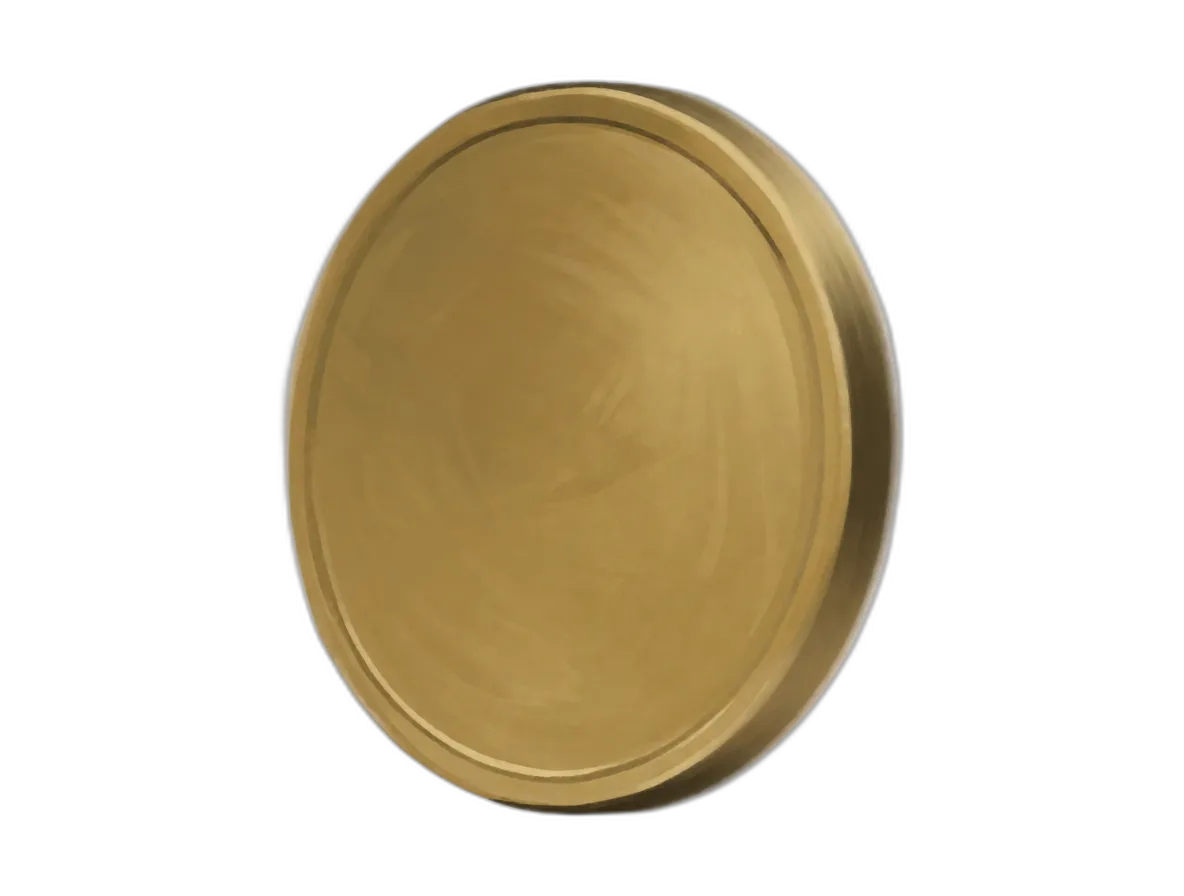
Spin a coin and listen to the last two seconds. It settles lower, the rattle becomes a hum, the hum climbs into a frantic buzz, and then it all ends at once with a slap. Everything about a dying spin should be slowing down. Instead something inside it accelerates right up to the final instant, and the mathematics describing it runs off to infinity.
The coin is not spinning faster. The place where it touches the table is racing round the rim, and that lap gets quicker as the coin lies down.
Two different things are going round
The confusion here is that a settling coin has two separate motions, and they behave in opposite ways.
The first is the coin turning about its own middle, the way a wheel turns. Watch a marked coin in slow motion and this rotation is unmistakably slowing down, from beginning to end, exactly as friction demands.
The second is easy to miss. At any instant only one point on the rim is actually touching the table, and that contact point travels around the edge of the coin.
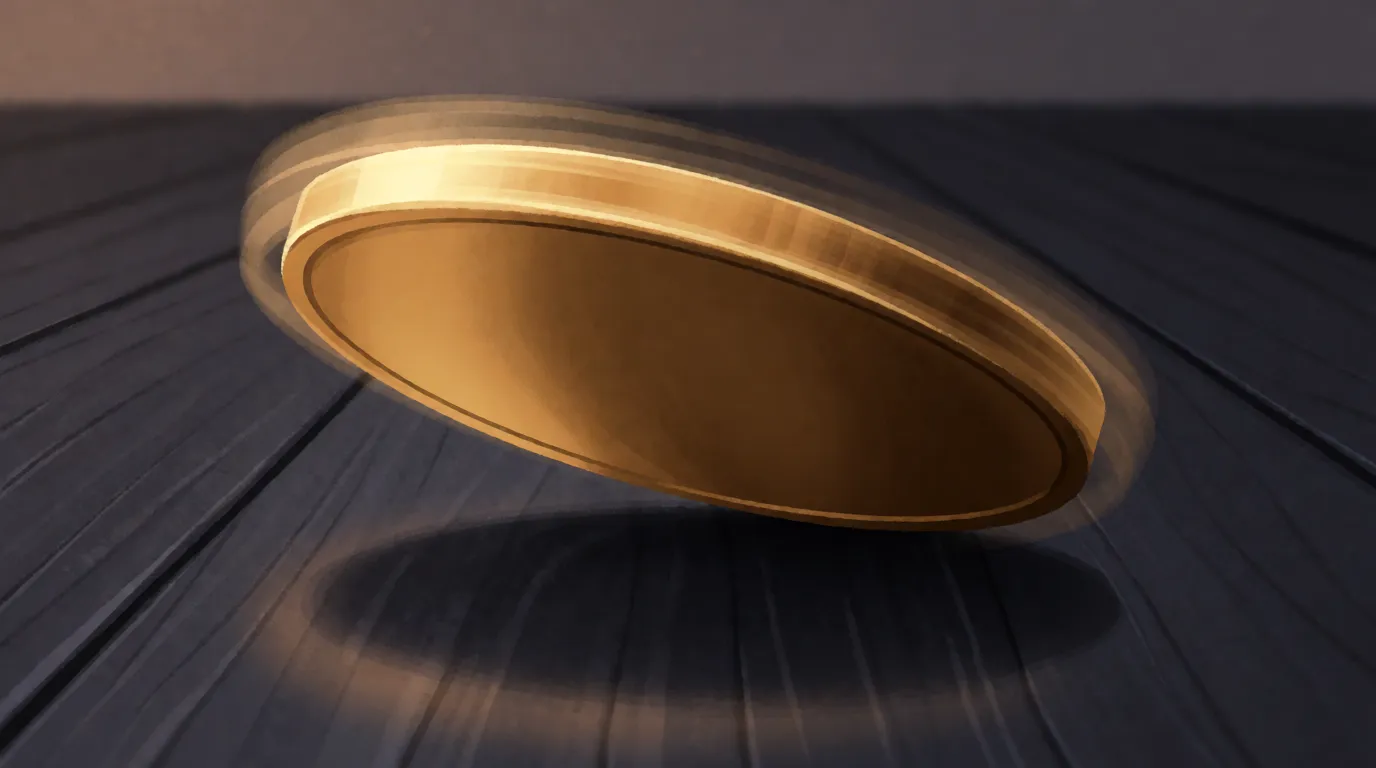
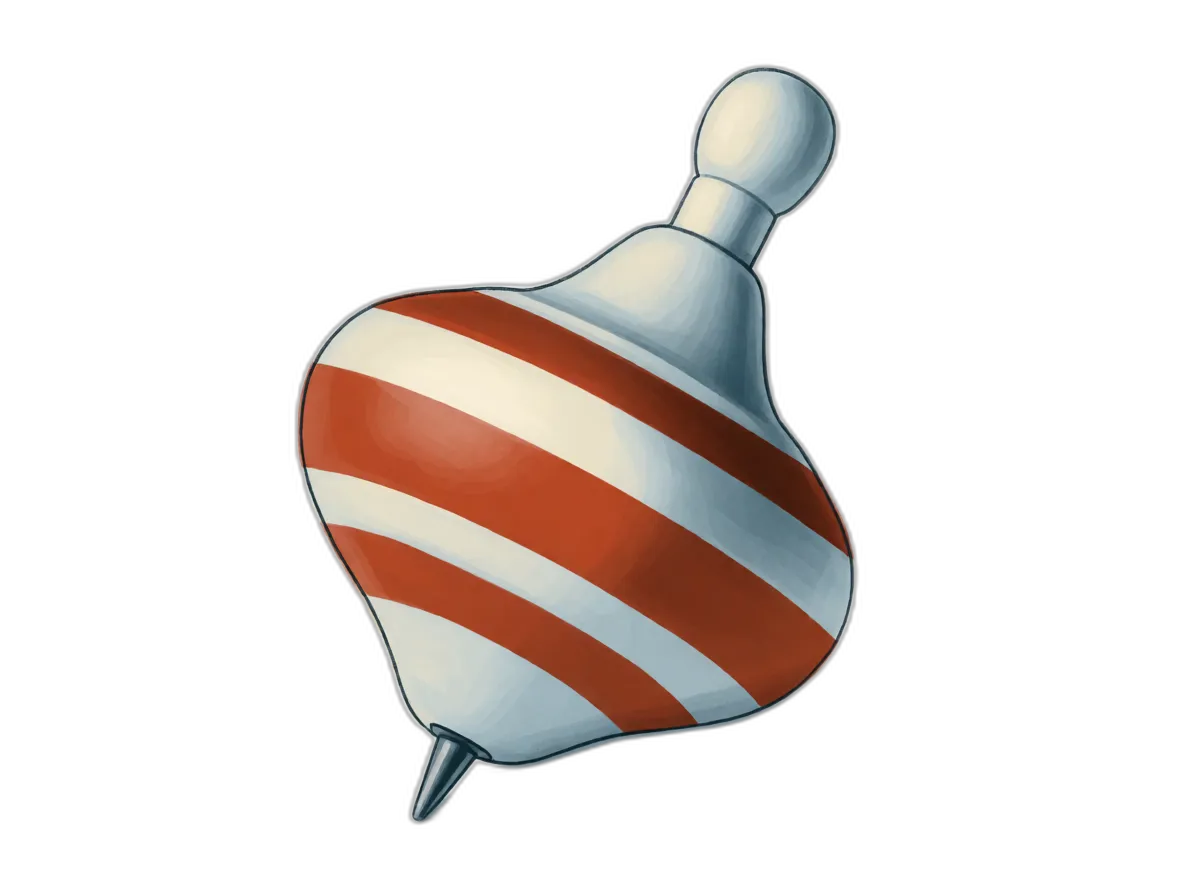
Those laps are what you hear. Each time the contact point completes a circuit, the coin presses once against the table, and a rapid series of presses is a note. That circling motion is called precession, and it is the same behavior a spinning top shows when it leans and swings its axis slowly around.
Flatter means faster
Now the part that makes it whirr. Picture the coin nearly upright, tilted just a few degrees off vertical. The contact point has an entire rim to travel and it does so at a leisurely rate.
Let the coin fall closer to the table and the geometry changes sharply. The rim is now barely lifted anywhere, so the contact point needs only a tiny movement of the coin to shift a long way around the edge.
The coin is losing energy the whole time. Its contact point speeds up anyway, because the job it has to do keeps shrinking.
As the tilt approaches zero, the rate of those laps climbs without limit. Push the arithmetic to the end and the frequency becomes infinite at the instant the coin lies flat.
A quantity that runs to infinity like that is called a singularity, and this one is stranger than most: it arrives after a definite, finite amount of time. The coin does not take forever to get there. It takes about five seconds.
It really is finishing early
Something else is odd about the ending, and everybody has noticed it without remarking on it. A spinning coin does not fade away. It stops abruptly, as though somebody switched it off.
Objects usually die away gradually. A swing loses a little on every pass and takes a long time to become still. A settling coin instead behaves normally for four seconds and then finishes in a fraction of one.
The shape itself has a name. Leonhard Euler studied rolling disks in the eighteenth century, and physicists now call a heavy disk settling this way an Euler disk in his honor.
That abruptness is exactly what the singularity predicts, and it is why the problem attracted a mathematician. In 2000, a few years before you were born, Keith Moffatt in Cambridge worked out how much energy a spinning disk loses to the air trapped underneath it.
Air is not a perfect fluid. It resists being sheared, a property called viscosity, and the film of air being squeezed between a nearly flat disk and a table gets thinner and thinner as the disk settles.
His calculation matched the observed abrupt ending, and predicted that the whole motion terminates at a definite moment rather than trailing off. Losing energy to the surroundings like that is called dissipation, and working out which route the energy takes is the entire argument.
The argument that followed

Publishing that answer produced a rapid disagreement, which is the enjoyable part. Within weeks Gerald van den Engh pointed out that air is probably not the main culprit for an ordinary coin on an ordinary table.
He argued that rolling friction between the rim and the surface removes far more energy than the air does, and that the abrupt ending survives either way.
Both effects are real, and how much each contributes depends on the disk and the surface. Twenty-five years later, papers are still appearing about a coin finishing its spin.
Which is why the toy exists
Somebody has built a machine specifically to make this last as long as possible. A polished steel disk about 75 mm(3 in) across, with a rounded edge, spun on a slightly dished mirror.
How long a polished disk on a mirror lasts against an ordinary coin on a table.
Every part of that design attacks one of the losses. The mirror is smoother than any table, the rounded rim reduces rolling friction, and the mass keeps it going. Removing air is the one thing it cannot easily do.
Time it on three surfaces
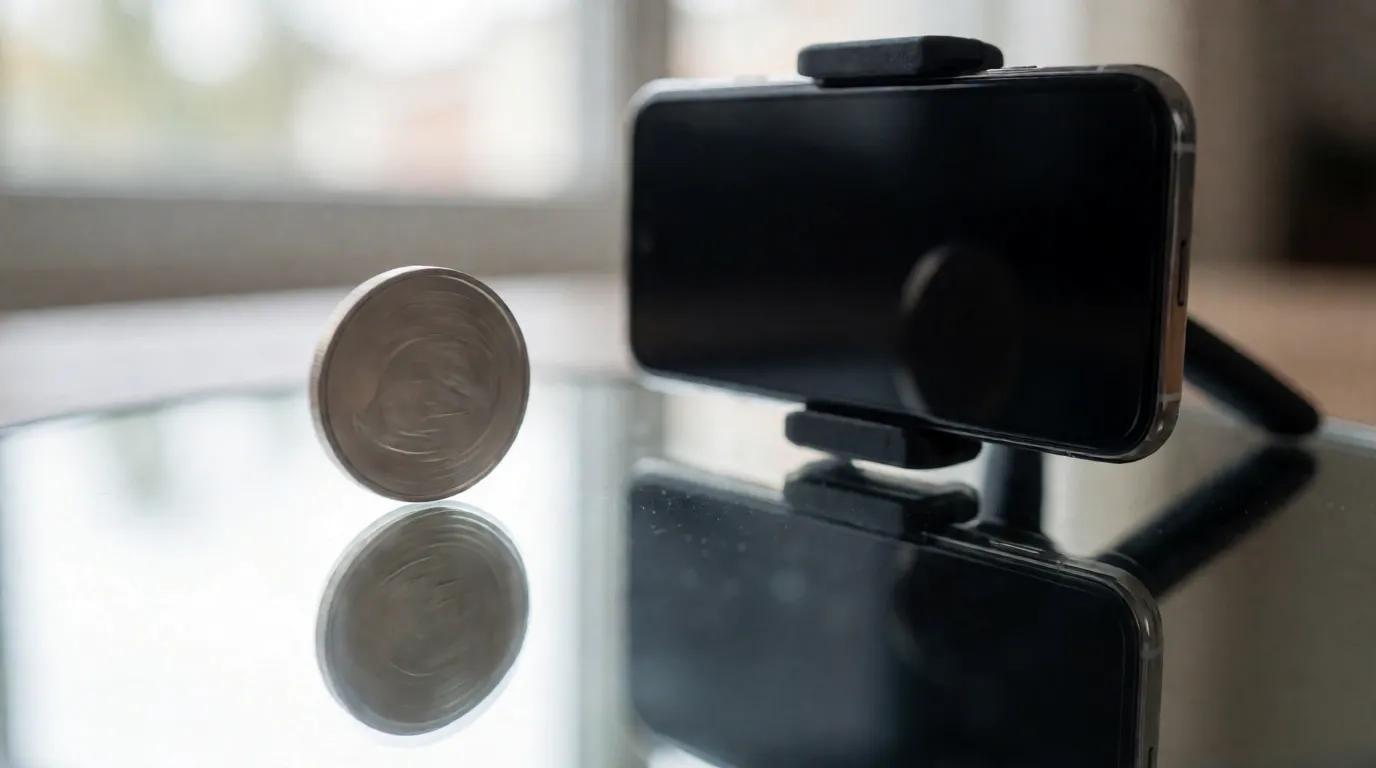
Glass beats wood, wood beats paper, and cloth stops a coin almost immediately. That ranking follows the roughness of the surface, which is evidence for the rolling friction side of the argument.
The slow-motion count is the one that changes how you hear the whole thing. The mark on the coin is going round more slowly at the end. The buzz on top of it is going round faster, and they are not the same motion at all.
A whole equation, hiding under a fifty pence piece
There is something worth appreciating about where this problem sits. A settling coin is available to everybody, costs nothing, and takes five seconds.
It also contains a genuine mathematical singularity, a live argument about which losses dominate, and a result published in one of the most demanding journals in the world.
So the next time a coin buzzes itself to a halt on a table, you know exactly what is climbing. Not the coin. A point on its edge, running faster and faster around a shorter and shorter track, until there is no track left.