Why do you only catch chickenpox once?
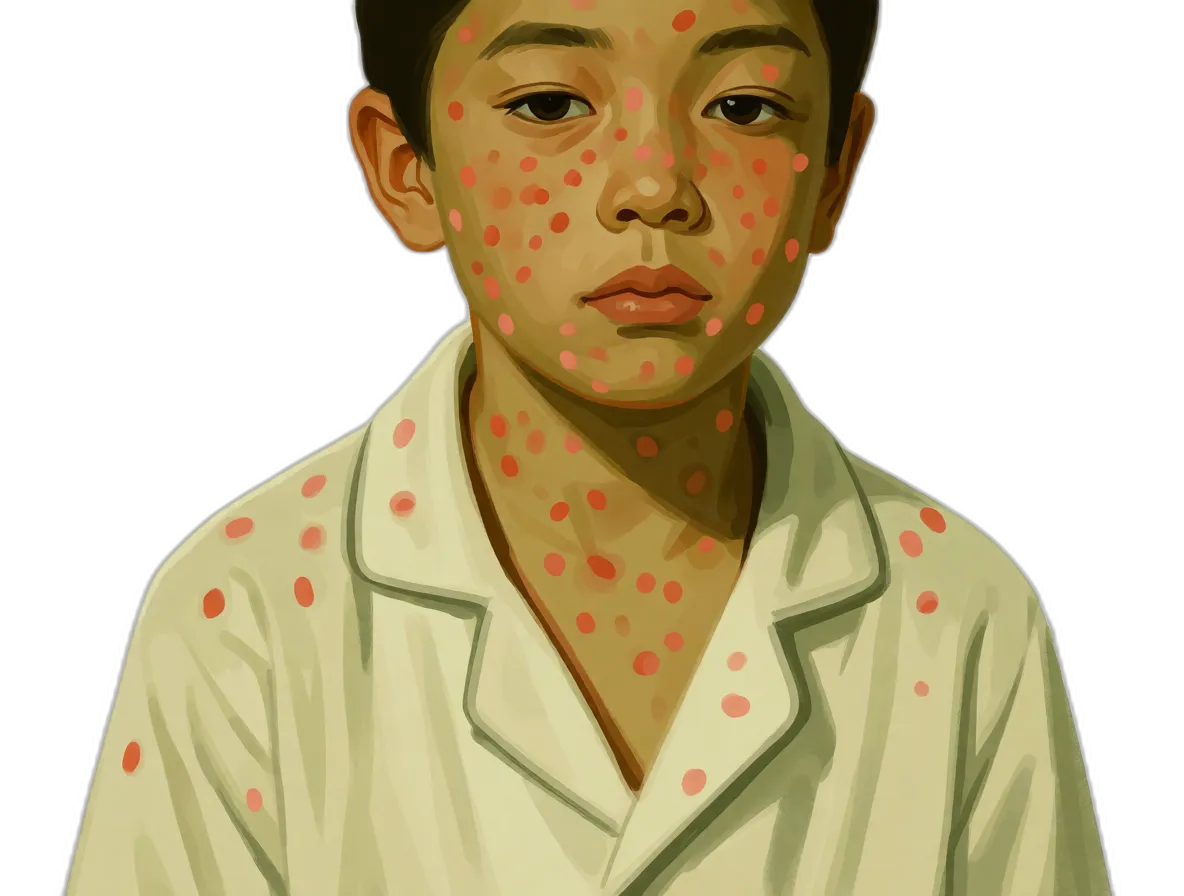
One kid in the house comes out in spots. A week later his sister has them too, and then half of her class does. In the same rooms, breathing the same air, sits an aunt who had chickenpox when she was nine and does not catch a thing. Her skin is no thicker than theirs. So what is she carrying that they are not?
She met this illness once, thirty years ago, and something she built that week is still on duty.
Fourteen days of nothing
Chickenpox is the work of a single virus: a short set of instructions wrapped in a coat. Its full name is varicella-zoster. Varicella is the old word for chickenpox; hold on to the other half, because it comes back.
A virus builds nothing by itself. It gets inside one of your cells, the microscopic living units your whole body is made from, and hands the instructions over. The cell does the building, and fresh particles leave to find fresh cells.
Chickenpox is also astonishingly contagious. You breathe it in from somebody else’s cough, and then, for two weeks, absolutely nothing happens. No spots, no fever, no clue. Doctors call that silent stretch the incubation period, and for chickenpox it usually runs fourteen to sixteen days.
When the spots finally arrive there are between 250 and 500 of them, each a shallow blister about 3 mm(⅛ in) across. Most children run a fever of around 38.5 °C(101 °F) as well.
So the strangest part of chickenpox happens before anybody can see it. Something takes two weeks to get going, and it is not the virus.
A hook for every shape
The slow thing is your defense, and it starts almost from scratch.
Your blood carries billions of lymphocytes: patrolling white blood cells whose entire job is finding things that should not be inside you. Each one carries a single kind of receptor, a shape built into its surface that fits one other shape and nothing else. Picture a hook. Receptors differ from lymphocyte to lymphocyte.
Those shapes are dealt out randomly while the lymphocytes are built, long before you meet anything at all. Your body makes no attempt to guess what is coming. It builds every shape it can and waits.
Which means almost every hook you own fits nothing you will ever meet. Around one lymphocyte in a hundred thousand happens to carry a hook that fits a bump on the chickenpox coat. Picture a packed stadium, and one person in it.
So the cells that can stop chickenpox are already inside you on the morning you catch it. There are just nowhere near enough of them.
One cell, doubled twenty times
Nowhere near enough, so your body makes more of them.
When a matching hook finally meets its bump, that lymphocyte switches on and begins copying itself. It divides about twice a day, multiplying faster than anything else in you, and every descendant carries the same hook as the original.
Roll a finger gently down the side of your neck, under the jaw. Those small soft lumps are lymph nodes, where the copying happens. When you are ill they swell, and the swelling is exactly that: identical cells, piling up.

Later generations do nothing but pump out antibodies: loose hooks of that same shape, released by the million into your blood. An antibody drifts until it meets a coat it fits, and sticks. A virus with antibodies stuck all over it cannot get into a cell at all.
So the incubation period is really ten days of copying, followed by a fight. The spots are that fight arriving in your skin. Antibodies win most of it, and they can only reach a virus that is out in the open.
Cells hold up a sample of what they build
A virus already inside a cell is out of reach of every antibody you own. Something has to deal with those, and nothing floating in your blood can see through a wall.
It does not have to. Every cell in you holds up small samples of whatever it is currently building, on stands dotted across its surface. Picture a shop window with one of everything on display.
Every cell in your body spends its whole life holding up a sample of what it is doing, hoping to be ignored.
That gives a second kind of lymphocyte something to check. Killer T cells patrol with hooks of their own, and what their hooks fit is the samples in the windows. A match means the ordinary cell behind that window is building the virus, so the killer destroys it, infected cell and virus together.
Between them, antibodies and killer T cells reach every copy of the virus that is showing itself. That last word turns out to be doing a great deal of work.
Where the last few copies go
Because a handful of copies stop showing anything at all.
That sleeping virus is the second half of its name. Much later in life, if the patrol thins with age, it starts building again and travels back along that nerve. What appears is zoster, better known as shingles: a band of blisters perhaps 10 cm(4 in) wide, following the path of that single nerve. About one person in three gets it eventually.
Your defense, then, is exact rather than complete. All of it hangs on one shape being matched, which is also the mistake that ran for two centuries.
Two hundred years of calling it smallpox
For most of history chickenpox had no separate name anyone trusted. Any spotty fever was a pox, and the pox everyone feared was smallpox, dangerous enough to kill a third of the people who caught it.
On 11 August 1767, nine years before the Declaration of Independence, a London physician named William Heberden stood up in front of the College of Physicians and pulled the two illnesses apart. He had seen enough of both to list the differences. Chickenpox blisters were shallow and thin-walled, came in waves over several days, and left almost no scars. Smallpox blisters were deep, arrived together, and scarred for life.

The warning at the end of his paper is what saved children. Surviving chickenpox, Heberden said, gives you no protection whatsoever against smallpox. Families had been assuming the opposite.
He had no idea why he was right. We do. The hooks you built against chickenpox fit chickenpox. A smallpox coat carries different bumps, and every receptor you own is the wrong shape for them.
In 1888 the Hungarian children’s doctor János Bókay noticed something stranger. Children kept catching chickenpox a couple of weeks after an older relative came down with shingles. Proof took sixty-five years. In 1953 the American virologist Thomas Weller grew the virus outside a body, from chickenpox blisters and from shingles blisters, and by 1958 had shown they were one and the same. Bókay was right: one virus, two illnesses, a lifetime apart. What nobody had yet measured was the speed that decides all of it.
How fast is twice a day?

Count the days: twenty doublings, ten days.
One matching cell, doubling twice a day, ten days later.
Ten days of copying, a few days of fighting, and the spots appear on schedule at day fourteen. That is the whole reason chickenpox takes two weeks to show up.
The cells that stay behind
Winning that fight leaves you with a million lymphocytes you no longer need, and almost all of them die within a few weeks.
A small population does not. Those settle into your blood and your lymph nodes as memory cells and simply keep living. Researchers who followed volunteers for twenty-six years found that antibodies against chickenpox fade so gradually that halving them would take about fifty years.
So the next time you breathe the virus in, the shapes it must get past are already waiting in their millions. Antibodies stick to the coats immediately, before a single copy reaches your skin. The second infection finishes in a day or two, far too small and too quick to raise a spot. You caught chickenpox again and never found out.
That is the trick Michiaki Takahashi borrowed after his own son caught a terrible case in the mid-1960s. By 1974 he had a weakened strain of the virus that teaches a receptor its shape without the fever or the itching. Vaccination is why most children reading this have never had chickenpox, and why a spotty week is becoming a story their grandparents tell.
Nothing in you remembers chickenpox the way you remember a birthday. Memory cells are not a note kept anywhere. The aunt in the room full of spots is not protected by anything about her skin. What she carries is immunity: a crowd of cells shaped for one virus, kept alive for thirty years, with nothing to do for all of it. The virus still gets in. It simply never gets going.