Why can’t you breathe and swallow at once?
Take a mouthful of water and pay attention to your breathing. It stops. Not because you decided anything, and not for long, but for about a second in the middle of every swallow you have ever taken. A cat lapping from a bowl does not have to do this. Neither did you as a baby, which is how you drank milk without coming up for air. Something changed.
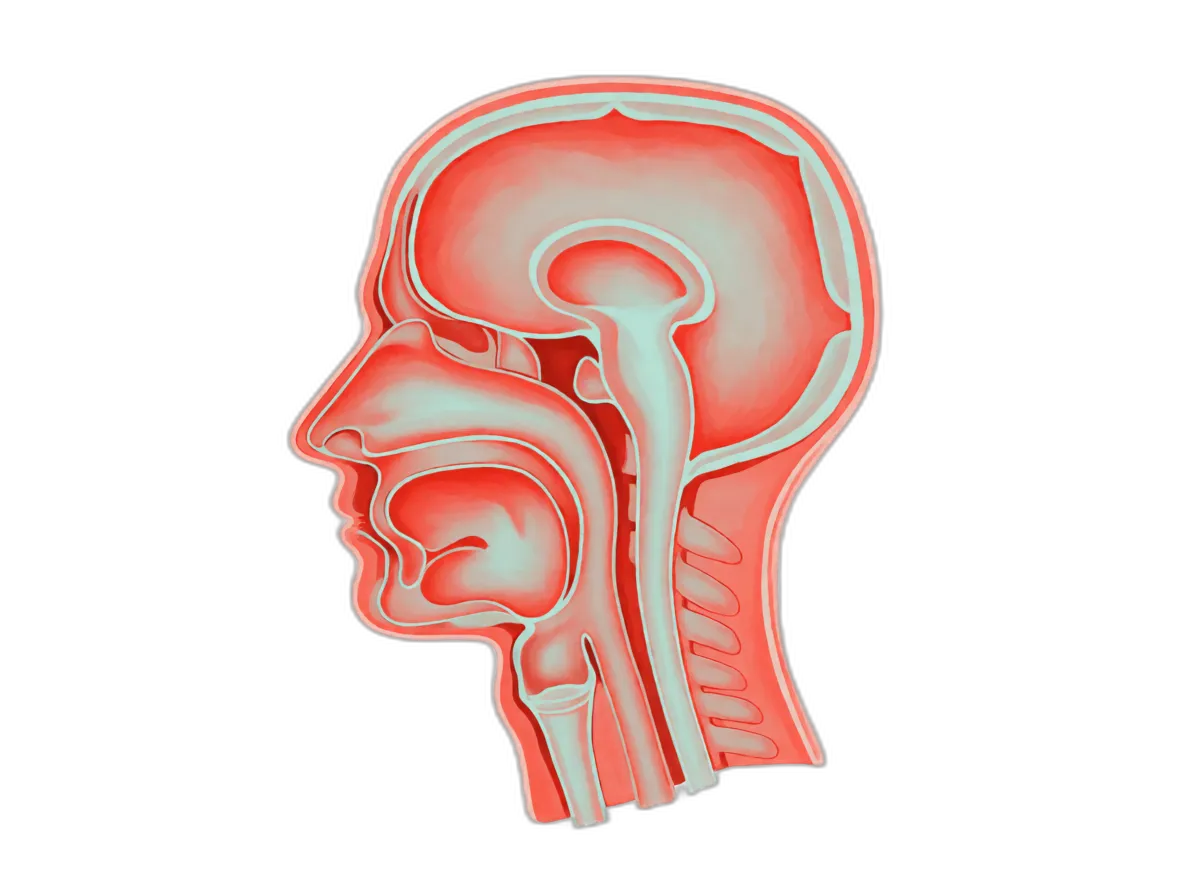
Air and food share one chamber in your throat, and a swallow works by sealing the airway shut for a moment.
One chamber, two jobs
Behind your mouth and below your nose is a single open space called the pharynx. Everything you breathe crosses it on the way to your lungs, and everything you eat crosses it on the way to your stomach.
At the bottom, the chamber splits into two pipes lying front and back. The front one is the trachea, the stiff ringed tube leading to your lungs. The back one is the esophagus, the soft tube leading to your stomach.
So this is a crossroads rather than a pair of separate roads. Air arriving from the nose must cross the food route, and swallowed material must cross the air route, inside the same small space.
A box you can feel through your skin
Feel the front of your neck. That firm ridge beneath your fingers is the top of the trachea, and the bump above it is the larynx, the cartilage box housing your vocal folds. In an adult it measures about 4 cm(1½ in) across.
A swallow is a sequence of doors
Swallowing is not a single movement. It is a rapid sequence of several stages, all triggered automatically once you begin, and you cannot change your mind halfway through.
First the tongue presses upward and backward, propelling the mouthful toward the throat. Simultaneously the soft palate — the flexible rear portion of the roof of your mouth — lifts and seals the opening to your nose, so nothing escapes upward.
Then the larynx pulls up and forward. Put your fingers on that bump and swallow, and you can feel it travel: it rises by more than 2 cm(¾ in) and comes back down.
As the larynx rises it tucks itself under the base of the tongue, and a leaf of stiff cartilage called the epiglottis folds down over the opening like a lid. The mouthful slides across the closed lid and into the back pipe.
Nothing whatsoever can be breathed while that lid remains shut, which is the entire answer. Physicians call the resulting gap in your breathing the swallow pause, and it typically lasts around a second.
You do not stop breathing because you are busy. You stop because the door to your lungs is closed and something is standing on it.
Babies do it differently
A newborn feeds for many minutes continuously, and could not possibly survive holding its breath throughout. So a baby’s throat is constructed to a completely different plan.
In a small baby the larynx sits much higher, up behind the tongue, close enough to lock into the soft back of the roof of the mouth. That makes a sealed channel from the nose straight down to the lungs, running past the food route rather than across it.
Milk flows around that channel on both sides and downward to the stomach, while air continues traveling through it undisturbed. Baby mammals generally share this arrangement, which is why a lamb or a kitten can suckle and breathe simultaneously.
From around three or four months, the human larynx begins to descend, and it keeps descending for years. As it drops, the interlock breaks, the crossroads forms, and the swallow pause arrives.
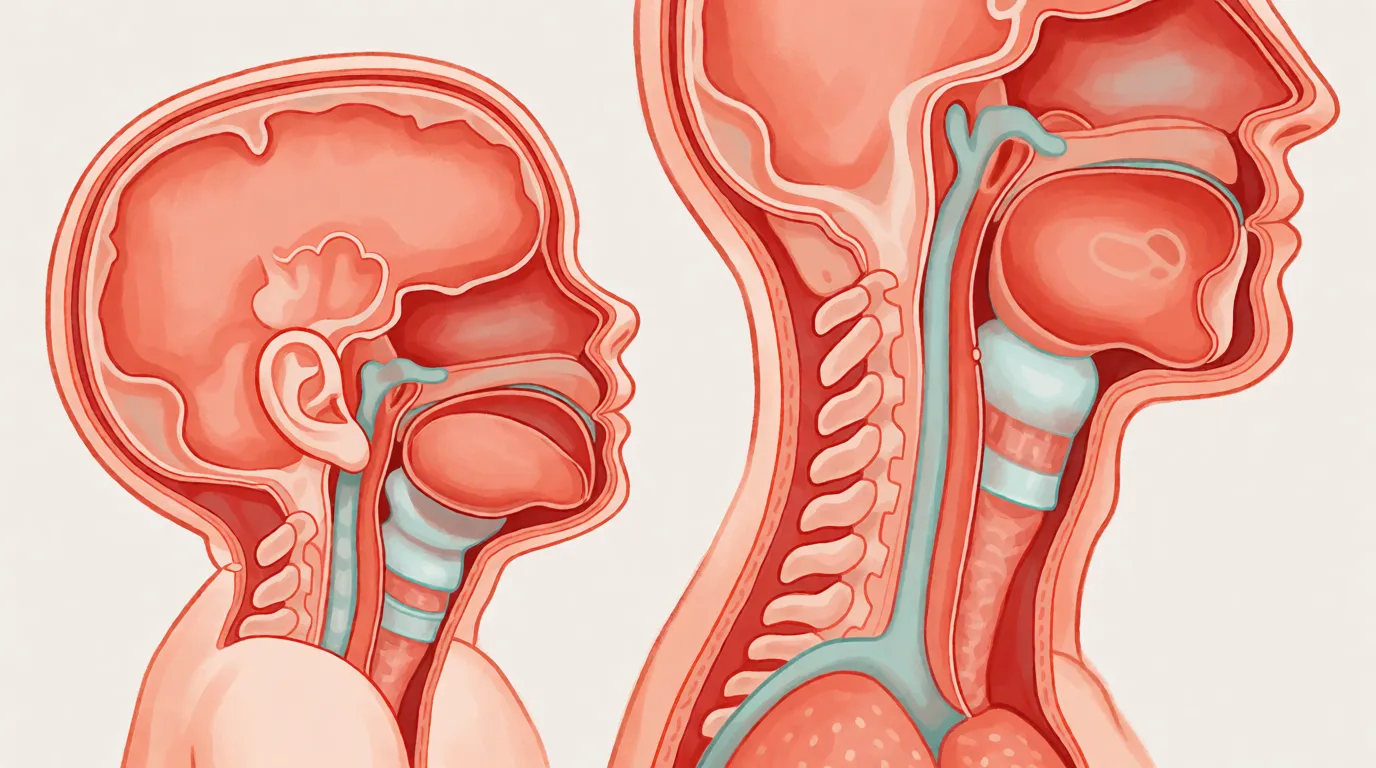
What the descent bought
A dropped larynx leaves a much larger open space above it, and that space is a resonator: it shapes the buzz your vocal folds make into recognizable vowels.
A larger, more adjustable chamber permits a far wider variety of sounds. It is the reason a human can pronounce “ee” and “oo” and “ah” distinctly, and part of why speech is effortless for us and impossible for a chimpanzee.
That trade — better speech in exchange for a choking hazard — was proposed by Victor Negus, a London surgeon who spent decades comparing throats across the animal kingdom. He published his great survey in 1949, roughly when your great-grandparents were young.
It has since become more complicated, in a way worth knowing. In 2001 Tecumseh Fitch and a colleague found permanently descended larynges in red and fallow deer, which do not talk.
In deer the descent lengthens the tube and lowers the pitch of a roar, advertising a larger animal than the one producing it. So a low larynx is not proof of speech. The honest position is that it assists our speech enormously without demonstrating that speech is why it happened.
Down the wrong tube

Feel the whole sequence happen

The gap approaches a second, and it is completely reliable. Nobody can breathe through it, however determinedly they try, because the sequence provides no mechanism for overriding the lid.
The two-or-three-swallows-per-sip result genuinely surprises people. Your throat divides a mouthful into portions small enough for a single pass each, entirely without consulting you.
An unusual piece of engineering
Almost no other animal has accepted this bargain. Most mammals retained the separate channel, continued breathing throughout meals, and never developed anything approaching our variety of speech sounds.
We gave up a safety feature that every kitten has, in exchange for a throat that can shape a hundred different sounds a minute. Choking on food remains a real danger to humans in a way it is not for a cat.
So the pause in the middle of your next mouthful deserves a moment’s attention. It is the price of an arrangement that makes conversation possible, paid in one-second instalments, several hundred times daily.