Why can’t you tickle yourself?
Wait for a friend to run a fingertip slowly up the inside of your arm and you will be squirming before they are halfway. Do it to yourself, at an identical speed, along an identical line, and nothing happens at all. Same finger, same skin, same slow drag. Your arm has no way of discovering whose hand is on it. So what is making the decision, and how does it know in advance?
The answer is not in your arm. It is in a prediction your brain made before your hand had even started moving.
Two kinds of tickle, and neither one works
Two American psychologists noticed that the word tickle was quietly covering two different sensations. Stanley Hall and Arthur Allin gave them separate names in 1897, back when your great-great-grandparents were the children being tickled.
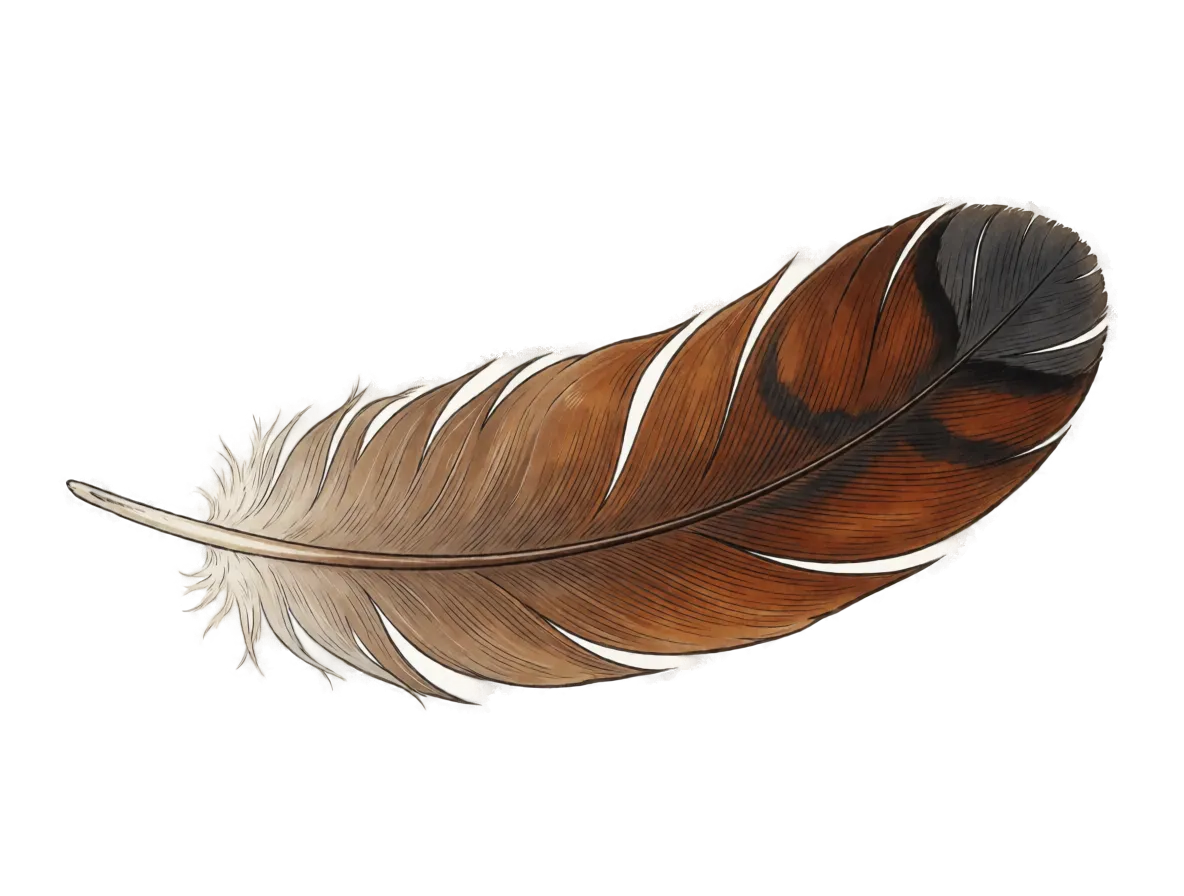
The first is knismesis, the faint creeping feeling of something barely touching your skin. A hair landing on your neck produces it. So does an ant wandering over your ankle. You brush at yourself automatically, and nobody laughs.
The second is gargalesis, the deeper tickle that firmer fingers produce on your ribs, your feet or under your arms. That one makes you shriek and thrash and beg for mercy. Both names are awkward, so call them the feather kind and the ribs kind.
Try both on yourself immediately, without leaving your chair. Drag one fingertip up the inside of your other forearm, as delicately as you can manage. Then dig your fingers into your own ribs. The feather kind delivers a faint nothing. The ribs kind delivers even less.
So whatever blocks the tickle is not fussy about which variety arrives. It cancels both. That points the investigation away from your skin, toward the part of you that ordered your hand to move.
Your brain keeps a copy of every order it sends
Every time you move deliberately, your brain issues a motor command. That is an order traveling down nerve fibers to your muscles, telling them how hard to contract.
The surprising part happens on the way out. A duplicate is peeled off and delivered sideways, to a region with no muscles to move at all.
That region is the cerebellum, a dense wrinkled lump tucked underneath the rear of your brain. It weighs roughly the same as a small apple, 154 g(5½ oz), about a tenth of your entire brain. For its size it is absurdly crowded with neurons, the branching cells that carry your body’s signals, and it needs every one of them.
Four out of every five neurons in your head sit inside that one small lump.
The cerebellum takes the duplicate and does something strange with it. It calculates the consequences for your skin in advance. Researchers call that machinery a forward model, and its answer a prediction. The prediction is far easier to picture as a guess.
So two separate things are heading for the touch-handling region of your brain. One is a genuine signal climbing up from your skin. The other is a prediction that departed earlier, from inside, with less distance to cover. What happens when they meet is the entire answer.
You only feel the part the guess got wrong
They meet in the somatosensory cortex, a strip of brain running over the top of your head like a headband. It converts signals from the touch receptors in your skin into sensations you notice. Call it the touch strip.
The touch strip does not simply forward the skin signal. It subtracts the prediction first, and shows you whatever is left over.
When you stroke your own arm, your cerebellum knew the entire plan: this hand, this speed, this line, beginning now. The prediction comes out nearly perfect, so nearly everything is subtracted. What survives is a dull drag you can barely be bothered to notice.
When somebody else strokes your arm, no order ever left your brain. No duplicate was made, so no prediction exists, and nothing is subtracted. The complete signal arrives at full strength, and a delicate touch at full strength is a tickle.
In 1998, Sarah-Jayne Blakemore and two colleagues in London watched this happening inside people’s heads. Volunteers lay inside a scanner that reveals which parts of a brain are working hardest. Their palms were stroked, sometimes by their own hand and sometimes by a machine. The touch strip lit up more for the machine, every single time. The difference between prediction and reality even has a proper name, prediction error, though the leftover will do.
So your brain reveals the unexpected part and quietly discards the remainder. That raises an obvious objection: surely knowing a touch is coming would be enough to spoil it?
The old answer was that you know where the finger is going
People have wondered exactly that for a very long time, and the answer looked settled for most of it. Charles Darwin published his version in 1872, in a book about how humans and animals display what they feel.

He had noticed that a small child can hardly tickle itself, and drew what looked like the only sensible conclusion. “The precise point to be touched must not be known,” he wrote. Surprise was the missing ingredient. You cannot surprise yourself, therefore you cannot tickle yourself.
That answer stood for more than a century, mostly because nobody could examine it. Testing it demands a hand that obeys you, then disobeys you deliberately by a measurable amount. Fingers are useless for that: yours arrive precisely where and when you sent them.
The apparatus that could do it was built in a London laboratory during the late 1990s: a small robotic arm with soft foam on the end, wired to a lever. Push the lever with your left hand, and the foam strokes your right palm.
So that apparatus managed the one thing fingers cannot. It left your order completely untouched and altered only the sensation.
Delay the touch and the tickle comes back
Volunteers lay with the right palm upward and pushed the lever with the left hand. Performed straight, it was as dull as stroking your own arm. Then the team began spoiling the match.
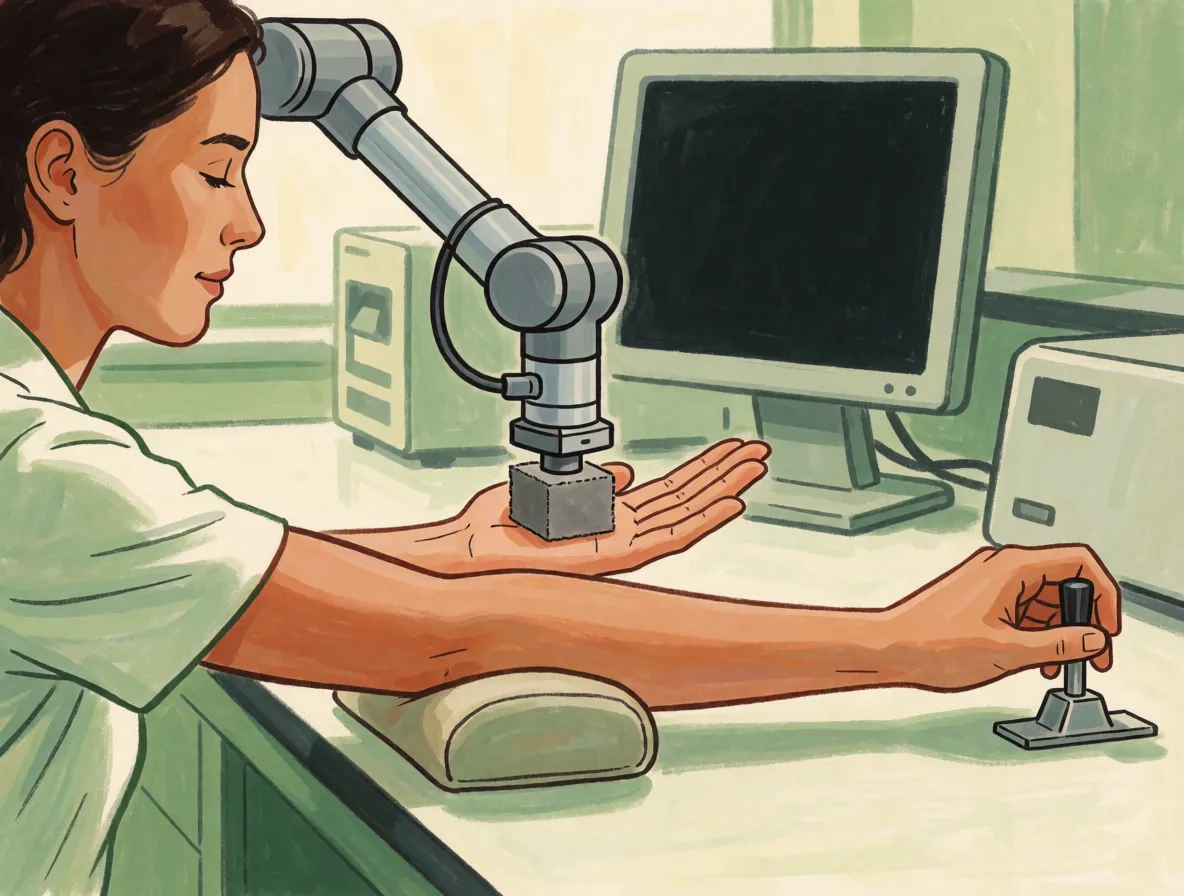
First they delayed the robot. Nothing about the movement altered except when the foam arrived. The longer they stretched the gap, the more it tickled. By three tenths of a second, roughly the length of a blink, people were being tickled by their own hand.
Your own hand can tickle you. It merely has to be late.
Then they left the timing alone and rotated the direction instead. The foam crossed the palm at an angle to the trajectory of the lever. Right moment, wrong path. That restored the tickle as well.
So the match must hold in two ways simultaneously, in place and in time. Miss either one and the leftover grows, and the leftover is the tickle. That is why you can scratch your own back without flinching, while an identical scratch from a friend makes you jump.
Push your own finger and find out
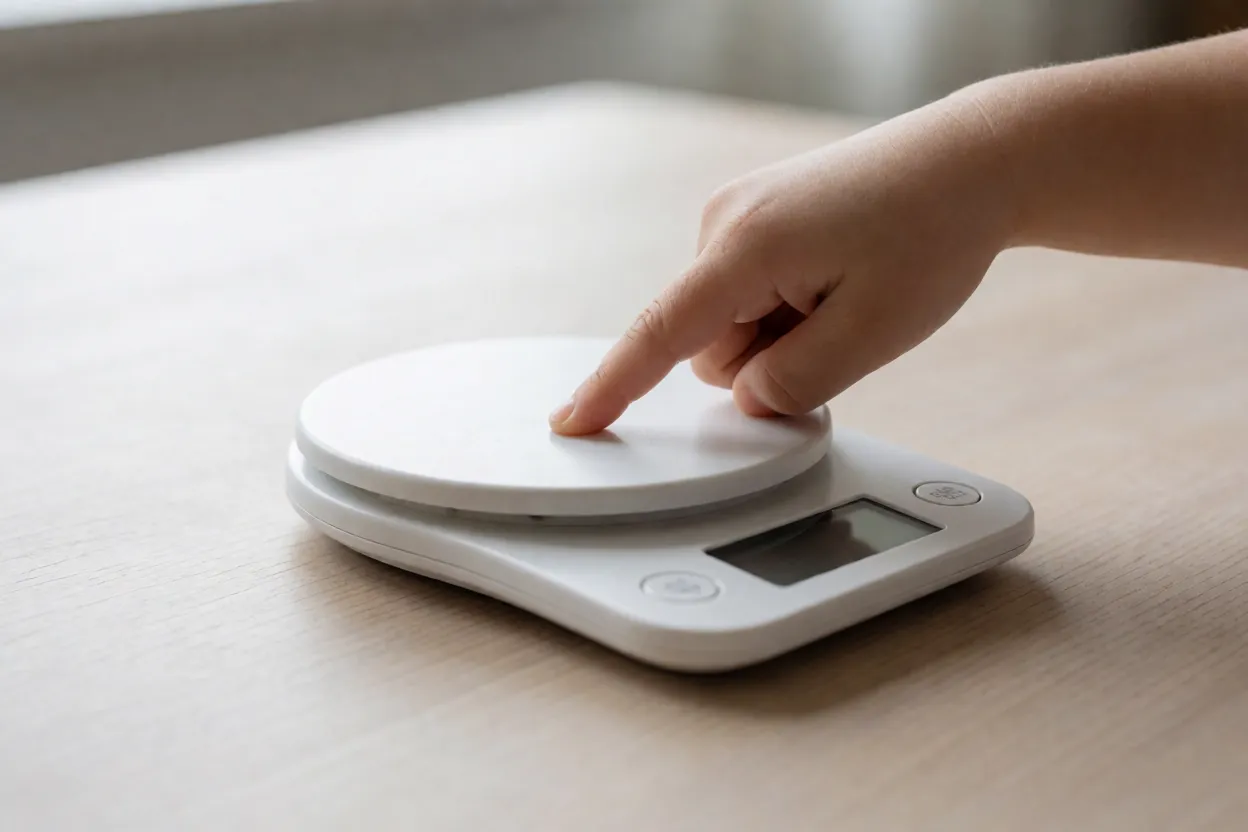
Almost everybody overshoots, frequently past 700 g(1.5 lb). Your own push feels lighter than a friend’s push of identical size, so you keep adding until it finally feels correct. The scale reports how far past them you went.
That is the subtraction again, operating on a shove rather than a delicate drag. You ordered the push, so your cerebellum predicted it, so the touch strip removed most of it before you felt anything.
This is running every second of your life
Nothing about your skin has altered while you read this. It remains exactly as sensitive to your own finger as to anybody else’s. The only thing that ever changes is whether your brain saw the touch coming.
Almost none of that machinery has anything to do with tickling. The same subtraction is why you can eat soup without your face reporting the spoon, and scratch your nose in the middle of a sentence. Those touches are predicted, subtracted and discarded before they reach you. Tickling is simply the easiest place to catch the process working, because a friend can walk over and break it.
One piece is still missing, and it is the piece you would imagine was easiest. All of this explains why your own hand fails. It explains nothing whatever about why a friend’s hand is funny. Nobody has a settled answer for why the ribs kind produces laughter at all, or what that laughter is for. The question is older than every experiment described here, and it remains open.
So the next time somebody goes for your ribs, you can at least be exact about what is happening. Your brain holds no duplicate of that order, so it built no prediction, so it has nothing whatever to subtract. All of it gets through.