Why does spinning make you dizzy?
Spin yourself round on the grass, arms out, ten or twelve times. Then stop dead and stand still. The lawn keeps traveling, the fence swings past, and you put a foot out to catch a fall that is not happening. Notice the order of events: you felt reasonably fine while you were actually spinning, and everything went wrong the instant you stopped. What is still moving?
You have six small loops of liquid inside your head, and liquid takes a while to notice that anything has changed.
There are three loops of fluid behind each ear
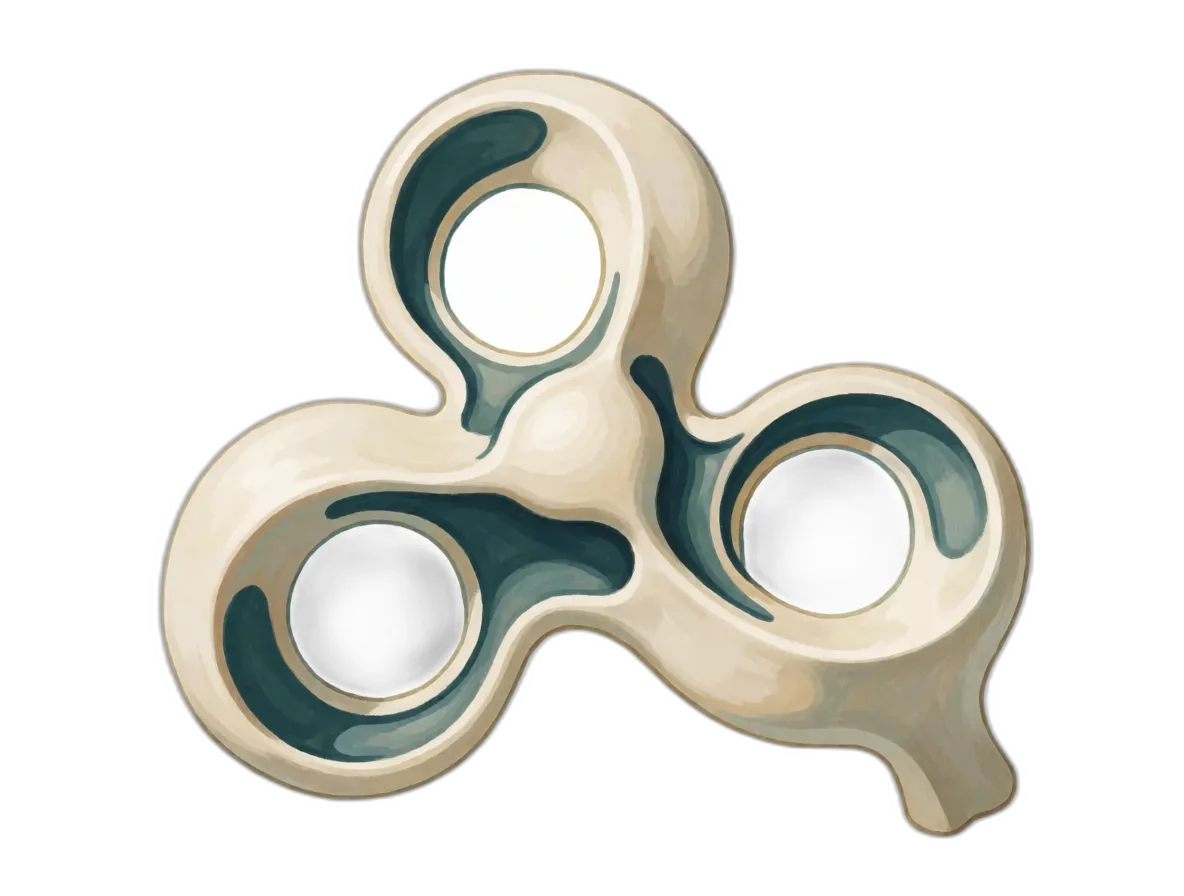
Buried in the bone behind each ear, right beside the parts that do your hearing, sit three small curved tubes called the semicircular canals. Each is a closed loop about 6 mm(¼ in) across.
The three loops sit at right angles to one another, like three surfaces meeting at the corner of a box. One detects nodding, another detects shaking your head, and the third detects tipping it toward a shoulder.
Loops per ear, multiplied by the number of ears you have.
Every loop is filled with a watery liquid called endolymph. Blocking each tube at one point is a flap of jelly, the cupula, which fits the tube like a swing door and is fixed along one edge.
Under the jelly door sit the sensors
Underneath that door sit hair cells, the microscopic building blocks every living thing is assembled from. Each one carries a fine bristle poking up into the jelly.
Bend the door and they fire; leave them alone and they go quiet. That is the entire instrument, and it measures precisely one thing: whether the jelly is being pushed.
The liquid moves late, and that is the point
Here is the trick your body uses, and it is the same trick that spills your drink when a bus pulls away. Liquid does not want to start moving, and once moving, it does not want to stop. That reluctance is inertia.
Start turning your head to the left. The bony tube turns with your skull immediately, because it is part of your skull. The endolymph inside lags behind for a moment, so relative to the tube it slides rightward and pushes the jelly door.
The hair cells report the push, your brain interprets it as “turning left”, and the report arrives within a few thousandths of a second. For ordinary head movements that is all that ever occurs.

Now continue spinning steadily instead of stopping. Within roughly twenty seconds the liquid has been dragged up to the identical speed as the tube. Nothing is sliding past anything, and the jelly door swings back to the middle.
At that moment your ears report that you have stopped. You are turning as fast as ever, and the instrument that measures turning has quietly gone silent, because it only ever measured changes.
Stopping is where it all goes wrong
Now plant your feet. The skull halts instantly and the tubes with it, but the liquid inside has been circling for twenty seconds and it keeps circling.
The moving liquid shoves the jelly door the opposite way, and the hair cells dutifully report a turn in the opposite direction. Your ears are now insisting you are spinning backward at speed.
Your eyes disagree completely. They can see the fence, the grass and the house, all of them satisfyingly stationary, and they say so.
Your ears are not broken and your eyes are not wrong. They simply hand your brain two accounts that cannot both be true.
Your brain has to act on something, and it trusts the ears. It steadies your body against a rotation that is not occurring, so you lurch. It also swings your eyes repeatedly, attempting to hold steady against a world it believes is sweeping past.
That eye movement is called nystagmus: a slow drift one way followed by a quick flick back, repeating several times a second. It is completely involuntary, it lasts about half a minute, and a friend can watch it happening.
Closing your eyes does not fix it
There is a matching trick that makes everything considerably worse, and every child discovers it accidentally. Tip your head sideways while spinning and a different loop gets dragged into the flow, so two sets of canals report contradictory rotations simultaneously. That is the version ending on the grass.
Cutting a pigeon’s ear, and misreading the result
The loops were sitting in anatomy books for centuries with nobody sure what they did. They are attached to the hearing organ, so the reasonable guess was that they were part of hearing.
In 1824, about seven generations before you were born, Pierre Flourens in Paris cut individual canals in pigeons and observed the consequences. Each bird began moving its head repeatedly, in the plane of the particular canal he had cut.
It is hard to imagine a clearer signpost, and he misread it. Flourens concluded he had damaged the part of the brain that controlled movement, rather than a sense organ that measured it.
Fifty years later, in 1874, Josef Breuer in Vienna repeated the work more carefully and reached the answer: the canals sense rotation, and they do it by the fluid inside them lagging behind. Two other scientists arrived at almost the same idea within months.

Proof arrived from Robert Bárány, who demonstrated in 1906 that running warm or cold water into somebody’s ear canal makes them violently dizzy. The temperature difference sets the endolymph circulating by itself, exactly as spinning does, in a completely stationary patient.
Hospitals still use that test today, and it won him the Nobel Prize in 1914. He received the news while being held as a prisoner of war.
Time your own eye flicks

Most people get somewhere between twenty and forty seconds, and an individual’s number stays reasonably consistent. That is a direct measurement of liquid gradually surrendering its motion inside a tube 6 mm(¼ in) across.
The eyes-closed run is the one that settles the argument. It changes nothing about the spinning sensation, because the sensation was never coming from your eyes.
Your ears report changes, not positions
The strangest fact here is the one hiding in the middle of the article. Steady spinning feels like nothing at all. Your canals can only detect a change of rotation, so a perfectly steady turn becomes invisible to them within about twenty seconds.
Pilots have died from that. Flying in cloud with nothing visible outside, a slow steady turn feels exactly like flying straight ahead. Rolling level again then feels like turning the other way. It is why pilots are trained to believe their instruments rather than their own heads.
So dizziness is not a malfunction. It is an instrument that measures changes, reporting a change that genuinely happened — you stopped — and being unable to tell your brain that the change is already over.