Why does wifi go through walls but light doesn’t?
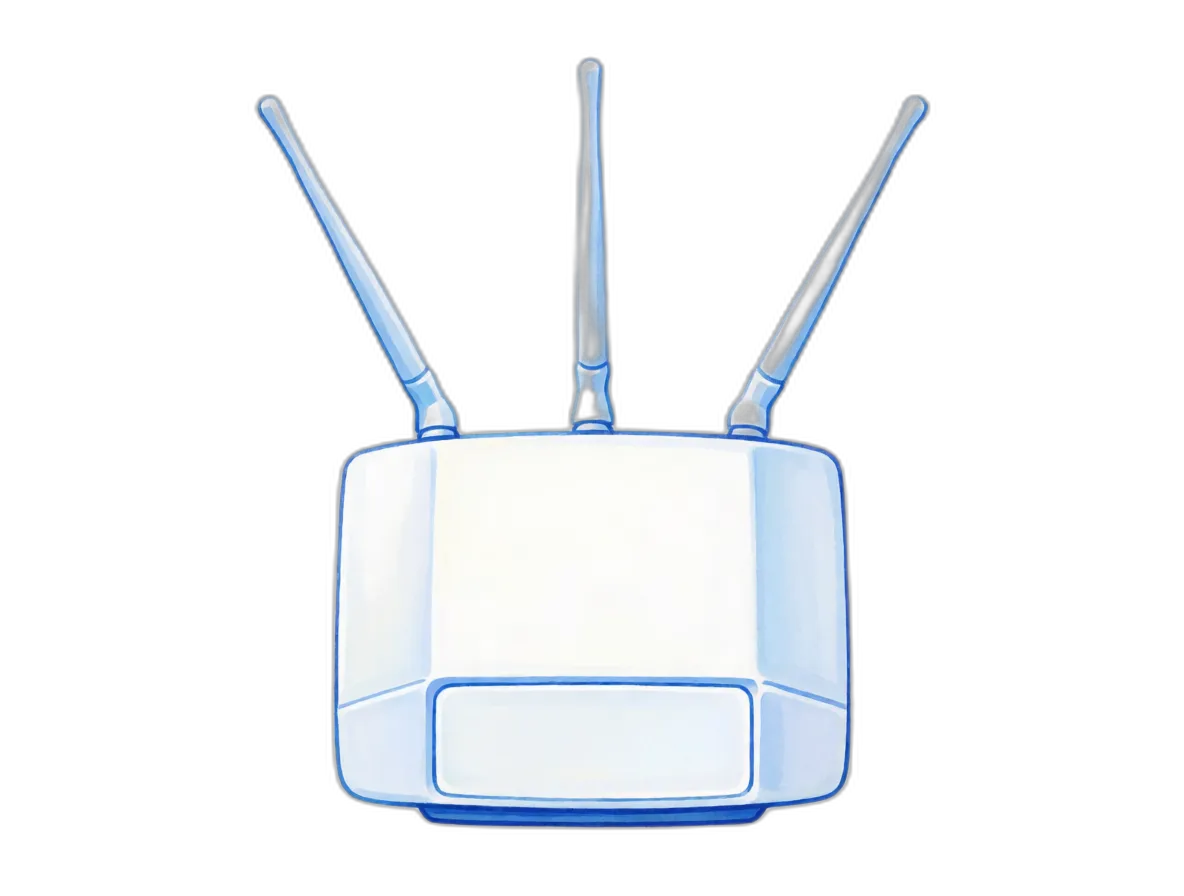
Shut your bedroom door and the light from the hallway stops dead. It cannot get through a centimeter of wood, or a sheet of paper, or your hand. Your phone is still cheerfully talking to a router two rooms away, through three walls and a floor. Both of those are the same kind of wave, traveling at exactly the same speed. So why does one of them treat a wall as solid and the other treat it as though it were not there?
They are the same thing at different sizes, and a wave only notices obstacles that are roughly as big as it is.
Light and wifi are the same family
Everything from radio to X-rays is an electromagnetic wave: a ripple of electric and magnetic push, traveling through empty space at the speed of light. Visible light is one narrow stretch of that family, and wifi is another.
What separates them is wavelength, meaning the distance from one crest of the wave to the next. Everything else about them is the same.
A wifi wave is about 12 cm(5 in) from crest to crest, which is roughly the width of your hand. Visible light crests are so close together that two thousand of them fit across a single human hair, and a hair is only 0.07 mm(0.003 in) thick.
How many times longer a wifi wave is than a wave of green light.
That is the whole difference between them, and it turns out to decide everything about what they can pass through.
A wave only notices things its own size
Waves are peculiar about obstacles. Anything considerably smaller than the wavelength is essentially invisible: the wave sweeps across it and continues as though the surface were perfectly smooth.
You have observed this in a harbor without noticing. Enormous ocean swells travel straight past a mooring post without breaking, while that identical post throws small ripples into confusion.
A brick wall, to visible light, is a mountain range. Every grain of sand in the plaster, every fiber in the paint and every crystal in the brick is enormously bigger than a light wave. The light ricochets off them one after another in random directions, and that disorderly bouncing is called scattering.
Scatter a wave enough times and it never gets through. Light entering a wall is turned back or absorbed within a fraction of a millimeter, which is why a wall looks like a wall.
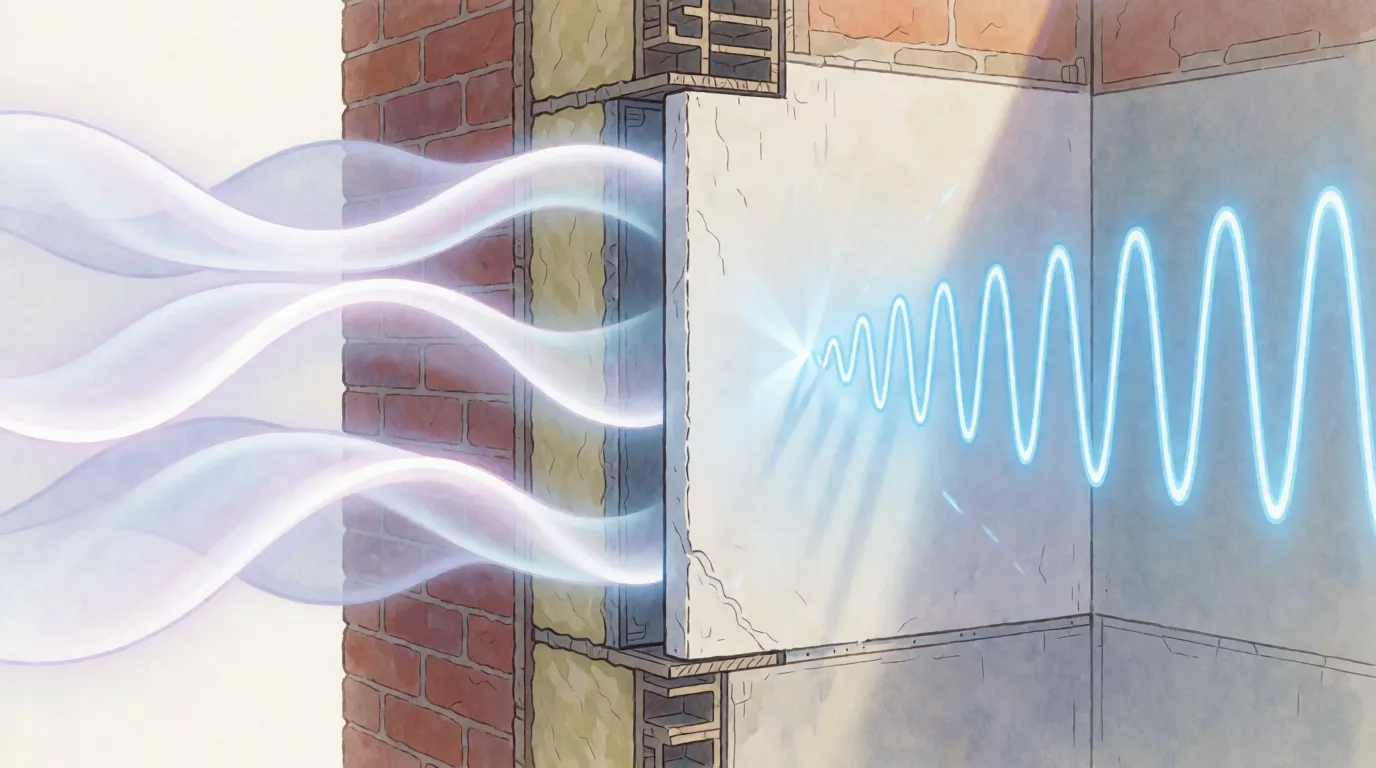
To a light wave a wall is a landscape of boulders. To a wifi wave the same wall is a smooth sheet of nothing much.
Now send a wave the width of your hand at that same wall. Every grain and fiber in it is thousands of times too small to matter, so there is nothing available to scatter from. The wave crosses, losing a little strength, and carries on beyond.
Water and metal are the exceptions
Two materials genuinely do stop wifi, and both are worth knowing, because between them they explain nearly every disappointing signal in your house.
The first is water. Water molecules can be set spinning by waves in exactly this range, so they absorb energy from them, which is also how a microwave oven heats your dinner. A fish tank, a bathroom or a crowd of people all weaken a signal noticeably.
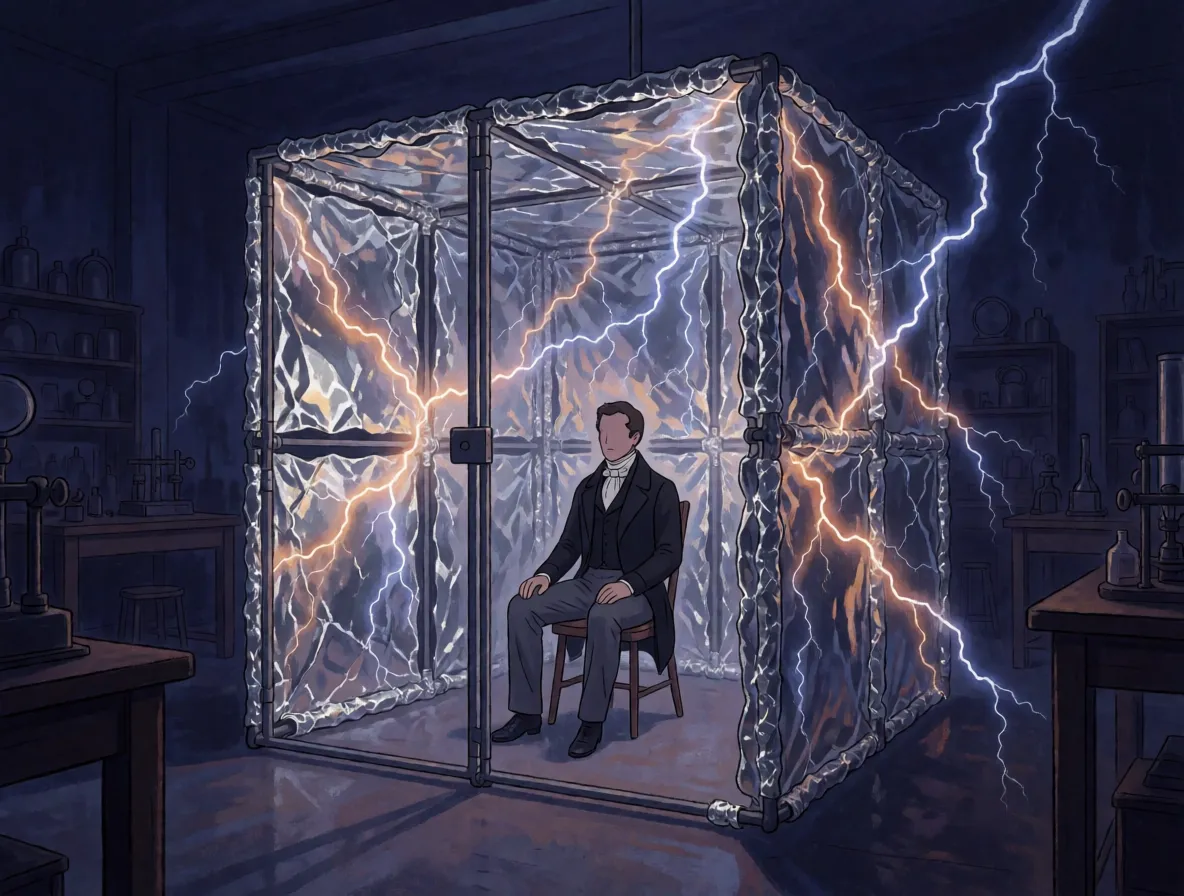
The second is metal, and metal is the dramatic one. A conductor is a material full of electrons — the minute particles that carry electricity — which are free to roam through it. An arriving wave pushes them.
Those moving electrons produce their own wave, aimed backward, which cancels the arriving one almost perfectly. Nothing gets through — not because the metal is thick, but because it answers back.
Thickness is not the point
The first waves that went through things
Nobody knew these waves existed until surprisingly recently. In 1887, about six generations before you were born, Heinrich Hertz in Germany built the first apparatus that produced them deliberately. He used a spark across a gap, and detected the result across his laboratory with a loop of wire.
He proved they behaved exactly like light: they could be reflected, focused and bent. He also concluded that they had no practical use whatsoever, which is one of the great wrong predictions in science.
Within fifteen years Guglielmo Marconi had shown otherwise. By 1901 he was sending signals across the Atlantic, past a horizon that should have blocked them, using waves long enough to bend around the curve of the planet.
Every antenna in your house descends from that spark gap. The genuine difference today is that engineers deliberately select a wavelength suiting the job. For conversations between rooms, the useful choice is a wave large enough to ignore the building entirely.
Test what actually stops a signal
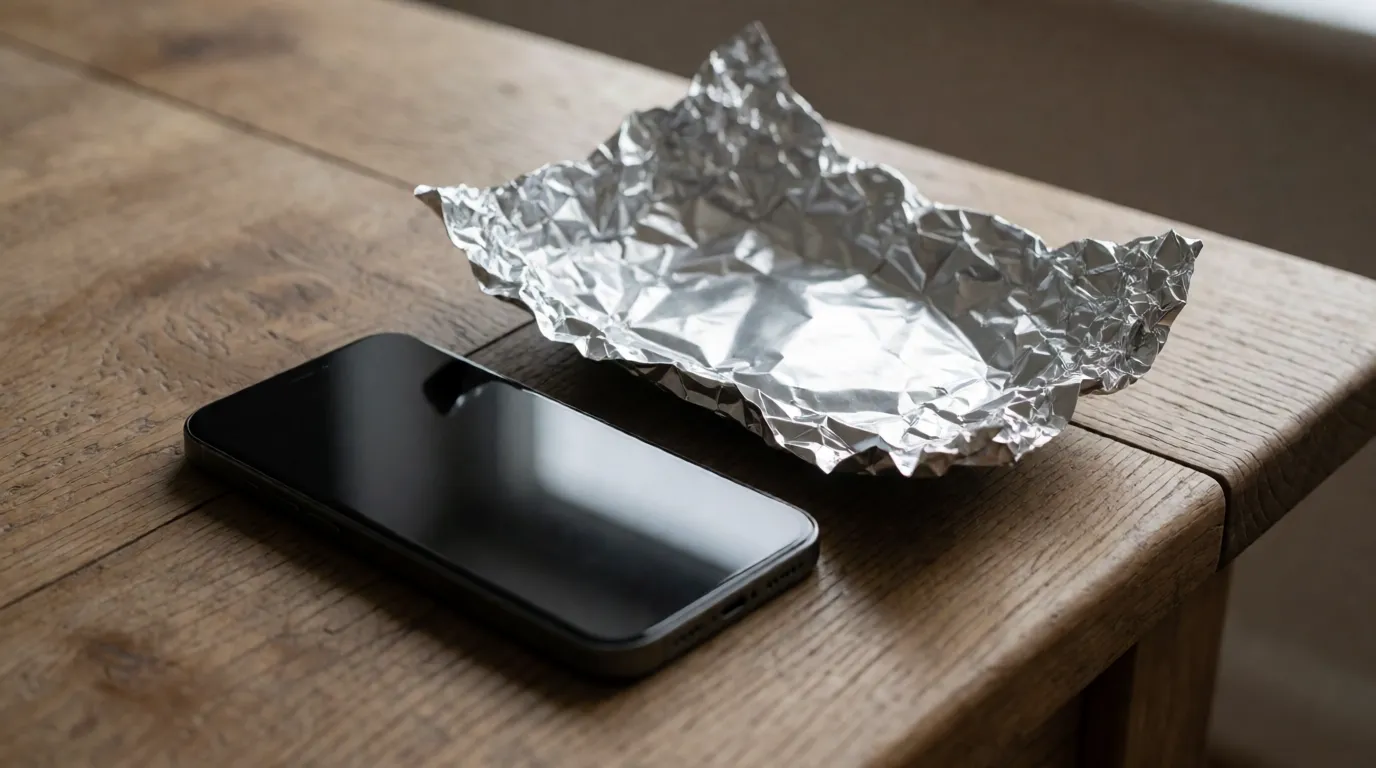
Wood and cushions barely register. Water is worse than either. The foil and the saucepan lid are in a different league altogether, and they are also the thinnest things you tested.
That ranking is the answer to the article in one column of numbers. What stops a wave is not how solid something feels in your hand. It is whether the material contains anything the wave can push on.
The size you choose decides what you can see through
There is a general rule hiding in all this, and it goes well beyond your router. Every wave used for looking at something has to be chosen to match the job.
Doctors use ultrasound to see a baby because those sound waves are around the size of body structures. Airport scanners use waves that cross cloth and stop at metal. Radio telescopes use waves meters long, which travel straight through dust clouds that block every scrap of visible light.
So the reason you can talk to a router through three walls is the reason you cannot see through them. Your eyes are built for waves small enough to be halted by paint. That is precisely what makes them so good at showing you where the paint is.