Why can you hear around a corner but not see around one?

Someone is talking in the kitchen. You are sitting in the hall, around the corner, and you can hear every word. You cannot see so much as an elbow. Light from that kitchen lands on the floor in a bright patch with a knife-sharp edge and goes no further. The voice ignores the corner completely. One room, one doorway, two opposite answers. Why does one come around and the other refuse?
Both of them come around. Sound and light are the same shape of thing, and every wave bends at an edge. The difference is size, measured against the doorway.
Both of them travel as waves
A wave is a pattern that travels while the material carrying it stays put. Drop a pebble in a puddle and rings race outward. The water races nowhere. What crosses the puddle is the disturbance, passed from one bobbing patch of water to the next.
The high part of each ring is a crest. The dip behind it is a trough.
Measure from one crest to the next and you have the wavelength, the wave’s own private ruler. Nearly everything here is settled by it.
Sound has the identical shape, drawn in air rather than water: compressed where the crest belongs, stretched thin at the trough. Light has the identical shape again, whatever light turns out to be made of.
So both are processions of crests. The question is how far apart they sit.
A voice measures in strides, light measures in hairs
Stand up and take one long stride. The carrying part of a voice — the deep, rounded part — has crests roughly that far apart, near enough 1 meter(3¼ ft) from one to the next. While somebody talks to you, crests the length of your stride arrive at your ear, several hundred every second, every one invisible.
Light is built to an entirely different scale. Green light has crests about 0.00055 millimeters apart, which is microscopic, and meaningless until you anchor it. So: pull out one of your own hairs. More than a hundred green crests, laid end to end, would reach across it.
Two waves, each with its own ruler. One measures in strides, the other a hundred to a hair. Now stand a doorway in front of each.
A doorway turns a wave into a row of fresh starts
Aim a wave at a barrier with a gap in it. Most is stopped dead, and the slice lined up with the gap goes through.
The surprising part: that slice does not stay a slice. Every point across the gap behaves like a brand new and independent source, starting a fresh ripple that radiates in every direction, sideways as readily as forward. A doorway is not really a hole. It is a row of miniature wave-makers standing shoulder to shoulder.
So why does any wave ever travel in a straight line? Because the wave-makers have to agree. Where two waves land on one spot, that spot does whatever both demand. Crest with crest builds a taller crest. Crest with trough leaves the water flat and the air still. Adding waves together like this is called interference, and the flat answer is the whole trick.
Stand directly in front of the gap and every wave-maker is the same distance from you. Their crests set out together and land together, so the wave is strong. Move to one side and the agreement slips: the far edge is now further away. Everything depends on how much further.
The two edges can only disagree by the width of the gap
Measure that extra distance. The far edge is further from you than the near edge, certainly, but never by more than the width of the gap itself. No geometry gets past that ceiling: the largest possible disagreement is the gap’s own width, and every wave-maker between the edges disagrees by less.
Suppose the gap is narrower than one wavelength. Then the two edges are under a single crest out of step, whichever direction you choose. Nowhere can the row fall far enough apart to cancel itself, so the wave pours out in wide semicircles and fills the space beyond.
Now suppose the gap is a thousand wavelengths wide. Turn a few degrees off straight ahead and the far edge is already hundreds of crests behind the near edge. The wave-makers now occupy every stage of the bobbing simultaneously, and added together they amount to nothing. That direction goes dead, and so does the next. Only straight ahead, where the distances are equal, survives, and the wave emerges as a beam that leaves a shadow behind the barrier.
This bending of a wave past an edge has a name: diffraction. Every wave does it, at every obstacle. How widely it fans depends only on the gap measured in wavelengths.
Catch it yourself. Hold two fingers up against a lamp and squeeze them almost shut, until the sliver of light between them has nearly vanished. Faint dark lines appear inside the sliver immediately, parallel to your fingers. You have narrowed the gap to a few dozen crests, and the light has begun disagreeing with itself.
A gap means nothing until you measure it in crests.
One doorway, two answers
Measure a doorway. About 80 centimeters(32 in) across, narrower than one crest-to-crest of a carrying voice. By the rule above, that voice cannot cancel itself in any direction. It leaves as a fan and delivers every syllable to you around the corner.
Now the identical doorway, against green light.
How many light crests fit across an ordinary doorway. For a voice, the answer is about one.
Step a hand’s width out of the light and the far side of the doorway is thousands of crests out of step with the near side. Everything cancels, and what escapes is a hard-edged rectangle lying on the floor.
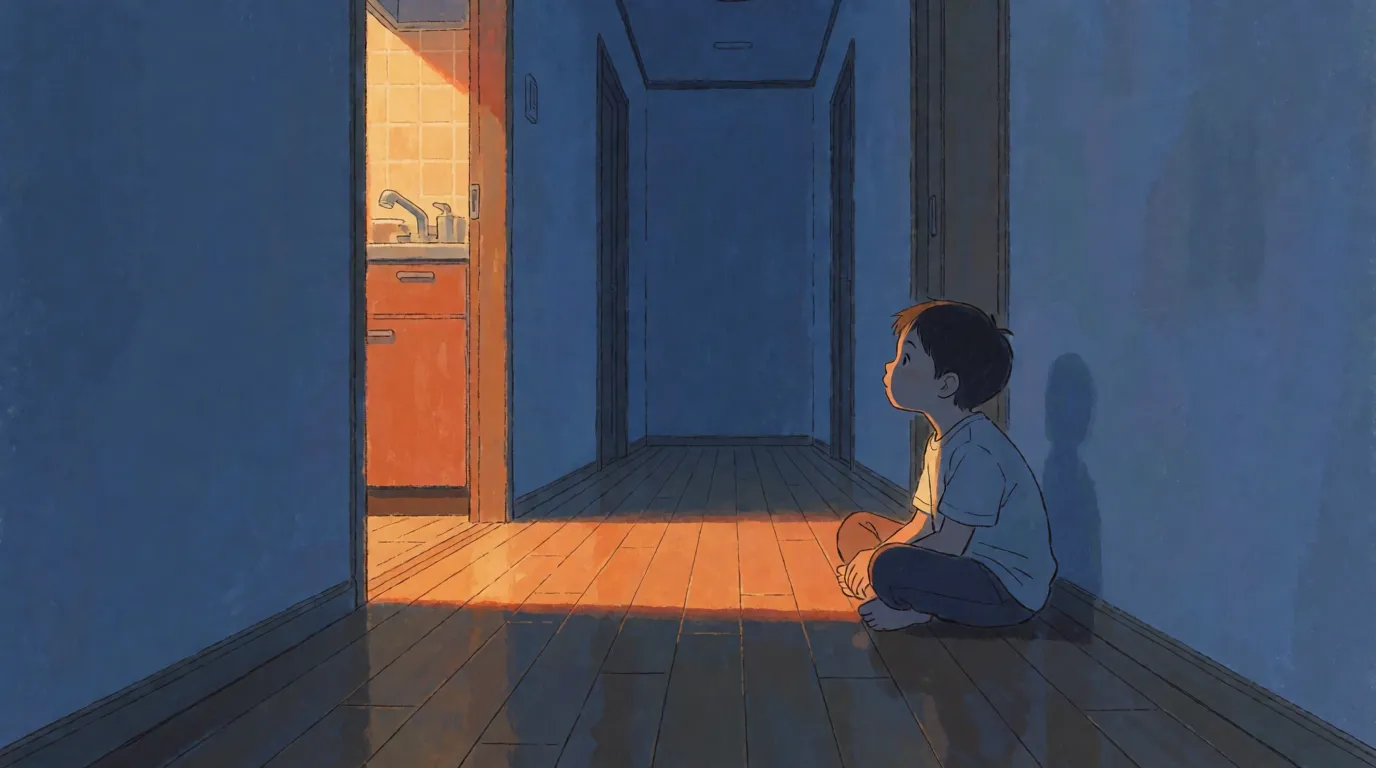
A voice barely fits through a doorway. That, exactly, is why it gets everywhere.
Reflection scatters a thin copy everywhere. Pouring out of a doorway as a fan is a different matter, and only a wave with crests wider than the doorway manages it.
A priest measured a shadow that came out too wide
That explanation took two centuries to find, because light so obviously does not bend.
Long before your great-great-grandparents were born, a priest in Bologna named Francesco Grimaldi, who died in 1663, looked harder. He let sunlight into a dark room through a small hole and stood a thin rod in it. Its shadow came out too wide, with faint colored stripes where its edges belonged. He named the bending in Latin, diffractio, meaning broken apart.
Then Isaac Newton repeated the observation and explained it wrongly. In Opticks, published in 1704, he proposed that the rod reaches out and tugs the passing light aside, deflecting each ray hardest closest in. The answer carried Newton’s authority, so it survived a century.
In 1818 the French Academy in Paris offered a prize for the best account of how light bends, and put Siméon Poisson on the judging panel. A young engineer named Augustin Fresnel entered a wave answer with the calculations complete. Poisson favored the particle answer, and worked out what Fresnel’s own arithmetic demanded: a brilliant spot at the dead center of the shadow of a small round disc. Ridiculous. François Arago set up the disc and looked. The spot was there, and Fresnel won the prize in 1819.
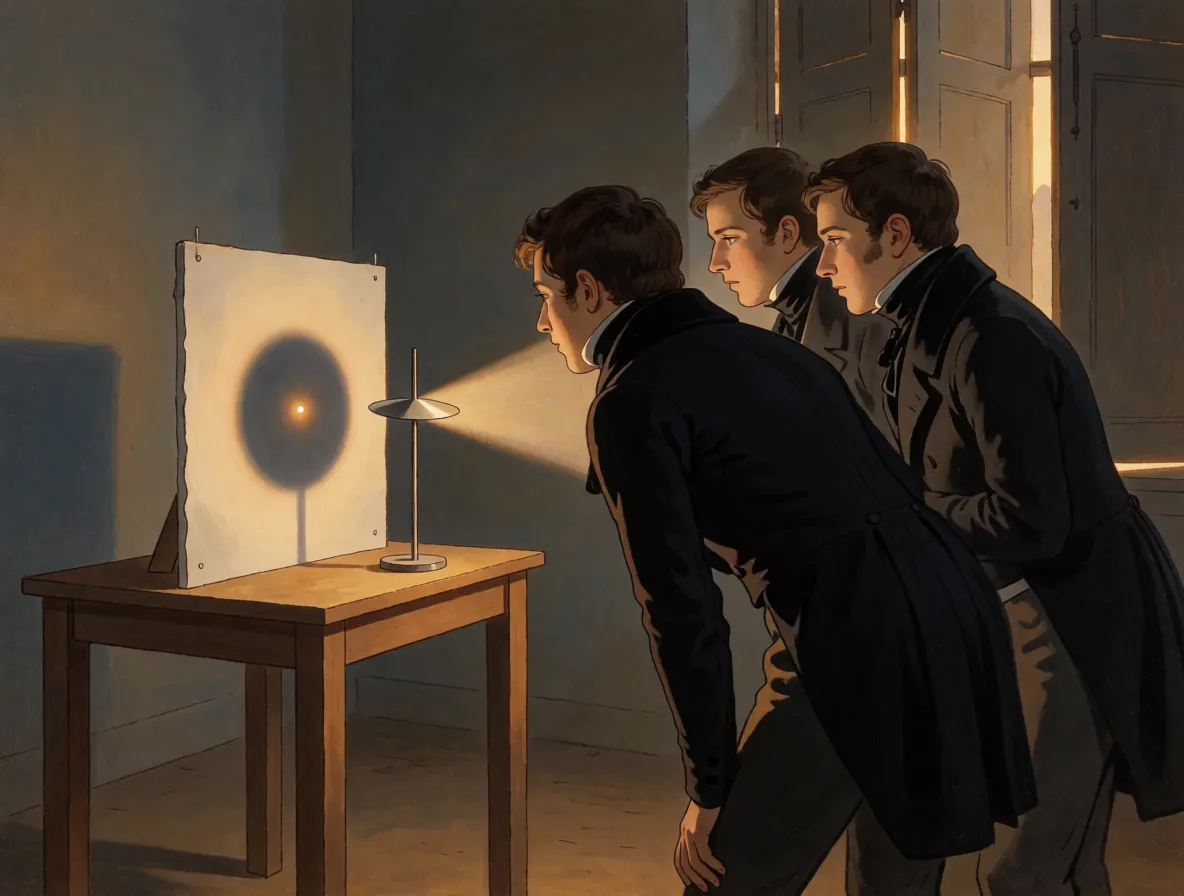
Light’s crests run more than a hundred to a hair, so the bending measures a fraction of a millimeter. Water ripples are enormous by comparison.
Open and close the fan in a baking tray
With the wide gap, whatever comes through heads up the middle of the tray and the far corners stay undisturbed. Squeeze the gap below one crest and the band opens into a fan reaching every corner.
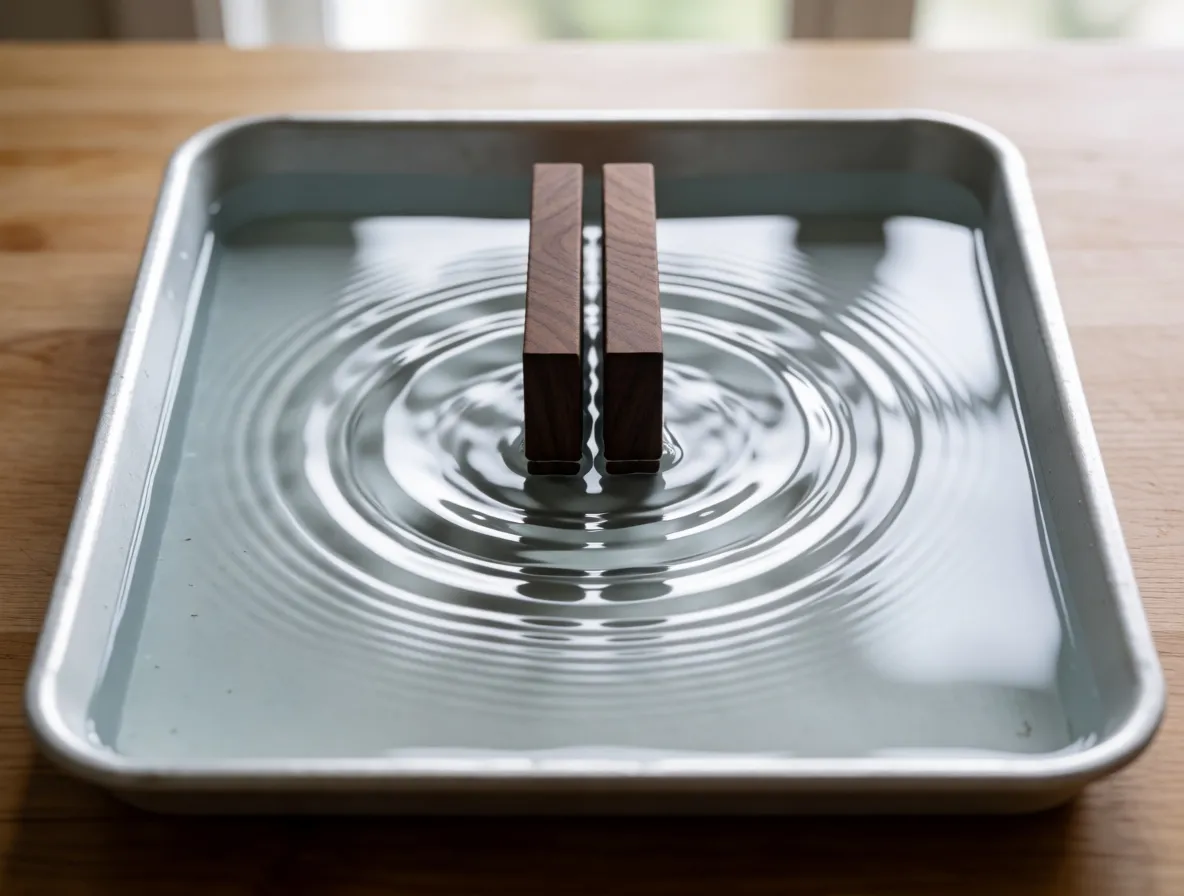
Nothing about the ripples changed. You altered one number, and the wave rearranged the tray to suit. Your hallway does it too.
The corner is sorting your voice
You knew half of this already, without being told. A voice from around a corner does not merely get quieter. It goes muffled, always the same way: the open rounded vowels arrive, and the sharp hissing consonants go missing.
Now you know the reason. A drawn-out ooo has crests a stride apart, wider than the doorway, so it fans out and fills the hall. An sss has crests about 5 centimeters(2 in) apart. That makes the doorway sixteen crests wide, enough to begin cancelling sideways, so the hiss leaves in a narrow beam across the hall. Your seat around the corner sits inside its sound shadow, the quiet zone a short-crested wave never reaches.
So the corner is not kind to your ears and cruel to your eyes. It applies one rule impartially to everything arriving: measure the wave against the gap, and release whatever is too large to be cancelled. A voice barely clears a doorway, so almost all of it escapes sideways. Light clears the identical doorway a million and a half times over, marches straight out, and leaves the person in the kitchen a privacy they never asked for.