How do noise-canceling headphones erase a sound?
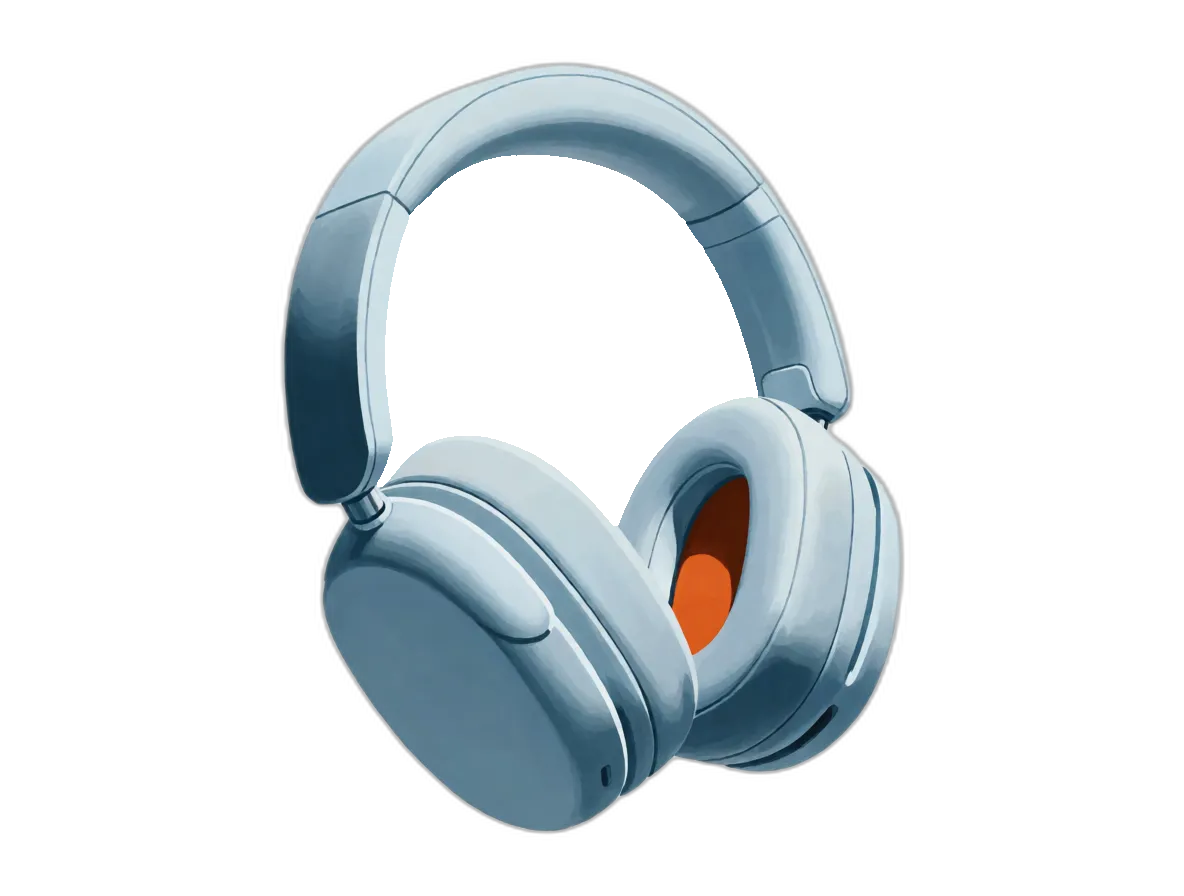
You are an hour into a flight, and the engines are filling the cabin with a low roar. Press the button on your headphones. The roar drops away as though a door had closed on it, yet the passenger beside you is still perfectly clear. Nothing was plugged and nothing was switched off. So what did that button do, and why did it spare the voice?
It manufactured a second sound. The headphone plays a noise of its own, shaped to be the exact opposite of the roar, and two opposite sounds arriving together leave the air still.
Sound is air being squeezed and let go
Every sound you have heard was air being pushed about. A loudspeaker cone moves forward and packs the air in front of it tighter, then swings back and leaves it thinner. Squeeze, thin, squeeze, thin, hundreds of times a second.
What crosses the cabin is pressure, meaning how hard the air pushes on whatever it touches. The air itself barely travels; the pattern of squeezing and easing is what moves.
At the end of your ear canal is your eardrum, a small tight skin stretched across the tube. Higher pressure bends it inward and lower pressure lets it spring back. That flexing is the entire message your ear receives.
Try it now. Rest two fingers on your throat and hum. That buzz is your voice box vibrating the air, and the vibrations grow as you hum louder: a louder sound is a bigger squeeze.
A sound is a pattern of pressure, and hearing is your eardrum copying it. So what happens when two patterns arrive at once?
Two sounds add up, and opposites add to nothing
Sounds do not take turns. When two reach one patch of air, that air does whatever both demand, added together. Two squeezes arriving at the identical instant make a deeper squeeze, and the sound is louder.
Now send in a squeeze and a stretch of identical size at the identical moment. One packs the air together by exactly as much as the other pulls it apart, so the air does neither. The pressure never changes, your eardrum never flexes, and there is nothing whatever to hear.
Physicists call this destructive interference: two waves arriving exactly opposite and wiping each other out. Nothing was absorbed and nothing was stopped; both sounds are still there, behaving as they always did. Only their total comes to zero, and the total is all an eardrum can feel.
So silence can be assembled by addition. Everything depends on how precisely the second wave matches the first.
A microphone hears it before your ear does
Matching the roar means knowing it, so the headphone listens. A microphone on the outer face of each cup, smaller than a grain of rice, is sensitive enough to measure the outside pressure tens of thousands of times a second. Your eardrum is inside, so the roar reaches the microphone first. That head start is everything.
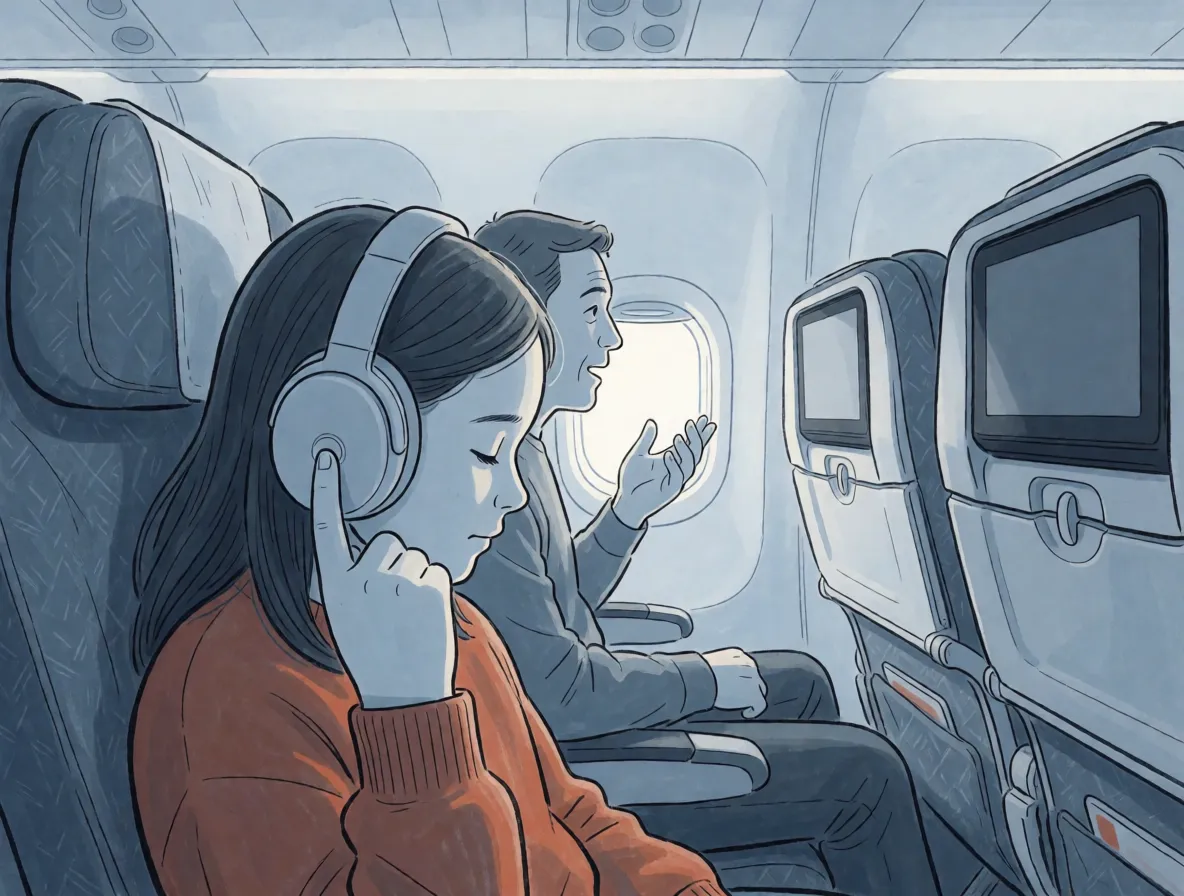
Inside the cup is a processor, a computer chip, and it inverts what the microphone reported: every squeeze becomes a stretch, every stretch a squeeze. That flipped copy goes to the miniature speaker already there for your music. Engineers call the invention anti-noise, a manufactured sound built to be the opposite of a real one.
The cup seals against your head, so the two meet in a pocket of trapped air with your eardrum in the middle. Added together they amount to nothing, and the drone disappears.
A flat battery undoes it all, though the headphones fit exactly as before. Done perfectly this would silence everything, and it plainly does not, for a reason measured in millionths of a second.
The processor is always a fraction late
Listening, inverting and playing do not happen instantly. Together they take about fifty microseconds, and a microsecond is a millionth of a second.
That has to fit inside the head start. Sound travels 343 meters(1,125 ft) every second, and the microphone sits about 3 centimeters(1¼ in) from your eardrum. The roar crosses that distance in roughly a ten-thousandth of a second, and the processor uses about half the time available. It must finish before the sound has crossed the width of your thumb.
Half a head start sounds comfortable, and for a drone it is. A sound’s frequency is how many complete squeeze-and-stretch wobbles it fits into a second. An engine drone is low, near a hundred wobbles a second, so one wobble lasts a hundredth of a second. Fifty microseconds is a two-hundredth of that, and the flipped copy lands where it should.
A faster sound is another matter. The delay never changes, but the quicker the wobble, the bigger the share of it the delay eats. A copy far enough out of step stops subtracting anything and starts adding instead, which is why a hiss survives where a drone does not.
So the trick works best on slow, steady sounds. That explains the hiss, not the voice.
A hum repeats itself, and a voice never does
Being late has a second cost. The processor cannot merely copy what it heard; it must work out what the wave will do next and play the opposite.
For an engine, prediction is easy. A drone is continuous and repeating: this wobble has the shape of the last one, and of every one for the past three hours. The processor gets a hundred worked examples a second and stays ahead of a sound that has given itself away.
Speech is not predictable. Its consonants and syllables change every few thousandths of a second. There is a burst of air for a t, a hiss for an s, a hard edge where words meet. By the time the processor finishes one measurement the word has moved on, and the flipped copy cancels something no longer there.
An engine announces what it is about to do. A voice keeps it to itself.
The headphones are not being polite. They are far better at cancelling a sound that has promised to stay the same, and an engine promises where a passenger cannot. The idea, though, is much older than the headphone.
The idea waited fifty years for a fast enough processor
In January 1933, when your great-grandparents were children, a German inventor named Paul Lueg wrote this exact idea down and claimed it as his invention. He drew a microphone in a pipe, an amplifier, and a loudspeaker further along, wired so the loudspeaker delivered the same sound reversed. America granted him the patent in 1936, titled Process of Silencing Sound Oscillations.

He appears never to have built it. The plan was sound and the equipment was not. Glass vacuum tubes could not measure a wave, invert it and replay it in the sliver of time the pipe allowed.
In the 1950s, engineers at the RCA laboratories in America finally built ones that worked. In 1957 Willard Meeker fitted the trick to a pair of earmuffs, which quieted sounds between fifty and five hundred wobbles a second and nothing above. It stayed in the laboratory: electronic circuits of that era were expensive, unreliable, and drifted out of adjustment.
Then, in 1978, an American engineer named Amar Bose flew home from Zurich and put on the headphones the airline handed out. The engines drowned the music, and he spent the rest of the flight covering a napkin with calculations. His headset eventually reached pilots in 1989, and one for the rest of us in 2000.
Walk into a quiet spot yourself
You cannot dismantle a headphone to watch this. You can assemble the identical cancellation on a floor, with two phones.
That gap is half of one wave. Double it, multiply by the waves leaving a phone each second, and out comes the speed of sound.
Two phones, a sock and a tape measure, and you have the speed of sound.
One thing about the plane is still unexplained. If the electronics are so poor at high frequencies, why does it not become a whistle when you switch them on?
The cushion is half the machine
Put the headphones on with the power off and listen. The cabin is already quieter, and what has gone is the top of the sound: the hiss, the rattle, the clatter of the drinks cart. None of that needed a battery.
That is passive isolation: plain physical blocking by foam, plastic and a seal against your head, and it works precisely where the electronics fail. A cushion is far too heavy to flap back and forth three thousand times a second, so high frequencies bounce off it. Low ones shove it gently along and pass straight through.
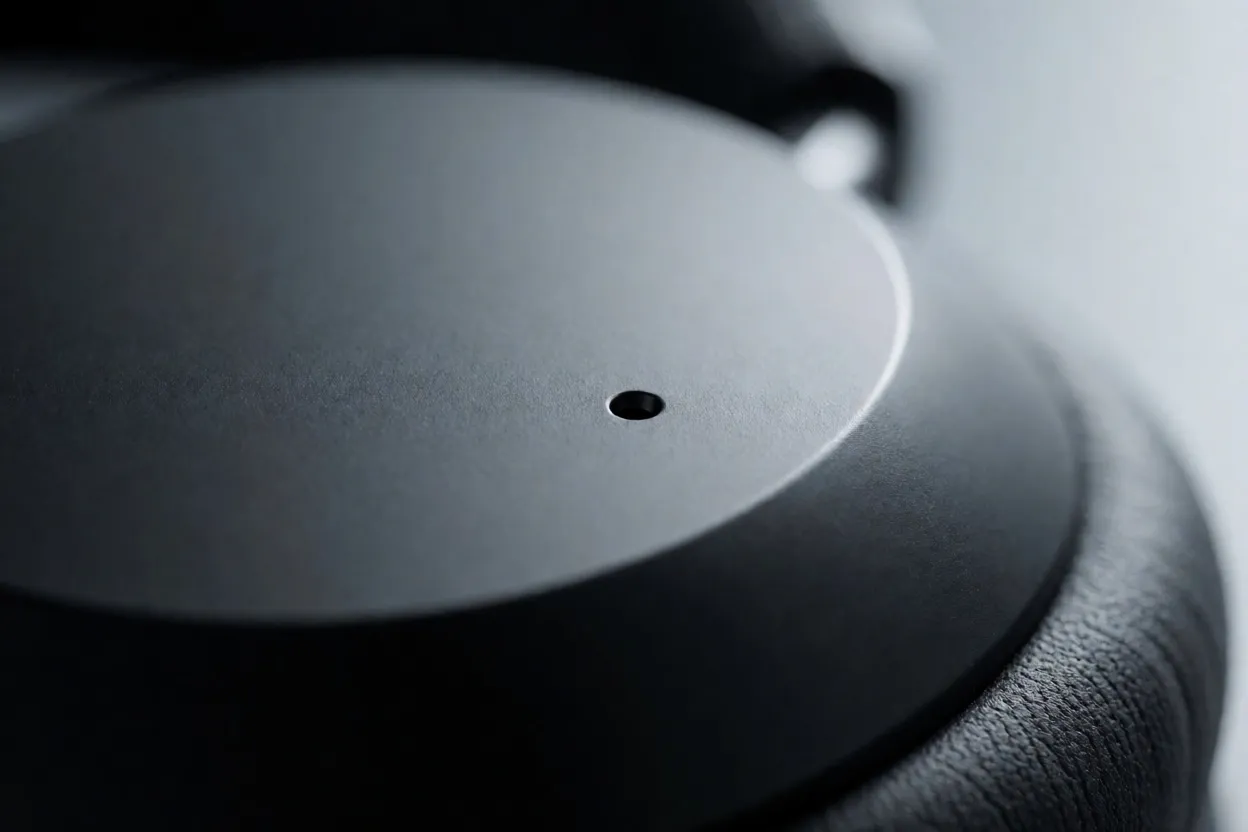
So the two halves cover for one another. Passive isolation takes everything fast; the processor takes everything slow, which is what a cushion is useless against — an engine, a bus, an air conditioner. The voice beside you stays audible in the crack between them: too quick for prediction, too low for the foam to stop.
Which is worth having. A machine that erased every sound equally would also erase the announcement about your gate, the person asking to get past, and somebody calling your name. What is clamped to your head is superb at one narrow job: the sound that never changes. It was the only part you wanted gone.