Why can’t we feel the Earth spinning?

Stand outside and do nothing. If you are near the equator you are being carried east at over a thousand kilometers an hour, which is faster than most passenger jets fly. Nothing whistles past. Nothing leans. Throw a ball straight up and it lands in your hand, rather than a kilometer behind you. The ancient astronomers who insisted the Earth stood still were not being stupid. They were reporting what their bodies told them.
Nothing about you can detect motion. Everything about you can detect a change in motion, and a spinning Earth barely changes anything.
Your body has no speedometer
Sit in a train with the blinds down and try to work out how fast you are going. You cannot. You can feel the train pull away, you can feel it brake, and you can feel every corner, but a smooth stretch at constant speed feels precisely like standing in a station.
That is not a shortcoming of trains. Nothing inside a closed box can measure its own velocity, meaning its speed together with the direction it is heading. There is no experiment that will tell you.
What you can always detect is acceleration: any change in that speed or direction. Your inner ear reports it, your stomach reports it, and a glass of water on the table reports it by sloshing.
Physicists describe this by saying that every measurement is made inside some frame of reference: whatever you are treating as standing still while you measure. Choose the train and the platform rushes past. Choose the platform and the train does.
So the interesting question is not how fast the Earth is going. It is how much the Earth’s motion is changing, from moment to moment, where you happen to be standing.
Going round in a circle is a change, but a tiny one
Travelling in a circle does count as changing direction, so a spinning Earth does accelerate you, and there is a real effect to look for. It is simply much smaller than the speed suggests.
The Earth turns once a day, and it is 6,371 km(3,959 mi) from the centre to the surface. At the equator that works out at 1,670 km/h(1,040 mph), and the number is genuinely enormous.
But the circle you are traveling in is enormous too. Going round something that size takes an entire day, so the direction you are heading changes very gradually indeed, and gradual changes are gentle ones.
The speed is spectacular and the turn is not. A whole day is a long time to get round one corner.
The result of that gentle turning is a slight outward tendency called the centrifugal effect — the same thing that pushes you against the door of a car going round a bend. On a spinning Earth it works against gravity, and it makes you very slightly lighter.
How much less a forty kilogram child weighs at the equator than at the poles.
Two hundred grams, which is about an apple. It is real, it is measurable with laboratory scales, and there is no chance whatsoever of noticing it.
Everything else is moving too
Here is the other half, and it is the half people forget. You are not the only thing being carried along. The ground is, the air is, the ball in your hand is, and so is every cloud and every bird.
A ball thrown straight up leaves your hand already traveling east at 1,670 km/h(1,040 mph), because your hand was. Nothing removes that sideways motion while it is in the air, so it comes down exactly where it left.
That is why nothing rattles. There is no wind of a thousand kilometers an hour, because the atmosphere is going round with the planet. Nothing is being left behind, so nothing has anything to push against.
The helicopter idea
That the same reasoning works for a moving ship was the point Galileo made in 1632, roughly thirteen generations before you were born, in the argument that finally answered the objection. Drop something from the mast of a ship gliding along smoothly, he wrote, and it lands at the foot of the mast.

The objection he was answering was ancient and reasonable. Ptolemy had argued in the second century that a spinning Earth would leave the birds and the clouds behind, and nobody could show him otherwise for fourteen hundred years.
The pendulum that finally showed it
An argument is not a measurement, and for another two centuries nobody could demonstrate the rotation directly. Then in 1851 Léon Foucault hung a heavy weight on a very long wire in Paris and set it swinging.
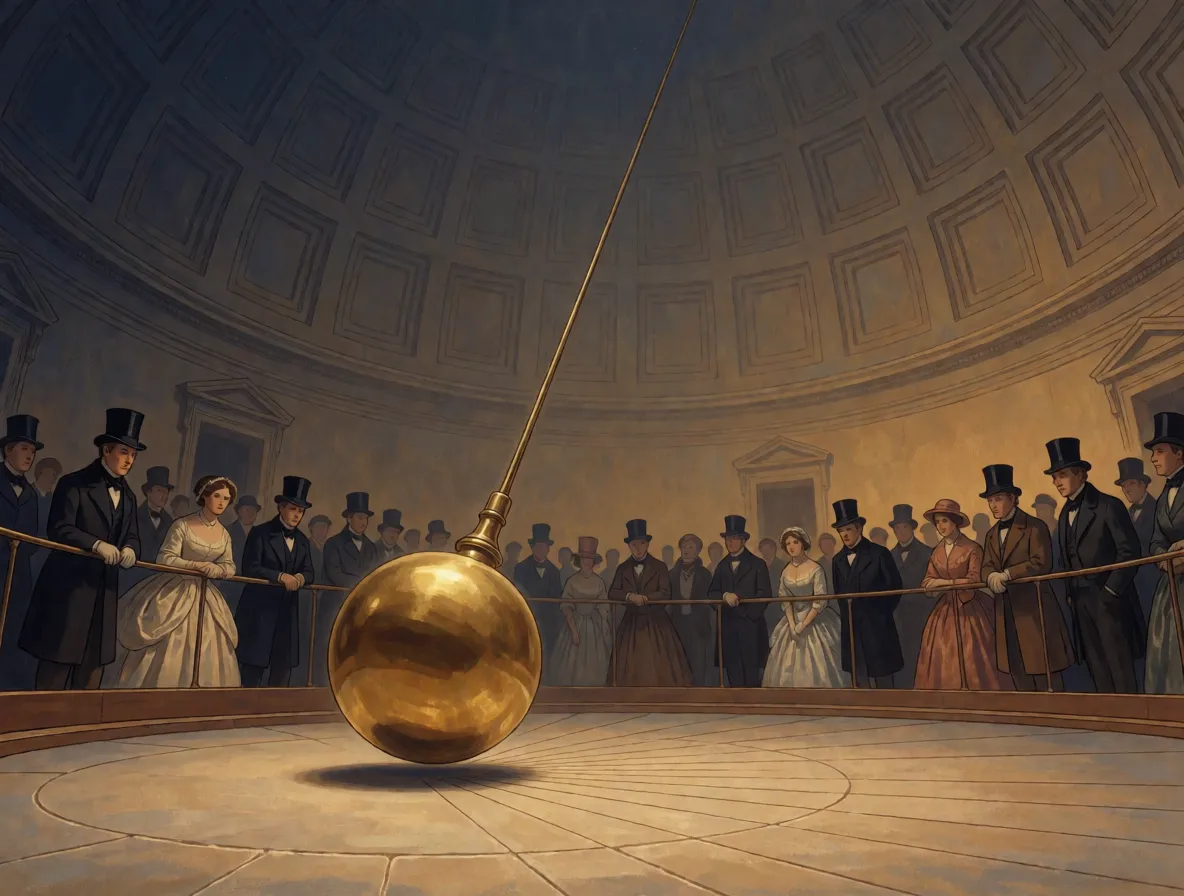
A swinging weight has nothing to push it sideways, so its swing keeps the same direction in space. The floor underneath it, the building, the city and the country all turn with the Earth.
So the swing appears to rotate slowly, and the rate depends on your latitude, meaning how far you are from the equator. At the poles it would take a day. In Paris it took about thirty-two hours.
Crowds queued to see it. For the first time, an ordinary person could stand in a room and watch the Earth turn under their feet, without knowing any astronomy at all.
Drop a coin on a moving bus

At steady speed the object lands at your feet, over and over, exactly as if you were dropping it in your kitchen. Your kitchen is also traveling at a thousand kilometers an hour, so this should not be a surprise, though it always is.
The braking test is what makes the result mean something. Then, and only then, does the object land somewhere else — because then, and only then, is anything actually changing.
Two thousand years of a sensible mistake
It is worth being fair to the people who got this wrong. Their argument was straightforward: if the Earth were spinning we would feel it, and we do not feel it, so it is not.
The first half of that was the mistake, and it took a strange amount of work to see. Bodies do not report speed. They report change, and a planet turning once a day changes almost nothing about your afternoon.
So the next time somebody tells you the Earth is spinning at a thousand kilometers an hour, you can agree, and add the more surprising part. Everything around you is doing precisely the same thing, which is exactly why the whole business is undetectable without a very long wire and a very patient crowd.