Why is Venus hotter than Mercury, when Mercury is closer to the Sun?
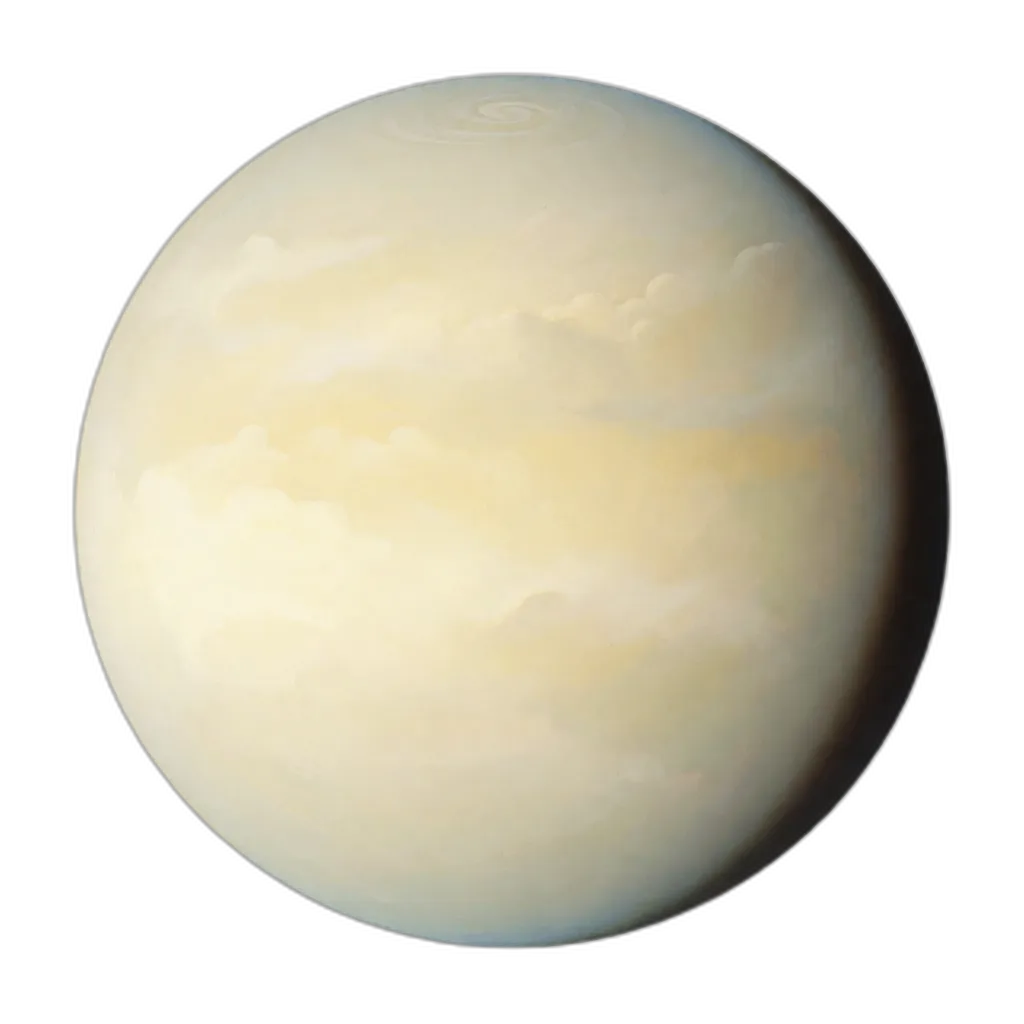
Stand close to a bonfire and your face stings. Step back and it fades. Mercury circles nearer the Sun than any other planet, close enough to melt tin at noon. So Mercury should be the hottest world we have. Venus beats it by hundreds of degrees, from twice as far out. What is Venus doing that Mercury cannot?
Venus is getting less sunlight than Mercury, not more. Its ground receives under a quarter of what falls on Mercury’s rocks, and it is still the hottest planetary surface in the solar system. Everything depends on what becomes of that energy after it lands.
Mercury’s ground gets fourteen times more sunlight
Sunlight thins as it spreads out. Every patch of Mercury gets three and a half times the sunlight Venus does.
But arriving is not the same as landing. Venus is wrapped pole to pole in unbroken white cloud. A planet’s albedo is the share of sunlight it sends back out to space without warming anything. Venus is the most reflective planet there is. Seventy-seven rays in every hundred are turned away before they reach the ground, which is why it outshines every star in your evening sky.
Mercury is bare gray rock, among the darkest surfaces in the solar system. It reflects seven rays in a hundred and keeps ninety-three.
Sunlight soaked up by one patch of ground, on each planet.
So Mercury’s rocks get fourteen times the sunlight Venus’s ever see, and Venus is hotter anyway. The answer must be what leaves.
Sunlight goes in short and heat comes out long
Try this now. Hold your palm a few centimeters from your cheek without touching. Within a second you feel warmth crossing the gap. Your hand is throwing out waves; your cheek is catching them.
Everything warm radiates constantly, and how hot a thing is decides what kind of waves it throws. The Sun’s surface sits at about 5,500 °C(9,900 °F), and at that heat the waves come out short and tight. Those are the visible light your eyes are built for.
A rock at a few hundred degrees is far cooler, so its waves come out longer and slacker. Longer waves of this kind are called infrared. They are invisible, they carry real heat, and they are what your palm threw at your cheek.
So a planet takes energy in as one wave and gives it back as another. Short in, long out. A gas that treats the two differently changes everything.
Carbon dioxide catches the long waves and throws them back
The gas wrapped around a planet is its atmosphere. Venus has an enormous one, and 96.5% of it is carbon dioxide. Its weight presses on the surface as hard as the sea does 900 m(3,000 ft) down.
Carbon dioxide barely notices short waves, so sunlight slides through and reaches the rock untouched. The long waves coming back up are another matter. A molecule is the smallest piece of a gas that is still that gas, and carbon dioxide molecules absorb long waves greedily. Each re-emits its wave a moment later, in whatever direction it faces.

Picture crossing a crowded playground with a ball. You throw it forward, someone catches it and throws it on, but not always the way you wanted, and about half the throws send it back. The ball reaches the far fence eventually. It just takes an extraordinarily long time.
That is every heat wave’s journey out of Venus. On Mercury the wave leaves the rock and is gone immediately: the playground is empty.
Heat does escape from Venus. It escapes slowly, and slowness has a price.
Venus heats up until enough of it leaks out
Energy arrives from the Sun every second, whatever else is happening. If it leaves more slowly than it arrives, the surplus stays and the ground gets hotter. And hotter ground throws its waves out harder.
So as Venus warms, the trickle escaping grows, until it balances everything the Sun delivers. At that moment the temperature stops climbing.
For the sunlight Venus actually keeps, bare rock would settle at about −46 °C(−51 °F), colder than your kitchen freezer. The real surface sits at 464 °C(867 °F), hot enough to melt lead.
Five hundred degrees separate the Venus that should be from the Venus that is, and the air built every one of them.
That is the whole engine. Energy that cannot leave quickly piles up until the planet is hot enough to force it out. The effect has a name, and the name is the most misleading thing about it.
It is named after a greenhouse and works nothing like one
Letting short waves in while holding long waves back is called the greenhouse effect, after the glass sheds gardeners grow tomatoes in.
Venus has no glass and no lid. Its warm air rises as high as it pleases. The gas itself does the holding, one catch and one throw at a time. If the air is the culprit rather than the nearby Sun, Venus ought to stay hot with the Sun switched off.
Fifty-eight days of darkness change nothing
Venus has the slowest rotation of any planet. The time from one sunrise to the next is a planet’s solar day, and on Venus that runs to 117 Earth days. Half of it is night: the Sun goes down and does not return for 58 days.
Mercury is similar: a solar day of 176 Earth days, with 88 of them dark. Its noon rock reaches 430 °C(806 °F), and by the end of that night has fallen to −180 °C(−292 °F). With nothing above it, the heat streams out and never returns.
Now Venus. Two months of unbroken darkness, on a surface hot enough to melt lead. NASA’s figure for the drop between day side and night side is zero.
Not a little. Nothing. The two temperatures match, and so do the poles and the equator. That atmosphere cannot shed its heat fast enough to cool in 58 days, and its winds keep circulating it around the globe. A planet warmed by a nearby Sun would cool when the Sun set. Venus does not.
The jungle that was never there
Cloud made Venus a blank, and astronomers filled it with water, because cloud on Earth means water. For generations Venus was imagined as a warm, wet, tropical world with swamps or oceans under the haze. Those clouds are droplets of sulfuric acid, and Venus has almost no water anywhere.
In 1932, about when your great-grandparents were born, Walter Adams and Theodore Dunham aimed the Mount Wilson telescope in California at Venus. They spread its light out in order, shortest waves to longest. That is a spectrum, and in it every gas prints its own signature of dark stripes.

They had discovered carbon dioxide under enormous pressure. The answer sat on a photographic plate for thirty years while the jungles stayed in the books.
A hundred and twenty-seven minutes on the ground
The astronomer who put it together was Carl Sagan, fresh from a doctorate in astronomy at Chicago. In 1961 he argued that all that carbon dioxide was holding the heat in, and that Venus was baking rather than steaming. The following year a spacecraft called Mariner 2 flew past and turned its instruments on Venus. The measurements matched.
Landing there was the Soviet Union’s project, and for a decade it went badly. Venera 7 came down by parachute in 1970 and transmitted for 23 minutes before its batteries expired. Venera 13 was built to survive 32 minutes and lasted 127. It sent home panoramic photographs of broken volcanic rock, and its microphone caught the Venusian wind, the first sound ever recorded on another world.
Two jars and a sunny afternoon
Somebody had caught carbon dioxide at it long before all that. In 1856 Eunice Newton Foote stood glass cylinders of different gases in sunlight. The one holding carbon dioxide climbed to 52 °C(125 °F), hotter than the rest, and was “many times as long in cooling” afterwards. Foote did not read her own paper at the scientific meeting in Albany; a colleague from the Smithsonian read it for her.
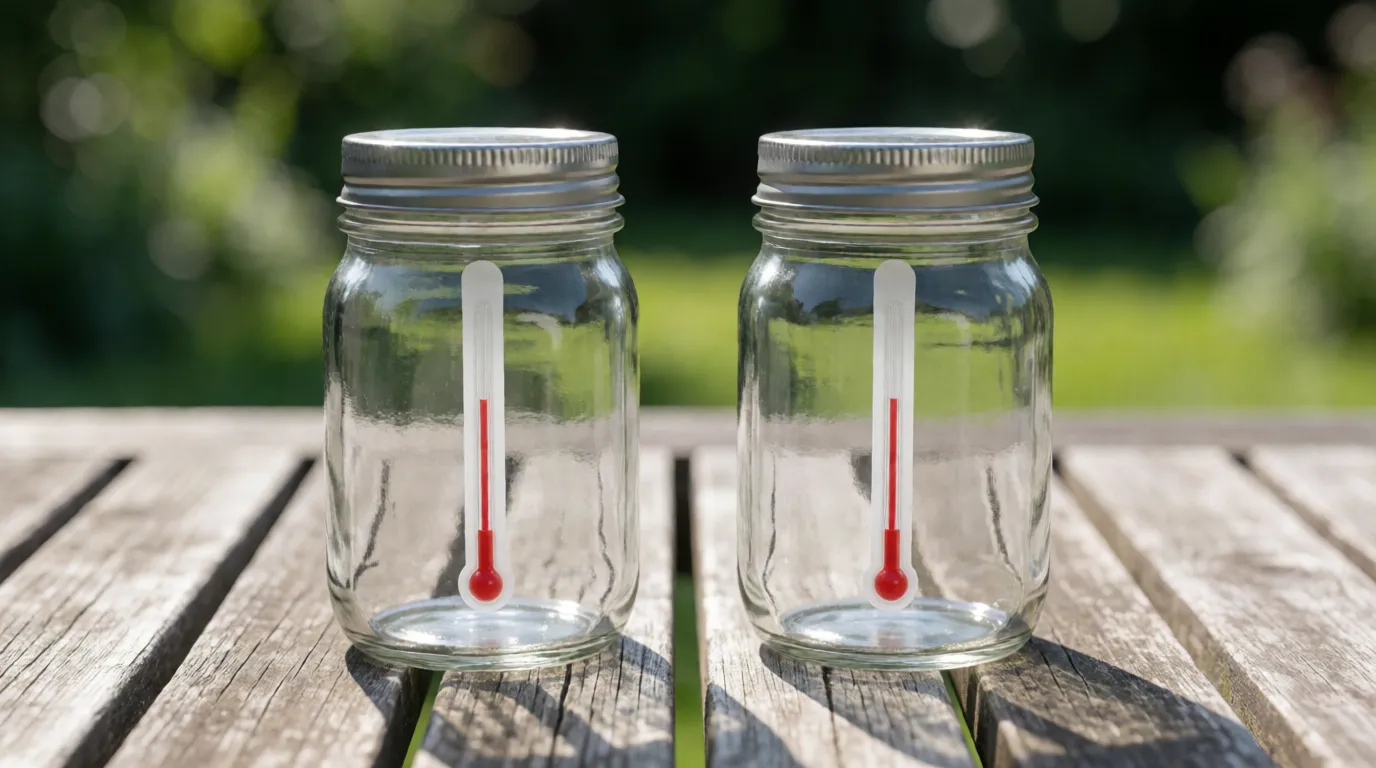
Foote had pure gas and a long afternoon, so her gap was large. Yours will be a degree or two, and the second reading is decisive. The carbon dioxide should surrender its heat more slowly in the shade. That is the half Venus does forever.
What Venus can do that Mercury cannot
The Sun is closer to Mercury and always will be. Mercury’s noon is genuinely savage. Then the Sun sets, and Mercury hands every bit of that heat back to space, because nothing is in the way.
Venus has something in the way. Every long wave leaving its ground meets the same crowded playground of carbon dioxide, gets caught, gets thrown, and goes the wrong way about half the time. Hardly any escapes first time, so the ground climbs gradually until enough of it does.
None of this is exotic. The same catch-and-throw above your head keeps Earth roughly 33 degrees warmer than bare rock would be, the difference between the world you live on and a frozen one. Mercury cannot hold on to its heat, and Venus cannot let go of its own.