Why does a cake need baking powder?
Make a cake from flour, sugar, butter and eggs and it comes out of the oven flat, damp and heavy enough to prop a door open. Add half a teaspoon of white powder to the same bowl and it climbs into a soft dome you can press a finger into. That half teaspoon weighs about as much as two paper clips. So what is it doing in there?
It makes a gas, and making the gas is the easy part. The difficulty is delivery. The gas has to arrive during the few minutes when the batter is still loose enough to swell and about to set solid.
A cake is full of holes before it goes in the oven
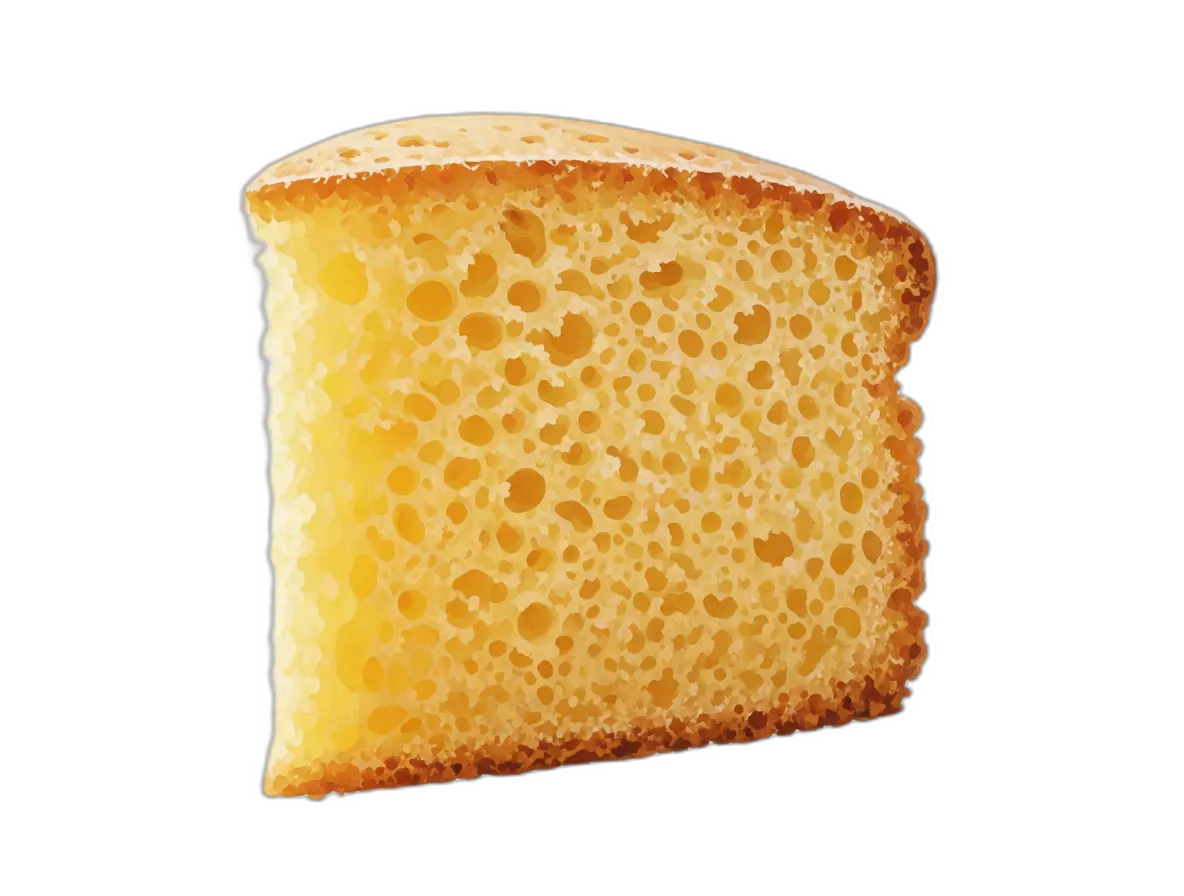
Hold a slice of cake up to a window. It is riddled with holes, and every one began in the mixing bowl.
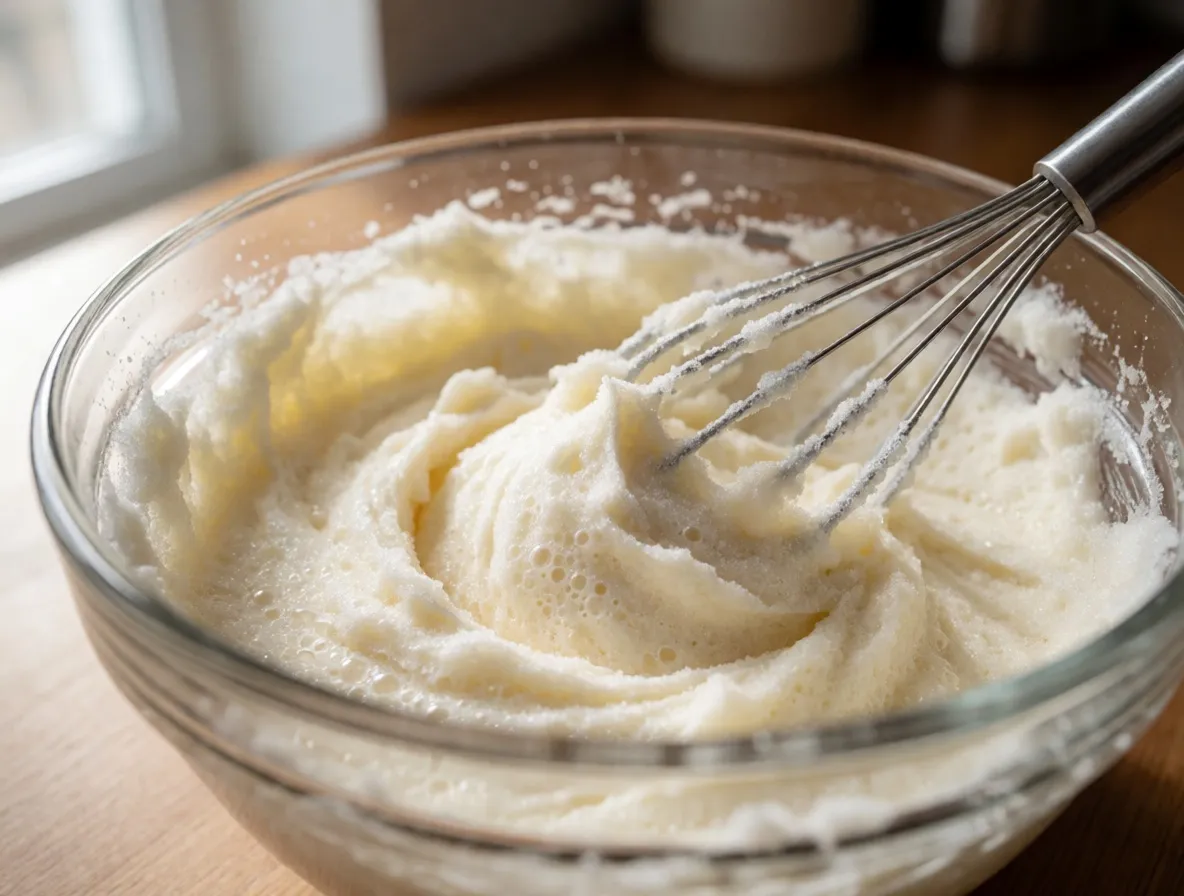
Beating butter with sugar is rough work. Sugar arrives as hard crystals with sharp edges, and dragging them through soft butter shreds air into thousands of microscopic pockets. Whisked eggs trap more. The batter is aerated, full of invisible air, before it is poured.
Heating those pockets expands them, though nowhere near enough. Carry a sealed bubble of air from a warm kitchen into a hot oven and it takes up half as much room again. A cake rises to two or three times the depth it was poured at.
So the holes exist before the oven is involved, and expanding them barely shows. The rest must come from gas that was never in the bowl.
Two powders that must never meet
That gas comes out of the white powder, which is really two powders that should never have been introduced.
The first is baking soda, which chemists call sodium bicarbonate. It is a base, one of the alkaline family: slippery, bitter, the family that oven cleaner belongs to. Their opposites are the acids, the sharp sour family of vinegar and lemon juice. Bring an acid and a base together in water and they neutralize each other immediately.
When an acid gets at baking soda, the soda falls apart. One piece leaves as carbon dioxide, the gas you breathe out and the gas that fizzes in lemonade.
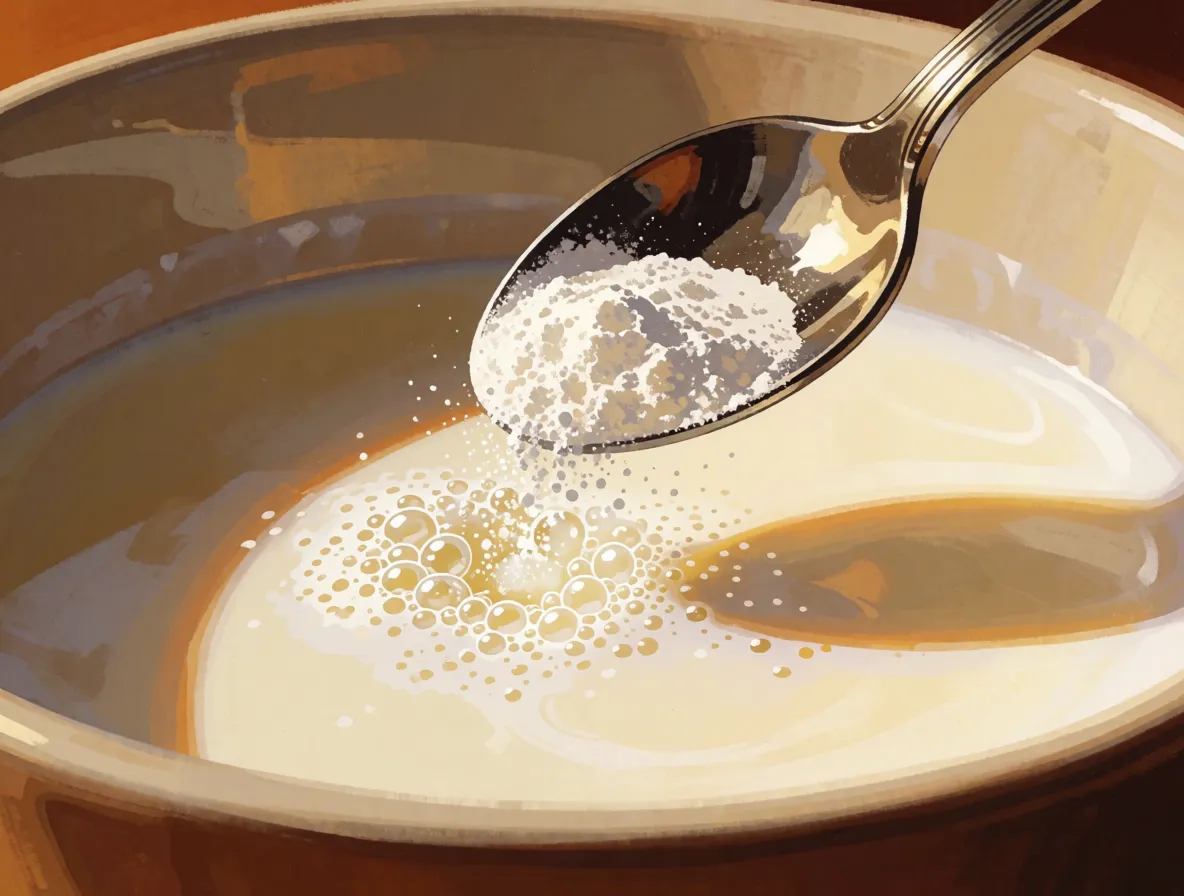
A tin of baking powder holds baking soda, an acidic powder and a quantity of cornstarch, pressed together doing absolutely nothing.
Nothing happens because dry powders cannot properly meet. Every grain is a solid lump, and only the outermost specks of an acid grain touch the soda. To reach each other they must break into individual particles drifting in solution, which is precisely what dissolving is. Water is the switch.
Try it on a saucer. Tip out a pinch of baking powder and watch it do nothing. Now touch it with one wet fingertip. It fizzes instantly, and only where the water landed.
The tin holds a chemical reaction that has been assembled and then halted, waiting for water. That is an awkward object to carry into a kitchen, where the first thing anybody does is make it wet.
Gas that arrives early is gas the cake never gets
Batter is a liquid, and a bubble inside a liquid refuses to stay where you put it. It floats upward, reaches the surface and bursts, the way carbonation escapes a glass of lemonade left out.
Gas arriving while the batter is cold and thin therefore finds tiny pockets, and much of it escapes at the surface.
Consider what an oven does first: it makes the cake runnier. Butter melts, sugar dissolves, and for several minutes the batter is thinner than it was in the bowl. Only afterwards does it stiffen. Between the two lies a window a few minutes wide, when the batter can still stretch but is nearly finished. That window is when a cake wants its gas.
Read the tin. It will almost certainly say double-acting, meaning the powder carries two different acids. The first fires the instant the batter is wet, seeding gas into the existing pockets. The second ignores water and is activated by temperature, staying asleep until the batter passes 60 °C(140 °F), deep inside the oven and inside the window.
A double-acting powder pushes twice, and the second push is aimed at the minutes that matter. A push lasts only while the gas is there, and a cake eventually goes cold. Something else must be holding the roof up.
The gas leaves and the holes stay
Two changes overtake the batter at around 70 °C(160 °F), hotter than a bath and well short of boiling. Between them, they end the stretching for good.
The first happens to protein, the stringy material that makes up most of an egg white and a little of flour. Heat makes those strings clump and stiffen, a change cooks call coagulating. You have watched it a hundred times: a raw egg white is clear and runny, and in a hot pan it turns white and solid in seconds.
The second happens to starch, the white food store packed inside every grain of flour. Heated starch drinks up water, swells and thickens into a stiff gel, a change called gelatinizing. It is identical to what makes a sauce go gluey when you boil it.
Between them, protein and starch solidify the liquid surrounding every bubble. A liquid full of bubbles is froth, and froth collapses. A solid full of bubbles is a foam, and a foam holds its shape permanently. Bread is one. A bath sponge is one. So is the slice you held to the window.
Everything you like about a cake — the softness, the spring when you press it — belongs to the walls between the holes.
Then the cake cools. The gas was always temporary: the carbon dioxide contracts, seeps out through the crumb and is replaced by ordinary air. The cake does not sag by a millimeter. The gas was not holding it up, it was only choosing where the holes would go.
Sold in two packets, with orders to keep them dry
For thousands of years there was no chemical leavening. A cake rose because of yeast, a living organism that takes hours, or because somebody beat eggs by hand until their arm ached.
An early shortcut was pearlash, potassium carbonate boiled out of wood ashes. It is a base, like baking soda, and its usual work was soap and glass. Amelia Simmons put it in her gingerbread in 1796, about eight generations ago, in American Cookery, the first cookbook written by an American. Four of her recipes call for it, two of them gingerbread, probably for an unflattering reason: all that molasses, ginger and cloves buries the unpleasant residue a base leaves.
For fifty years afterwards, cooks guessed the missing acid, stirring soda into sour milk or buttermilk and hoping it was sour enough.
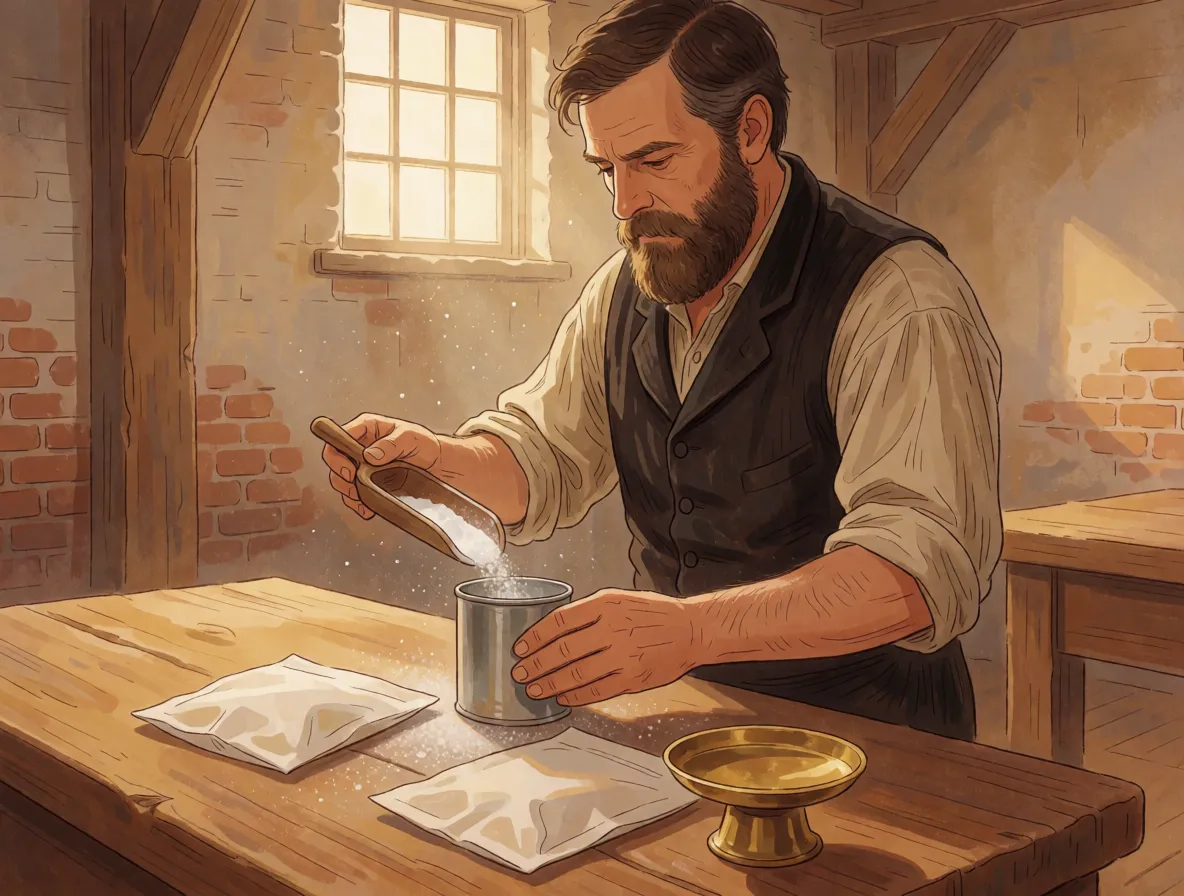
In 1843 the English chemist Alfred Bird mixed a powder of his own, because his wife could not digest yeast. The tidier answer came from Eben Norton Horsford, a Harvard professor trained in a German chemistry laboratory. In 1854 he opened a factory in Rhode Island with his partner George Wilson. In 1856 he patented an acid for baking, made from animal bones treated with sulfuric acid to release their phosphorus.
The acid could now be measured rather than guessed. Horsford still sold it in two paper packets, combined at the last moment. Sealed into one can, acid and soda found the humidity in the air, worked quietly in the dark and reached the kitchen finished. Fixing that took until 1869, and the fix was cornstarch, packed in alongside to keep the truce dry.
Catch both pushes with a balloon
The truce holds only while the powder is dry, and you can break it twice on a kitchen counter.
The soda bottle does almost nothing at either stage: soda is half the machinery, and plain water brings no acid. The powder bottle swells the moment the water goes in, then stops. In the hot water it swells again, with nothing added, because the second acid has woken up.
A teaspoon of baking powder weighs about four grams, and at least twelve grams in every hundred must leave as gas.
Half a gram sounds like nothing. Once it is oven-hot, that gas occupies about 0.4 liters(1.7 cups), a little more than a can of soda. All of it must be crowded into pockets you cannot see.
What the cornstarch is really for
Turn a tin of baking powder over and read the ingredients. Cornstarch will be near the top, and it does nothing for your cake whatsoever. It has one job, the same job it was hired for in 1869. It sits between the acid and the base and drinks any dampness that gets in.
Which explains the tin at the back of the cupboard that somebody opened two years ago. Every time the lid came off, moisture from the kitchen air went in, and the powder did the only thing it knows. The gas came off gradually, in the dark, with the lid on, and nobody was there to catch it.