Why are there two high tides a day and not one?
Scratch a line on a beach in the morning, where the water stops. Come back six hours later and the sea has climbed far past it. Six hours after that it has drained away, and by bedtime it has returned. The Moon is only ever on one side of Earth. So why does the sea rise twice a day, and not once?
Because the Moon does not pull on Earth all at once, with a single strength. It pulls on every rock and every bucketful of seawater separately, and always hardest on whatever is nearest. That one fact heaps the ocean up in two places instead of one.
The Moon pulls hardest on whatever is closest
Gravity weakens as you move away from whatever is doing the attracting, and you can watch that happen in five seconds.
Put a paper clip on a table and hold a fridge magnet just above it. The clip leaps up while the magnet is nearly touching. Raise the magnet by two fingers’ width and the magnetic grip has vanished completely. Gravity fades over distance the same way, only more gradually.
Earth’s diameter is 12,742 km(7,918 mi), straight through the middle, and the Moon sits 384,400 km(238,900 mi) away. So our near hemisphere, the half facing the Moon, is roughly three percent closer than the far one — a tiny head start, but a genuine one.
Different distances mean different amounts of pull. The Moon’s gravitational attraction is slightly stronger on the ocean directly beneath it than on the rock at Earth’s center, and weaker still on the ocean at the opposite side. The gap between the strongest tug and the weakest is a tidal force.
So the Moon pulls the near ocean hardest, the middle moderately, the far ocean least. That heaps water underneath the Moon, and explains nothing about a second heap opposite.
The far side gets left behind
Line up three friends on skateboards, one behind another, all facing the same way. Tow the front one hard, the middle one moderately, the back one gently. Everybody rolls forward; nobody rolls backward.
Now ride the middle board and watch. The friend in front creeps steadily away from you, and the friend behind slips away in the opposite direction. The line stretches at both ends, though nobody was shoved apart.
Earth is that line of skateboards. The Moon tows the near ocean hardest, the solid rock in the middle moderately, the far ocean most gently. You live on the rock, and seen from there the near ocean creeps toward the Moon while the far ocean is quietly left behind.
Each heap is a tidal bulge. Out in the open ocean a bulge stands barely 54 cm(21 in) above the surrounding sea, roughly the depth of water in a bath.
Two bulges, both following from one rule about gravity weakening over distance. What is missing is a clock.
Earth turns through both bulges
The bulges do not travel around the planet. They stay lined up with the Moon while Earth rotates underneath them.
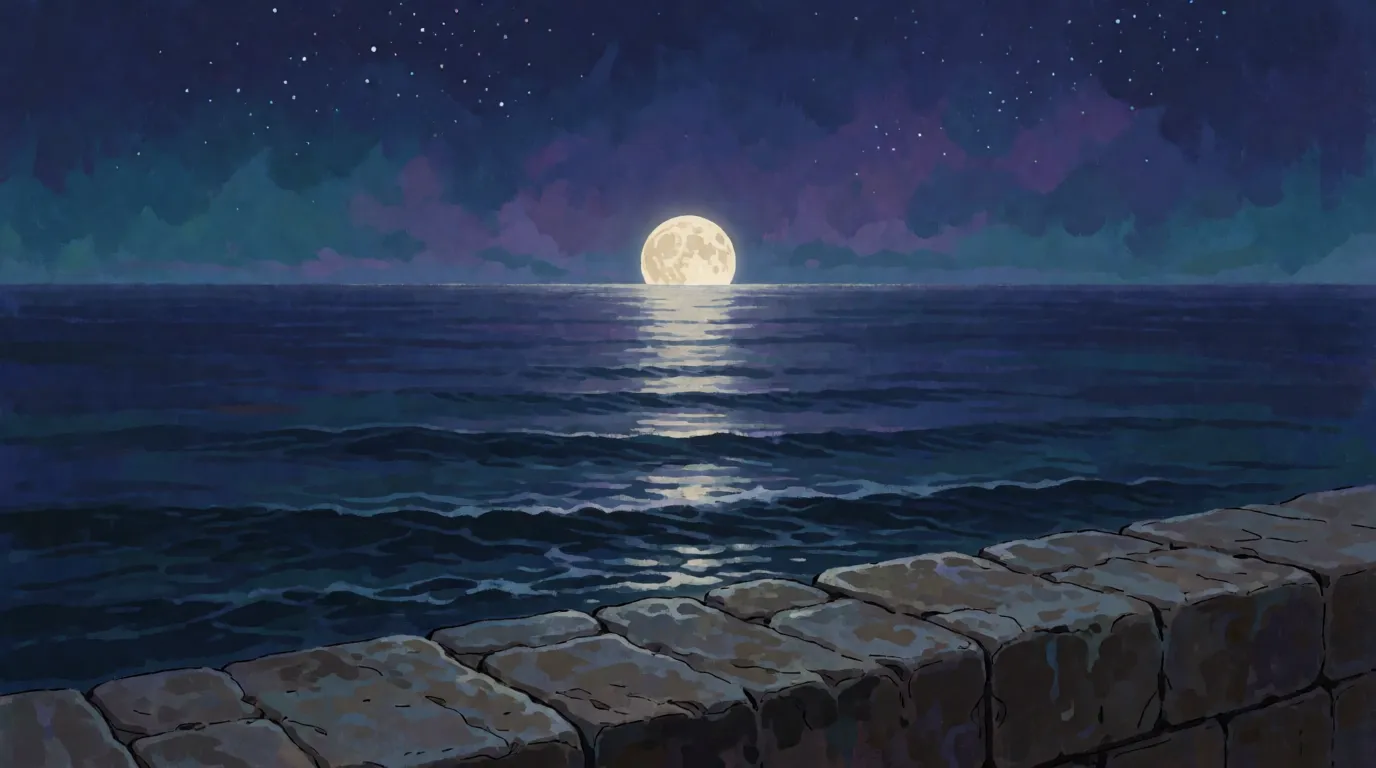
Your stretch of coastline is carried around once a day. On the way it passes beneath the bulge facing the Moon, out again, then beneath the bulge pointing away. Two highs and two lows, every rotation.
The rotation takes slightly longer than a day, however, because the Moon refuses to wait. While Earth turns, the Moon travels along its monthly lap, so Earth keeps turning to catch up. That stretched-out rotation is a lunar day, lasting twenty-four hours and fifty minutes.
The arithmetic of two bulges in one lunar day.
The interval between high tides is therefore twelve hours and twenty-five minutes, which is why high water arrives almost an hour later each day.
So two bulges plus one rotation hands every coastline two high tides. Which raises an awkward question about the other bright object in the sky.
The Sun tows harder and lifts less
The Sun is gigantic, and its gravity holds Earth on its yearly path. Beside it our Moon is a pebble, so everyone would expect the Sun to own the tides.
The Sun tows Earth almost two hundred times harder than the Moon does, and raises a tide half the size.
Strength alone builds no tide. A tide is built from the gap between the pull at one end of a world and the pull at the other. That is how a small nearby Moon beats a huge faraway Sun. Finding that gap took remarkably long, and the man who wanted it most missed it entirely.
The man who got one tide a day
In 1609, roughly fifteen generations before you were born, the German astronomer Johannes Kepler wrote that the Moon draws the seas upward. He could not prove it, and the ancient idea sounded to educated people like fortune-telling.
In 1616 the Italian Galileo Galilei offered a rival explanation. Earth spins while it travels around the Sun. Those two motions together, he argued, shove the oceans back and forth inside their basins — exactly the way water slops in a carried tub.
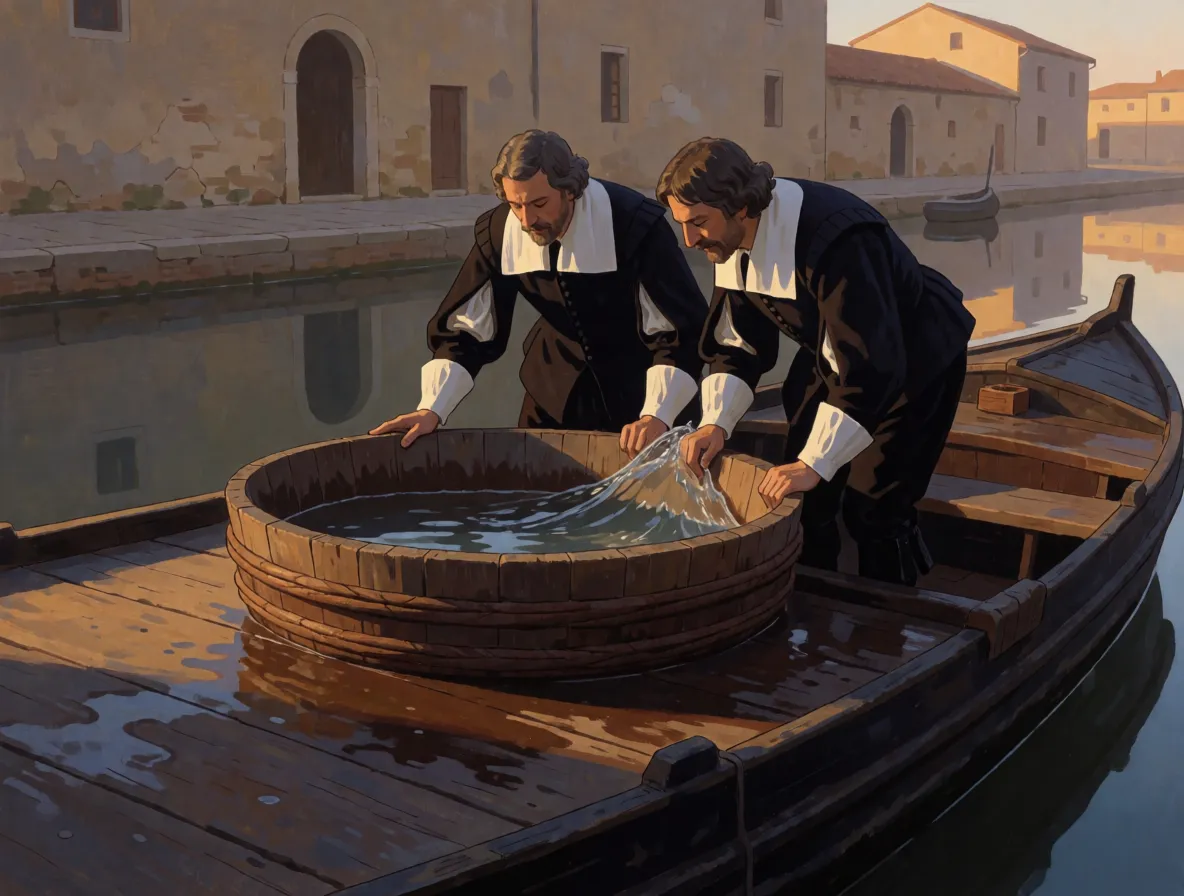
He liked it enough to build a whole book around it in 1632. Look carefully at the prediction: one shove per spin produces one high tide a day. Galileo blamed the missing tide on water sloshing about by itself. He had meant to call the book Dialogue on the Ebb and Flow of the Sea, believing the tides proved that Earth moves. The Inquisition, the Church’s censors, struck the tides out of his title.
The correct answer appeared in July 1687. The Englishman Isaac Newton devoted the third book of his Principia to the consequences of gravity. There he showed that the Moon’s uneven pull heaps the ocean at both ends of the planet simultaneously.
Newton had the cause exactly right. What he did not have was a realistic ocean.
Real oceans have edges
Newton imagined a planet wrapped in a smooth shell of water. The genuine Earth has continents in the way, and oceans sitting in basins with shores, shallows and corners.
Not quite a century later, in 1776, the French mathematician Pierre-Simon Laplace worked out the consequences. Water needs time to travel, so it never settles into two tidy heaps. Each ocean basin instead carries a tide that sweeps around it as a wave.
Your tide therefore depends on your particular basin. Most coastlines receive the familiar pattern of two highs and two lows every lunar day, which has a proper name: a semidiurnal tide. Around the Gulf of Mexico the sloshing works out differently, and many places experience one high and one low each lunar day — a diurnal tide.
Heights vary surprisingly wildly. The distance between high water and low water is the tidal range, and averaged across the world it is merely about 1 m(3 ft). At the head of the Bay of Fundy in Nova Scotia it reaches an enormous 16 m(52 ft), roughly the height of a four-story building.
Twice a day is the ordinary case, not the law, and a tide’s size is mostly the shape of its container. What makes Fundy so ridiculous is something you can build on a kitchen counter.
Rock a tray in time with the water
Every basin of water owns a rhythm: the time a wave needs to cross it and come back. Push repeatedly in step with that rhythm and the water eventually climbs much higher. That is resonance, which amplifies a small push into a big wave.
The Bay of Fundy is a long funnel whose natural rhythm falls close to the interval between tides. Every incoming Atlantic tide arrives at the perfect moment to shove the last one along.
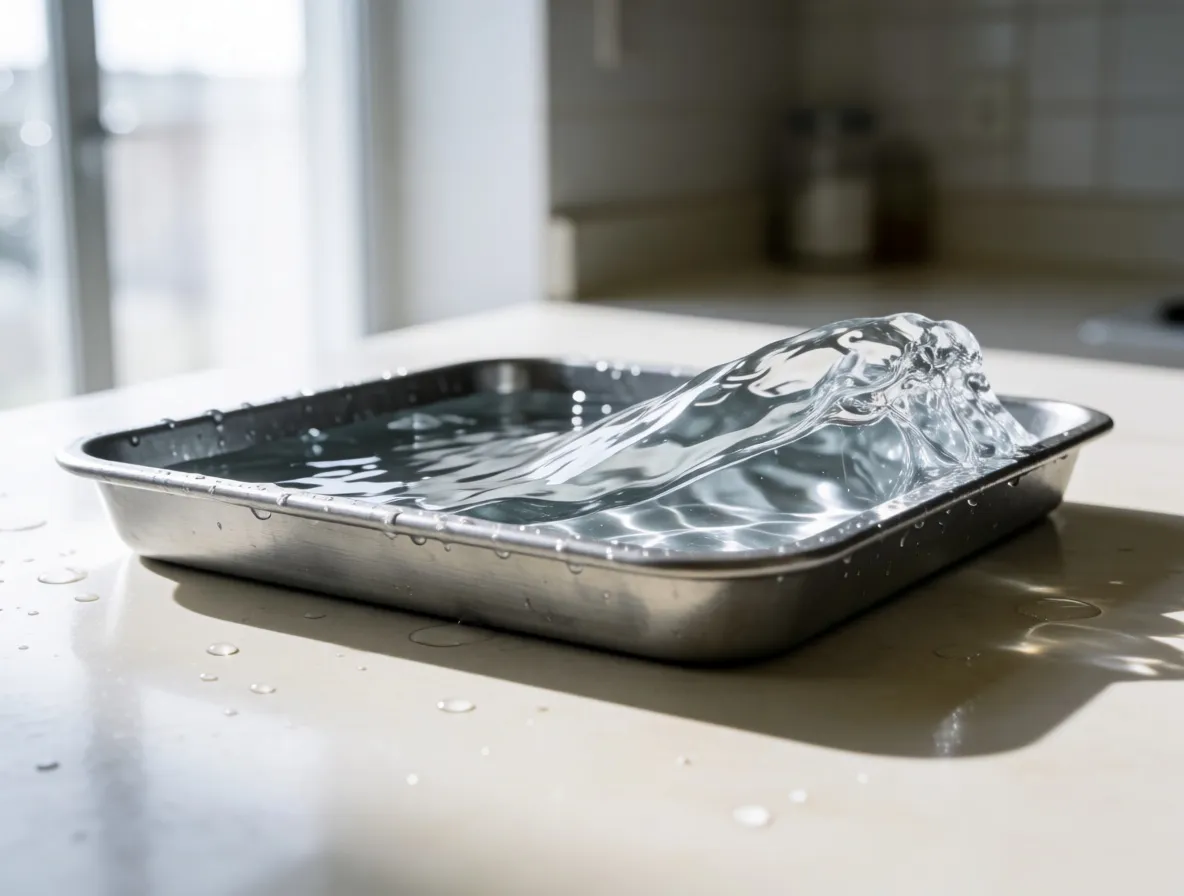
Now rock it deliberately too fast. The water stops cooperating and merely chops. Coastlines behave identically. A basin out of step with the Moon gets a modest tide; a funnel that matches gets a wall of water. Nothing about the Moon changed, only the container.
The high tide you never see coming
Go back to your scratched line on the beach. One of today’s two high tides arrived while the Moon hung overhead. The other arrived roughly twelve hours afterward, while the Moon was below the horizon, invisible on the opposite side of the planet, underneath your feet.
That second tide is the peculiar one, and it gives the whole game away. It cannot be the Moon lifting the water, because the Moon is nowhere near it. That water got left behind, because the Moon tows the planet slightly harder than it tows the water beyond it.
Both bulges, the obvious one and the impossible-sounding one, follow from the same small fact. The Moon’s grip loosens over distance. Stretch anything wide enough across that loosening grip and it will swell at both ends, whether it is an ocean, a planet or a moon. Twice a day, on every beach in the world, a rule of gravity gets spelled out in wet sand.