Why can’t light climb back out of a black hole?
Point a flashlight at the ceiling and the beam is there before you finish the thought. Light is the fastest thing in the universe, and nothing has ever overtaken it. Yet there are places in space where light sets off in every direction and none of it comes back. What is beating the fastest thing there is?
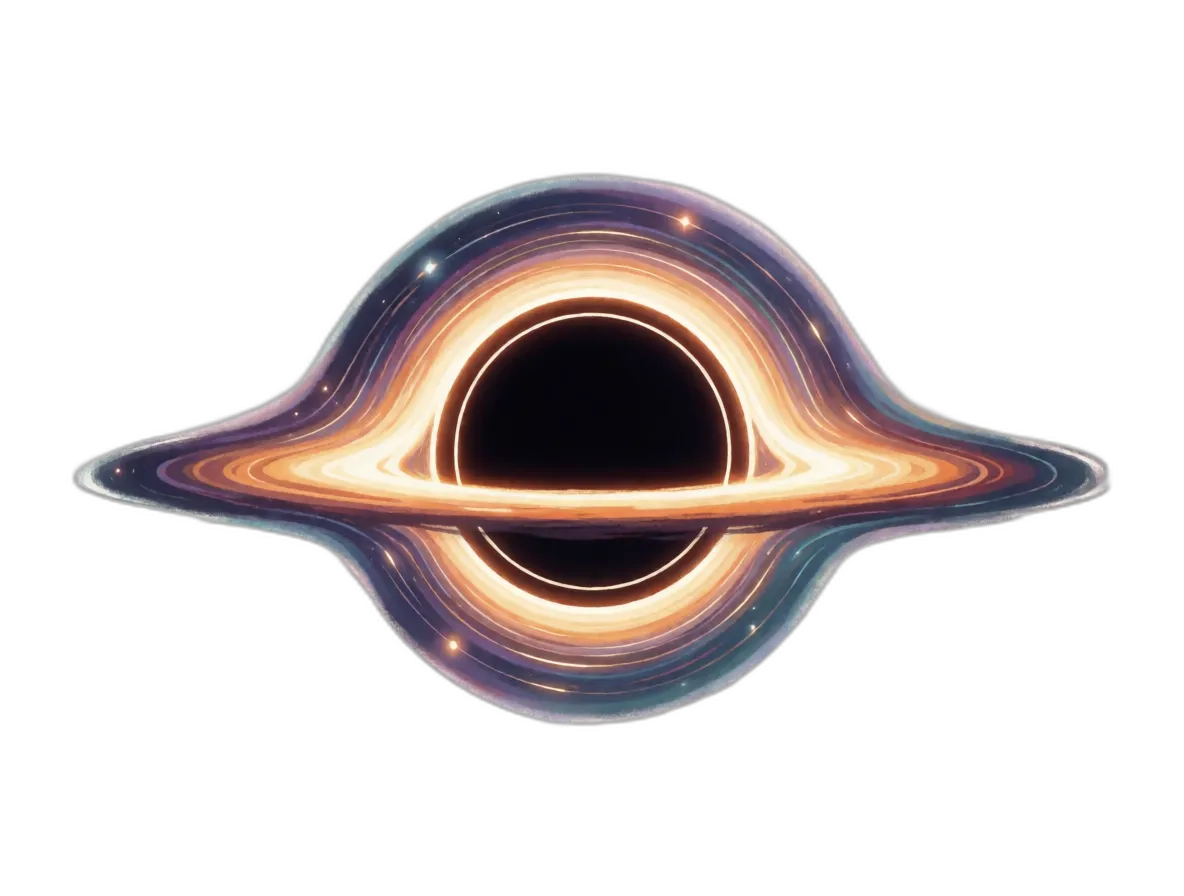
Nothing is beating it. A ray of light leaving the middle of a black hole sets off at exactly the speed light always travels. It never loses a fraction of that on the way. The trouble is where it arrives: close enough to a black hole, every direction a ray can point leads further in.
A star heavy enough to keep its own light
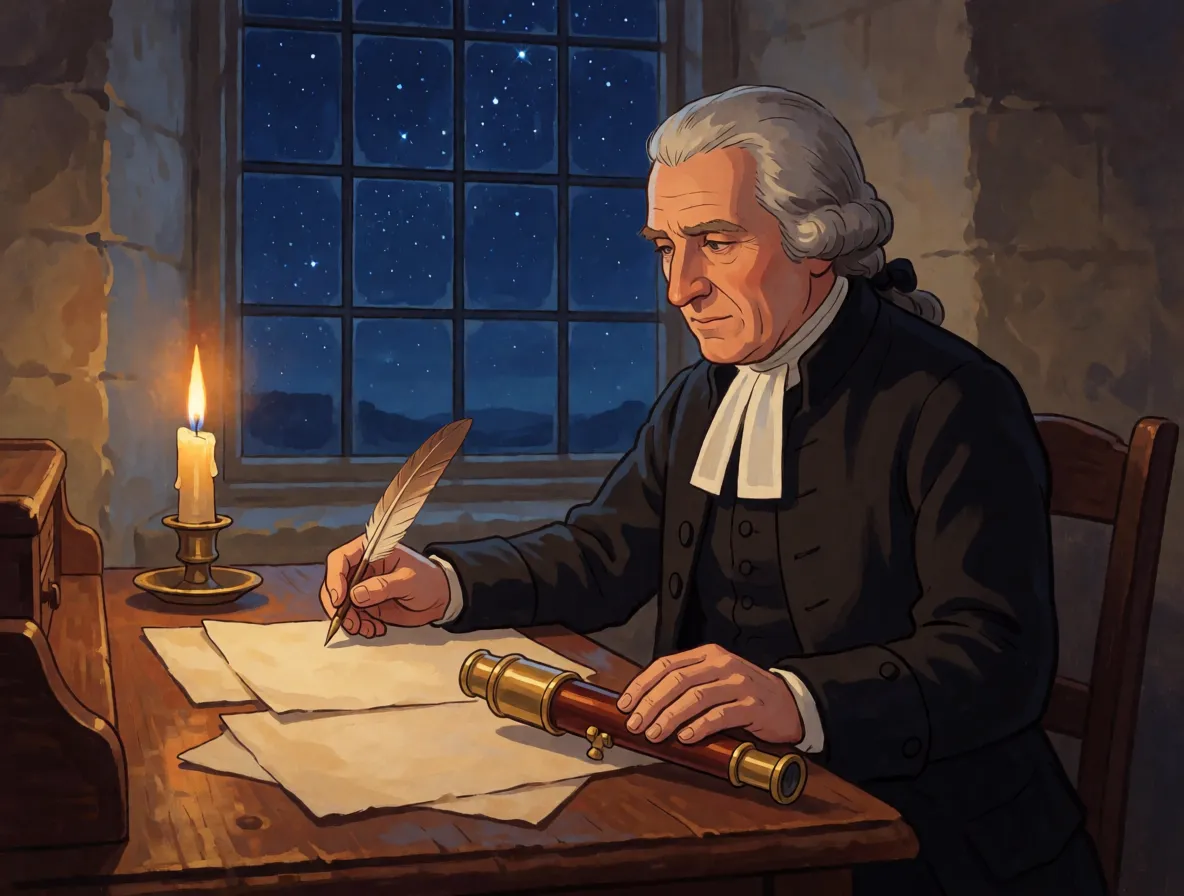
In 1783, long before your great-great-great-grandparents were born, an English village rector worked out how heavy a star would have to be. John Michell ran a Yorkshire parish and did his astronomy from the rectory at night.
Throw a ball straight up and it comes back down. Throw it hard enough and it never comes back at all. That lowest speed is the escape speed, or escape velocity, and it depends on how heavy the world beneath you is and how tightly packed. Leaving Earth takes 11.2 km(7 mi) every second.
So what if a star were heavy enough that its escape speed passed the speed of light? Isaac Newton had settled a century earlier what light was: corpuscles, tiny particles flung out by the star. Corpuscles would rise, slow, stop and drop back.
Michell sent the numbers to Henry Cavendish, who read them to the Royal Society. An enormous luminous star at our Sun’s density, five hundred times its diameter, would pour out light, get it all back, and from here be invisible.
That was not even the point of the paper. Michell had set out to measure how much a heavy star slows its own starlight down, which is the one thing in it that turned out to be impossible. His distance was right anyway, but the reasoning under it was wrong from the first sentence.
Light does not slow down on the way up
The first person to delete the idea had reached it himself, apparently without reading Michell. Pierre-Simon Laplace, the finest mathematician in France, printed his own version in 1796. It ran in the first two editions, and by the third, in 1808, it had quietly gone. Laplace never said why.
He had reason to be uneasy. The evidence was turning against the Newtonian picture of light as thrown pebbles. Light spread and overlapped the way ripples on a pond do, and nobody could say whether gravity had any grip on a ripple.
The deeper problem took another century to face. A thrown ball leaves your hand fast and is already slowing. Light never does. It leaves at 300,000 km(186,000 mi) every second, and however far it climbs, that is still its speed on arrival. Every observer, anywhere in the universe, takes the identical measurement.
Gravity does change the light. It arrives redder, carrying less energy, but never slower.
So there is no speed light fails to reach. If the escaping thing has not changed, whatever traps it must be what it is escaping through.
The space around a black hole is falling in
What traps the light is the space it is crossing. That is a strange thing to say about empty space, and it comes out of the theory Albert Einstein finished in 1915: general relativity.
A heavy object bends the shape of the surrounding space and time, and everything nearby follows that shape. Space and time turn out to be one bendable thing rather than two, which is why physicists run the words together into spacetime.
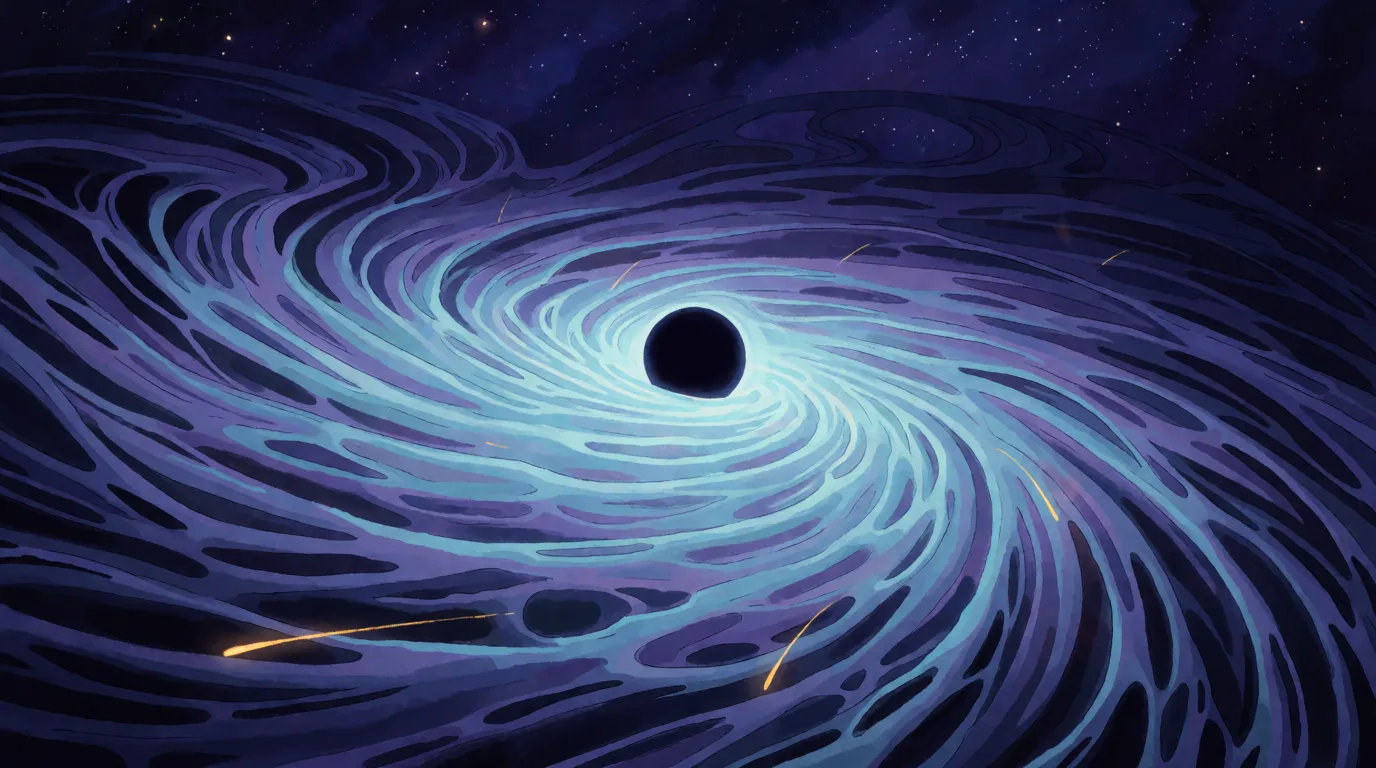
The space around a heavy object is falling inward, like a river sliding toward a drain, and the closer in you look the faster it runs. Anything in that space is carried along, feeling nothing at all. That weightless carried feeling is free fall, the half-second you get jumping off a swing.
Light is carried too: through the space immediately around it, a ray still travels at its own fixed speed. But that space is going somewhere.
Try it with your hands. Lay one hand flat and walk two fingers of the other forward across it. Now slide the flat hand backward, faster than your fingers are walking. The fingers never stop going forward. They still finish behind where they started.
Light’s speed is measured against the space right around it, and near a black hole that space is moving. Everything hangs on one number: how fast.
The line where the falling wins
Close to the middle the falling is quick, and far out it is a gentle drift. Somewhere between, at one particular distance, space falls inward at exactly the speed of light.
Picture a ray sitting on that line, aimed straight out. It travels outward at light speed while the space beneath it slides inward at light speed. The two cancel. The ray is still going full speed and never gets any further out. That surface is the event horizon.
Step inside it. Here space falls faster than light travels, so the cancelling no longer comes out even. A ray aimed straight out still leaves at full speed, and still ends the second nearer the middle.
Aim it sideways, or at any angle, and the same thing happens. Every direction a ray of light can point now leads further in. Out is not a direction light is too slow for, it is a direction that has stopped existing.
Nothing there works like a wall. You would cross it in free fall, feeling precisely nothing, into a place where none of your choices point home. How far out does that line sit?
Nine millimeters for the whole Earth
Where that line sits was worked out over the winter of 1915 by Karl Schwarzschild, a forty-two-year-old astronomer volunteering in the German army. He read Einstein’s new equations between artillery trajectories on the Russian front, posted back the solution, and was dead of a rare skin disease five months later.
His result is wonderfully plain: the distance depends on one quantity, how much stuff the object contains. Double the weight and you double the distance. Physicists named it the Schwarzschild radius.
Squeeze Earth small enough and its line would sit 9 mm(⅓ in) out from the center, making the whole horizon a ball not quite two centimeters across. Every ocean, every mountain and every person, inside a marble.
Our Sun weighs three hundred and thirty-three thousand times as much, so its line sits that many times further out.
Earth’s horizon, multiplied by the number of Earths it takes to make a Sun.
The Sun would go dark inside a ball you could walk across in an afternoon, and every ray it sent out would still be leaving at full speed.
Three kilometers is an hour’s walk. So the whole trick is size, not strength, and that is what almost everybody gets backwards.
Far away, a black hole pulls like anything else
All that racing space is a local affair. The falling only outruns light very near the middle; further out it is the same gentle gravitational drift as from any object of that weight.
Sucking was never the right word. A black hole is a place with an edge, and the edge falls wherever the flow beats the swimmer. That is a race you can set up in a sink.
Make the same edge in your kitchen sink
Ripples cross shallow water at a fixed speed, decided by the depth. So all you need is water running faster than its own ripples.

That sharp circle is a hydraulic jump, and the V trailing your finger is the cone that trails a supersonic aircraft. Read it as a list of everywhere your ripple can reach, closing up as the water speeds up.
Your sink runs the film backward, which is worth saying. The water flows outward, so the ring keeps ripples out rather than in. Flip the direction and the arithmetic underneath is identical.
Nothing had to beat the light
Remember the flashlight. Carry it inside the horizon and switch it on, and every ray leaves the bulb as rays always do: full speed, dead straight, no hesitation. Each covers exactly the ground light covers in a second, and finishes it closer to the middle than it started.
The light never lost a race. There was no race. What it ran out of was the list.
You already know one direction that behaves this way, and have never thought it strange. Tomorrow. Nothing drags you into next Tuesday, and you cannot spend an afternoon in last Tuesday. Inside the horizon, further in works the way later does: inevitable, and no kind of destination.
Michell had the distance right and the reason wrong, the oddest part of the whole story. He found the line by picturing a pebble thrown too gently, and it really does sit where he put it. The universe let him keep the number and held on to the explanation for another hundred and thirty years.