Why is the sky blue at noon and red at sunset?
Go outside at lunchtime and look straight up. The sky is blue, and it is blue over deserts, over cities and over the ocean. Come back at bedtime and that same sky has turned orange, with a red sun resting on the horizon. Identical sun. Identical air. So what changed?
The distance changed. Blue and red are two ends of one story, and the entire difference is how much air the light crossed before it reached your eye.
Sunlight is a stack of waves of different lengths
Sunlight looks like one thing. Each color inside it is a wave, and what distinguishes one color from another is its wavelength, the distance from one ripple crest to the next. Red waves are the longest your eye can register. Violet waves are the shortest.
A violet wave measures roughly 400 nanometers, and a nanometer is a millionth of a millimeter. Nearly two hundred violet waves would fit across a single hair. A red wave measures around 700, so the longest color you can see is not even double the shortest.
That modest difference does all the work in this article, once sunlight meets something to work on.
Every air molecule throws light sideways
What it meets is air. The atmosphere above you is transparent, so a clear sky looks like nothing at all. It is in fact crowded with molecules of nitrogen and oxygen, the two commonest gases up there. A molecule is a small group of atoms bonded together, far tinier than a wave of light. Over a thousand would fit end to end inside one violet wave.
Every molecule carries electrons, the minute fast specks of matter circling the outside of atoms. A passing light wave pushes and pulls on those electrons, and they wobble in step with it.
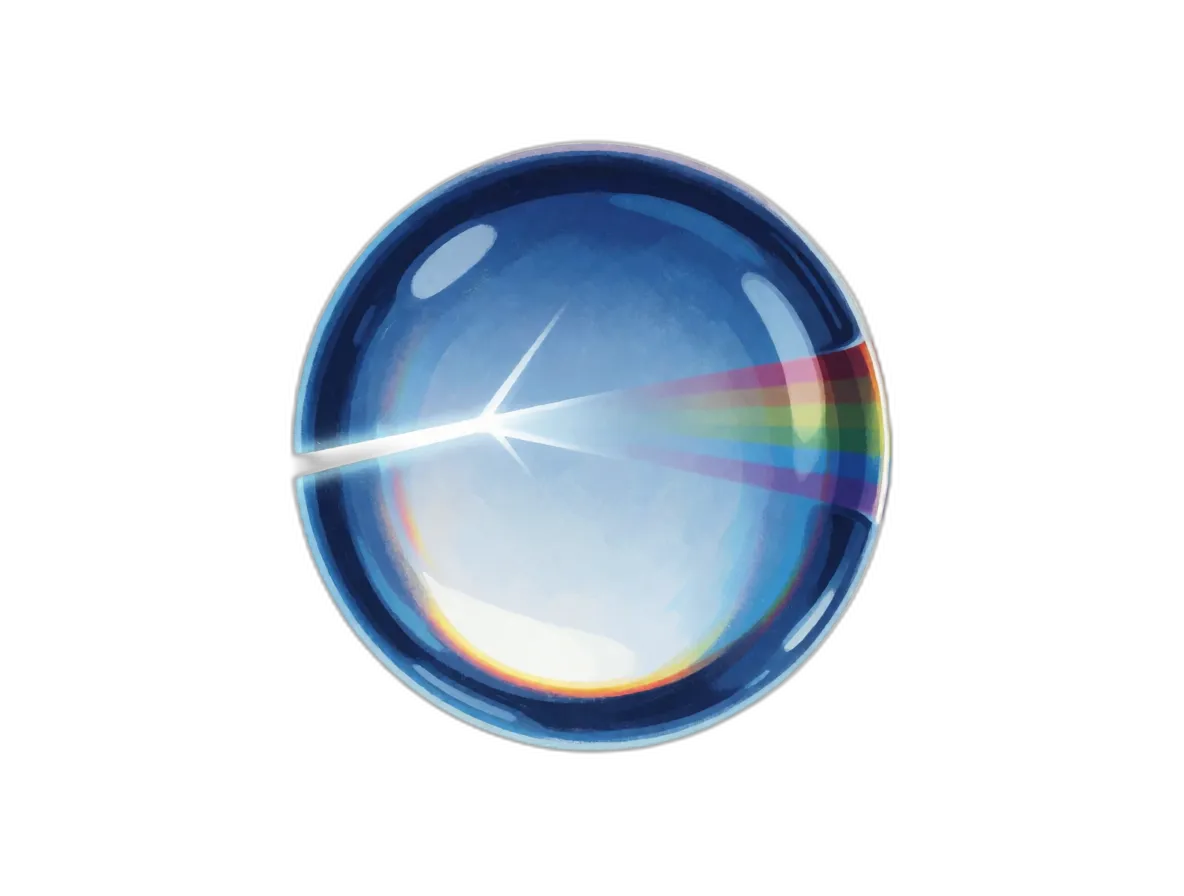
A wobbling electron radiates: it gives out light of its own. So the molecule sends a faint copy of the wave that shook it, in every direction at once, like a garden sprinkler. This is scattering: light arriving from one direction and departing in all of them.
A sliver of the sunbeam is picked up and flung sideways, over and over, the entire way down.
The shorter the wave, the harder it is thrown
A short wave has its crests packed closer together, so it shakes an electron more times per second. A faster shake is a harder shake, and harder shaking throws out a brighter copy.
The effect multiplies steeply. Take how many times longer a red wave is than a violet one, write that number down four times, and multiply the four together.
Wavelengths in nanometers. Violet is thrown sideways about nine times as hard as red.
Roughly ten to one. So sunlight crossing the atmosphere sheds short waves in every direction while long ones carry straight on. Now consider a patch of sky well away from the sun. No sunbeam is aimed at you from up there. Every scrap of light returning from it was originally traveling elsewhere, and that patch is blue because blue is most of what gets thrown.
The air has no color of its own. Blue is simply the light it is worst at leaving alone.
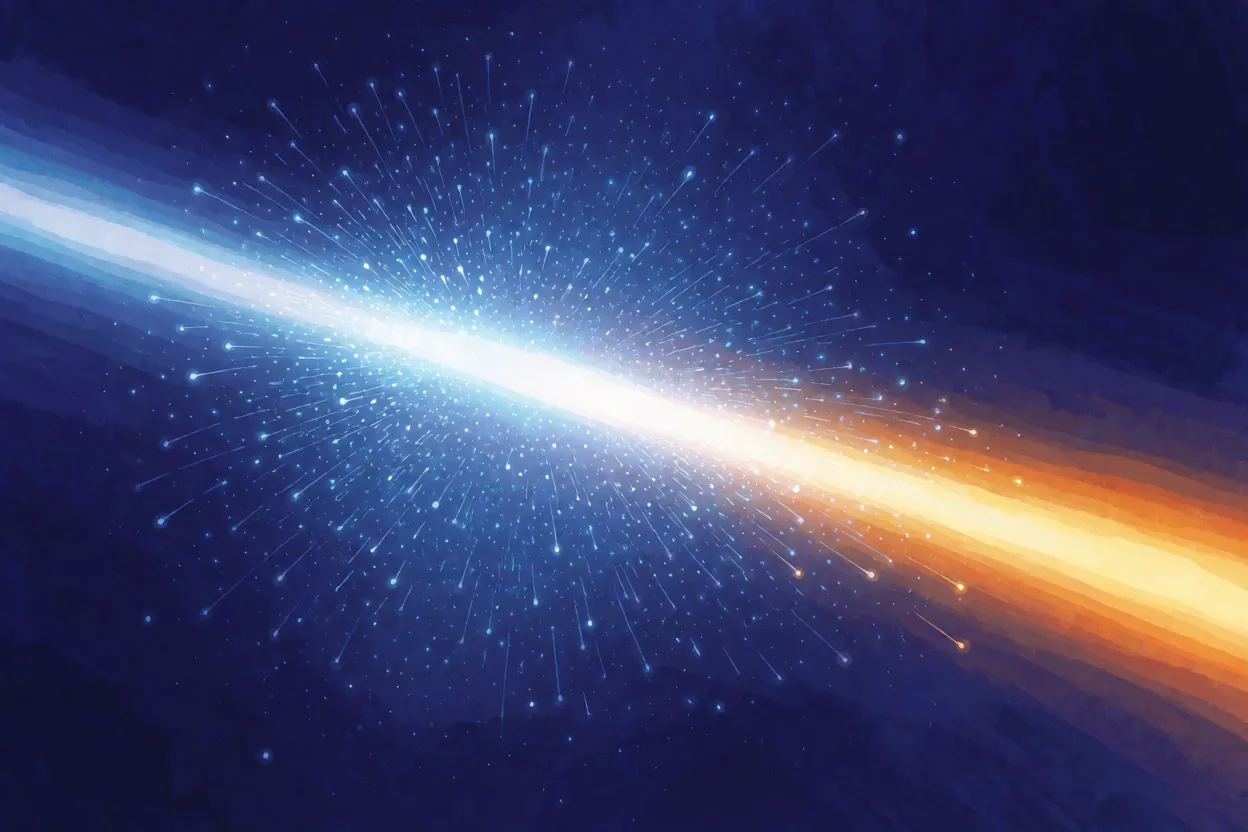
The same effect works over shorter distances. Look through a window at the furthest hills you can see, then at something nearby. The distant ones are paler and bluer: a few miles of atmosphere have laid a thin wash of blue over them. Blue, though, is not the shortest wave there is.
Blue, and not violet, for two separate reasons
Scattering alone predicts a violet sky. Two facts correct that, and either one alone gives the wrong answer.
The first concerns the sun. Sunlight is not an even helping of every color. It burns brightest through the greens and blues and tails away toward the violet end. There is less violet in the beam from the start.
The second concerns you. The back of your eye is lined with cones, the cells that sort incoming light into colors, and there are three kinds. One kind responds best to blue-ish light. Even that kind is barely sensitive to violet, and the other two have no useful sensitivity at all.
You examine a sky rich in blue and violet with detectors that are excellent at blue and nearly blind to violet. Blue wins twice: more of it arrives, and far more of it registers.
Climb higher and the sky darkens
Every scrap of that blue is manufactured along the way, in the atmosphere itself. So how much you see depends on how much air is stacked above your head. Climb a mountain and a generous slice of that air lies below you instead, and the sky overhead deepens.
That settles daytime, though not evening. Working out why took another hundred and eleven years, and the first person to try got it wrong.
Three men, three altitudes, one afternoon
The year was 1788, roughly eight grandparents back along your own family chain. A Swiss naturalist named Horace-Bénédict de Saussure decided the blue of the sky was something to measure rather than admire.
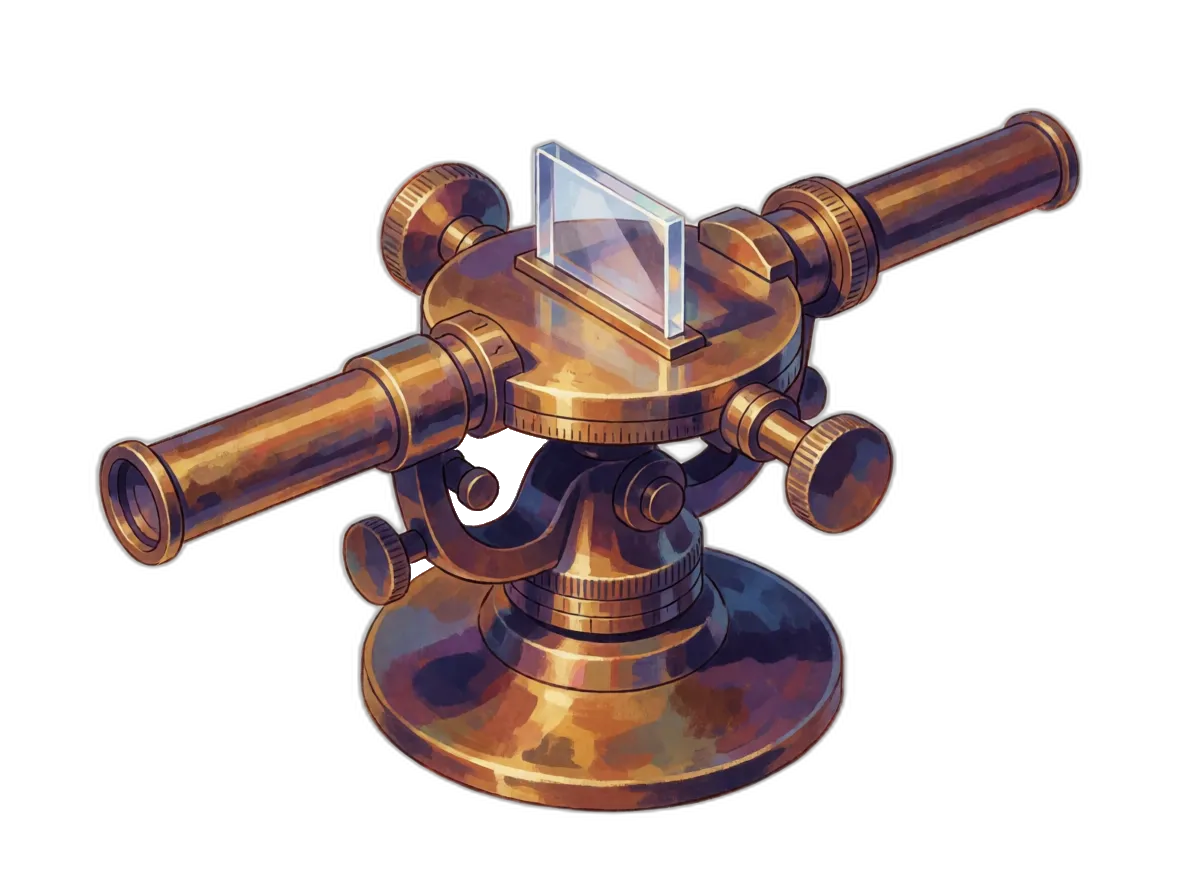
He built a cyanometer: a card ringed with paper strips dyed in even steps from nearly white to nearly black. You held it up, found the strip that matched the sky, and recorded its number. It was the first instrument ever built to measure a color.
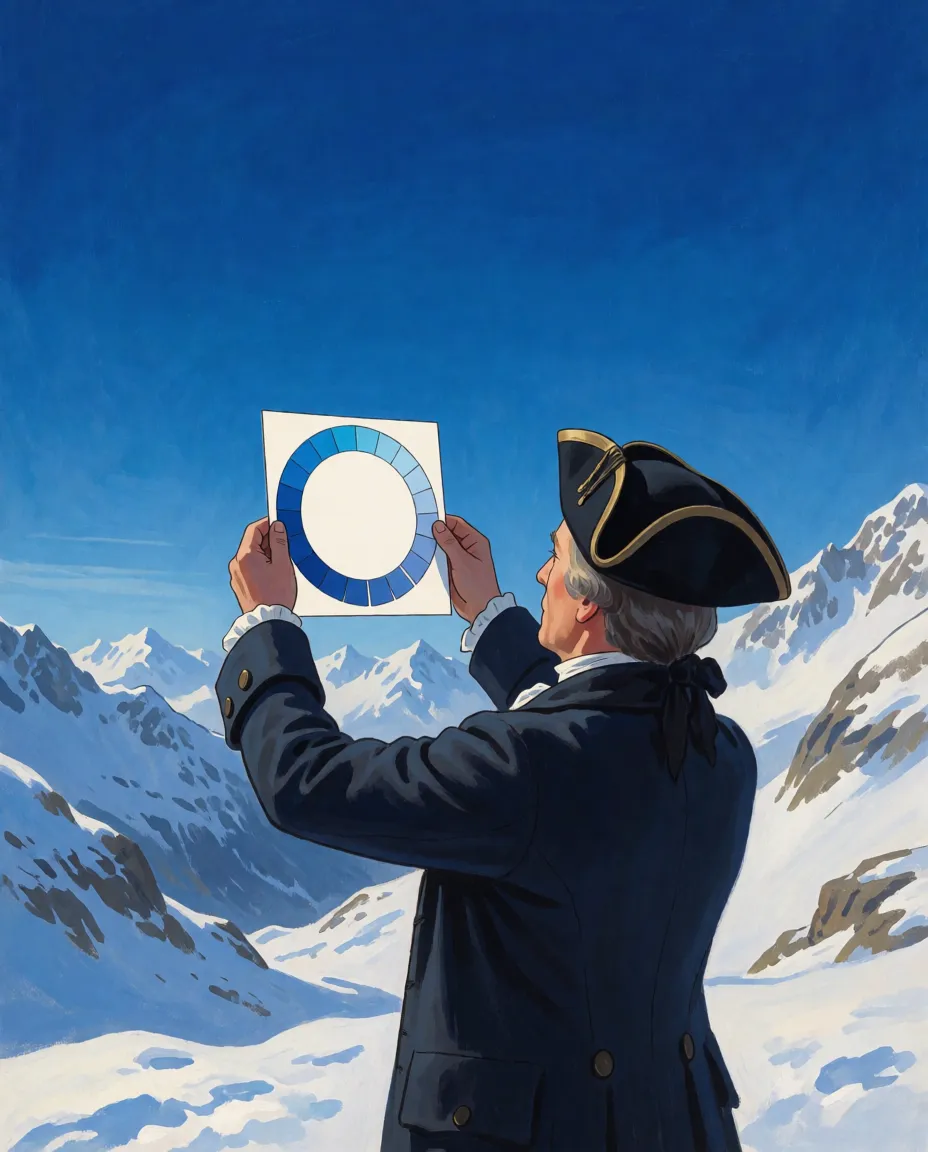
Then came the measurement that mattered. On one day in 1788, three observers took their measurements simultaneously. Saussure stood on the Col du Géant, an alpine pass 3,356 m(11,000 ft) up. His son read from the Chamonix valley. His friend Jean Senebier read from Geneva, merely 375 m(1,230 ft) above the sea.
The higher the observer, the deeper the blue. Saussure had the fact and the wrong explanation. He blamed the humidity, the water floating in the air, for spoiling a color he imagined was purer at altitude.
The blue that turned out to need no dust
Eighty years later that idea still stood, propped up by an excellent experiment. In 1869, in a basement laboratory in London, John Tyndall shone a white lamp along a glass tube and gradually filled it with a fine haze. Viewed from the side, the tube glowed blue. Viewed end-on, along the length of the beam, the identical lamp appeared red.
He had built a working sky in a tube, both halves at once. Tyndall drew the obvious conclusion: something suspended in the air, dust or fine droplets of water, must be doing the scattering.
In 1871 the English physicist Lord Rayleigh worked out the mathematics and discovered the rule that short waves are thrown far harder than long ones. He also assumed floating particles were responsible.
Changing his mind eventually took another twenty-eight years, for a dull reason. It was impossible to manufacture air with absolutely nothing suspended in it, so no experiments could clear the dust of blame. In 1899 Rayleigh attacked the problem using arithmetic. He calculated how much light the molecules of ordinary air must scatter unaided, and the answer matched the brightness of the genuine sky. Particles were never needed. The atmosphere was doing it alone.
A low sun has vastly farther to travel
That leaves the evening, and angles. The atmosphere is a skin rather than a deep pool. Almost all of it lies within 10 km(6 mi) of the ground, less than plenty of people walk before breakfast. Above you, the air simply runs out.
At noon the sun rides high, so its light descends almost vertically and crosses that skin by the shortest available route. In the evening the sun rests on the horizon and its light arrives almost horizontally. Sideways through a thin skin is an enormous distance. A setting sun reaches you through roughly thirty-eight times as much air as at midday.
That is thirty-eight times the opportunities to be thrown sideways. The short waves are picked off almost completely, ending up in somebody else’s patch of sky. What survives in a straight line to your eye is whatever was hardest to throw. Long waves. Orange and red.
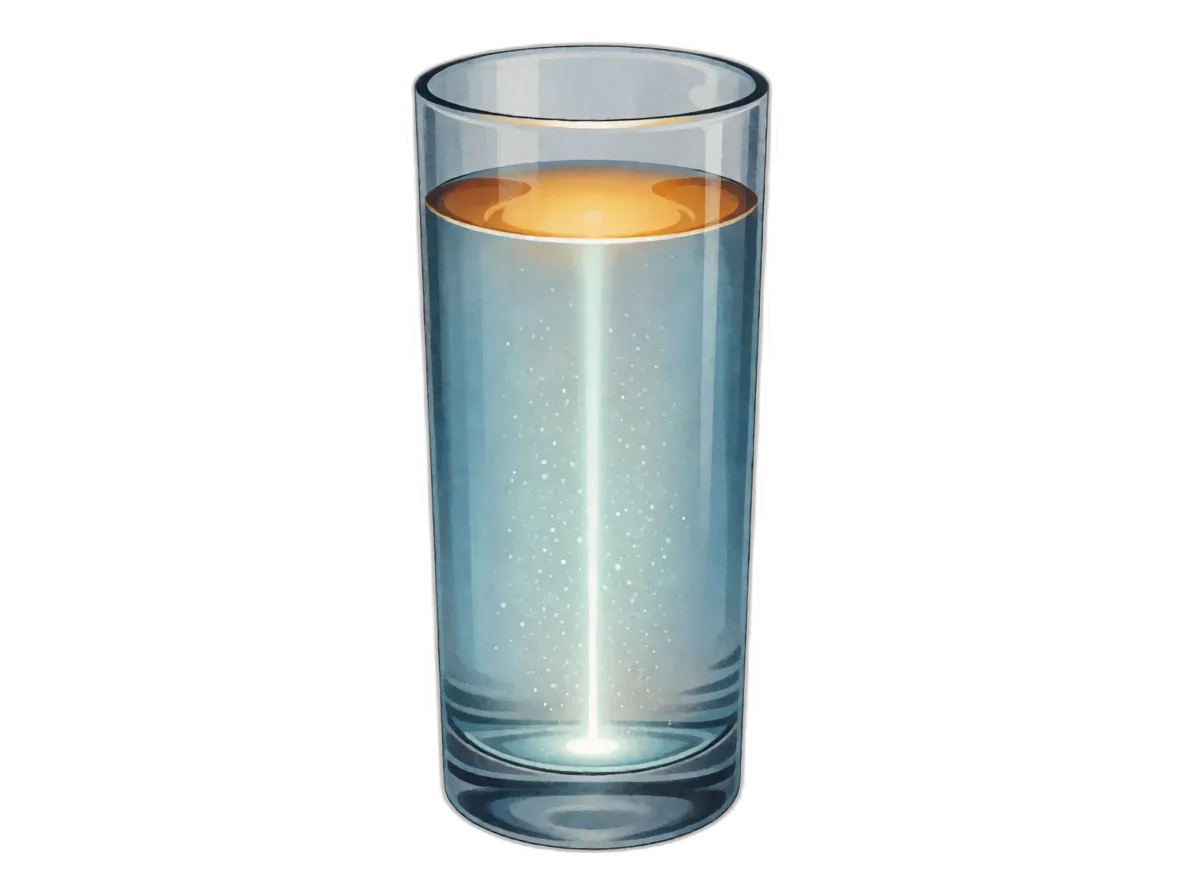
Build both colors in a glass of water
From the side the water turns a pale misty blue that deepens with the first few drops. Looking straight down the beam, the light travels the opposite way: white, then cream, then yellow, then a dull orange by around ten drops. Side view and top view are noon and sunset, in one glass, at one moment.
The color you lose is somebody else’s afternoon
So nothing changed between lunchtime and bedtime except the length of the journey.
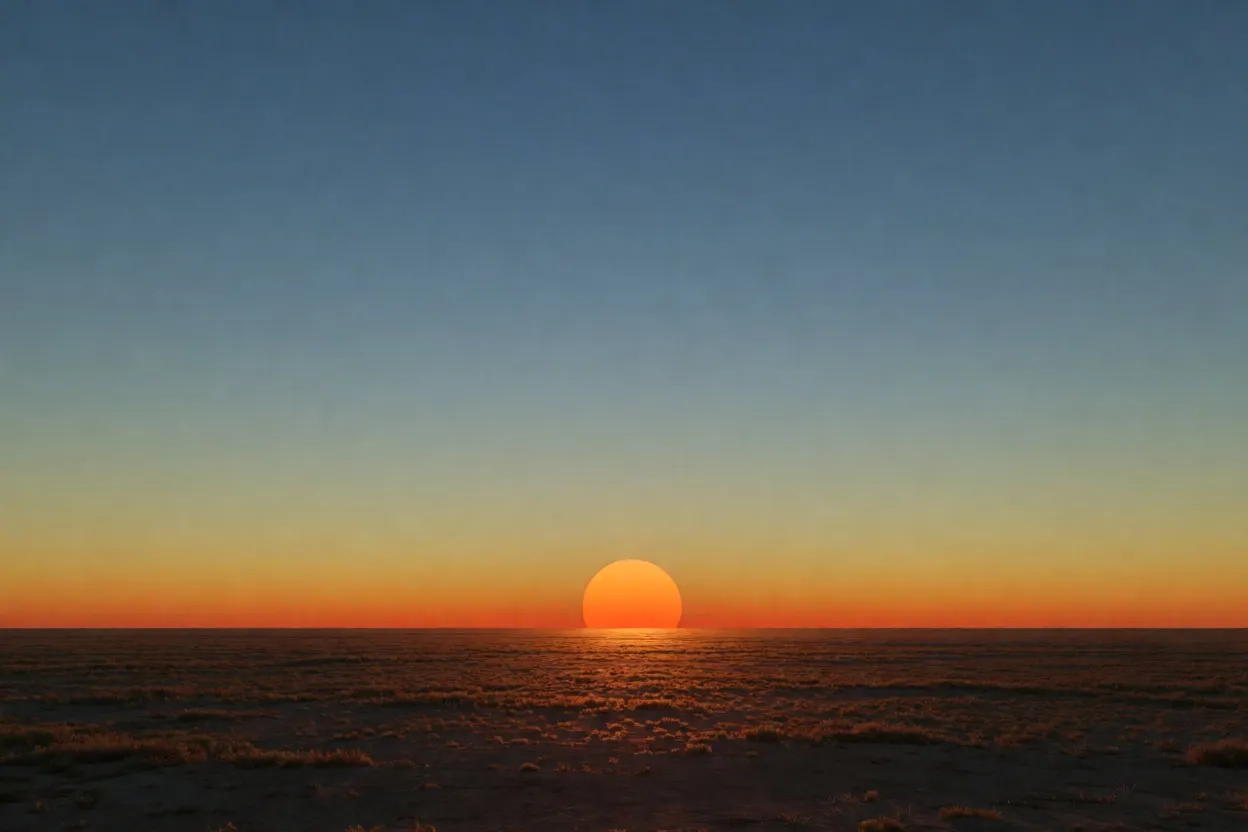
At midday you watch sunlight that crossed the thinnest slice of atmosphere there is, and the sky beside the sun glows with the blue that slice threw out. At sunset the identical beam runs the long way through the identical skin, and almost every short wave has been handed to a sky somewhere else. Somebody a thousand miles east of you is standing under a blue afternoon, lit partly by the violet you never received.
The red sun at the end of your day is not a different light. It is the leftovers of the blue one.