How do we know what the stars are made of?
Go outside tonight and pick a star. Nobody has ever been to it. Nobody has ever brought back so much as a spoonful to test, and nobody ever will. Yet ask an astronomer what that star is made of and you will not get a shrug. You will get a list, in order, with amounts. Where does the list come from?
From the light, and from nothing else. A star is far too distant to visit. But it sends light out in every direction, and a little of it lands in your eye. Read that light closely enough and it is carrying an ingredient list.
The rainbow has gaps in it
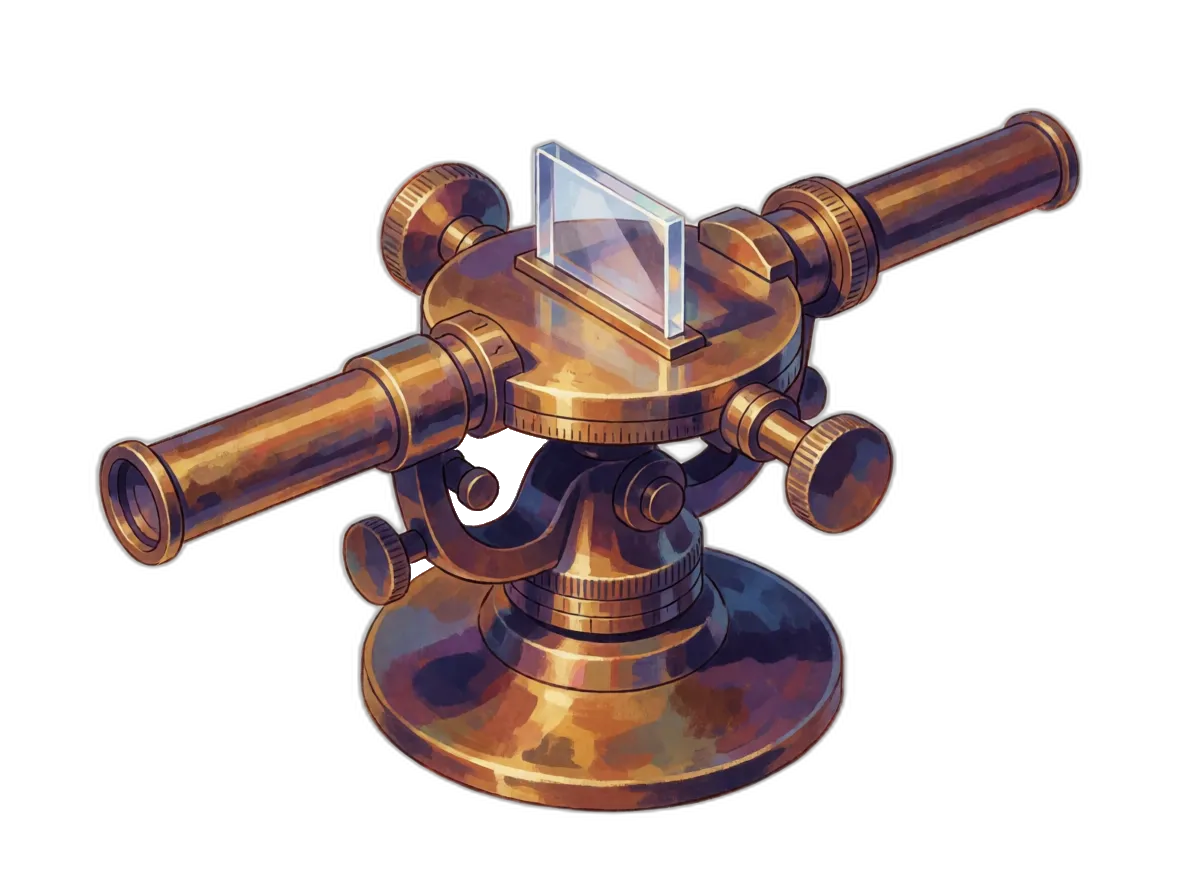
Sunlight looks white. It is really every color at once, packed so tightly that your eye gives up and calls the mixture white. Rain unpacks it: refraction inside each droplet bends every color by a slightly different amount, fanning them apart. A prism, which is a wedge of glass, does it indoors. Spread out in order, the whole set is a spectrum.
Check this now. Put a drop of water on a white patch of a phone screen and look down through it. The drop works as a lens, and the white separates into red, green and blue dots. There was never any white there.
Seven generations ago a Bavarian glassmaker named Joseph von Fraunhofer spread out sunlight more carefully than anybody before him. He was not stargazing. He manufactured lenses, and lamplight gave him a bright yellow stripe to measure his glass against. In 1814 he looked for that stripe in sunlight and found hundreds of dark ones instead.
Fraunhofer catalogued their positions, then turned his prism on other stars and found different patterns there too. He died at thirty-nine, never learning what a single line meant. The gaps were real and fixed, and nothing yet explained what was doing the cutting.
A ladder with nothing between the rungs
An atom is the smallest piece of a substance that is still that substance, and it is mostly empty space. A heavy core sits in the middle. Around it are electrons, specks so light that the core outweighs thousands of them.
An electron cannot sit at just any distance from that core. Picture a ladder. It stands on the bottom rung, or the next one up, or the one above that. It is never halfway between two rungs, because there is nothing halfway to stand on. Each allowed height is an energy level, and the rungs are spaced unevenly: wide gaps near the bottom, crowding closer higher up.
So lifting an electron up one rung costs a fixed amount of energy. Not roughly that amount. Precisely the size of the gap being crossed.
Only one color fits the gap
Light does not arrive as a smooth stream. It comes in separate packets, and one packet is a photon. Every photon carries a set amount of energy, and that amount is what your eye recognizes as its color. Blue photons carry more than red ones.
Now combine the two ideas. When a photon reaches an atom, one question decides everything: does this packet carry exactly what it costs to lift an electron up a rung? If so, the atom swallows it whole and the electron climbs. If it carries too much energy, or too little, it sails straight past unnoticed.
An element is a substance built from one kind of atom only: hydrogen, iron, helium. Every element keeps its rungs at different heights and so demands different packet sizes. Hydrogen swallows hydrogen’s colors, iron swallows iron’s, and no two lists are identical.
Pass white light through a cloud of one element and it emerges with a few exact colors missing.
A star writes its own list on the way out
That is what a star does to its own light. The light is manufactured deep inside, where the gas is crushed and blazing, and it begins with every color in it. To escape it must cross the star’s outer atmosphere, a far cooler layer of gas, and every element up there takes only its own colors from the beam. What reaches your eye is the remainder, with thin stripes cut out. Each missing stripe is an absorption line, and its position identifies the element responsible.
By 1859, in Heidelberg, Robert Bunsen and Gustav Kirchhoff had been vaporizing known substances, each glowing with its own arrangement of bright colored lines. That October Kirchhoff ran it backwards, sending a fierce white light through a flame loaded with sodium, the substance you eat in salt. The sodium subtracted yellow instead of adding it, and a dark stripe appeared where sunlight already carried one.
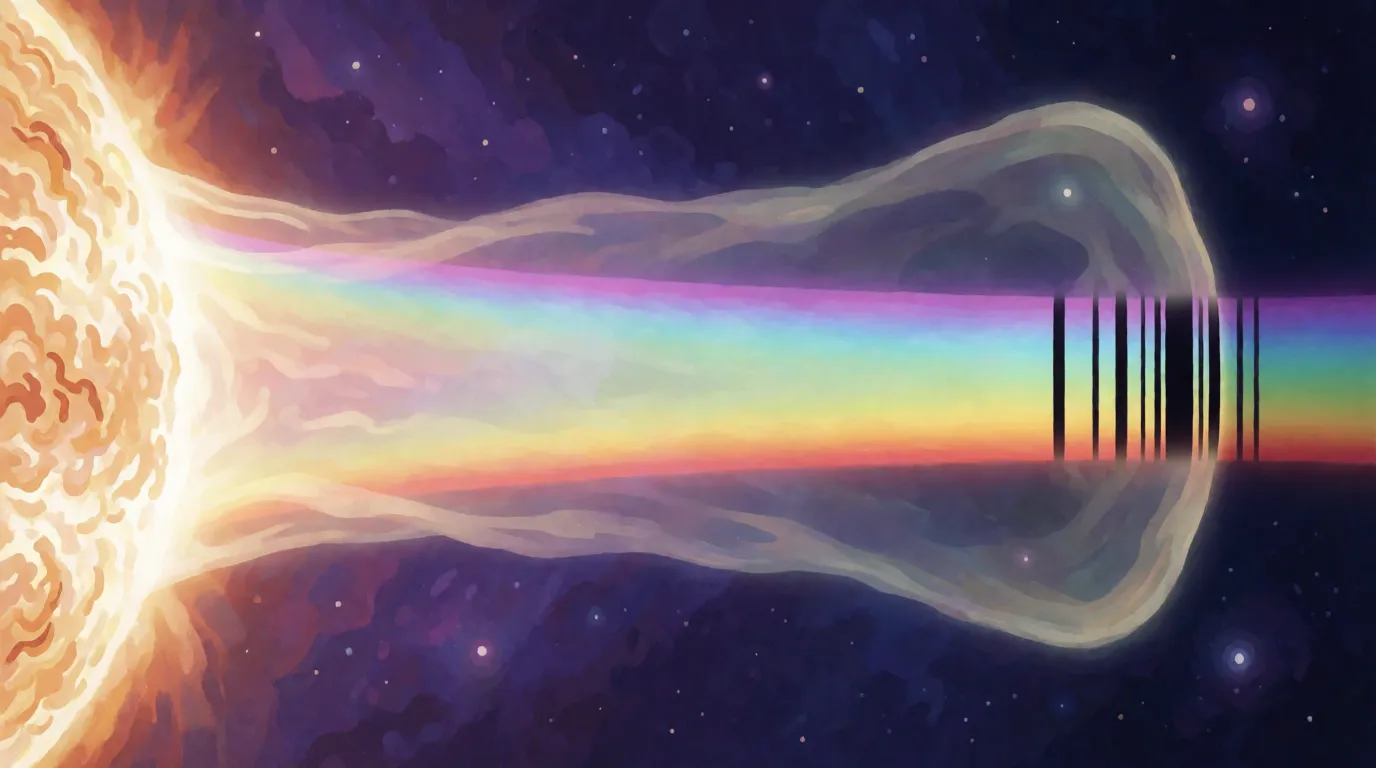
A gas removes precisely the colors it gives off, so the Sun contained sodium. Anybody with a prism could now catalogue a star’s ingredients. Nobody could yet say how much of each was there.
A dark line does not mean a lot of atoms
Here is the trap that held everybody up for sixty years. To swallow a color, an electron must already be standing on the right rung.
The hydrogen colors your eye can see are produced by electrons jumping up from the second rung. An electron parked on the bottom rung cannot make those jumps: the photons it needs are ultraviolet, and ultraviolet is invisible to us. In a star with a surface temperature near 3,000 °C(5,400 °F), almost every hydrogen electron sits on the bottom rung. Hydrogen can fill that star and still leave hardly a mark on its light.
Raise the temperature and electrons get knocked upward. A substantial share now stand on the second rung, ready, and hydrogen’s lines go thick and black.
So a line’s darkness carries two quantities at once: how plentiful the element is, and how many of its atoms are ready to absorb. Iron’s lines are heavy in a cool star for the second reason. Everybody had been reading them as the first.
A star can be built almost entirely out of one thing and barely mention it in its own light.
The sentence she was told to add
Separating those two quantities took a twenty-four-year-old. In 1925 Cecilia Payne was finishing a doctoral thesis at Radcliffe College, because Harvard, whose photographic plates she read all day, refused doctorates to women. She calculated how much of each element a star needs for its lines to look as dark as they do at that temperature.
Iron, calcium, magnesium, silicon and titanium all came out at roughly the same level in her table. Hydrogen came out about a million times higher.
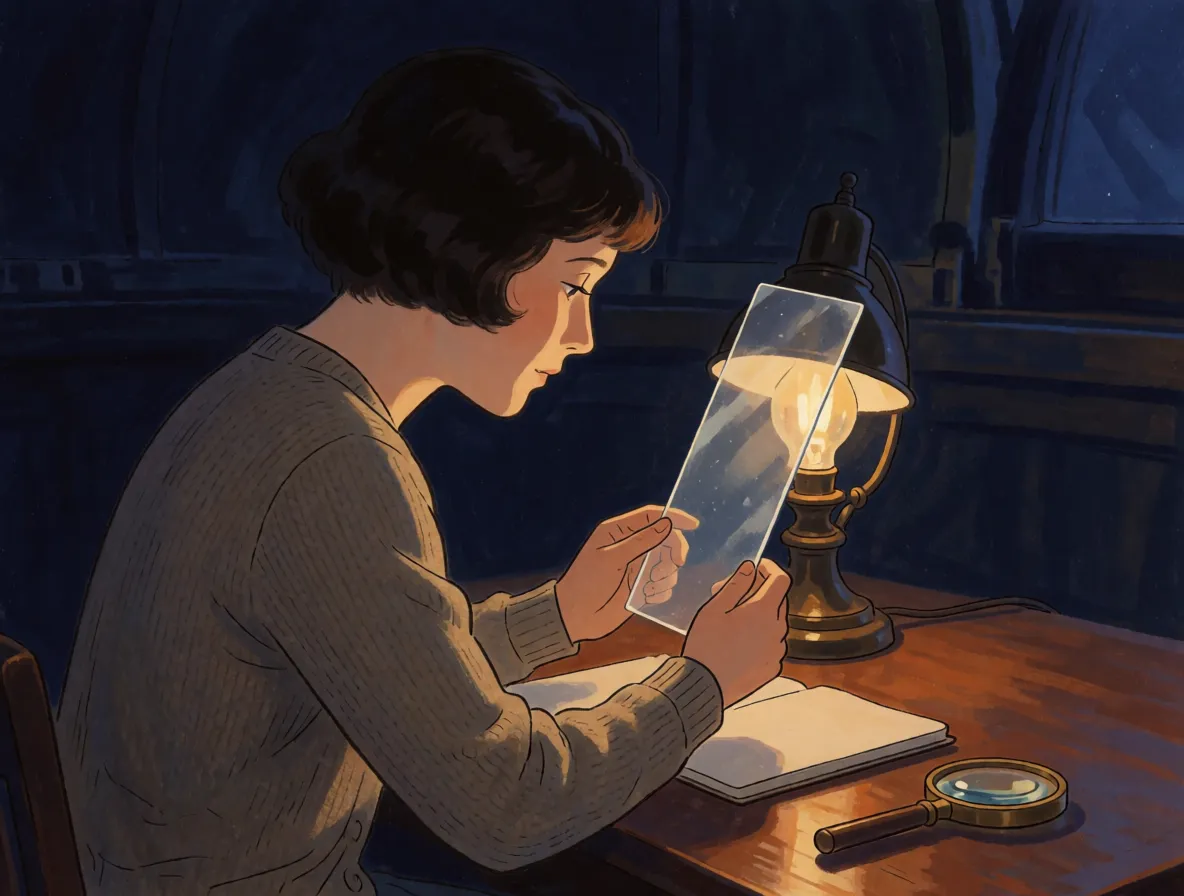
Every senior astronomer expected stars to resemble the ground beneath your feet. Henry Norris Russell, the most respected of them, read her draft in 1925 and told her the hydrogen figure was clearly impossible.
She published it anyway, with a sentence added beside her own numbers: “The enormous abundance derived for these elements in the stellar atmosphere is almost certainly not real.”
Four years later Russell attacked the problem with different instruments and obtained her answer. He wrote in print that hers was the most important measurement of its kind before his own. The result travelled under his name regardless. Her numbers were right.
What a star turns out to be made of
Take ten thousand atoms of the Sun’s outer atmosphere and sort them.
Ten thousand atoms of the Sun, sorted. The last pile is every other element there is, added together.
That is a surface at 5,500 °C(9,900 °F), and roughly the same proportions hold for almost every star. What makes one star’s spectrum look different from another’s is mostly temperature.
All of it was read off gaps in a rainbow by people who never left the ground. The opening step is something you can manage at a kitchen table, with a disc you were about to throw away.
Split a light yourself

The glowing wire hands you a continuous ribbon: every color, no gaps. The phone hands you three separate stripes, red, green and blue, with darkness between. Your phone has never manufactured white light; it produces three colors and lets your eye finish the job. You have told two lights apart without touching either, which astronomers call spectroscopy.
The element found in the Sun first
It once found something nobody on Earth had ever collected. In 1868 astronomers watching the Sun’s rim during an eclipse found a bright yellow line where no known substance belonged. Norman Lockyer and the chemist Edward Frankland made the only argument that fitted: it belonged to an element nobody had handled. They named it helium, from the Greek word for the Sun. Twenty-seven years passed before anybody gathered any down here.
So no, nobody has been to a star, and nobody needs to go. Every star sends a sample of itself out in all directions, continuously. It arrives as light with pieces cut out, and the shape of what is missing identifies what did the cutting. The list was hanging in the sky the whole time. It wanted only somebody willing to examine a rainbow closely enough to notice the missing parts.