Why is a rainbow always in the same place?
Watch where a rainbow appears and it is never anywhere surprising. The sun is always behind you, the bow is always in front, and it is always the same size. Walk toward it and it retreats. Stand beside a friend and point at the same spot, and you are not looking at the same rainbow at all — you are each looking at your own, built from different raindrops.
A raindrop cannot send light back at just any angle. There is a limit, and the whole rainbow sits at that limit.
One drop, in and out
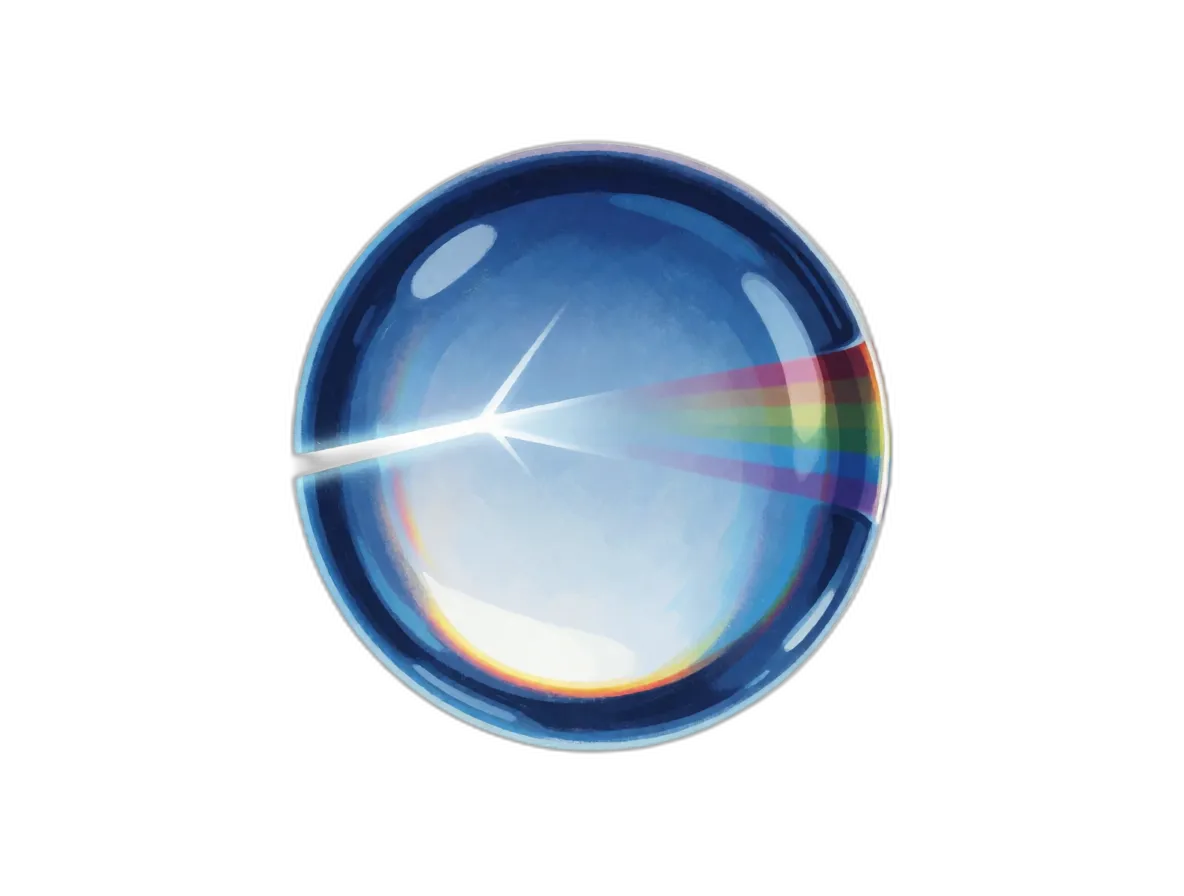
A raindrop falling through the air is not tear-shaped. Small ones are almost perfect spheres, roughly 1 mm(0.04 in) across, held round by the pull of their own surface.
Sunlight arriving at a drop does three things in quick succession. It bends as it enters the water, because light travels more slowly through water than through air and changes direction at the boundary. That bending is called refraction.
Then it crosses the drop, strikes the curved back wall, and a portion bounces off. That is reflection, the same behavior a mirror relies on, happening here on the inside of a water surface.
Finally it crosses back and bends again on its way out into the air. In and out, with one bounce in the middle, and the ray leaves heading back roughly the way it came.
The angle has a limit, and light piles up there
Here is the part that determines everything. A ray striking the drop dead centre returns straight back along its original direction. A ray arriving near the edge is barely deflected. Every ray in between is turned by some intermediate amount.
Calculate them one after another and something surprising emerges. As the entry point travels outward from the centre, the total turn increases, reaches a maximum, and afterward decreases again.
The largest turn a ray can make, and the same angle measured from the direction straight back toward the sun, in degrees.
No ray comes out further round than that. Rays entering near the special spot all emerge at almost exactly that angle, so light bunches up there and thins out everywhere else. Physicists call it the angle of minimum deviation; you can call it the piling-up angle.
So a drop is not a lamp illuminating everything around it. It concentrates almost all of its returned light into a narrow cone, and that cone is identical for every drop in the sky.
The bow is centred on your own shadow
Now put yourself in the picture. Light comes from the sun, past your head, and carries on to a point directly opposite the sun from where you stand. That point is where the shadow of your head lands, and it has a name: the antisolar point.
Any drop positioned 42 degrees away from that direction is aimed correctly to deliver its piled-up light directly to your eyes. Anything closer in, or further out, is not.
Sweep 42 degrees around in every direction and you have traced a circle. That is the entire shape of the rainbow, and it is centred exactly on the shadow of your head.
A rainbow is not in the sky. It is a direction, measured from a spot that moves whenever you do.
You normally observe an arc rather than a circle because the ground interrupts it. Fly above a rain shower, or look down at spray from a bridge, and the missing half appears. Rainbows are complete circles.
The colors arrive at slightly different angles, because each color refracts by its own amount. That spreading has a name: dispersion. Red light bends least and piles up at about 42 degrees; violet bends most and piles up at about 40. Those two degrees are the entire width of the band.
The pot of gold has a problem
That also settles the argument about whether two people see an identical rainbow. Each of you occupies your own antisolar point, so each of you collects light from a completely different population of drops. Photograph it and the camera receives a third rainbow, aimed at the lens.
Two centuries with a glass ball
The rainbow resisted explanation longer than you might expect, because understanding it requires one drop rather than an entire sky. In the fourteenth century, around 1304, roughly twenty-five generations before you were born, Theodoric of Freiberg had the idea that cracked it.
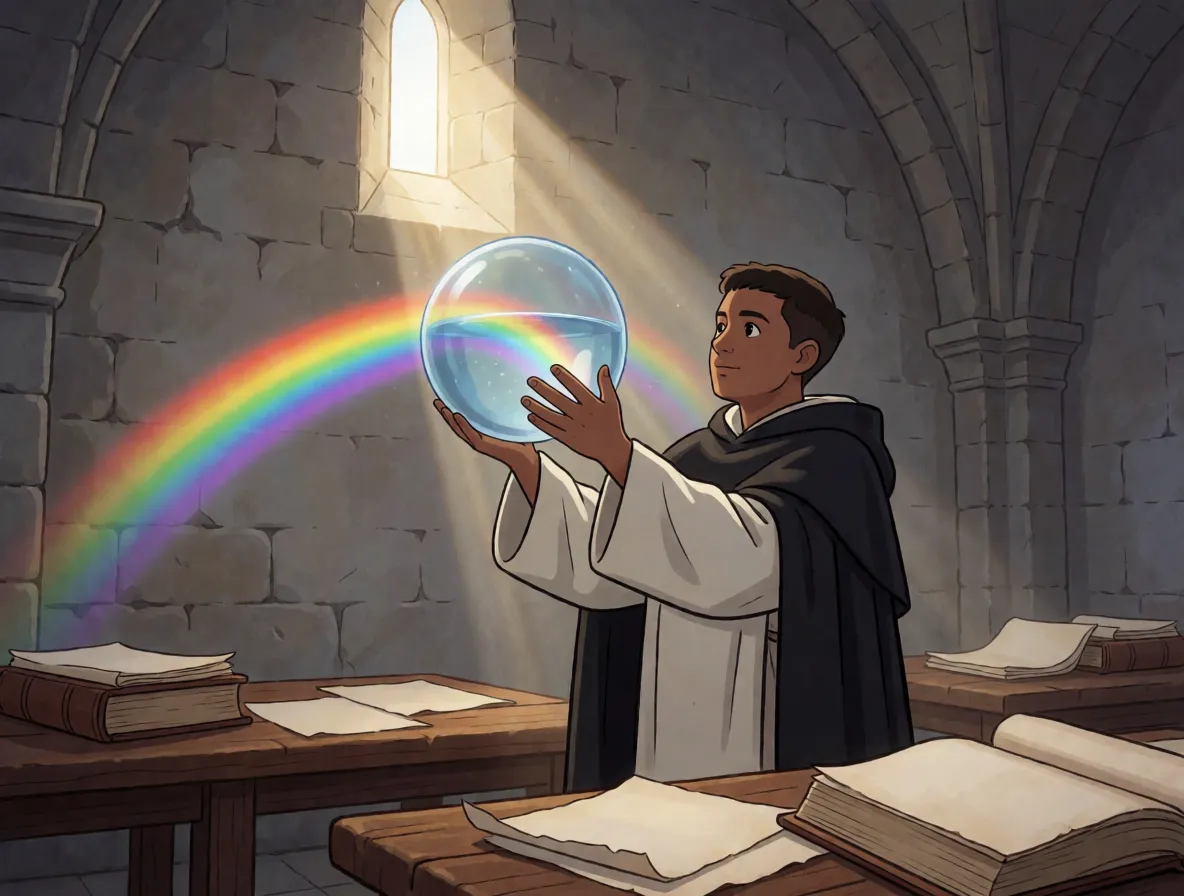
He filled a glass sphere with water and treated it as one enormous raindrop. By moving it about in a sunbeam and noting where the colors appeared, he traced the path: in, reflect off the back, out. He even worked out the higher, fainter second bow, which involves two bounces instead of one.
His work was largely forgotten, and the calculation waited three hundred years. In 1637 René Descartes did the geometry properly, ray by ray, and found the piling-up angle by arithmetic rather than by moving a ball around.
What neither of them could explain was the color. That arrived in 1666, when Isaac Newton showed that white light is a mixture, and that each color bends by its own amount. Bending is what makes a rainbow, so a mixture of colors that bend differently must come out spread into a band.
Make one on the lawn and measure it
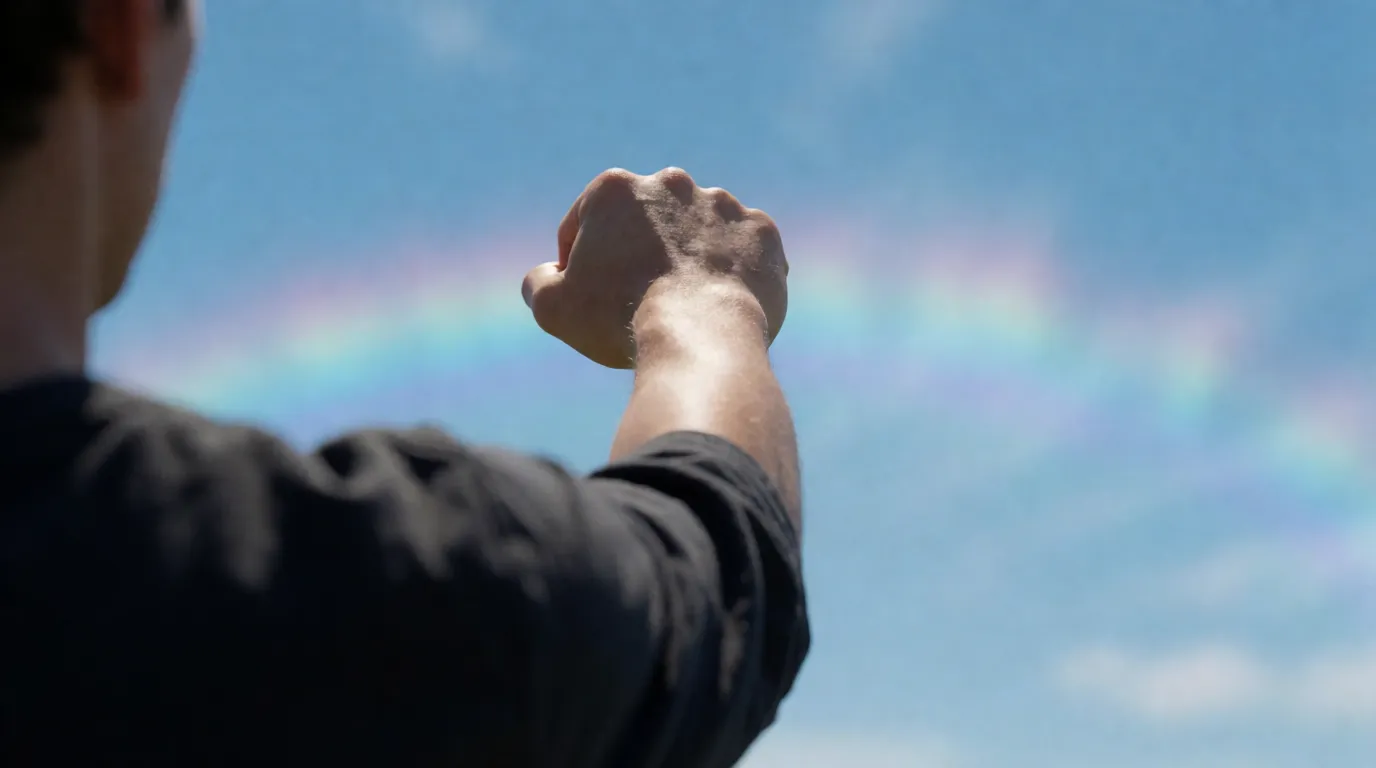
What the measurement tells you
Four fists reaches roughly forty degrees, which is convincing enough. Repeat it on a different day and you get an identical count, because the angle never varies.
The sideways step is the part that genuinely surprises people. Your bow travels with you and your friend’s does not move whatsoever, which is difficult to argue with once you have watched it happen.
Why they are a morning and evening thing
One last prediction falls out of the geometry, and it explains something you have probably noticed without asking about it.
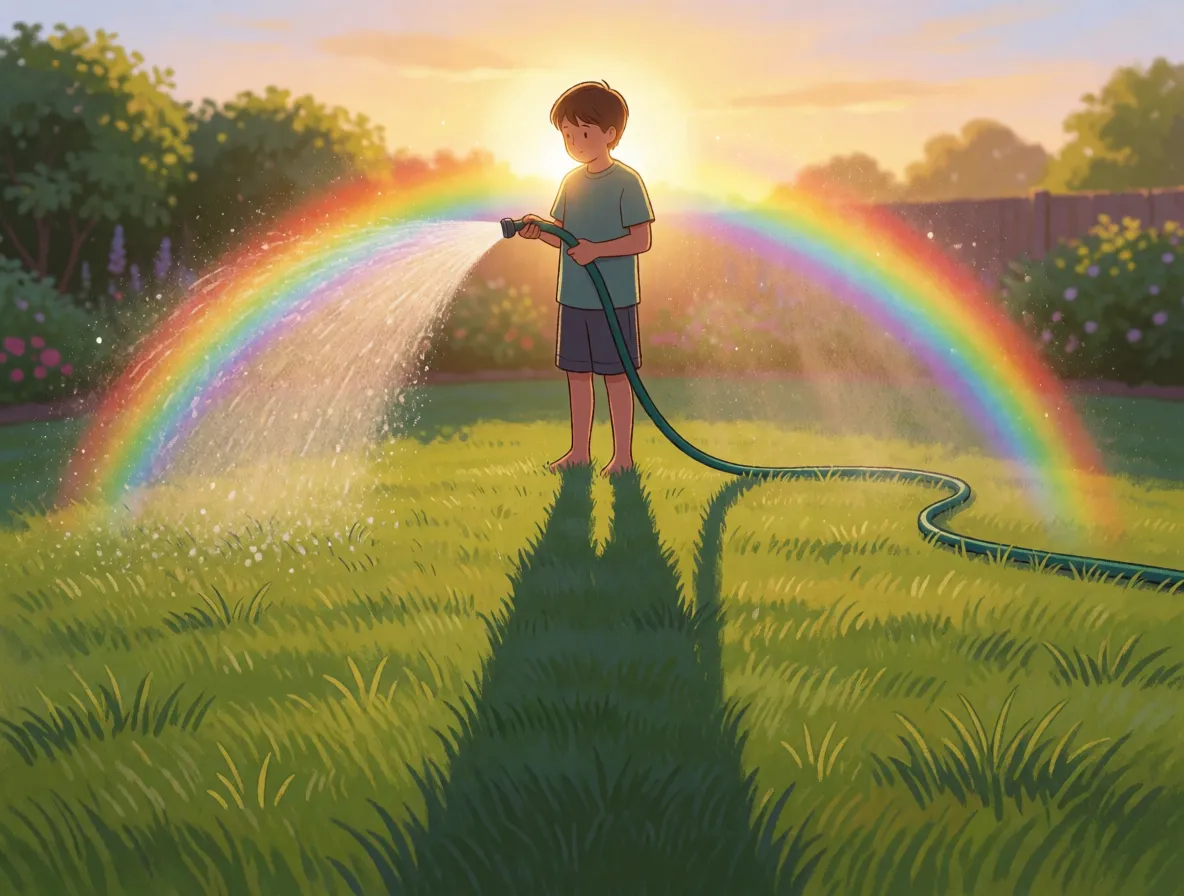
If the sun stands high in the sky, your antisolar point sits well below the horizon, and a circle 42 degrees around it lies underground. There is nothing available to see. Rainbows are impossible near midday in summer for precisely that reason.
Drop the sun to just above the horizon and the antisolar point rises to just below it, so most of the circle stands up in the sky and you get a tall, dramatic bow. That is why the best rainbows come with low sun, and why a rainbow at noon means you are somewhere the sun does not climb very high.