Why does the Moon look bigger near the horizon?
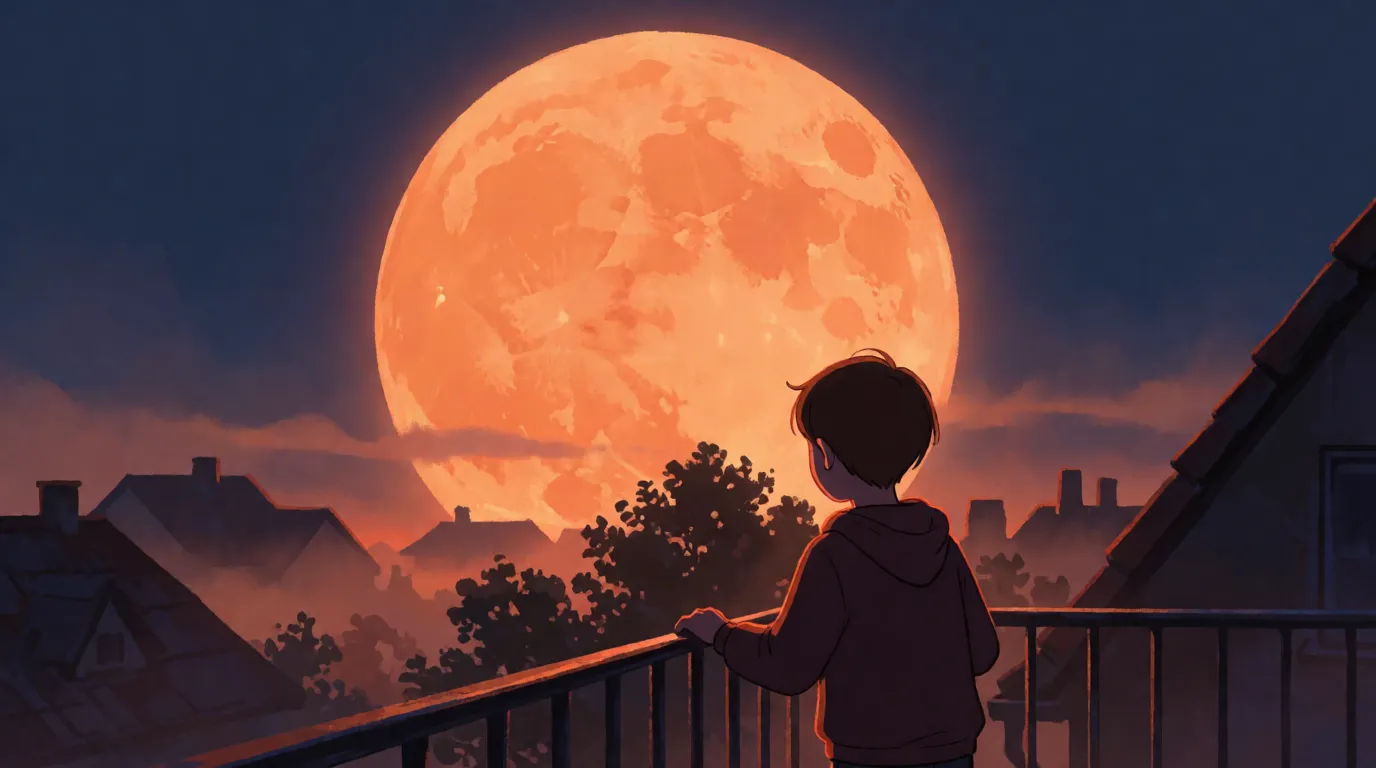
A full Moon coming up behind the rooftops looks absurd. It is orange, it is vast, and everybody in the street stops to look at it. Three hours later the same Moon is riding high overhead and it has shrunk to something ordinary. Photograph it twice with the same camera and the two discs measure exactly the same. So what grew, and where?
Nothing about the Moon changed, and nothing about the air changed either. The growing happens somewhere between your eyeball and your opinion.
Your eye receives an angle, never a size
Your eye cannot measure how big anything is. It only records how much of your view something takes up, which is an angular size: a slice of the scene in front of you, measured as an angle.
Angles get counted in degrees, with ninety of them stacked between straight ahead and straight up. The Moon takes up about half a degree, and half a degree is smaller than almost anybody guesses.
Stretch your arm out and look at your little fingernail. It comfortably covers the Moon, at every hour of every night, in every position in the sky. Held at arm’s length, the Moon is roughly 6 mm(¼ in) wide.
That half a degree barely varies. The Moon is around 384,000 km(239,000 mi) away, and rising or setting does not bring it any closer. If anything the horizon Moon is slightly further off, because when it sits low you are standing on the side of the Earth rather than the top.
The extra distance is one Earth radius, in kilometers, so the horizon Moon is a fraction smaller.
So the disc arriving at your eye is not merely similar in both positions. It is very slightly smaller down at the horizon, which is the exact opposite of what you saw.
Your brain converts angles into sizes, using distance
Nobody experiences the world in angles, and that is a deliberate piece of work. Your visual system takes the angle and combines it with its own estimate of how far away the object is, then reports a size.
Test it on a friend. Ask them to walk twenty paces away from you and watch carefully. The angle they occupy halves, and halves again, but you do not see a person shrinking — you see the same person, further off.
That correction is called size constancy, and it runs constantly, without permission and without your noticing. It is the reason a room full of furniture makes sense at all.
Notice the machinery it depends on, though. To convert an angle into a size, your brain needs a distance, and the Moon is at a distance nothing in your life has prepared you to judge.
The sky is not judged to be a dome
Ask somebody to point straight up, at the zenith — the point in the sky directly overhead — and then at the horizon, and ask which is further away. Almost everybody says the horizon. The sky reads as a flattened lid rather than a proper dome.
The reason is what lies in between. Look toward the horizon and your gaze crosses a garden, then a street, then rooftops, then hills, each one telling you how far you have traveled. The distance is built out of that chain.
Look straight up and there is nothing in between at all. No chain, no evidence, and the visual system settles on something disappointingly close.
Now put a Moon in each position. Both deliver half a degree. The one at the horizon is filed as distant, and a distant object filling half a degree has to be gigantic. The zenith Moon is filed as nearby, and the identical half a degree becomes something modest.
Your brain is not making a mistake about the Moon. It is making a mistake about the sky, and the Moon is merely written into it.
The air is not a magnifying glass
The color is atmospheric, though, and that part is honest. Low down you are looking through a long slab of air that scatters blue light out of the beam, leaving the orange behind — the same reason sunsets are red. A big Moon is an illusion. An orange Moon is not.
A thousand years of arguing about it
This is one of the oldest recorded arguments in science, and the first famous answer was wrong. In the second century, Ptolemy was working in Alexandria, and he blamed moist air near the horizon for enlarging the Moon.
He changed his mind later, in a book on optics, and suggested that judged distance was responsible after all. Hardly anybody noticed. The vapor explanation was simpler and it survived for centuries.
Then, in the eleventh century, a scholar in Cairo got it essentially right. Around 1030 Ibn al-Haytham argued that the Moon looks larger because the ground running away toward the horizon makes the sky there seem more remote, while the empty sky overhead seems nearer. His account is remarkably close to what researchers propose today.

Testing it took another nine centuries. In 1962 Lloyd Kaufman and a colleague built artificial moons and moved them about with mirrors, so they could show people the same disc with the landscape visible or hidden. Hide the terrain and the illusion shrinks dramatically.
The argument is still not finished, which is the honest part. The illusion turns up for pilots in a completely black sky, where there is no terrain to see, so distance cues cannot be the whole story. Something about where your eyes are aimed matters too, and nobody has closed the case.
Take the landscape away and watch it collapse
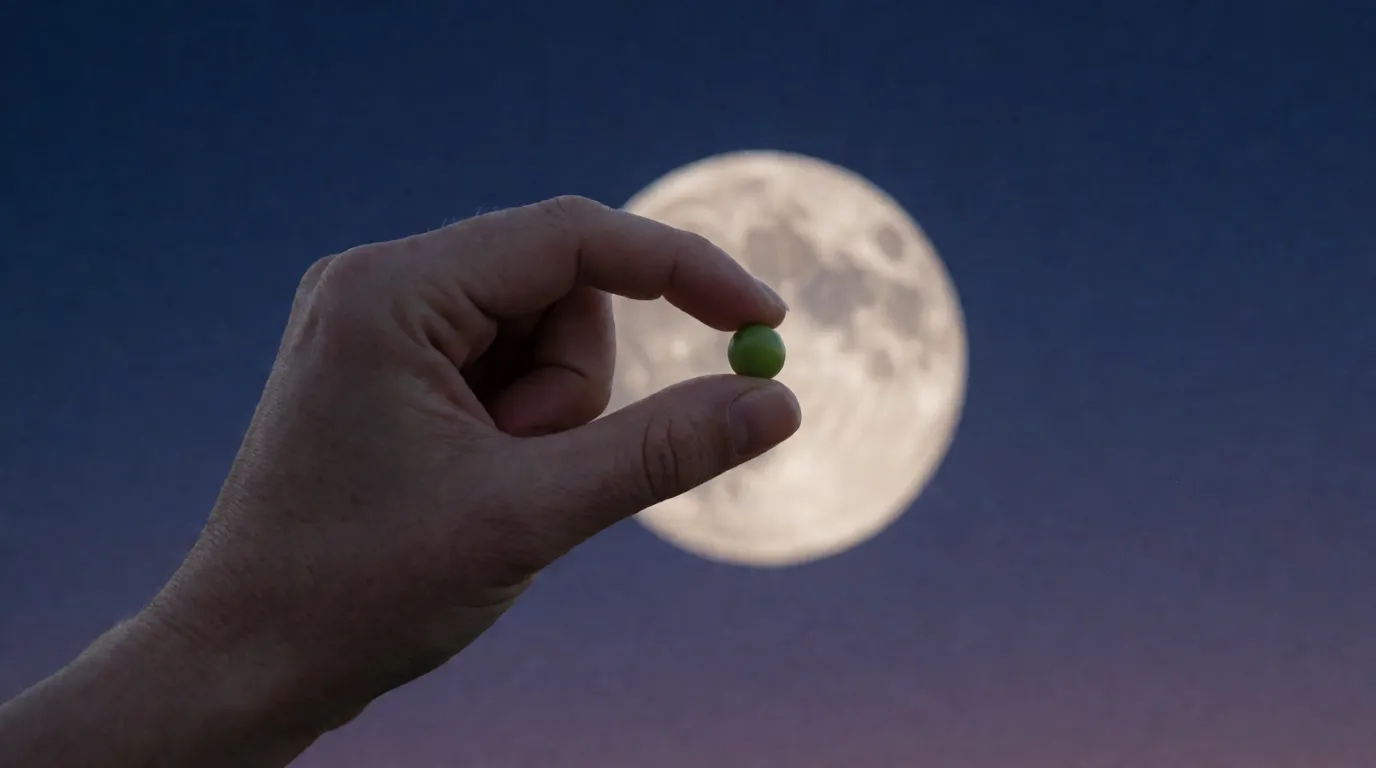
The pea covers the Moon both times. On the photographs the two discs come out the same width to within a pixel or two, and everybody who watches you do it insists you have cheated somehow.
The upside-down trick is the strangest part, and it works on almost everybody. Tipping your head wrecks the way your visual system reads the landscape, so the distance estimate that inflated the Moon simply does not get made.
The illusion you cannot switch off
Here is the genuinely odd thing. You now know precisely what is happening, you have measured it with a vegetable, and the next enormous Moon will look exactly as enormous as it ever did.
Understanding never dismantles it, because the machinery doing the work sits far below the part of you that reads articles. Your visual system is not offering an opinion for you to reconsider. It is handing you a finished picture.
So the Moon over the rooftops is real, in the only sense that matters: it is what you genuinely see. It is simply not what is up there. Somewhere in the last few steps between your eye and you, half a degree of sky got a distance attached to it, and the distance was a guess.