Why is the back of the fridge warm?
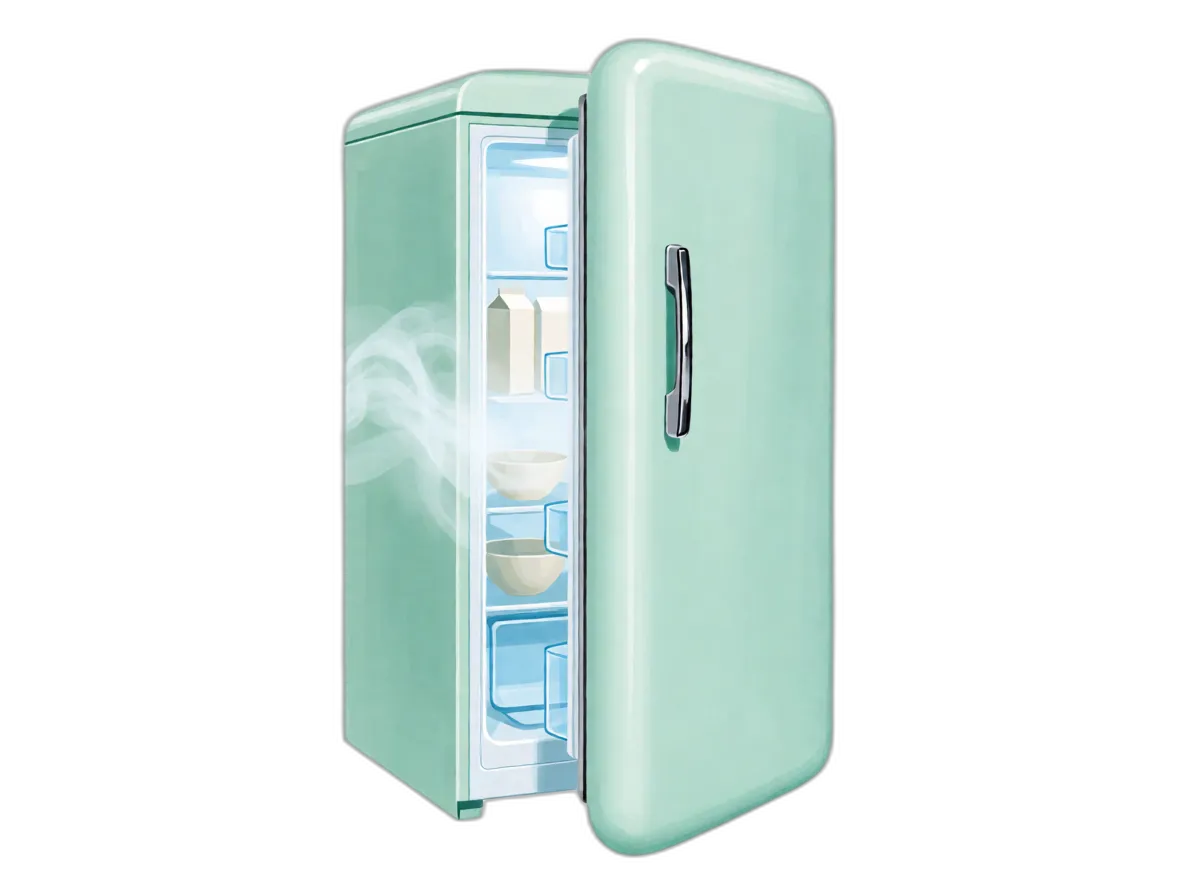
Slide your hand around the back of your refrigerator, or low down its sides. The metal there is warm — not hot, but warm like a mug of tea after ten minutes. That is odd, because this machine has one job in the house, and the job is cold. So what is the warmth doing on the outside of the coldest thing in your kitchen?
Nothing inside a refrigerator manufactures cold. There is no cold in there, no supply of it, no part that produces any. What the machine actually does is remove heat from your milk and leave it in the room, and the warm metal at the back is where it lets go.
Cold is not a thing you can make
Heat is real. It is the energy of a tiny vibration inside everything, and the faster the vibration the hotter something is.
Cold is only our word for having less of it. There is no tank of cold to pour into a box.
So a refrigerator has one option: remove heat from the milk and leave it somewhere else. That somewhere is your kitchen.
But notice which way heat travels. It runs downhill on its own, into colder things, never the opposite. A mug of tea cools into a room; a room never cools into the mug.
Your milk is already colder than the kitchen, and the machine must keep removing heat from it anyway. That is uphill.
So a fridge is not making cold; it is carrying heat uphill, out of a cold box and into a warm room. Carrying it uphill needs a liquid with one strange habit.
A liquid that boils inside your fridge
The habit is boiling.
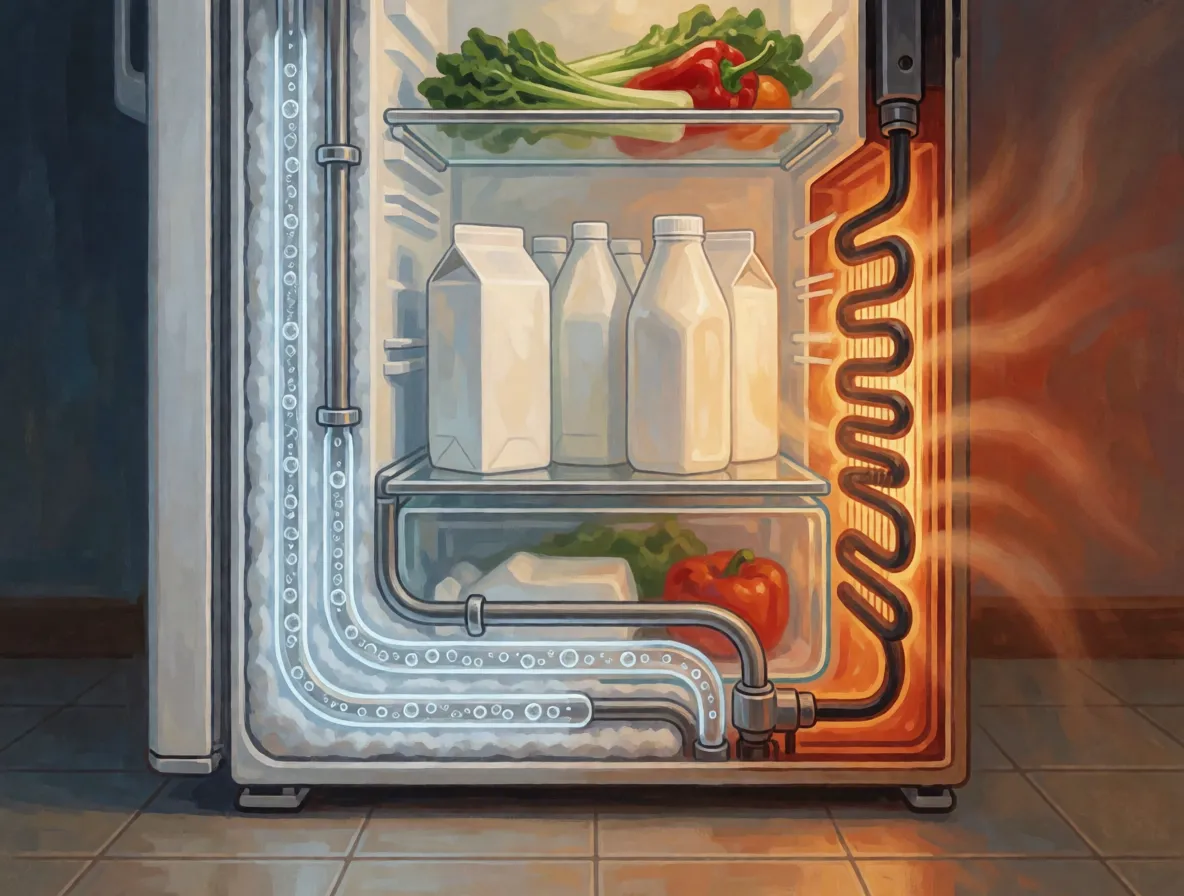
Sealed inside the pipes is a liquid called a refrigerant, chosen because it boils at a ridiculously low temperature. In a machine built recently it is usually isobutane, a relative of the fuel in a see-through lighter.
Water boils at 100 °C. Isobutane boils at −11.7 °C(10.9 °F), twelve degrees below the temperature at which water freezes.
A pipe of it runs through the insulated wall of the cold compartment, where it boils quietly all day.
Boiling is the entire trick, because boiling absorbs heat. Wet the back of your hand and blow across the patch. It turns colder than the air you blew at it. Water evaporating off your skin carried the heat away.
So a liquid is boiling inside your fridge at a temperature that would freeze water. The heat it needs comes from the nearest warm object: your food. Why boiling is so greedy is the next question.
Where the heat goes when a liquid boils
Boiling is greedy because of what a liquid is.
Everything is built from molecules: tiny groups of atoms, invisible under any school microscope. In a liquid they touch and pull on one another. That attraction is why a puddle stays a puddle.
To boil, a molecule must escape that pull completely and fly away as gas. Escaping costs energy, and the only energy available is heat from nearby.
Watch a pan on the stove. Once the water boils, its temperature stops climbing: it sits at 100 °C until the pan runs dry.
The heat is still pouring in. It goes into tearing molecules loose rather than making them vibrate faster, so a thermometer never registers it. Heat that disappears like that is called latent heat, from a Latin word meaning hidden.
The quantity is startling: heating one gram of water from ice-cold to boiling takes 418 joules; evaporating that same gram takes 2,257 joules more.
Boiling swallows over five times the heat that warming it did.
So a boiling liquid absorbs heat without becoming warmer. In your fridge that heat comes out of the milk and departs as gas. But the gas is still colder than your kitchen, so its heat has nowhere to go.
Squeeze a gas and it gets hot
The gas has to be lifted first.
Underneath the cabinet sits a compressor: a small electrical pump that squashes gas into a smaller space.
Squashing a gas heats it, and you have felt this. Pump up a bike tire hard and fast, then touch the cylinder. It is warm.
The compressor squeezes far harder. The gas emerges hotter than a hot bath, and finally hotter than the kitchen surrounding it.
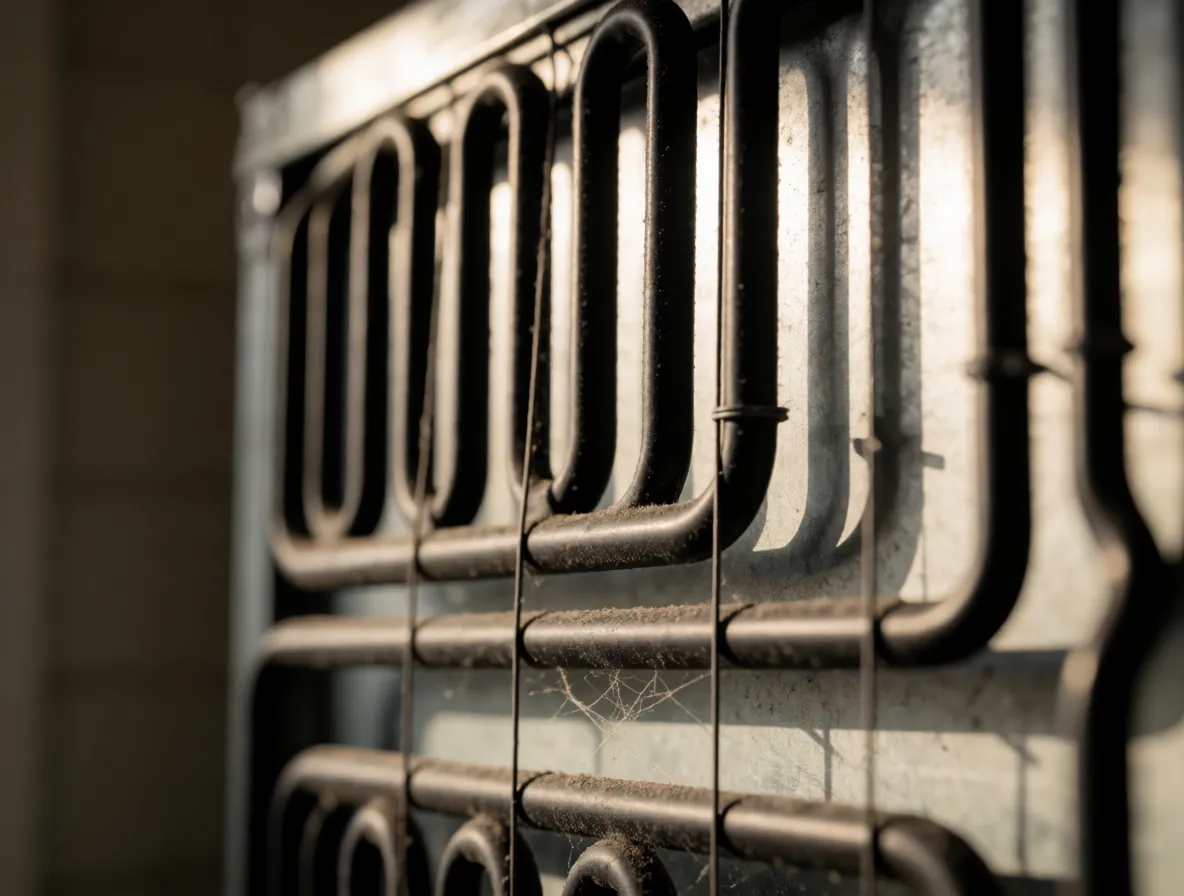
From there it travels into a long coil of black pipe on the back, and downhill now means outward: warmth pours out of that pipe into the room.
The coil is the condenser, and it is the warm metal your hand found. Giving up heat, the gas condenses back into liquid, which is what its name promises.
So the compressor’s real job is lifting the gas above the temperature of the kitchen, so its heat can escape downhill. Your milk’s heat is now in the kitchen air. What leaves the coil is warm, hard-squeezed liquid, useless for chilling.
Letting the squeeze off
That liquid must become cold again.
The part that manages it is the least impressive object in the machine: a thin copper tube. The hole down its middle is under a millimeter across, the width of the lead in a mechanical pencil.
Pressure means how hard something is being squeezed. On the near side of the tube the liquid sits at high pressure, put there by the compressor. On the far side the compressor has been sucking gas away, so the pressure is low.
Pressure also decides when a liquid boils. Squeeze it harder and it demands more heat before boiling. Release the squeeze and it boils sooner, at a lower temperature.
So the liquid trickles through into that low pressure and expands. Inside the fridge the pressure drops below the atmospheric pressure of your kitchen. Isobutane boils there at about −25 °C, cold enough for a freezer at −18 °C(0 °F).
The thinnest tube in the machine makes the cold cold. The same isobutane circulates forever: about 60 g(2 oz) in a whole refrigerator, the weight of an egg. The loop is closed.
What an open door really does
That loop makes a popular idea fall apart.
A fridge warms your kitchen more than it cools the box inside it, and nobody can build one that does not.
The same is true with the door shut, only slower. Electricity enters the compressor whenever it hums, and finishes as heat. The coil gives out everything your food lost, plus everything the motor spent.
That extra is the price of shoving heat uphill. Getting a machine to do it took a surprisingly long time, because the science was ready long before the plumbing.
Boiling was already making ice in 1756
In 1756, at the University of Edinburgh, a chemistry professor named William Cullen stood a dish of ether under a glass jar and pumped out the air. Ether evaporates easily, and with almost no pressure above it the ether boiled at room temperature, absorbing heat so fast that the water around the dish froze. Cullen had demonstrated refrigeration, and nobody wanted it.
In 1851 in Apalachicola, Florida, a physician named John Gorrie watched patients die of yellow fever. He believed bad air off the swamps carried the epidemic, and that chilling a sickroom would help. It was mosquitoes. Ice came by ship and ran out every Florida summer, so he built a machine to manufacture his own. That year he was granted patent 8080.
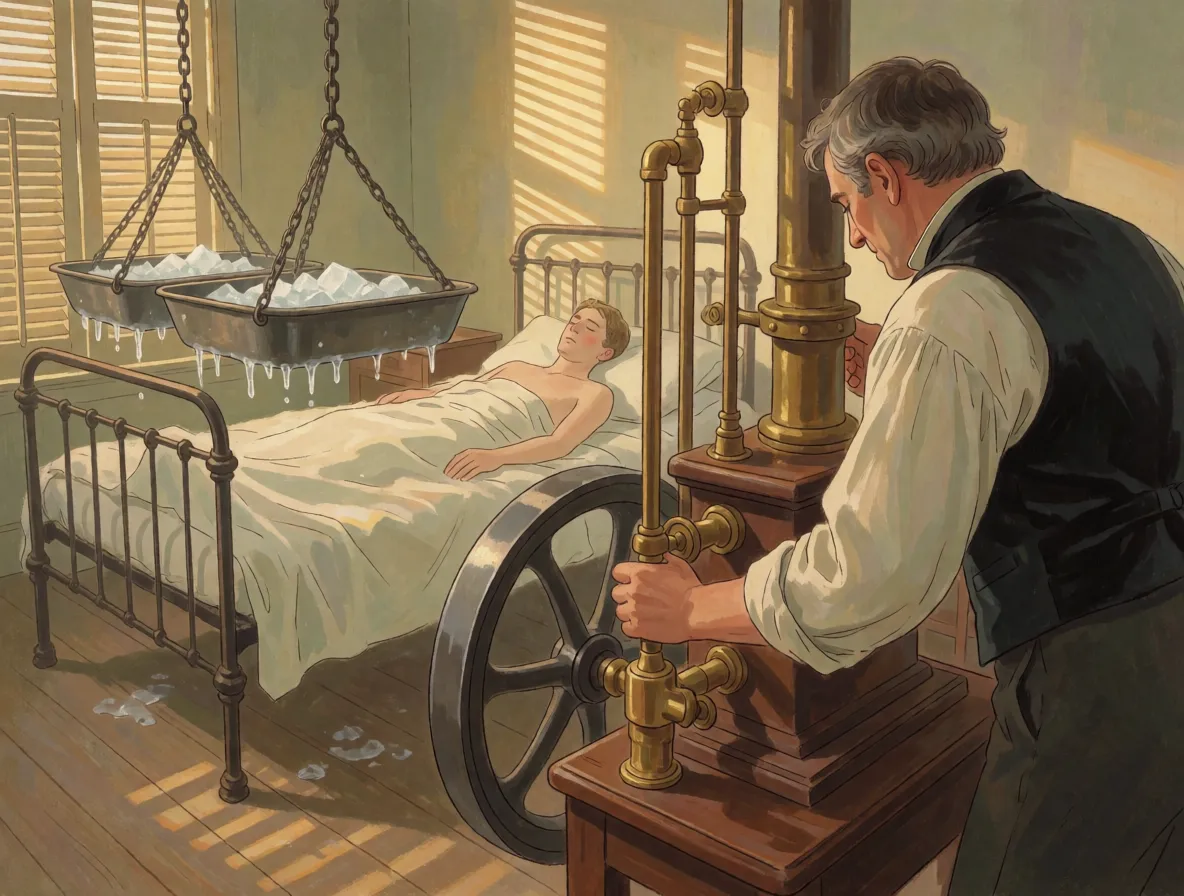
Wrong reason, working machine. The newspapers mocked him, his backers left, and he died four years later with nothing.
Kitchens then waited another lifetime, for a dull reason: leaks. Home refrigerators in the 1920s used poisonous gases, so most families kept an icebox and a delivery of ice instead. In 1927 engineers at General Electric, led by Christian Steenstrup, sealed the motor, pump and gas inside one welded steel can with nothing to leak from. That was roughly when your great-grandparents were small children.
So the idea was two centuries old before it reached a kitchen, held up by leaky pipework. What Cullen watched in a jar is happening in your fridge tonight, and on your table in a minute.
Make a thermometer colder than the room
The water should drag the reading several degrees below the room, further if the air is dry. Alcohol drags it further, because its molecules escape more easily.
That is evaporation, cooling a thermometer that is sitting in a warm room with no machinery anywhere near it.
A fridge is a pump for heat
Go back and put your hand on the warm metal.
Everything you have followed finishes there. Heat left the milk, entered a boiling liquid, rode out as gas, and was lifted by the compressor above the temperature of the kitchen. The warmth under your hand is your dinner, cooling.
A machine that carries heat from a cold place to a warm one has a name: a heat pump. Turn one around, with the boiling pipe out in the garden and the warm coil indoors, and it heats a house. Some homes are warmed exactly that way, by a refrigerator running backwards.
The coldest thing in your kitchen is the only appliance that is warm when nobody is touching it, because nothing in it ever made a scrap of cold. It moved heat, all day, uphill.