Why does popcorn pop?
Kernels go into a hot pan and, for a whole minute, absolutely nothing happens. You can hear them sliding about. Then one goes off like a firework, the rest follow, and thirty seconds later the lid is lifting. Nothing was added to that pan. A hard yellow bead the size of a pea has become a white lump you could balance on a fingertip. So where was all that white hiding?
It was hiding inside the bead, and it was as hard as a tooth. To turn it soft and white, a kernel has to cook itself inside a sealed box, and then destroy the box.
A sealed box with water inside
Pick up a raw kernel and look at it. Almost everything you are holding is starch. That is the hard white food store a corn plant packs around every seed, and it is identical to the cornstarch in a kitchen cupboard.
Locked in with the starch is water. Not a drop you could pour out. It is trapped inside microscopic starch granules, and it amounts to roughly one seventh of the kernel’s weight. Popcorn left in an open jar for a year loses some of that moisture to evaporation, and afterward it pops badly or refuses altogether.
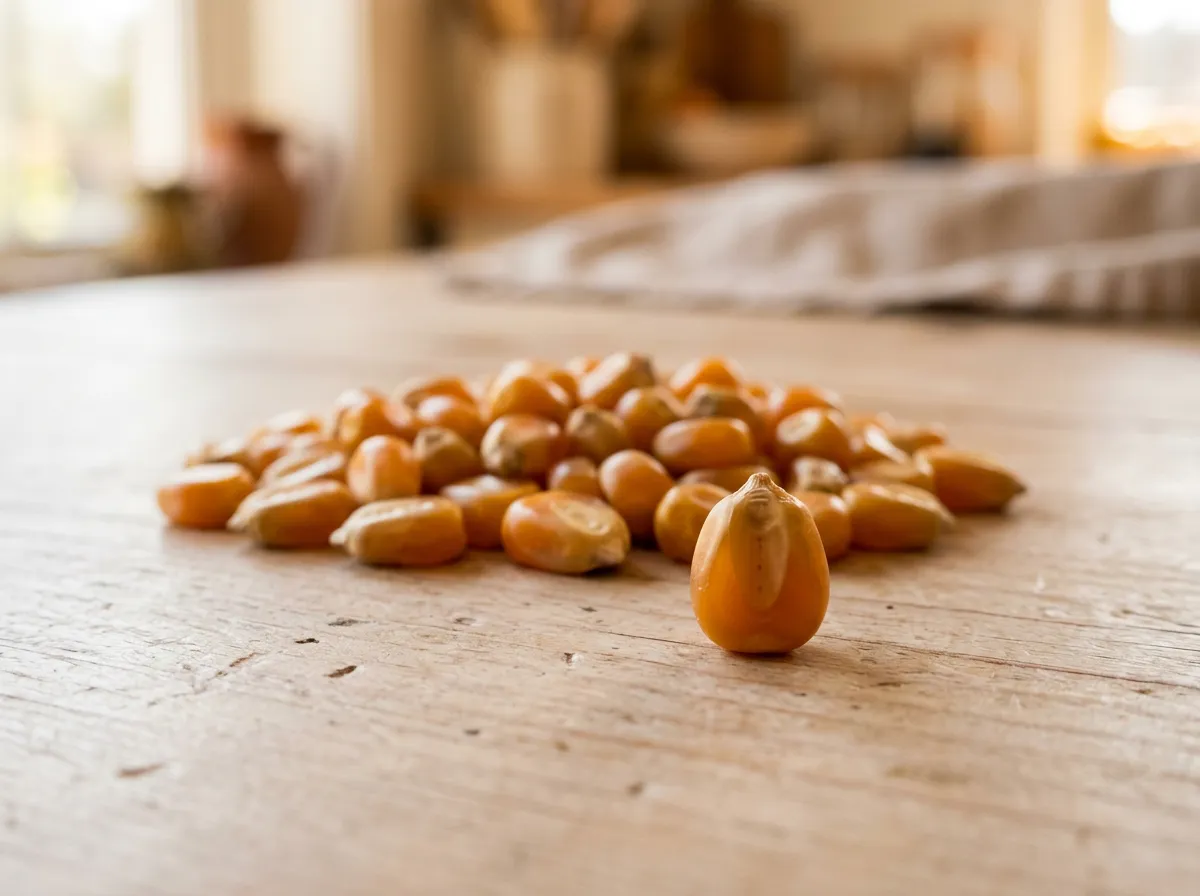
Wrapped around the outside is the hull, the glassy skin that scientists call the pericarp. It is built from cellulose, the stiff fiber that makes celery stringy. On most seeds a skin like that is merely packaging. On popcorn it is the entire mechanism. It is thicker, harder and very nearly impermeable, meaning almost nothing can pass through it in either direction. Sweet corn and field corn are different varieties of the same plant, and neither one has anything like it.
You have met the hull already. It is the papery scrap that wedges between two back teeth and stays there all afternoon.
So a kernel is a sealed box with water shut inside. Water in an open saucepan simply boils away into the air, which raises an obvious question: why does this water not do the same?
Steam with nowhere to go
Because it has nowhere to go. Heat the pan and the water begins doing what water does at 100 °C(212 °F), which is to vaporize. Steam takes up hundreds of times more room than the liquid it came from. In an open saucepan that expansion is harmless, because the steam escapes upward. Inside the hull there is nothing to escape into.
So the water stays liquid well past its own boiling point. Water held above boiling that cannot become vapor is called superheated, and it is a tense condition for water to be in.
Every additional degree shoves harder against the interior of the hull. That shove is pressure, and by the time a kernel is ready it has climbed to about 9.3 bar(135 psi). That is more than the tires of a racing bicycle carry, packed inside a seed you could hide beneath a fingernail.
The atmosphere presses on you at about 15 pounds on every square inch. A kernel resists nine times that.
A kernel has become a sealed box under enormous pressure. But pressure by itself would only split it like a hazelnut, and a split hazelnut is nobody’s idea of popcorn.
The starch turns to dough before the skin gives way
Something else has been happening while the pressure climbed. Starch does not stay hard when it is hot and wet. The granules swell, soften and merge into a thick, elastic dough, which is exactly why a raw noodle goes floppy in boiling water. Cooks call the change gelatinizing.
Inside a kernel this dough is far hotter than any saucepan, and it is compressed from every direction, so it stays precisely where it is. It is a soft white paste occupying a space it cannot leave.
The sequence of those two events matters more than anything else here. If the hull surrendered early, the pressure would escape while the starch was still hard, and you would be left with a scorched bead with a crack in it. Because the hull holds on, the starch is already soft by the time the moment arrives.
The same pressure that will destroy the hull is the only thing that can cook what is inside it.
That moment turns out to be startlingly precise. In 2015 two French physicists, Emmanuel Virot and Alexandre Ponomarenko, warmed kernels gradually and counted the results. At 170 °C(338 °F) only about a third of them exploded. Ten degrees hotter and virtually every one did.
So the box fails at a temperature you could set a dial to, with softened starch and superheated water waiting inside.
Everything finishes in a hundredth of a second
The instant the hull splits, the pressure inside collapses to nothing. All that superheated water is released, and every drop of it becomes steam at once. The energy stored in the box now has somewhere to go. The steam drives the softened starch outward and whips it into a foam, a solid riddled with bubbles, the way a bath sponge is.
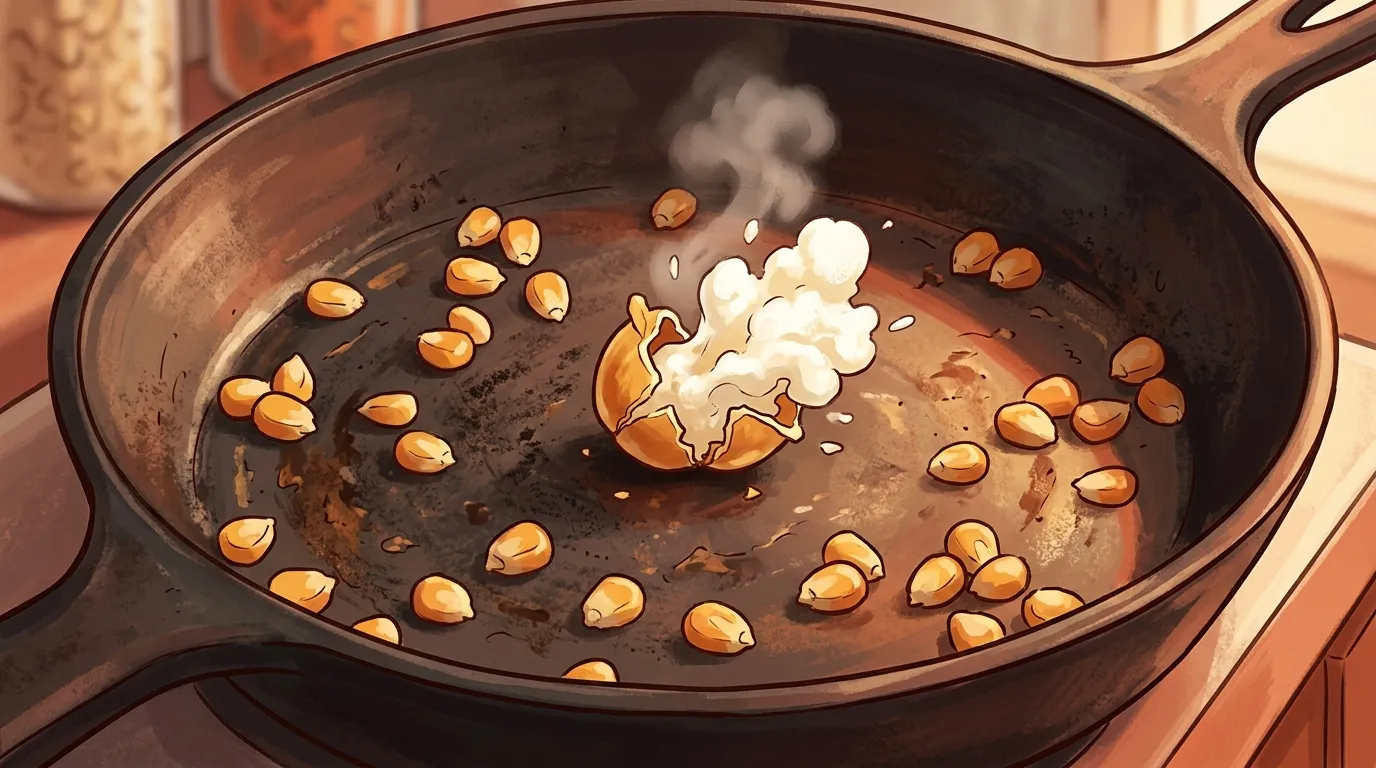
The kernel turns itself inside out as this happens. Then the foam meets cold air and stops dead. Within roughly a hundredth of a second it has solidified, and what you eat is a shape frozen halfway through an explosion.
That is the entire sequence, and it runs faster than a blink. Water is trapped, the water superheats, the pressure climbs, the starch softens, the hull fractures, the steam escapes, the foam solidifies. Every piece in the bowl has completed all seven stages.
Bred for six years before anyone knew why
People have been popping corn for thousands of years without a word of this. Even the growers who improved popcorn had no idea what they were improving.
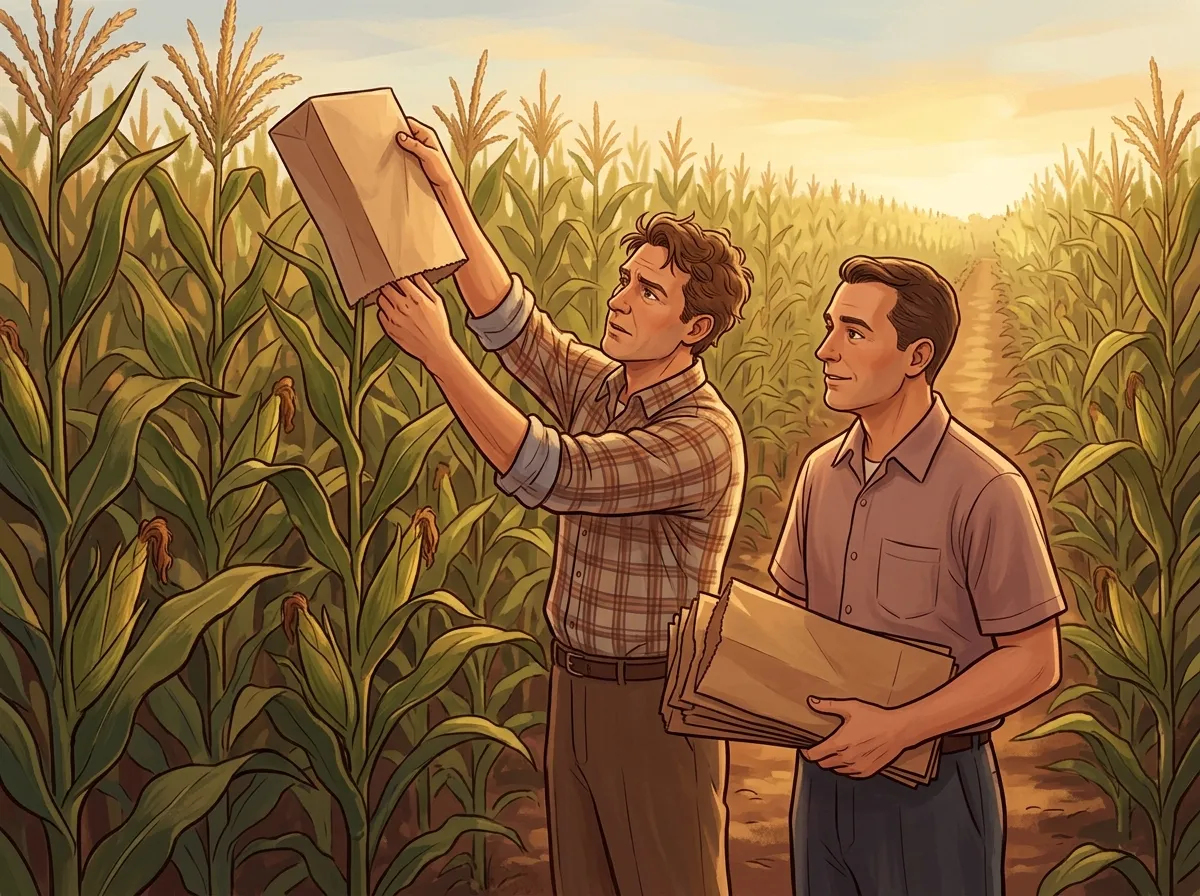
Orville Redenbacher and Charles Bowman met as agriculture students at Purdue University and went into business together in 1940. From 1959 they crossed one popcorn plant with another by hand, season after season, pollinating them under paper bags and keeping whichever hybrid popped best.
They had no method for asking a plant why it was good. All they could do was pop a measured cupful and record how far it expanded. That single measurement was the only one available, so expansion is what they selected for. It took until 1965, when your grandparents were small, to arrive at a corn that swelled further than anything else on sale.
The explanation took a further eighteen years. In 1983 a team led by Carl Hoseney at Kansas State University photographed popping kernels with an electron microscope. They also did something much simpler. They scratched the hulls before heating them, and the scratched kernels sat there and browned quietly. The hull, they wrote, works as a pressure vessel. The quality everyone had been breeding for was hiding in the one part nobody had thought to measure, and it is the part we throw away.
That scratch test is small enough to repeat in a kitchen.
Prove it with a pin
Most of the punctured ten emerge brown and unpopped. Most of the untouched ten explode normally. You have not altered the water, the starch or the temperature, and both piles came from a single packet. The only difference between them was one scratch, and that was enough to stop everything else. It is precisely what happened in Kansas in 1983.
The part you spit out
So the white was inside the bead the entire time. It is the identical starch that made the kernel hard, blown into a foam by water it had been carrying all along, and solidified before it could sag.
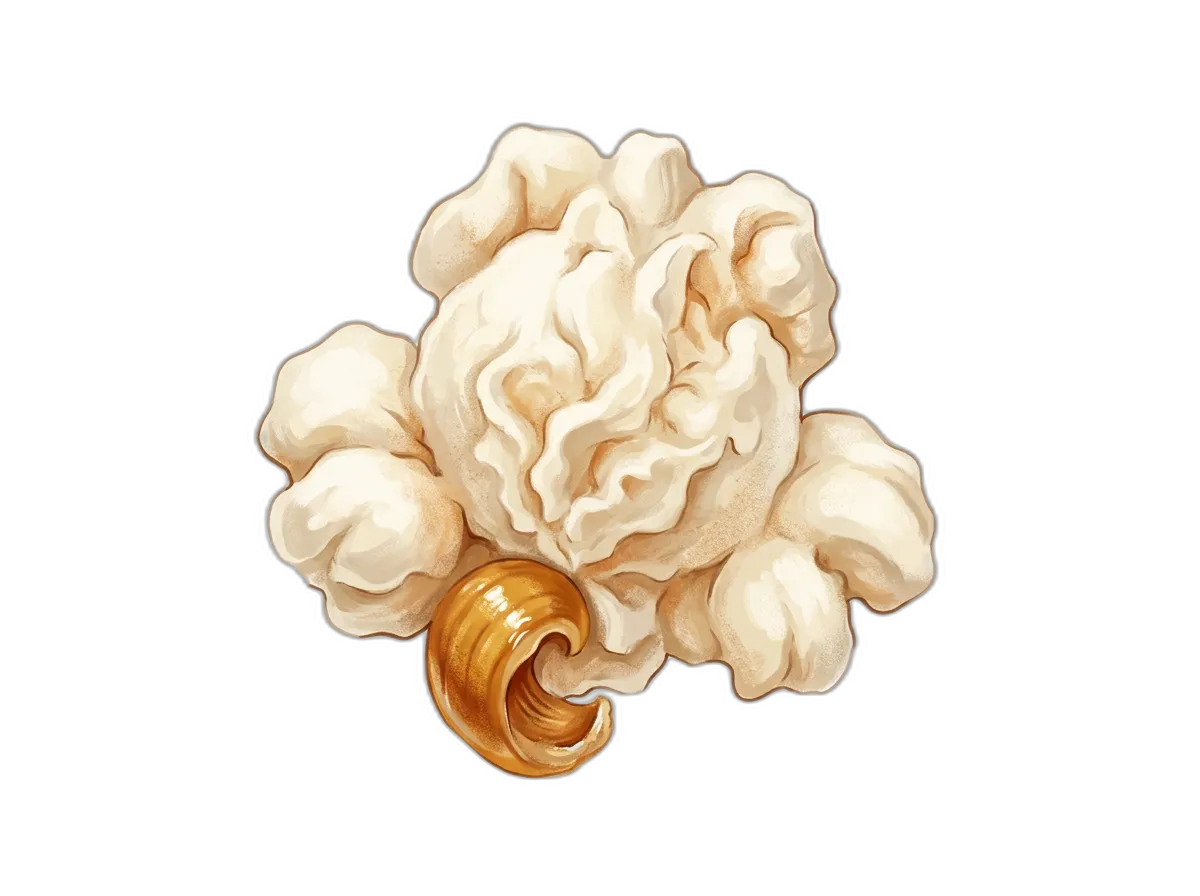
The hull survives too. Turn a piece of popcorn over and you will find a small dark scrap at the base, curled and glossy. That is the leftover pressure vessel, burst and emptied, and it is the reason there is anything edible at all. Virot and Ponomarenko discovered one last thing about that instant. A piece shoves off the hot pan with a stubby leg of starch and jumps a few cm(an inch or two) into the air, like an extremely small gymnast.
Next time a pan goes silent and then begins firing, you will know what the silence contained. It was a crowd of sealed boxes growing hotter with nowhere to put their steam, every one of them waiting for its skin to fail.