Why does shaking a fizzy drink make it explode?
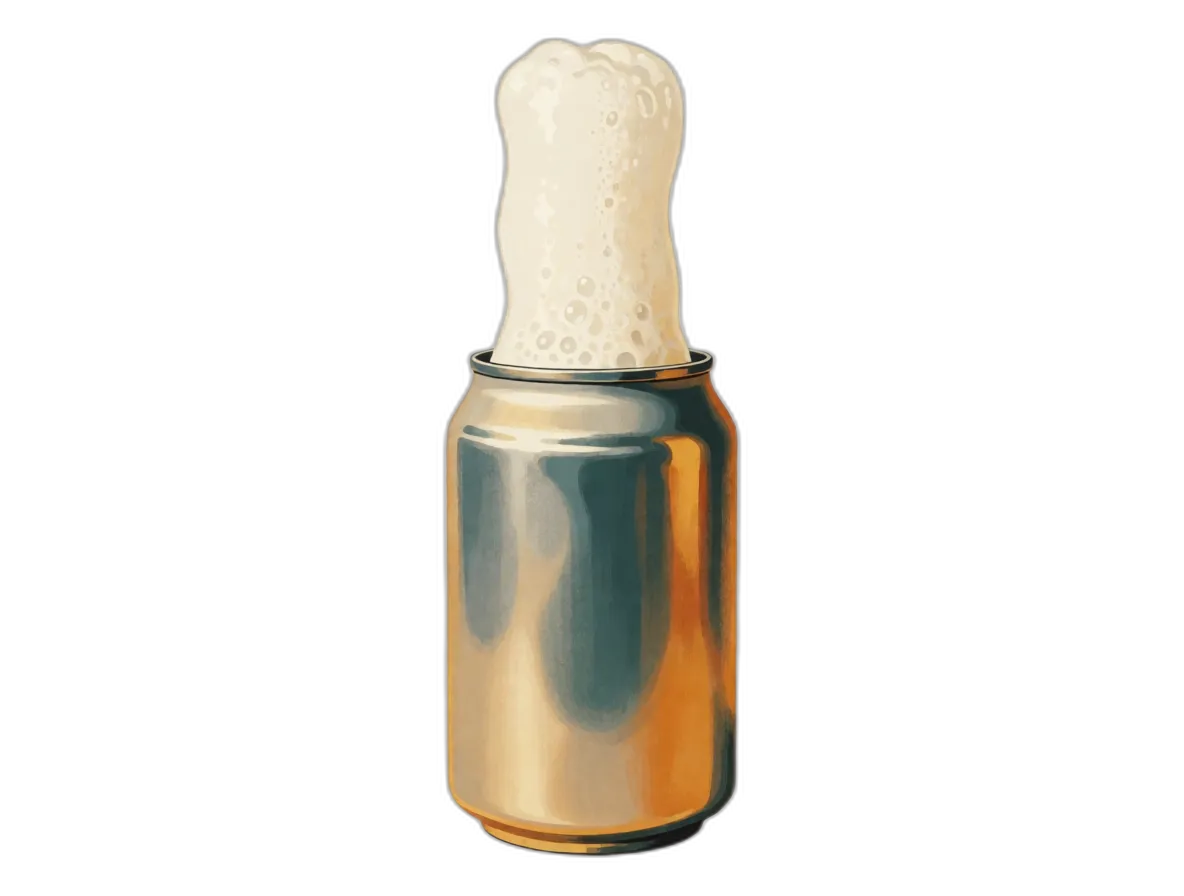
Somebody hands you a can that has been rolling around in a bag all afternoon. You open it anyway, and half of it lands on your shoes. Everybody knows that shaking is what did it, and almost everybody assumes the shaking pumped the can up somehow. Attach a gauge and measure the push inside, before and afterward, and you get the same answer twice. So what did all that rattling actually change?
Shaking adds no extra push whatsoever. What it adds is thousands of places where a bubble is allowed to begin.
A sealed can is mostly gas in hiding
The fizz in a fizzy drink is carbon dioxide, an ordinary invisible gas that your own breath is full of. At the bottling factory it is forced into the liquid, and there it stays.
Forced in far enough, the gas stops behaving like a gas. Its molecules — the smallest complete pieces a substance can be divided into — separate from one another and slot individually between the water molecules. Nothing looks different. A sealed can appears perfectly still.
Chemists call gas hidden that way dissolved, which is exactly what sugar does when it disappears into tea. The gas has not left. It has merely been broken into pieces too small to see.
There is a startling quantity of it. A 330 ml(11 fl oz) can holds roughly 1.2 liters(2.5 pints) of carbon dioxide, measured as ordinary gas.
The carbon dioxide dissolved in one can would fill nearly four cans if it all escaped.
The squeeze that keeps the gas hidden
Squeezing that much carbon dioxide into that little liquid demands a considerable push. Inside a sealed can, the gas in the gap above the drink presses on everything around it about three times harder than the atmosphere in your bedroom does.
That measurement of pushing is called pressure. Pressure is what holds the dissolved gas where it is, and the can is engineered to survive it: a wall of aluminum thinner than a human hair, curved into the strongest shape available.
Pop the tab and the pressure escapes in a fraction of a second. Water at ordinary atmospheric pressure cannot possibly hold that much carbon dioxide, so the majority of it now has to leave.
A bubble is not allowed to start from nothing
Here is where everybody’s mental picture goes wrong. The obvious guess is that the gas immediately reappears throughout the drink. It cannot.
Water molecules cling to each other, and at any water surface that clinging produces surface tension, a stretched skin that resists being pulled open. A brand-new bubble in the middle of a liquid would be a tiny hole with a great deal of skin wrapped around a very small space. Building one is very nearly impossible.
So the escaping gas waits for a surface that already exists. A scratch on the glass, a speck of dust, a stray cotton fiber: each of these shelters a microscopic pocket of trapped air that the liquid never managed to fill. Physicists call such a pocket a nucleation site, although a starting spot describes it better.
Pour a fizzy drink into a glass and watch it for ten seconds. The bubbles do not appear everywhere. They rise in steady threads from four or five fixed points on the glass, over and over, because those are the only starting spots available.

The escaping gas, then, is limited by starting spots rather than by how much gas is waiting. Which means anything that manufactures more spots will empty the can faster.
Shaking scatters starting spots through the whole drink
Above the liquid in every sealed can sits a small gap of gas. Shake the can and that gap is torn apart. The liquid slops through it, chopping it into thousands of separate bubbles and dragging them down through the drink.
Now count what you have. Each of those bubbles is a surface that already exists, suspended in the middle of the liquid where a bubble could never have formed alone. You have manufactured starting spots by the thousand, and distributed them everywhere at once.
Open it now and gas pours into every one of them simultaneously. Each bubble expands, collides with its neighbors and merges. Foam occupies enormously more volume than the equivalent liquid, so the drink has nowhere available except upward, and out through a hole the width of your thumb.
The gas was always leaving. Shaking only decides how many doors it leaves by.
Leave the same can alone for ten minutes and it opens quietly. Nothing escaped during the wait, and nothing calmed down. The scattered bubbles simply floated back to the top and merged into the gap they came from, taking every starting spot with them.
Tapping the lid does nothing at all
The only thing that reliably works is the thing nobody has patience for. Waiting lets the bubbles rise and rejoin the gap on their own, and once they are gone the drink behaves as though it was never disturbed.
The man who invented fizzy water thought it was medicine
Nobody set out to invent a drink. In 1767, roughly nine generations before you were born, Joseph Priestley lived beside a brewery in Leeds. He became fascinated by the layer of heavy invisible gas lying above the fermenting vats. It was carbon dioxide, although he called it fixed air.

He held bowls of water above the vats and discovered that the water quietly absorbed the gas and turned pleasantly sharp to taste. By 1772 he had published instructions so that anybody could manufacture it, using chalk and acid, and asked for nothing in return.
Then came the wrong turn. Scurvy is the sailors’ illness that loosens teeth on long voyages, and physicians of the day assumed it was a kind of rotting happening inside the body. Fixed air appeared to slow rotting down in meat. Priestley concluded that his bubbly water ought to cure it.
The Royal Navy took the idea seriously enough to send an apparatus with James Cook when he sailed around the world in 1772. It cured nothing, because scurvy is caused by missing a vitamin found in fresh food, and bubbles supply no vitamins whatsoever.
The invention survived anyway, for an entirely ordinary reason: people liked how it tasted. A watchmaker named Johann Jacob Schweppe worked out how to bottle it strongly enough to keep the fizz in, and began selling it in Geneva in 1783. Every can in every fridge descends from a failed medicine.
Weigh the mess instead of guessing at it
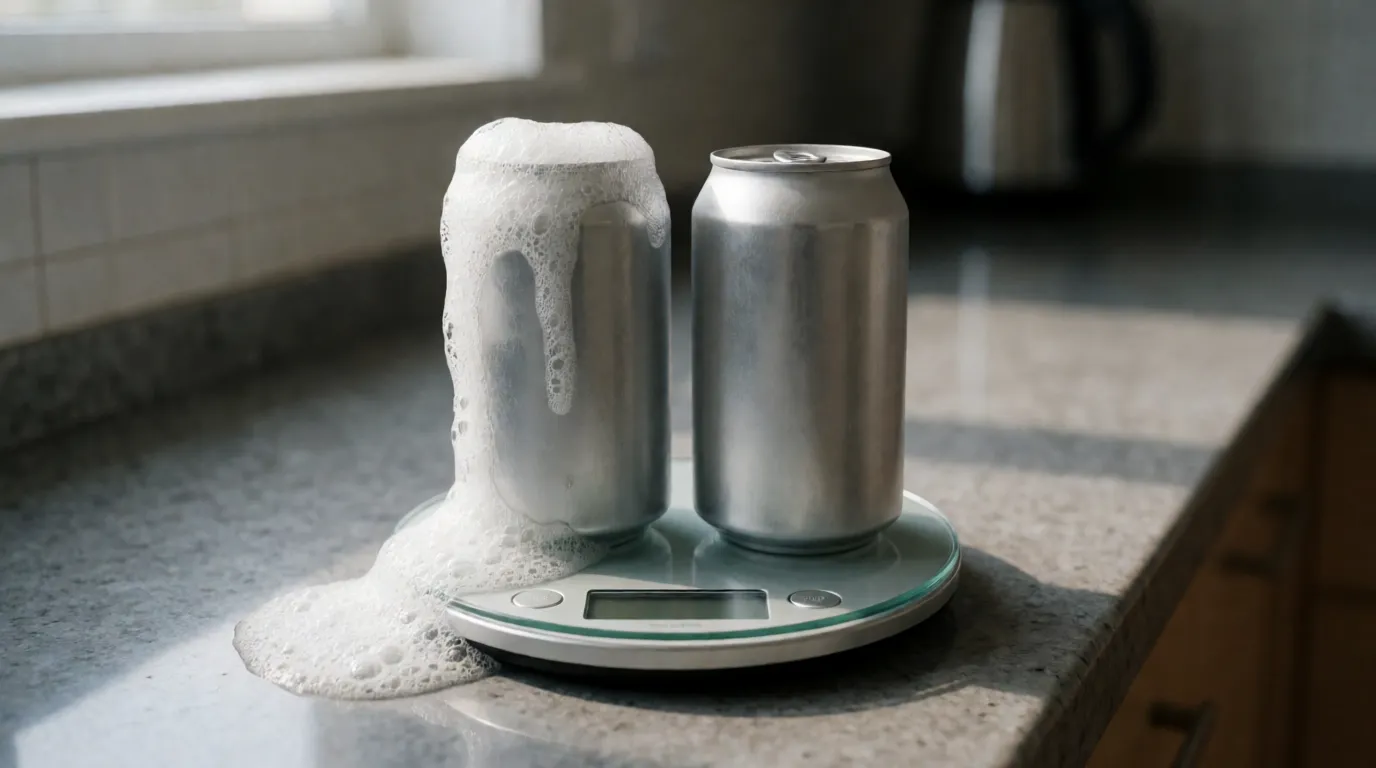
The can you opened immediately loses far more, and the difference is startling for two cans that were shaken identically. Nothing about the second can was calmed or released. It was simply given long enough for its bubbles to float up and vanish.
That is the whole mechanism, weighed out in grams. Shaking never changed how much gas the drink contained, and it never changed how hard that gas was pushing. It changed only the number of exits.
Fizzy drinks are always escaping
An open glass of soda goes flat on the table in an hour, and nobody calls that an explosion. It is exactly the same process, running slowly, through the four or five starting spots a glass happens to offer.
Shake the can and you hand the gas ten thousand exits instead of five, and the hour becomes a second. The violence you get in the face is not extra energy that shaking put in. It is the ordinary escape you would have watched all afternoon, delivered at once.
Which is why the only genuine cure is patience. Set the can down, wait, and the bubbles will quietly undo everything the shaking did, without your help and without a single tap.