Why does soap get grease off a plate when water won’t?
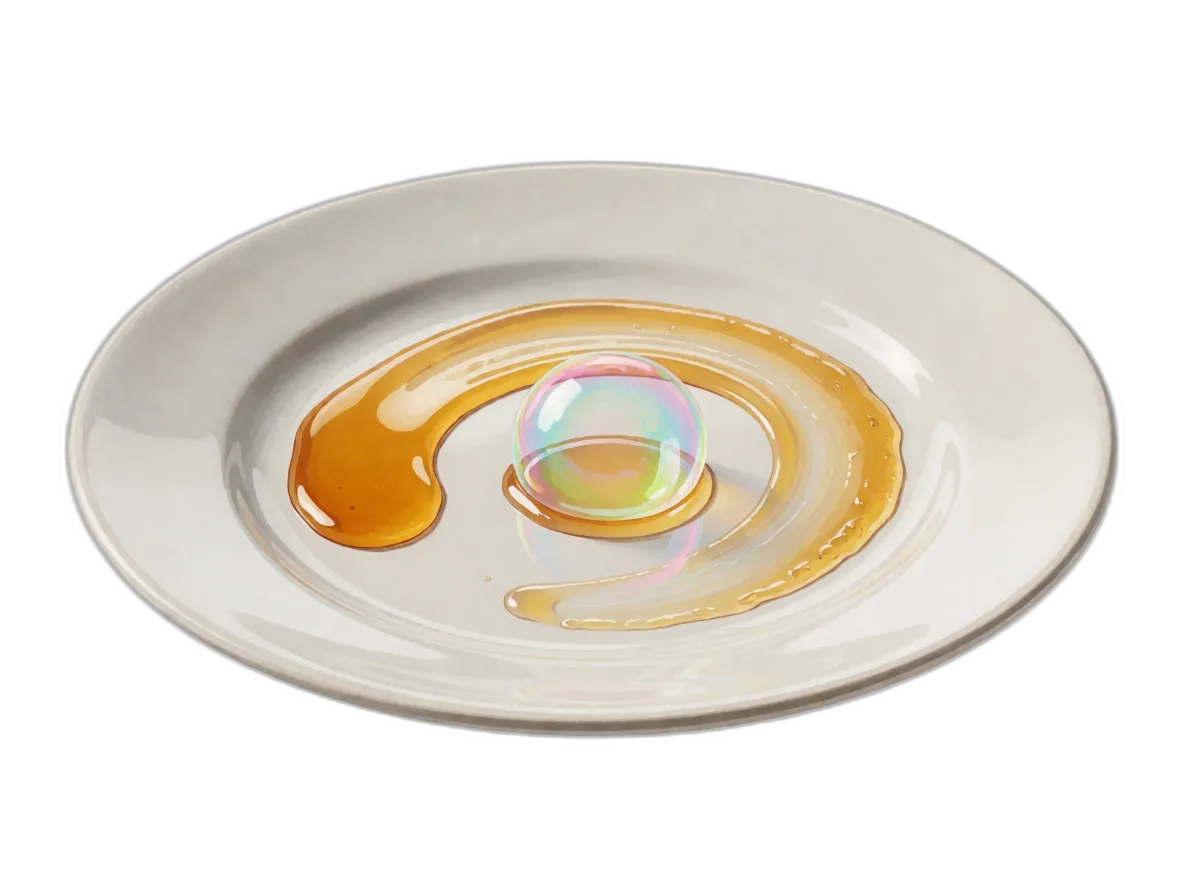
There is a plate in the sink with a slick of bacon fat across it. Hold it under the hot tap: the water beads up, slides off the greasy part and leaves it where it was. One drop of dish soap, and within seconds the plate squeaks. Nothing burned the grease and nothing melted it, so where did it go?
Soap does not attack grease. Every scrap of it is built in two halves that want opposite things, and rescuing one of those halves from the water is what hauls the grease off your plate.
Water would rather hold on to itself
Everything on that plate is built from molecules: small groups of atoms locked together in a fixed arrangement. Water is one kind and grease another. The difference that matters is what their outsides will hold on to.
A water molecule is lopsided. Its two hydrogen ends sit on the same side of a single oxygen, leaving one end faintly positive and the other faintly negative. So every water molecule is attracted to its neighbors. Those attractions are hydrogen bonds, made and broken billions of times a second.
You can watch the consequence without equipment. Water gathers into round beads on a window instead of lying flat, as though a skin were stretched over it. That pull is surface tension: hydrogen bonds holding the surface together.
Grease offers water nothing to bond to. A grease molecule is a long chain of carbon with no positive or negative end anywhere. Water molecules would rather hold each other than make room for something they cannot hold, so they close ranks and squeeze it aside.
Try that on the nearest screen. Press a fingertip against it and tilt it toward a light: there is grease from your own skin, shaped like a fingerprint. Rub with a dry finger and the smear travels around. It never leaves.
So the tap fails for a reason unrelated to force: water is fully occupied holding on to itself. Cleaning the plate needs something water is willing to hold.
A molecule with two opposite ends
Squeeze dish soap into your hand and it looks like one smooth liquid. The bottle probably says detergent, meaning a cleaner assembled in a factory rather than boiled out of fat and wood ash. Either way the molecule is shaped identically, and that shape is the answer.
One end is electrically charged, far more strongly than water’s faint lopsidedness, and water bonds to it eagerly. Call it the head.
The other end is a hydrocarbon tail: a chain of sixteen or eighteen carbon atoms carrying no charge anywhere. Water gets no purchase on it whatsoever. Chemists call anything like this hydrophobic, from the Greek for water-fearing, which slightly libels it: the tail fears nothing, and water simply cannot hold it.
Consider the result. A head the water grips tightly, joined to a tail built from the same hydrocarbon chains as the grease itself. One molecule, welcome in both places.
Cold water works too. Warm water only helps by softening fat that has already gone solid.It already changes how water behaves. Soap molecules crowd to the surface and wedge in among the water molecules, interrupting the hydrogen bonds. Surface tension collapses, so soapy water stops beading and spreads flat into the corners of a saucepan and the weave of a shirt.
So soap loosens the grip that makes water bead up, and offers grease something water is willing to hold. A single molecule still cannot shift a smear of bacon fat. Everything depends on what happens when there are billions.
Why the tails end up in a ball
Underwater, those tails are in trouble. Every water molecule around them is already bonded to another, and none will bond to a tail. The tails get shoved together by everything refusing to touch them, the way a crowd closes in around an empty space.
Pushed inward, they discover the one thing they can hold: each other. Identical hydrocarbon chains pack together comfortably, each tail dragging its own head behind it.
What forms is a tiny ball. Every tail points inward, hidden in the middle. Every head points outward, where the water can bond to it. That ball is a micelle. Below a certain concentration of soap there are none at all; above it they assemble spontaneously, in trillions.
They are microscopic. One ball measures four to six nanometers across and holds fifty to a hundred soap molecules. A nanometer is small enough that seventy thousand of them lie side by side across a single one of your own hairs.
Soap balls, shoulder to shoulder, across one hair.
So soapy water is full of tiny balls, each with a hidden middle made entirely of hydrocarbon tails. That middle is the strangest location in the sink: a pocket of oily nothing suspended inside water. And something on the plate fits it perfectly.
The grease leaves in the middle of the ball
The middle of a soap ball is built from the same hydrocarbon chains as grease itself. To a grease molecule it is the most comfortable place for a long way in any direction. So grease moves in.
The soap never goes looking. Balls drift past constantly, and every time a tail brushes the smear it stays put. More tails follow, the film is gradually prised off the ceramic, and it breaks into droplets small enough to be surrounded.
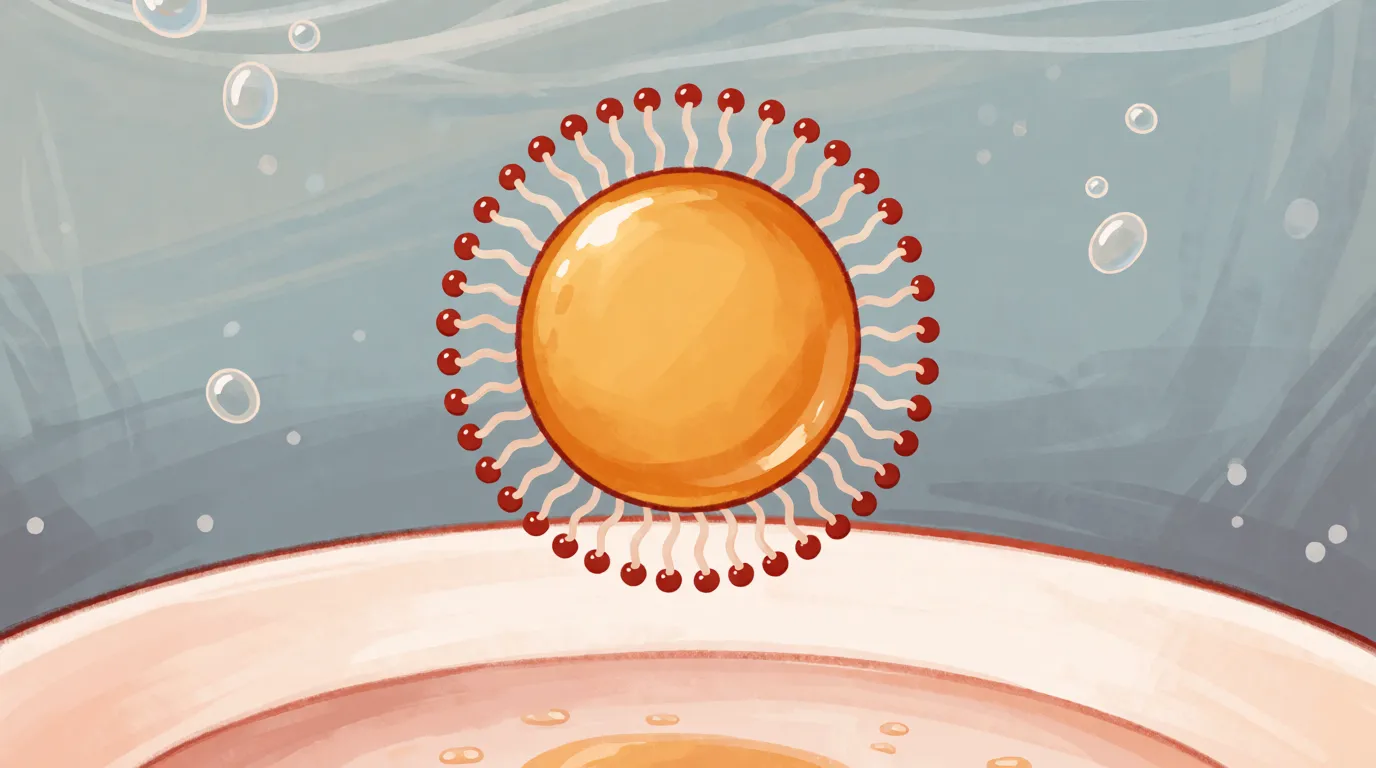
Examine one droplet from outside. Grease in the middle, tails around it, and facing the water a shell of electrically charged heads. Water bonds to them exactly as to other water, so it lifts the droplet and carries it away. A liquid carrying a second liquid it would normally refuse is an emulsion. You drank one today if you had milk.
Every droplet leaving the plate is still grease. It has only been given an outside that water is prepared to hold.
Anything water could not hold leaves the same way. So how did anyone establish that a ball nobody can see was there?
The kitchen sink beat the laboratory
Soap is at least forty centuries old, and for most of that time nobody wondered how it worked. The first person to measure anything useful about water surfaces never set foot in a laboratory.
Agnes Pockels was German, learned physics from her brother’s university textbooks, and nursed her parents at home because German universities were closed to women. She experimented at the kitchen sink. In 1891, when your great-great-grandparents were children, she described a shallow tin trough with a sliding metal strip. It swept the surface clean, letting her measure exactly how hard the water pulled. A clean surface pulled the same however she moved the strip. The faintest trace of anything else changed the measurement.
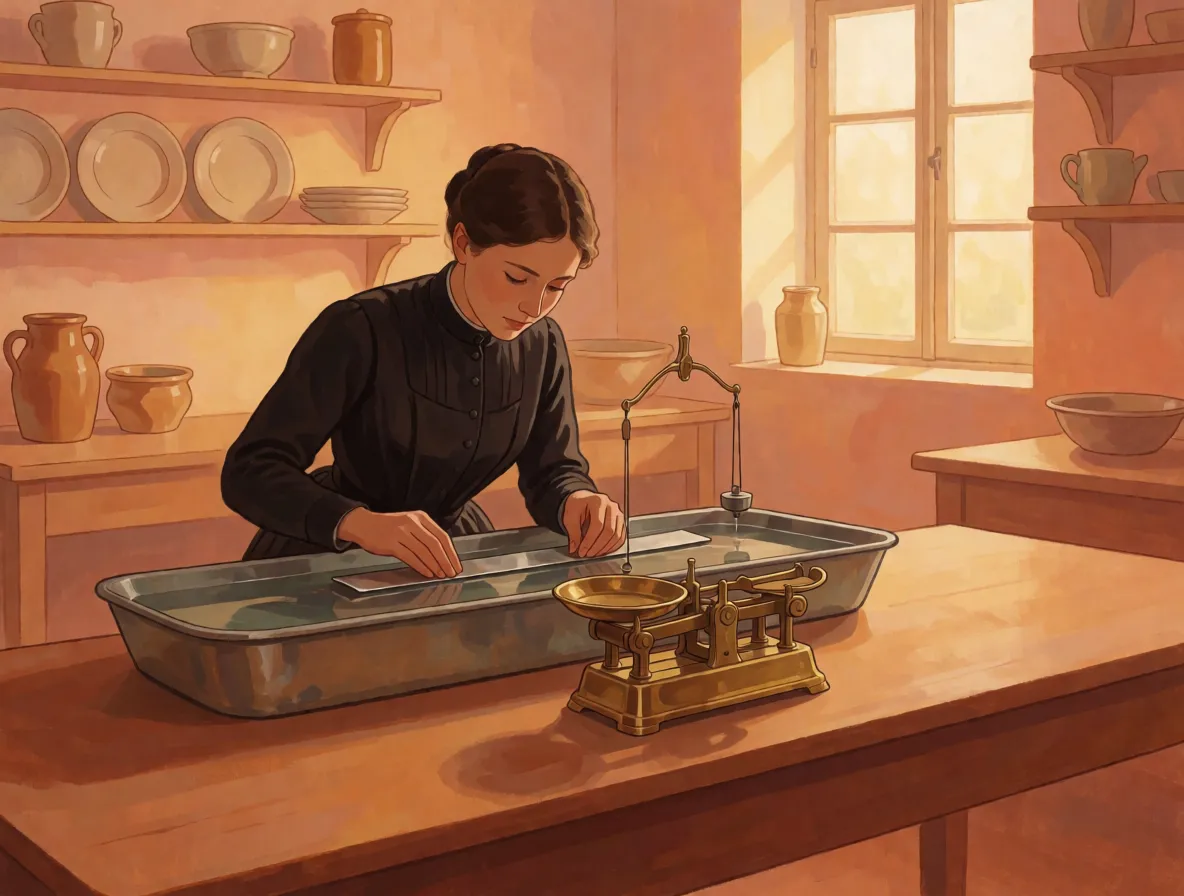
Her results reached print because Lord Rayleigh, a British physicist chasing the same problem, forwarded her letter to the journal Nature. It ran in 1891, and her trough is still standard equipment.
Measuring a surface is one thing. Guessing what floats underneath is harder, and no microscope could show a soap ball. In 1913 James McBain put a strange result to a meeting of British chemists: a soap solution conducted far less electricity than the quantity of soap predicted. His explanation was that the molecules were ganging up into clusters, leaving fewer separate pieces adrift than anybody had counted.
Chemists disliked it. Presenting the evidence again in 1925, McBain was dismissed by the chairman: “Nonsense, McBain.” The idea took another twenty years to win. The arrangement drawn above was set out by Gilbert Hartley in 1936.
Instruments settled the argument. The effect fits in a jar.
Shake a jar and time it
Oil and water separate quickly when left alone. Time it, then add soap and time it again. The second number is the whole article.
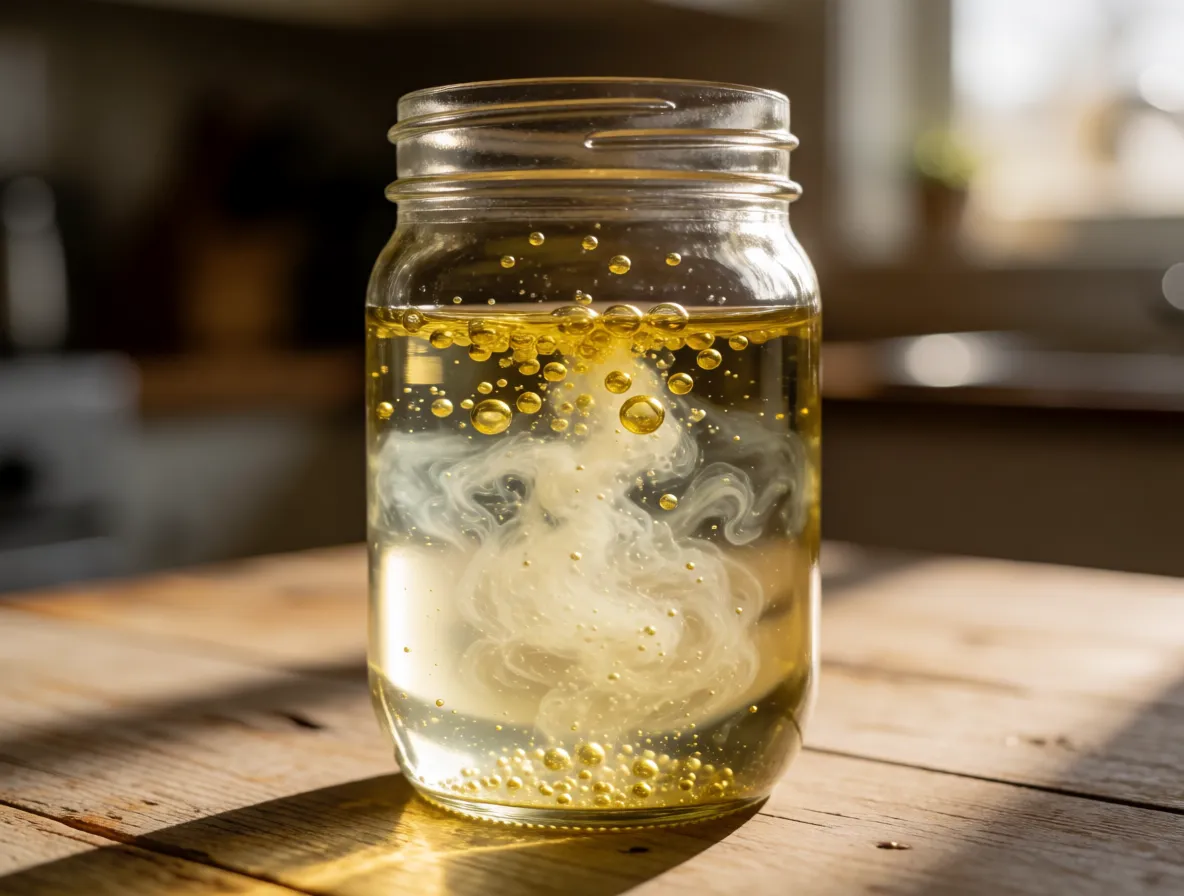
The first jar usually clears in under a minute: big droplets collide, merge and float up. The second stays cloudy, frequently for ten minutes and sometimes hours. Its droplets cannot merge, because each is wrapped in heads carrying the same charge. Identical charges push each other away, and that repulsion keeps them separate.
Nothing in that jar dissolved the oil. Hold it to a window: the cloudiness is millions of invisible droplets scattering the light. You have seen that cloud somewhere else, most days of your life.
Where the grease actually went
Look at the water going down the drain at the end of the washing up. It is grey and cloudy, and you have probably never wondered why. Clean water is clear, and so is soapy water until it has done some work.
That cloud is the grease. Every scrap that came off the plates is still there, chopped into droplets too small to see individually, each in the middle of its own ball of soap. Together they scatter the light. The plate is clean because the grease is in the water, and the water looks like that for the same reason.
Which answers the question you started with. The tap alone left the grease behind because water molecules hold on to each other and had nothing to hold the grease by. Soap does not burn grease, dissolve it or destroy it. Soap gives the water a handle.