Why does salt melt ice?
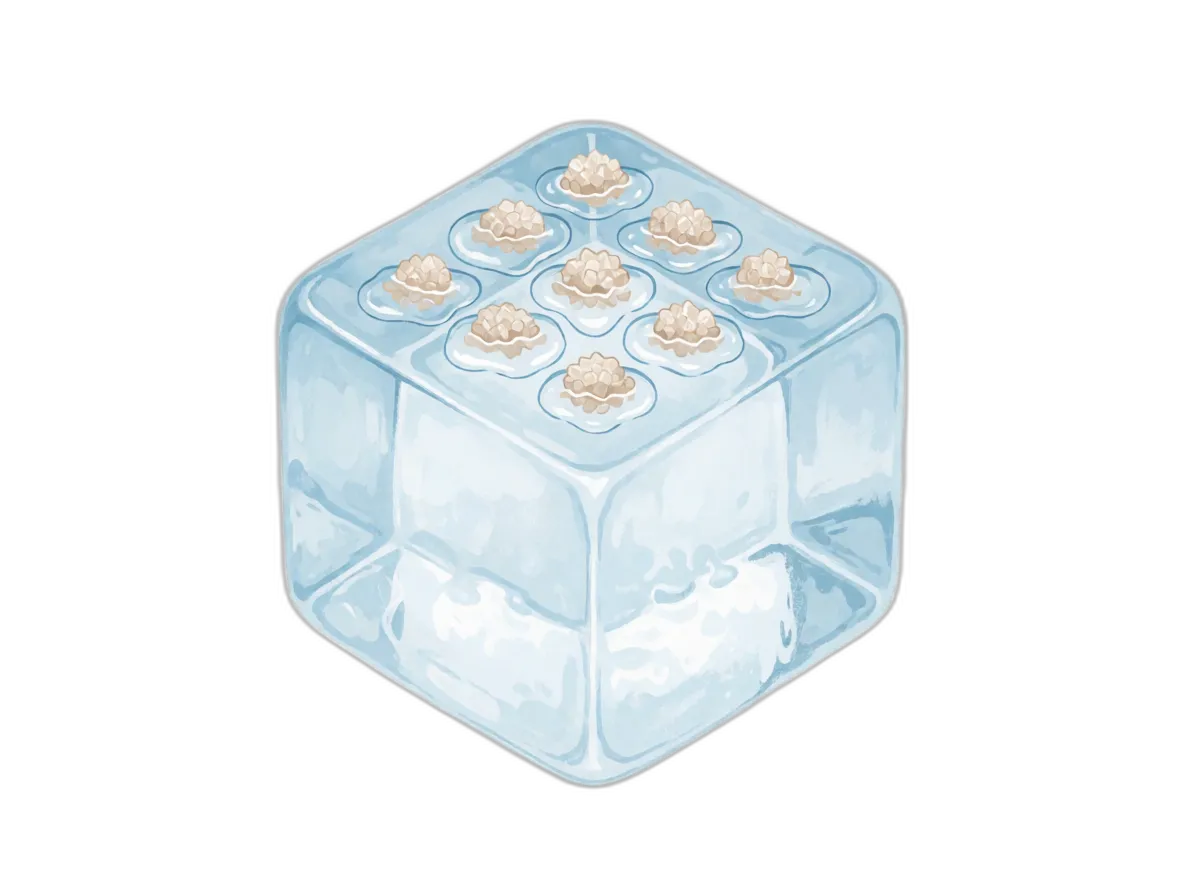
Somebody scatters a handful of grit on a frozen path and by the afternoon the ice has retreated into the corners. The salt came out of a bag in an unheated shed. It is exactly as cold as the ice it is standing on, and it arrives with no warmth of its own to give away. Yet ice that was perfectly solid all morning gives up. What did the salt actually do to it?
An ice cube is far busier than it looks, and salt does not attack it. Salt simply gets in the way of the traffic coming back.
Ice at zero degrees is a two-way street
Water is made of molecules, the smallest complete pieces water can be divided into, each one an oxygen atom with two hydrogen atoms attached. In liquid water they tumble past one another freely.
In ice they are locked into a repeating pattern, every molecule holding hands with its neighbors in a rigid framework called a crystal. That pattern is why ice is hard, and why snowflakes come out six-sided.
Now the part that nobody pictures correctly. At the surface where ice meets liquid water, nothing is standing still. Molecules are constantly breaking away from the crystal into the liquid. Other molecules are constantly arriving from the liquid and joining the crystal.
At exactly 0 °C(32 °F) the two rates match. Just as many leave as arrive every second, so the ice neither grows nor shrinks. Chemists call that temperature the melting point, and it is a balance rather than a barrier.
Warm the ice slightly and leaving speeds up, so the cube shrinks. Chill it and arriving wins, so the cube grows. Everything depends on those two rates, which means anything that changes either one changes the ice.
Salt gets in the way of the traffic coming back
Drop a grain of salt onto a wet ice cube and it dissolves, meaning it comes apart and spreads through the liquid in pieces too small to see. Salt is sodium and chlorine locked together, and in water the two separate completely.
Each piece carries an electrical charge, which is why chemists give them their own name: ions. Water molecules immediately surround every ion and hold it in the liquid. The important consequence is simply that ions occupy room.
Look again at the ice surface with salty water above it. Some of the positions directly against the crystal are now occupied by ions, and an ion cannot possibly join an ice crystal. Its shape is wrong for the arrangement, and the surrounding water molecules are gripping it anyway.
So arrivals drop. Departures do not, because a molecule sitting inside the crystal has no way of knowing that any salt exists anywhere. Leaving now beats arriving, and the cube shrinks. That shrinking is melting.
Salt never touches the ice. It only crowds the doorway the water was coming back through.
Melting stops again once you go cold enough
The balance is not gone, only moved. Chill the salty water and every molecule slows down, including the ones leaving the crystal. Go cold enough and departures fall until they match the reduced arrivals, and the ice stops disappearing.
That lower balance point is what chemists call freezing point depression, or simply the drop. The more ions you dissolve, the more positions get blocked, and the further the temperature has to fall before the traffic evens out.
Ordinary seawater against the saltiest brine that can still stay liquid, measured in degrees Celsius. More salt, bigger drop.
Salt therefore has a limit, and it is a particularly useful one to know. Below about −21 °C(−6 °F) no quantity of salt will keep water liquid, which is why road crews in genuinely cold countries switch to different chemicals entirely.
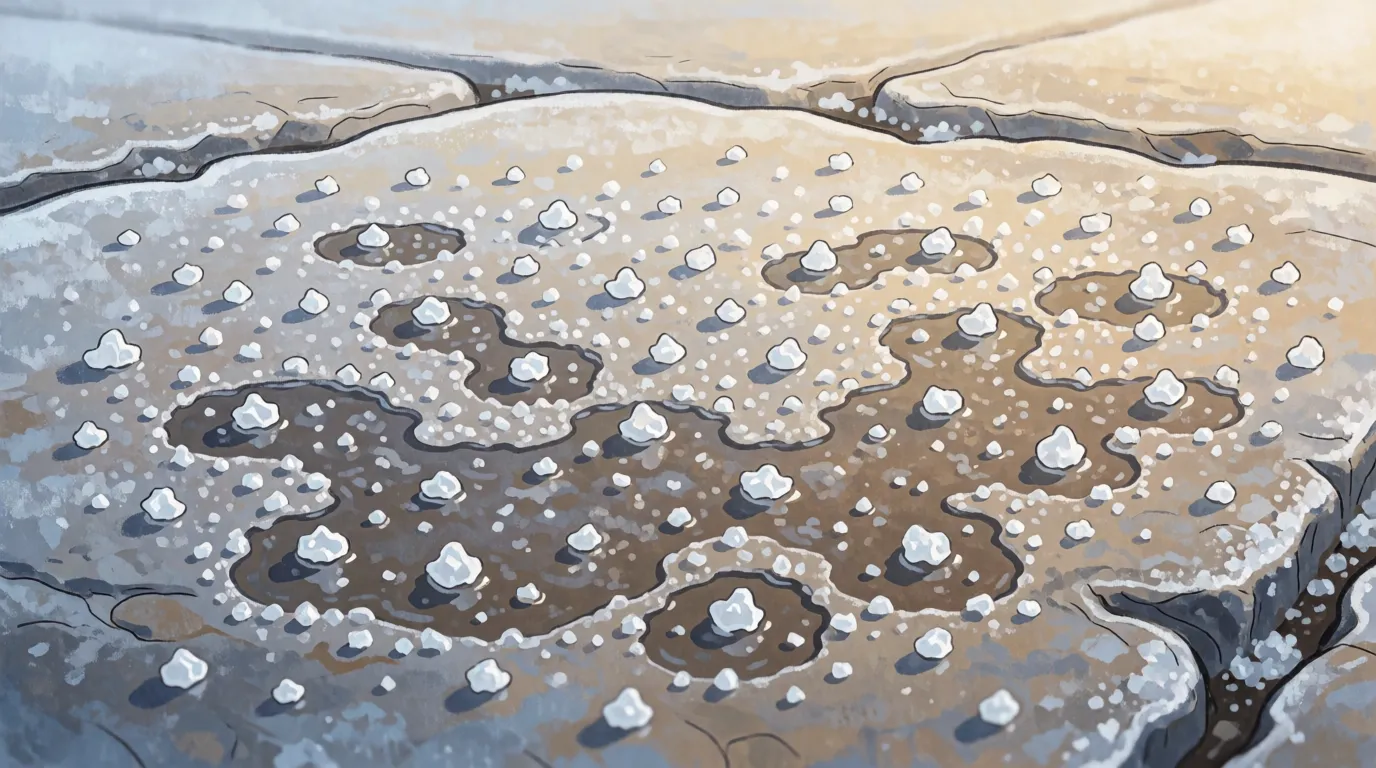
Put a grain of salt on an ice cube straight from the freezer and watch for a minute. A small pit appears under the grain, not a general softening. Melting starts wherever the salt is and travels outward from there.
The sea does freeze
Ice, then, is picky about what it will accept, and salt is left behind in the liquid whichever direction the process runs. That fussiness turned out to be the key to a puzzle that held chemistry up for years.
Salt gave chemists the wrong answer for a decade
Long before anyone understood any of this, cooks were using it. In 1843, when your great-great-great-grandparents were small, Nancy Johnson patented a wooden bucket with a crank on the lid. You packed ice and salt around an inner metal can, turned the handle, and produced ice cream at home.
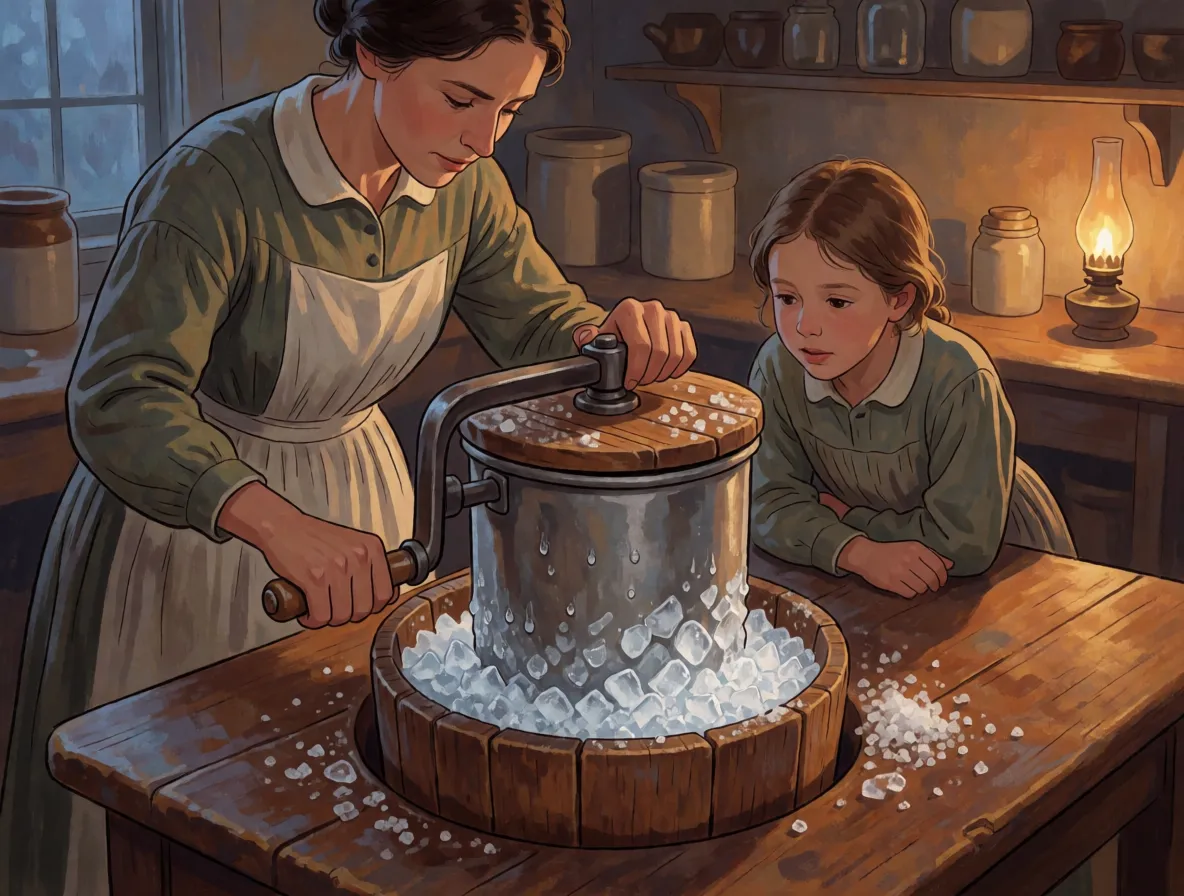
The recipe spread across America, and nobody could explain it. That began to change in 1878, when François-Marie Raoult in France started freezing solutions of every substance he could obtain and measuring the drop with care.
He found something wonderfully simple. The drop did not depend on what he dissolved. Sugar, alcohol, anything: equal numbers of dissolved pieces produced equal drops. Chemists suddenly had a way to count molecules they could not see.
Then the salts spoiled it. Every salt Raoult tested dropped the freezing point twice as far as it should have, and the method that worked beautifully on everything else gave answers exactly double for salt.
The explanation came from Svante Arrhenius in Sweden in 1887, and almost nobody believed him at first. Dissolved salt, he argued, does not stay whole. It splits into two charged pieces, so one spoonful of salt is two spoonfuls of obstruction. The awkward double answer had been the truth all along.
Find out how cold salted ice gets
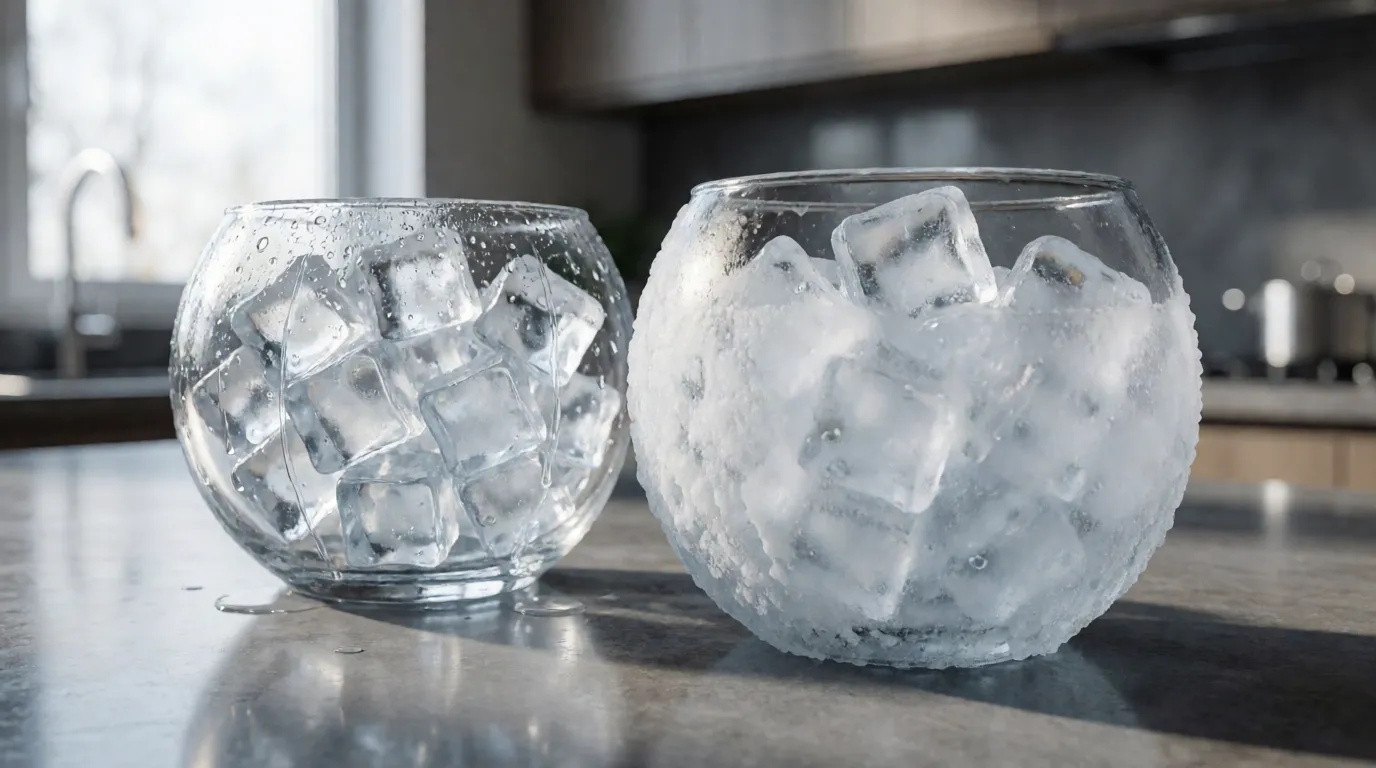
The plain ice sits at zero, as it always does. The salted bowl typically reads somewhere between −10 °C(14 °F) and −18 °C(0 °F), which is colder than the freezer compartment of most refrigerators.
That measurement kills the last comfortable guess about how salt works. Nothing was warmed up whatsoever. The mixture became dramatically colder while the ice disappeared faster, because every molecule breaking away from the crystal carried energy off with it.
Nancy Johnson’s bucket depended on precisely that. Salted ice reaches temperatures plain ice never can, and cream refuses to freeze at zero.
Everything the salt did, it did by blocking
Go back to the frozen step. The salt is still as cold as it ever was, and it still contains no heat worth mentioning. It never touched the crystal.
All it did was dissolve into the microscopic film of water that covers any ice. That film filled with pieces incapable of joining a crystal, and the departures carried on at full speed with nothing arriving to replace them. The ice was always dismantling itself. It was only ever being rebuilt at an identical pace.
That is why the pits form under the grains, why the puddle refuses to refreeze overnight, and why the sea can be liquid at temperatures that would turn your bath solid. Salt does nothing to the ice at all. It simply stands in the doorway.