Why does a snowflake have six sides?
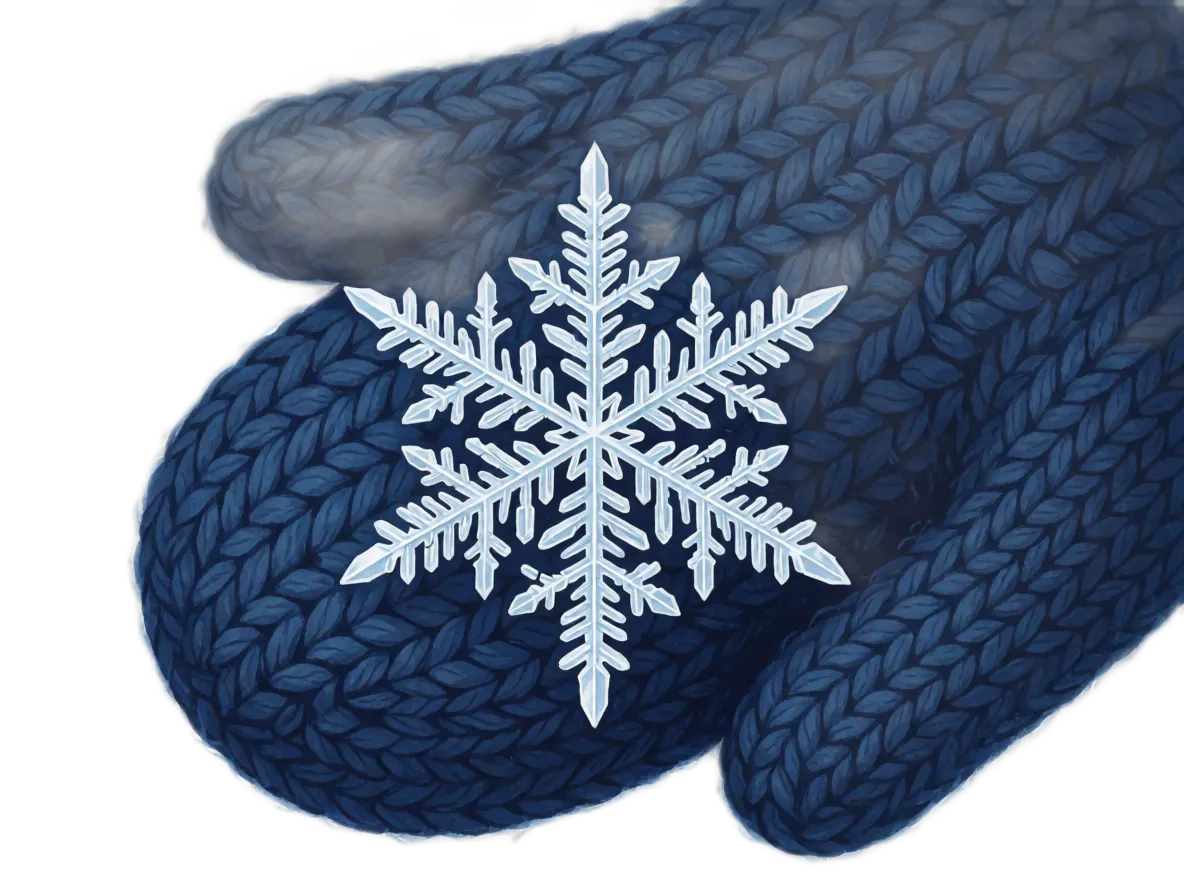
Stand outside in slow, dry snow with a dark sleeve and wait. Flakes land on the wool without melting, and you can count the arms. Six. The next one, six. Nobody ever finds five arms, or seven. Yet the pattern that decides that number is millions of times too small to see, and no two flakes are identical. So how does something invisible end up drawn large enough to count?
Nothing carves a snowflake. It grows outward from a speck, and it grows fastest exactly where it already sticks out furthest. Six corners get a tiny advantage, and never give it back.
The six is real, and far too small to see
Water comes in pieces, and the smallest piece that is still water is a molecule.
When water freezes, every molecule takes hold of four neighbors at a fixed angle, and only one arrangement fits. The molecules settle into rings of six, joined edge to edge and repeating in every direction. A regular repeating pattern like that is a crystal.
A six-sided ring is a hexagon. Ice is hexagonal all the way through, and that is where the number six is hiding.
Now measure one. A single ring is roughly half a millionth of a millimeter in diameter. Pull out one of your own hairs: about 180,000 rings would fit across its width. A decent snow crystal measures around 2 mm(0.08 in), or 25 hairs side by side.
How many six-sided rings lie across one snow crystal.
So the shape you count on your sleeve is four and a half million rings wide. The hexagons explain why the number is six. They explain nothing about how a microscopic pattern becomes visible.
A snowflake grows out of the air, never out of a drop
A snow crystal never was a droplet. It begins on a microscopic particle of dust floating in a freezing cloud. Then it grows by collecting water vapor: separate water molecules drifting loose in the air, too far apart to be wet.
Vapor is everywhere in the atmosphere, and your breath is full of it. Inside a cold cloud it wanders until it meets the speck of ice, and there it attaches — one molecule, then another, then another. No melting happens, and no condensation either.
So the arms appear while the crystal grows, directly out of vapor. Where the crystal puts them is the next question.
The first ice is a flat hexagonal plate
Every molecule that lands has to fit the hexagonal pattern, so the outline of the growing speck can only follow the rings. What it takes is a plate: a flat tile with six straight edges and six corners.
Each straight edge is a facet, a genuinely flat face. Salt grains and sugar grains carry facets too, which is why both sparkle.
Now the geometry does something small and very important: in a six-sided tile, the corners stand further from the middle than the flat edges.
Check it on a pencil, since most pencils are hexagonal. Look straight down the end of one, and the six ridges stand further from the lead in the middle than the six flat sides. On a new snow crystal that difference measures a few molecules, which turns out to be enough.
So the crystal begins as a hexagonal plate whose corners are barely ahead of its facets. Nothing yet says the corners should win.
The corners reach the vapor first
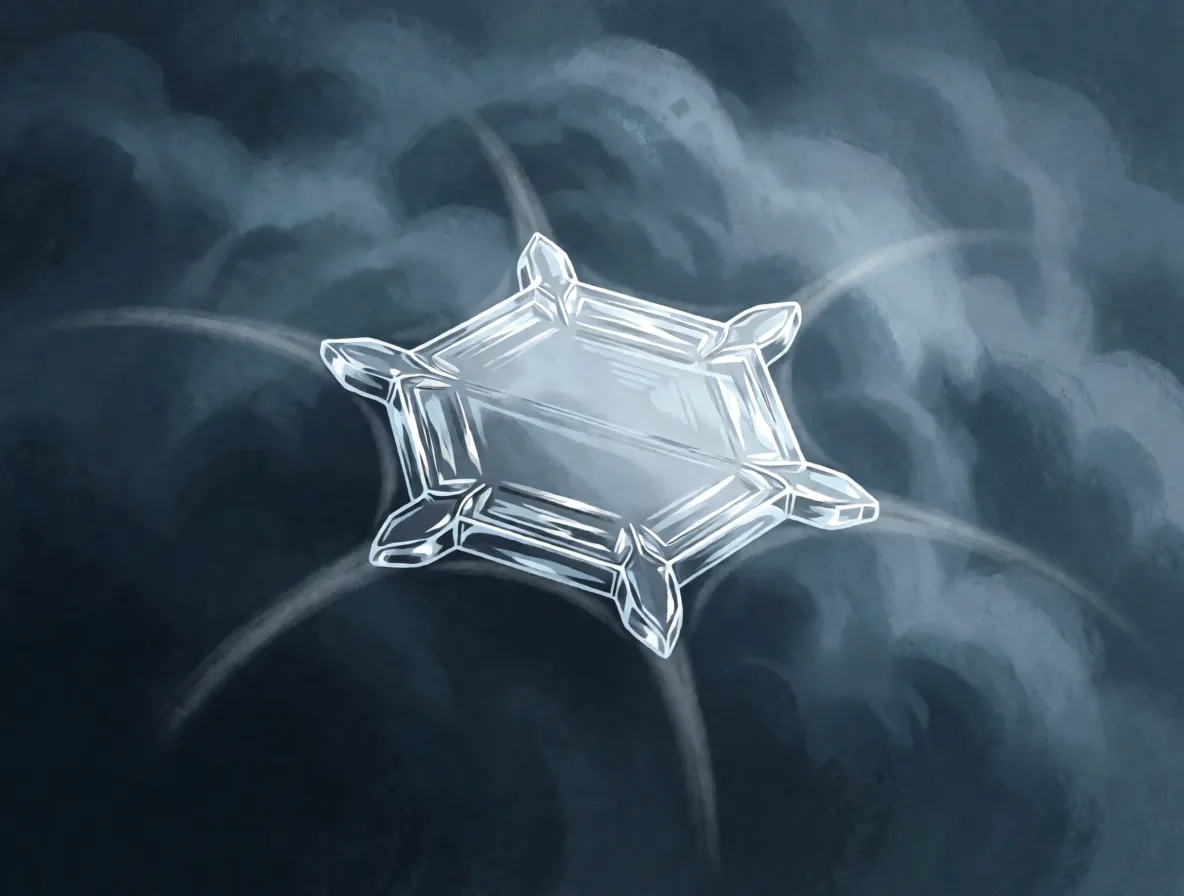
Growing takes vapor, and vapor stops being evenly spread once a crystal starts feeding on it.
Molecules do not fly straight to the ice; they stumble about, colliding with air, and spread slowly. That slow spreading has a name: diffusion.
Every molecule the crystal captures is one removed from the surrounding air. A depleted layer builds up around each facet, thin and short of vapor. Fresh molecules have to diffuse in through that layer, and diffusion is slow.
A corner sits outside that layer, projecting past it into air nothing has stripped yet. Molecules arrive at a corner sooner than at the middle of a facet, so the corner grows faster.
That is the entire trick, and it deserves saying plainly: whichever parts of a crystal stick out are fed first.
Once a corner is ahead, it stays ahead
An advantage that feeds itself does not stay small.
Follow one corner. It grows slightly faster, so it projects slightly further, which puts it in richer air, so it grows faster still. Further out, faster. Faster, further out. Within minutes the six corners have stretched into six arms, and the plate they came from is a hub in the middle.
Every arm is built from the same hexagonal rings, so every arm carries corners of its own. Each bump along an arm is a fresh corner running away in exactly the same manner. Those become the side branches, which is why they always leave the arm at the same angle.
Nothing ever enlarged the hexagon. The corners copied it outward, again and again, in a race they could not lose. That explains six. It explains nothing about why the six arms on one flake so often match.
Nobody grew a snowflake on purpose until 1936
For 270 years everybody could draw the six, and nobody could grow it.
In 1665 the English scientist Robert Hooke held snow and frost under one of the earliest microscopes, and drew six-branched figures far more elaborate than anyone suspected. Drawings accumulated for centuries afterward, but nobody could grow a snow crystal deliberately and watch it happen.
Ukichiro Nakaya, a Japanese physicist at Hokkaido University, decided to try. He began in 1933, when your great-grandparents were children, and the difficulty turned out to be embarrassingly practical. A crystal needs somewhere to start, and everything he suspended in his freezing chamber simply furred over with frost. Wool, silk, cotton thread, fine wire, even spider silk. Frost, every time.
What worked was a single rabbit hair, which carries tiny knobs spaced along its length, and one knob is a small enough perch for one crystal. On March 12, 1936, three years in, a crystal grew on the tip of one while he watched.
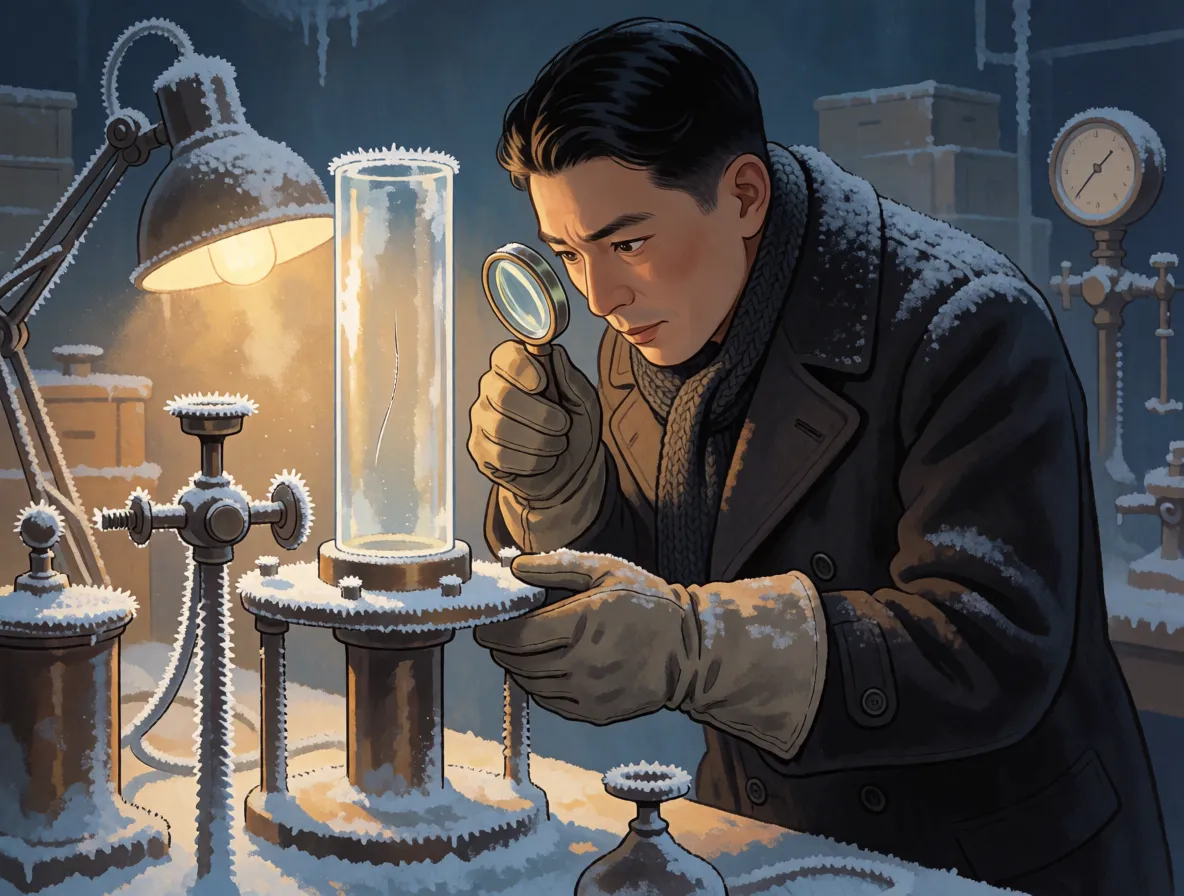
Then he did what photography could never do: he altered the weather, one setting at a time, recording which shape emerged. Three thousand photographs later he had a classification: a map of weather against shape.
Six arms, one journey
The map has a strange shape: a small shift in temperature swaps one form for a completely different one.
Near −15 °C(5 °F) a crystal grows the wide flat six-armed stars everyone pictures. Warm it to about −6 °C(21 °F) and the same water grows needles and stubby columns instead. Raise the humidity, meaning how much vapor the air carries, and the branches multiply. Lower it and you get plain hexagonal tiles with no branches.
Kenneth Libbrecht, a physicist at Caltech in California who published a book of his measurements in 2021, still cannot say exactly why the swaps are so sharp.
A falling crystal encounters all of it, drifting for tens of minutes through air that is never identical twice. The shape it is growing changes whenever the air does, which makes a snow crystal a recording of its own journey.
Now put the six arms back. All six belong to one crystal, packed into a space smaller than a grain of rice, and weather does not vary that finely. When the crystal falls into damper air, all six arms encounter it simultaneously, and all six sprout branches together. Six arms that match is symmetry: one shape repeated evenly around a middle.
The six arms never learn what the others are doing. They agree because they are riding the same piece of sky.
The arms are not copying each other; they are obeying the same instructions at the same moment. Two crystals never travel identical journeys, so they never grow identical shapes.
Grow your own arms in the freezer
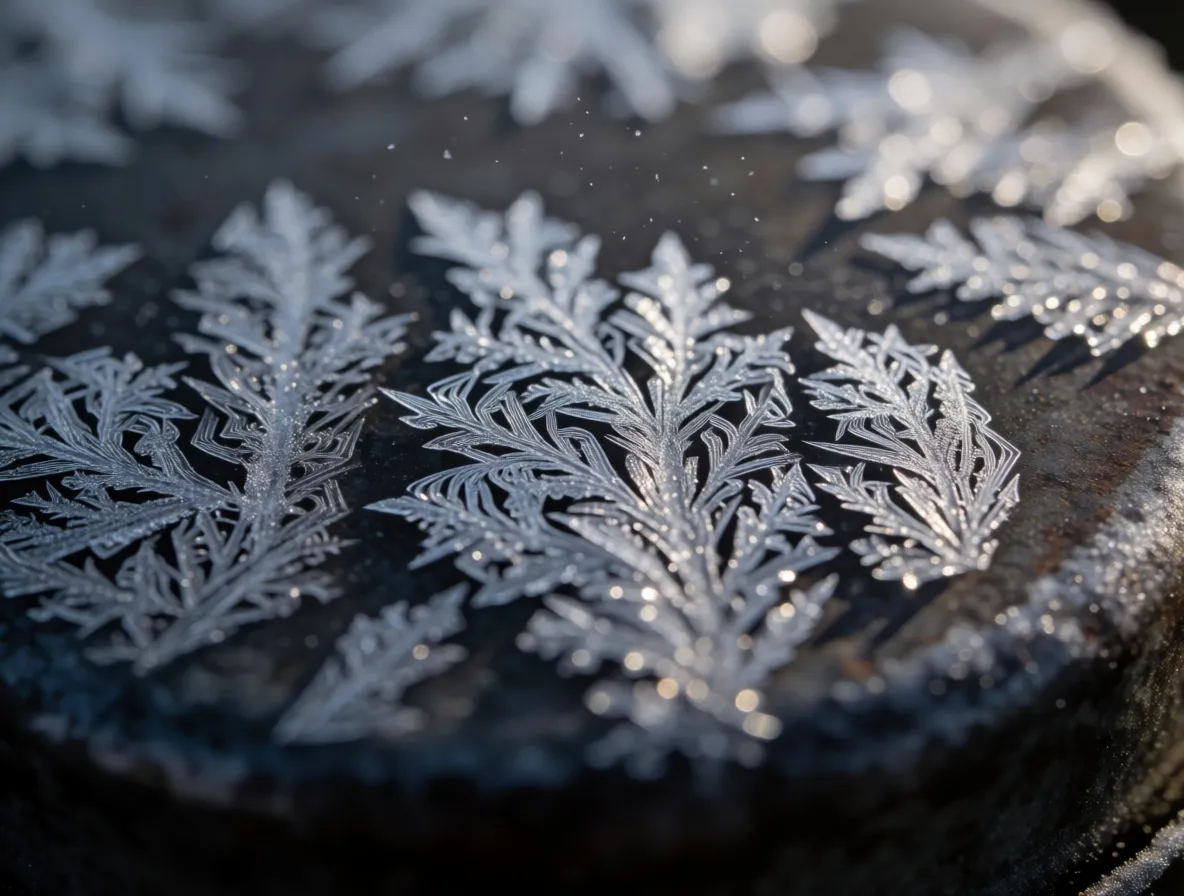
The lid should be furred with frost, and close up much of it is branched. Now compare the cup: same water, same freezer, same night. The cup froze from liquid and is a clear blank lump. The lid grew from vapor and carries feathers.
What is on your sleeve
Go back to the dark sleeve and the flake sitting on it.
It carries six arms because water freezes into hexagonal rings, and because a growing crystal is fed fastest wherever it already projects furthest. Six corners, six advantages, six runaways. Every side branch is the same race happening again, smaller.
Its six arms match because they are one crystal riding one path through one cloud, so whatever shaped one of them shaped all six simultaneously. Examine a real snowfall, though, and most flakes are lopsided. Tidy symmetrical stars are rare, and every snowflake photograph you have ever seen was chosen.
Which is why nobody can hand you the same snowflake twice. Its shape records a fall that will not happen again. A hexagon too small to see, copied outward four and a half million times, until it is finally big enough to land on your sleeve and be counted.