Why did sailors’ old wounds open up again?
In the spring of 1741 a British warship was crawling across the Pacific, its crew dying. One of the sick men had been shot in battle more than fifty years earlier. The wound had closed long ago. Now the old scar opened, as though it had never healed. Nothing had touched it. So what had been holding it shut for fifty years, and why did it let go?
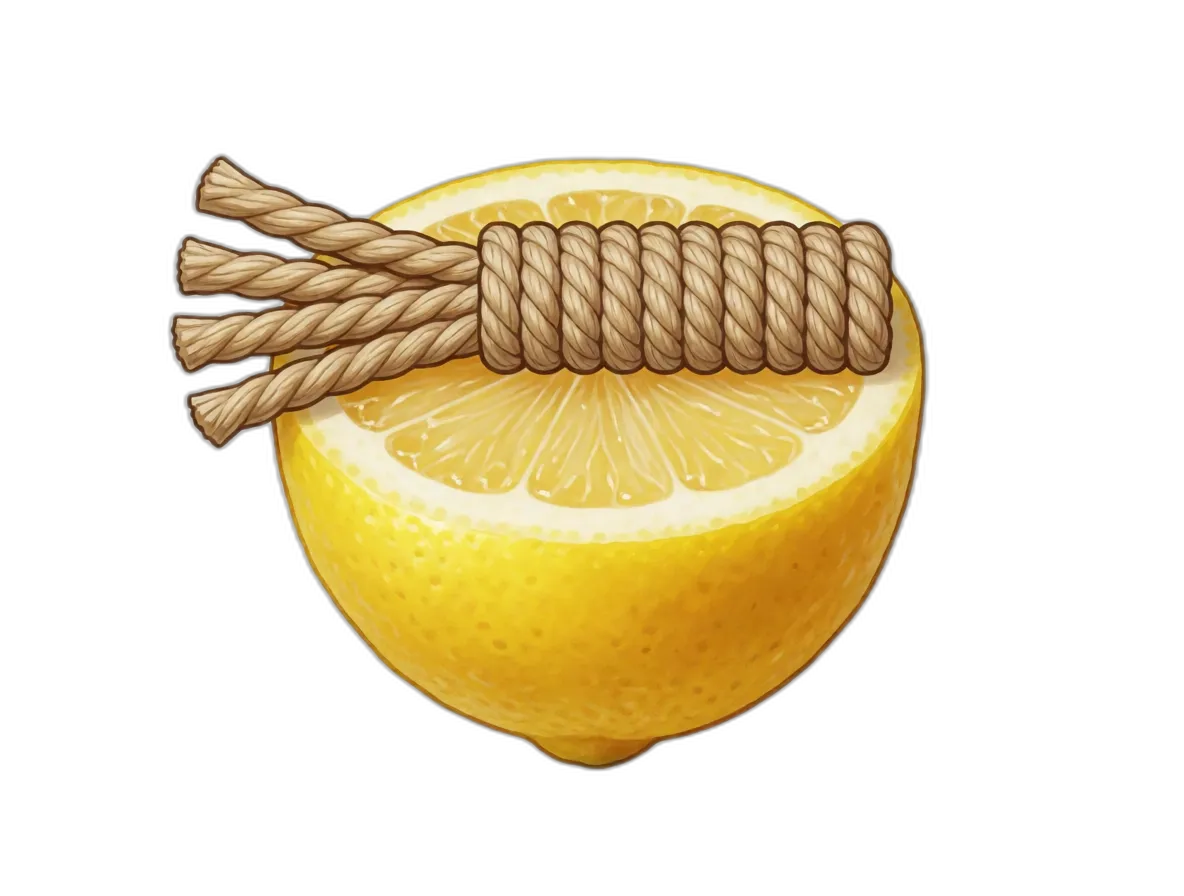
Your body builds itself out of rope. It cannot finish a single length of that rope without help from something it is unable to make, and has to eat.
You are held together by rope
The rope has a name: collagen. It is a protein, a long chain of parts called amino acids, folded into a working shape. It is flexible, almost impossible to stretch, and the most abundant protein in you. Collagen is the structural material of skin, gums, tendons, ligaments, cartilage and the walls of the tiny blood vessels called capillaries. Boil it out of bones and you get gelatin, the wobbly stuff in Jell-O.
Your scars are collagen too. Find an old one on your knee and run a finger across it. It feels smoother and shinier than the skin beside it, a clue to how it was built. Under a microscope, ordinary skin shows ropes criss-crossed in every direction; a scar shows them laid in a hurry, in straight parallel lines.
So the mark on that sailor was rope, and rope does not give way after fifty quiet years. Something was taking it apart.
The rope only holds if it has hooks
A length of collagen is not one strand. Three strands wind around one another, exactly the way the strands of a real rope do. One loose strand stretches and slips; three locked together hold.
They lock only because of something added afterwards. Once a strand is finished, a tool travels along it fitting a tiny hook at set places. The hook is one oxygen atom with a hydrogen attached, bolted onto a particular amino acid. The hooked link has a proper name, hydroxyproline. Call it the hook.
Each hook alters the shape of the link it sits on, and the altered shape lets the three strands settle tightly together. Fit the hooks and the rope survives your body temperature of 37 °C(99 °F). Skip them and the strands unravel at around 24 °C(75 °F), cooler than a warm room. Hookless rope collapses inside you before it is ever used.

So the hooks turn three separate strands into one rope. What fits them?
One small chemical unjams the hook-fitter
The tool that fits the hooks is an enzyme: a machine your body builds to speed up one chemical change, over and over, without being used up. Its real name is prolyl hydroxylase, so the hook-fitter will do. It carries a single iron atom at its tip, and that iron grabs oxygen from the air you just breathed and drives it onto the chain.
Every so often the job misfires. The iron loses an electron, ends up unable to grab anything at all, and the hook-fitter stops dead.
One substance in your body puts that electron back. It is a vitamin: a chemical you need in tiny amounts, cannot manufacture for yourself, and therefore have to eat. Its proper name is ascorbic acid, and almost everybody calls it vitamin C. It is a small molecule with one job here, and doing it restarts the hook-fitter.
Without vitamin C the hook-fitters jam one by one, and the strands built that week never lock into rope. Faulty rope never leaves the place where it was assembled; it is dismantled on the spot.
Nothing in you is ever finished
That explains why a starving sailor could not heal a fresh cut. It does not explain a fifty-year-old scar coming apart.
Your ropes are never left alone. Your body dismantles its own collagen and lays fresh collagen down continuously, everywhere, all your life. Biologists call it turnover; it is really just maintenance. Skin, gums, capillaries, scars: none of them is a finished object sitting where it was put.
Your oldest scar is the newest thing about you.
Surgeons measured the rates in the 1970s, and old scars turn out to be dismantled faster than ordinary skin. So a vitamin C deficiency goes wrong twice over: no replacement rope is made anywhere, while the old rope keeps being removed, fastest of all in a scar. That combination has a name: scurvy.
So the scar did not tear. It was quietly removed from underneath, nothing replaced it, and the old cut was as open as the day he was shot. Working that out took two centuries.
The cure was found, and nobody quite believed it
We know about the man from that battle because the ship’s chaplain wrote him down. Richard Walter sailed with Commodore George Anson’s squadron, which left England in 1740 with eight ships and 1,955 men. Count back from you to your parents, from them to theirs and on: 1740 is ten generations ago. Four years later one ship came home, with 145 of them aboard.
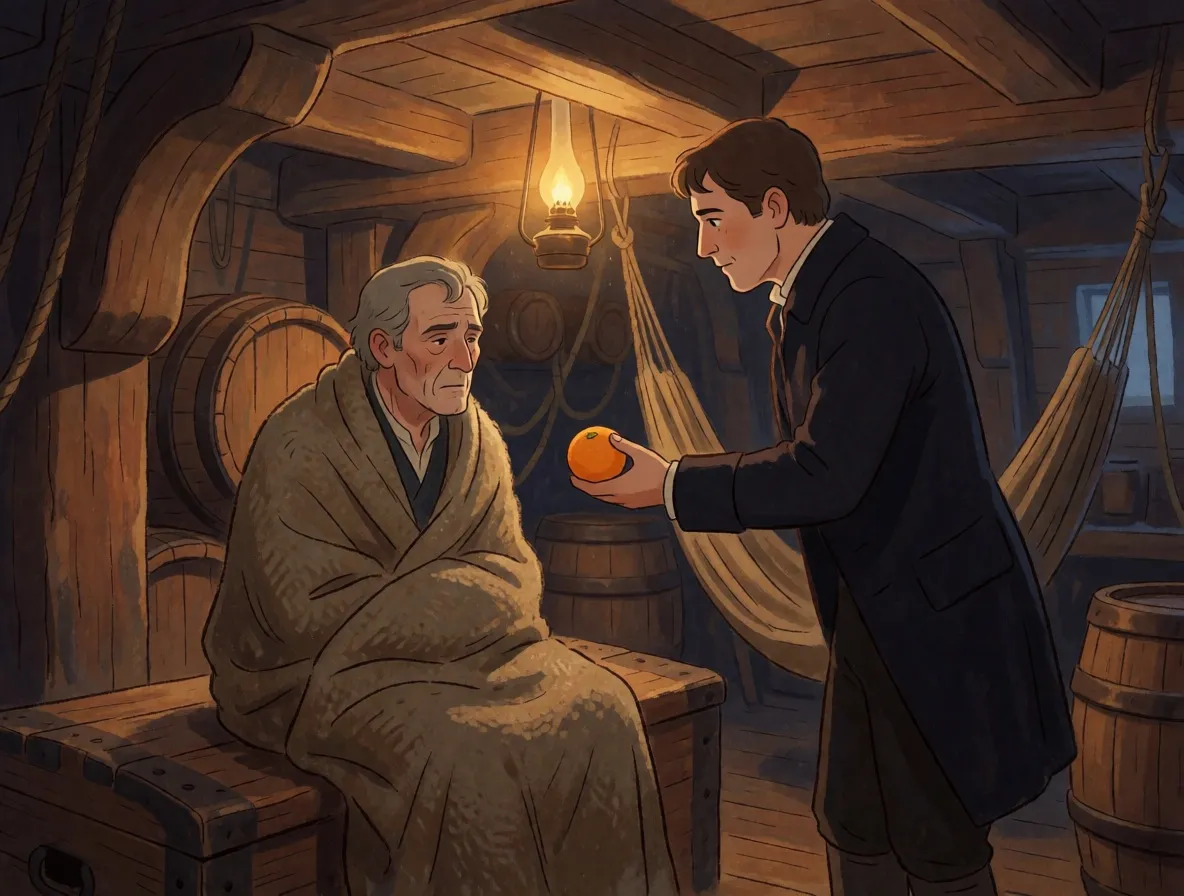
In 1747 a naval surgeon named James Lind ran a controlled experiment aboard HMS Salisbury. He took twelve sick sailors, split them into six pairs, and gave each a different remedy: vinegar for one, seawater for another, cider for a third. The pair fed two oranges and a lemon a day had recovered within six days. Nobody else improved at all.
A medium orange carries about 70 milligrams of vitamin C, and 10 milligrams a day prevents scurvy.
One orange a week. That is all it would have taken.
The story does not end the way it is usually told. Lind never concluded that citrus fruit was the answer. He thought the disease had several causes needing several cures, and his book of 1753 gives the experiment two pages. He also recommended boiling lemon juice into a syrup so it would keep, which quietly destroys the vitamin. The Royal Navy did not issue it fleet-wide until 1795. Lind had died the year before.
Then the navy swapped lemons for limes
Once issued, it worked. Every sailor received 22 ml(¾ oz) of lemon juice a day, about four teaspoons, stirred into his daily rum so he could not skip it. By 1799 the disease had almost vanished from the fleet.
Then, around 1860, the navy switched to limes grown in British colonies: citrus, cheaper, and surely just as good. Limes carry roughly a quarter the potency of lemons, and the juice was pumped through copper pipes and left standing in air, destroying much of the remainder. In 1918 Harriette Chick tested the navy’s lime juice at the Lister Institute and found it did practically nothing.
So for sixty years British sailors drank a cure with the cure taken out, and the disease returned on long voyages, famously on Antarctic expeditions.
Nobody had ever held the substance itself. That took until 1928, when Albert Szent-Györgyi extracted an unknown chemical from animal glands. In 1932 his laboratory found it in Hungarian paprika, and other researchers proved it was the missing ingredient. He and Norman Haworth renamed it ascorbic acid in 1933, 186 years after Lind boiled it out of his lemon juice.
Boil the juice and watch the cure vanish
Lind’s syrup was a sensible idea that destroyed what it was meant to preserve. You can watch that happen on a stove.

Divide the smaller count by the larger: that is the fraction that survived the heat, usually well under half. Lind sent his syrup to sea in good faith. Roughly that much arrived.
The scar was never a finished thing
Anson’s men were not unlucky in some mysterious way. Their provisions were salt beef, hard biscuit, dried peas, cheese and beer, none of which carries any vitamin C. Your body stores under half a teaspoon of it and spends a thirtieth daily, so two months from land empties the store. Officers fared better: they brought their own onions and marmalade aboard.
Here is the piece hiding in plain sight: almost every other animal manages without oranges. A dog manufactures its own vitamin C in its liver, and so do cats, cows and rats. We cannot, because the last gene in the recipe is broken in humans, in monkeys and apes, and in guinea pigs. Our ancestors presumably ate enough fruit for it not to matter. The ruined copy still sits in your DNA, doing nothing.
So that sailor was not carrying a fifty-one-year-old scar. He was carrying rope, taken down and rewound thousands of times since the year he was shot. Somewhere off Cape Horn the rewinding stopped. His wound had never truly closed. It had only been closed again, and again, and again, by a body still quietly doing the work fifty-one years later.