Why do onions make you cry?
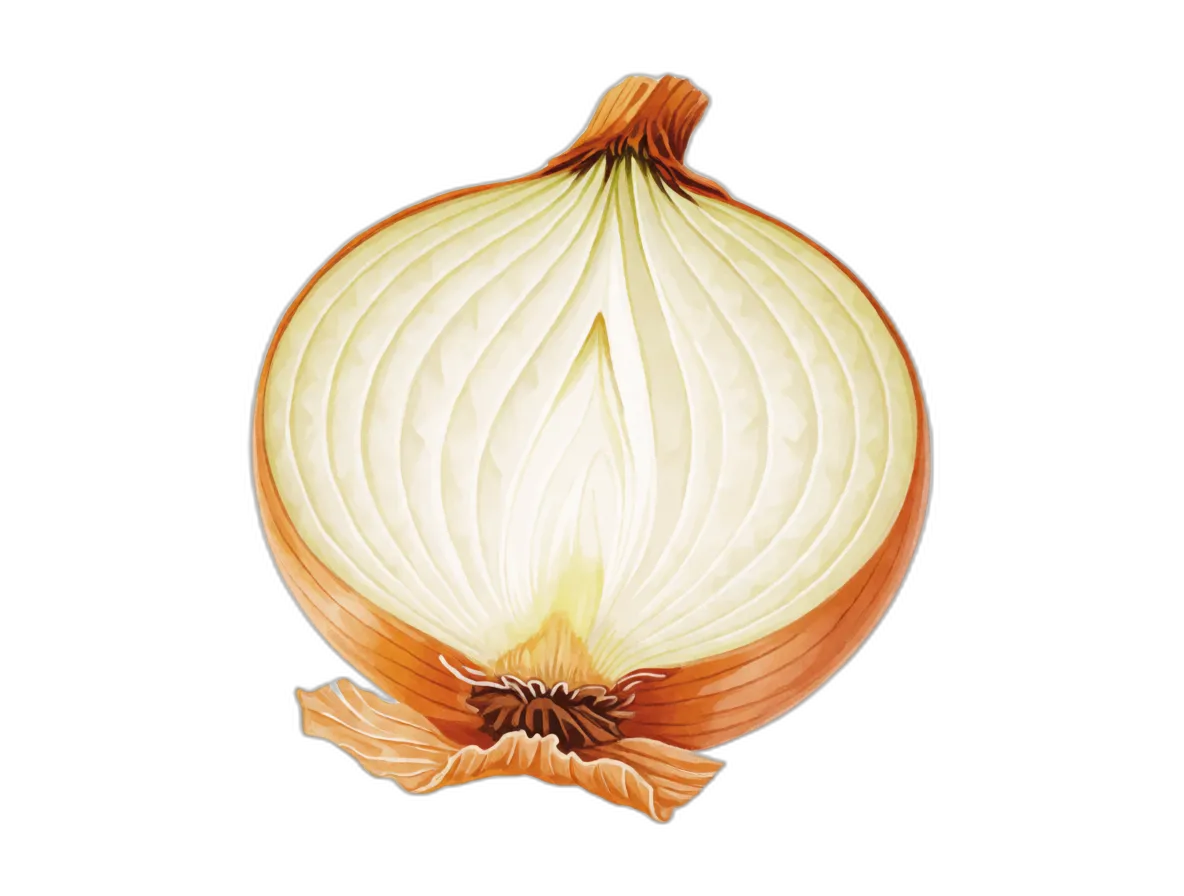
There is half an onion on the board and your eyes have started to sting. Nothing splashed you, and you have not touched your face. That onion sat in the vegetable drawer for three weeks without troubling anybody. Something crossed the gap between the board and your eyes, and it did not exist before the knife went in. So what did the cutting build, and why did it come straight for you?
An onion keeps the two halves of a weapon in separate rooms, and it never mixes them itself. Your knife does the mixing. Everything else happens in the next two seconds.
A whole onion is harmless
Leave an onion on the counter for a month and it will do nothing to you. Sniff it, roll it, hold it against your face. Nothing. That is not because the onion is empty. It is because everything in it is stored apart.
An onion is built from cells, like every living thing: microscopic compartments of watery liquid, each wrapped in its own membrane. Inside a single onion cell floats a second bag, the vacuole, filling most of the space.
The liquid surrounding the vacuole is the cytoplasm, and it holds a stockpile of one particular molecule. A molecule is a fixed group of atoms, the smallest particles chemistry deals in, locked into one arrangement. This one is harmless and has no smell, and the onion has spent the whole winter accumulating it.
Sealed inside the vacuole is the thing that takes it apart. While the wall holds, they never meet. Every caterpillar that bites an onion ruptures that wall, which is exactly the point.
Try it on a plant near you. Tear a blade of grass and smell the torn edge. That sharp green smell arrives a second or two afterwards, because it is being manufactured while you hold it.
So an onion carries no tear gas about. It carries the ingredients, kept apart and ready. The knife introduces them.
The knife splits one molecule into two
The thing waiting in the vacuole is an enzyme. An enzyme makes one particular chemical change happen over and over, at enormous speed, without being consumed itself. Chemists call this one alliinase. Call it the splitter.
A knife ruptures every cell along its path, and one slice across an onion opens roughly a million of them. Vacuoles burst, the splitter floods into the cytoplasm, and it finally meets the molecule it was designed for.
The stored molecule is a modest object: twenty-two atoms arranged around a single atom of sulfur. The splitter breaks it into two halves of exactly eleven atoms each. Nothing is added and nothing discarded.
One cut, one molecule, two halves.
One half is a scrap of the ordinary material living things assemble themselves from. The other half keeps the sulfur, and it is desperately unstable. Left alone it disintegrates almost immediately.
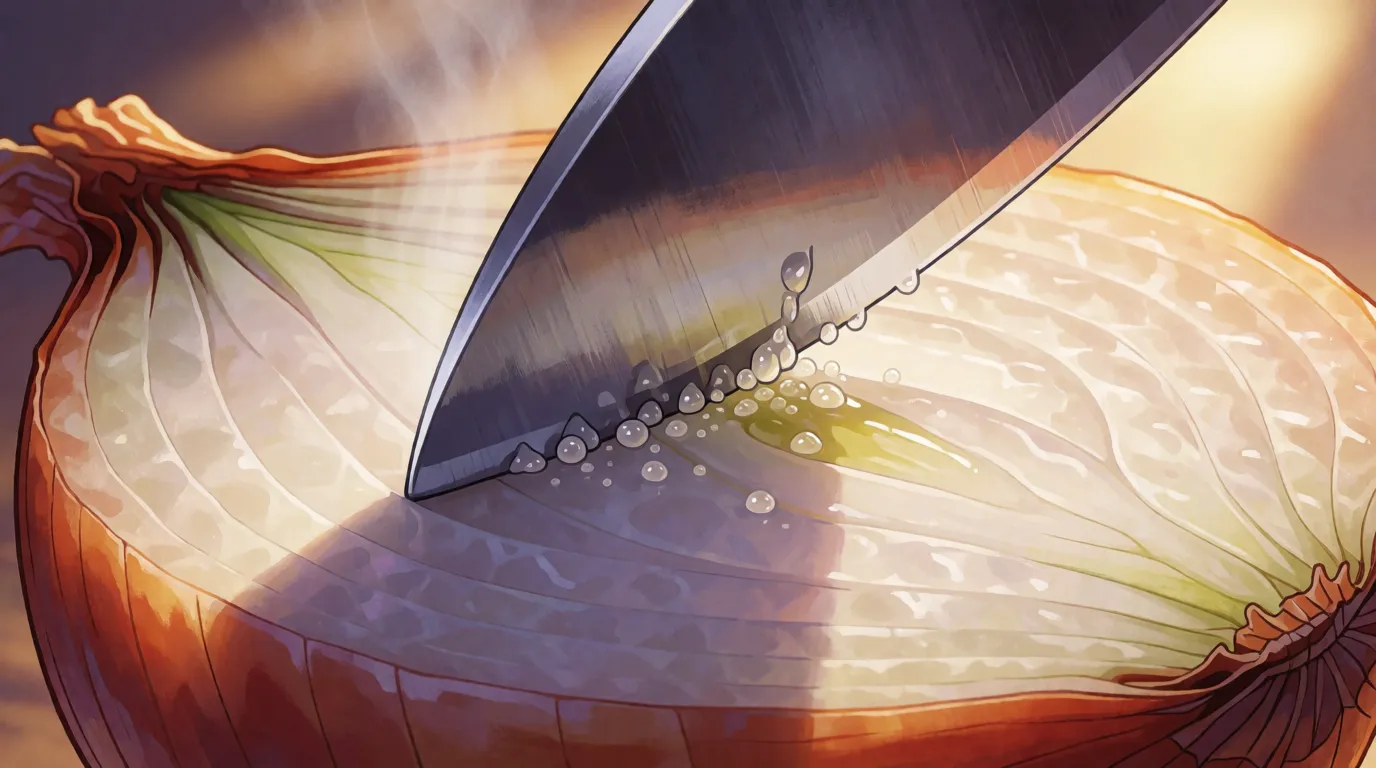
So the first second after a cut leaves an onion full of a sulfur fragment that cannot survive. What reaches that fragment first decides whether your eyes stay dry.
One hydrogen atom is why it reaches you
A second enzyme gets there first. Its name is lachrymatory factor synthase, from the Latin word for a tear. From here on, the tear-maker.
The tear-maker cuts nothing. It accepts the eleven atoms it is handed and relocates exactly one. A single hydrogen atom is lifted off the oxygen it was perched on and set down on a carbon two places along. Same eleven atoms, different molecule. Chemists call the result syn-propanethial S-oxide. It is the only substance here capable of making you cry, so: the tear molecule.
Relocating one hydrogen sounds like nothing whatsoever. It is the entire answer.
Water molecules seize any hydrogen sitting on an oxygen, and they seize it hard. That grip is the strongest hold water has, and it is what kept the onion’s stockpile dissolved in the cytoplasm all winter. Move the hydrogen onto a carbon, and the surrounding water has nothing left to grasp.
The tear molecule is small and light, and the liquid around it can barely contain it. Molecules in a liquid jostle constantly, and now and then one is knocked hard enough to fly out through the surface. For this one that happens continuously. A liquid that escapes into the air at room temperature is volatile, and few things a kitchen produces are more volatile.
That is the step people skip over. Within a second or two of the cut, the tear molecule is airborne. It lifts off the board, spreads the way any smell spreads, and reaches the wet surface of your eye, roughly 40 cm(16 in) above.
Your eye’s own water finishes the job
Your eye is never dry. A film of salty liquid covers the front of it, renewed with every blink. The tear molecule dissolves into that film the instant it lands, and in water it disintegrates.
It breaks into three pieces, and one is sulfuric acid. An acid surrenders a fragment of itself to whatever it touches, and sulfuric is the fiercest sort. The quantity is absurdly tiny and cannot injure you. You know the feeling from lemon juice in a cut lip.
Your eye, though, has no skin. The transparent window at the front of it is the cornea, crowded with bare nerve endings — the exposed tips of nerves that report damage. Nothing covers them, which is why one eyelash feels enormous.
Those endings fire. The signal reaches your brain and returns as a protective reflex, an action your body performs without consulting you. Your tear glands, the lacrimal glands above each eye, flood the surface, diluting the acid and sluicing it away. You are not upset and you are not being poisoned. You are being rinsed.
Nothing on that board touches your face. The attack is carried by one molecule light enough to leave the juice by itself.
That is the whole route: board, air, eye, acid, tears. Establishing that an onion needs two enzymes, not one, took forty years.
For forty years nobody looked for the second enzyme
Artturi Virtanen was a Finnish biochemist who had already won a Nobel Prize for discovering how to stop cattle feed rotting. In 1961, when your grandparents were at school, he and a colleague identified what an onion stores and what the tears are made of.
The picture he left behind contained one enzyme. The onion held its harmless molecule, the splitter cut that molecule in half, and the sulfur fragment then rearranged itself into the tear molecule unaided. Nobody hunted for a cause, because rearranging is what unstable fragments do.
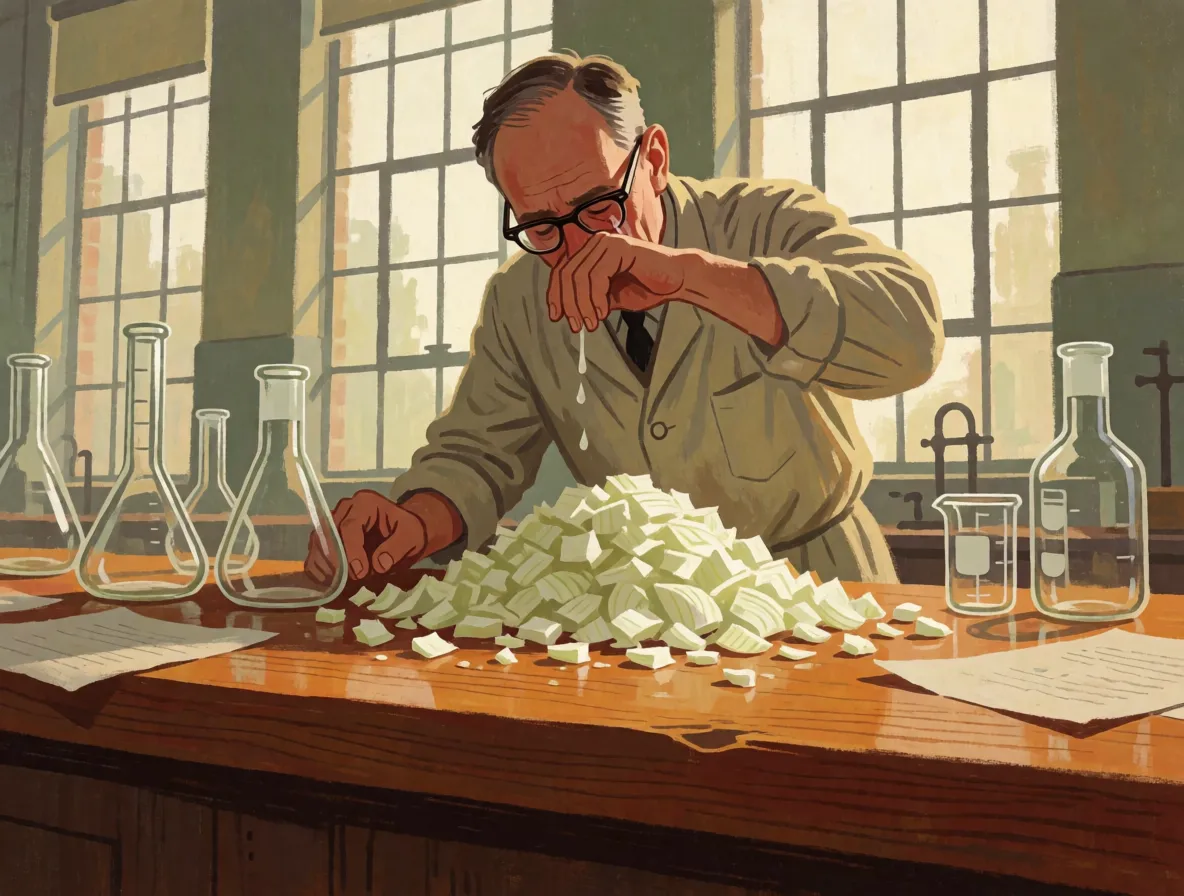
That explanation held for four decades, and it quietly closed a door. You cannot switch off a step that nothing performs, so a tearless onion looked impossible.
The correction came from a food company. In 2002 Shinsuke Imai and six colleagues at House Foods Corporation, near Tokyo, demonstrated that the rearrangement does not happen by itself. Something performs it. They had found the tear-maker, and announced it in one page of the journal Nature.
In 2008 Colin Eady, in New Zealand, switched the tear-maker off. His onions grew normally, and the sulfur destined for the tear molecule went into other flavor molecules instead. That variety never reached a shop, although growers have since bred ordinary onions that manufacture far less.
So the tears cost the plant two enzymes and a wall between them. Machinery like that can be slowed down, and a kitchen counter will measure by how much.
Race a cold onion against a warm one
Enzymes work briskly when warm and sluggishly when cold. Evaporation slows in the cold too, because molecules in a chilly liquid jostle more feebly. Refrigerate half an onion and you obstruct two steps at once.
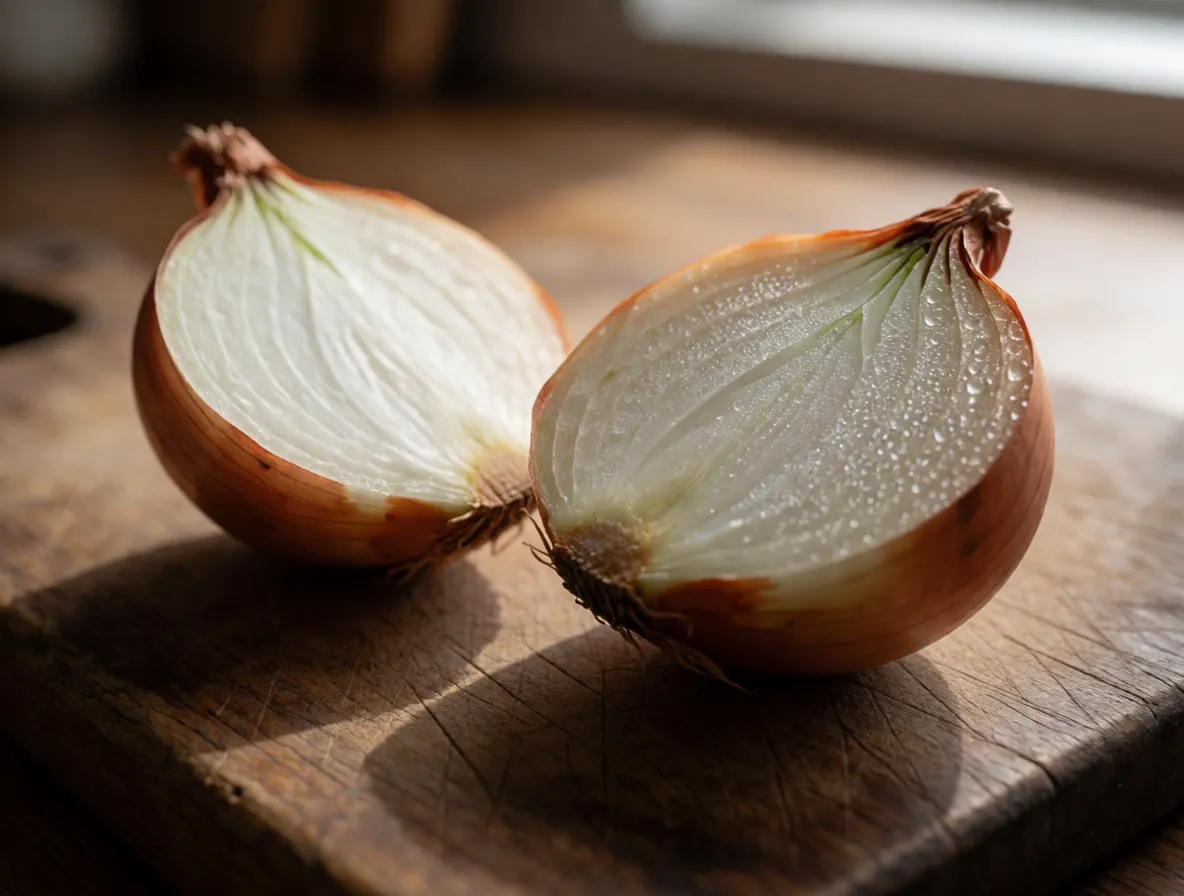
Most people buy several times longer with the cold half. Step five is the part nobody predicts.
Why a bowl of chopped onion stops bothering you
You have probably noticed this without ever asking. The stinging is worst in the first half minute of chopping. Return to the same bowl twenty minutes later and you can put your face directly over it.
The tear molecule cannot be stored. It drifts into the room, it falls apart on its own, and no more is manufactured once the last ruptured cells have finished spilling. One study put the peak at around thirty seconds after the damage, with the whole performance over inside five minutes. The molecule that made you cry no longer exists.
Which answers the question you started with. Nothing came out of the onion. The onion kept two harmless chemicals in two separate rooms, and your knife performed the one step it could never perform for itself. What stung you was built on the board, in the second after the blade went through, out of ingredients that had waited all winter for something to take a bite.