Why does rust make iron swell and crack?
There is an old painted gate in somebody’s garden with an orange patch near the hinge. Everyone says rust eats metal away. But the paint at the edge of that patch has not worn thin and sunk in. It stands up off the gate in a blister that crackles when you press it. Something underneath is getting bigger, which is a peculiar thing for a hole to do.
Nothing is taken out of a rusting bar. Iron grabs hold of oxygen and water, and the material it builds occupies more than twice the room the iron had. It has to go somewhere, so it pushes.
Rust only forms where water and air meet
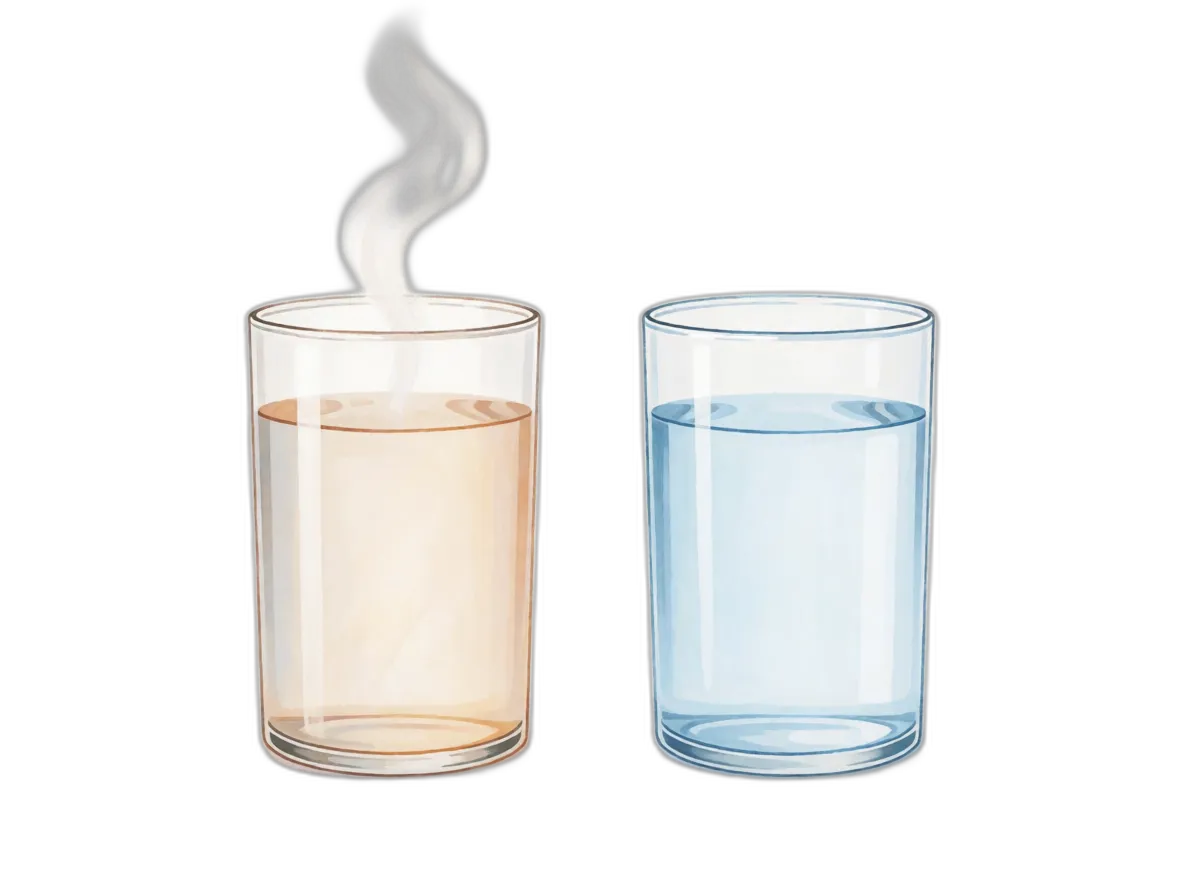
Leave a steel nail on a shelf indoors and it sits there for years looking new. Drop the same nail into a saucer of water and it goes orange overnight. Boil the water first, seal the air away, and the nail stays clean.
Rusting needs water and oxygen together. Remove either one and it stops completely. A bike chain survives a dry summer and dies in one wet October.
Everything solid is built from atoms: the smallest particles a material can be broken into and still be that material. A bar of iron is a stack of iron atoms. Air is mostly nitrogen, with about a fifth of it oxygen.
Water landing on iron dissolves oxygen out of the air and carries it against the metal. There the two lock together, combining into an oxide: the name for anything a metal makes by joining with oxygen. Rust is an iron oxide with water molecules caught inside.
So rusting is a chemical joining. A bar joining onto things cannot be losing anything.
A rusting bar gets heavier
It gains weight, and chemists took a long time to believe that. In the spring of 1774, roughly eight generations before you were born, the French chemist Antoine Lavoisier heated tin and lead in sealed glass vessels and weighed everything carefully. The metal crumbled to grey powder and grew heavier. The vessel as a whole did not change weight at all, and when he cracked the seal, air rushed in from outside. The weight the metal gained had come out of the air shut in with it.
Everyone had believed the opposite. Rusting supposedly released a substance called phlogiston, so a rusted metal ought to finish lighter. It never did, and the explanations grew stranger. In 1778 Lavoisier ended the argument by naming the useful part of the air: oxygen.
That grey powder is an oxide too. Rust is the version iron makes, slowly, in the rain.A rusting bar is collecting material rather than shedding it, and material that arrives has to fit somewhere.
The new material needs twice the room
Inside a bar of iron the atoms are packed as tightly as atoms can be. They sit in a crystal lattice: a repeating three-dimensional grid where every atom touches its neighbors on all sides. There is no spare space in it.
Rust is those same iron atoms with oxygen wedged between them and water caught in the gaps. That arrangement is looser and far less orderly, so it occupies more space.
In 1923 Pilling and Bedworth measured how much more. They let metal corrode completely, then compared the volume of the oxide with that of the metal. Their measurement is now the Pilling–Bedworth ratio, and every metal has one.
Iron comes out at 2.14, so every scrap that rusts needs slightly more than twice the space it occupied as metal.
Twice the room, in a position that had exactly enough room for iron. On the open face of a gate the surplus stands out into the air. Underneath paint, or inside concrete, there is nowhere for it to go.
Iron’s skin splits and falls off
Every metal exposed to air grows a skin of oxide. Whether that skin is protective depends entirely on how well it fits.
Pilling and Bedworth found the dividing line in their own numbers. Below 2, the oxide is only slightly roomier than the metal it replaced, so the skin stretches across and holds. Above 2 it cannot possibly cover the ground beneath it, so it wrinkles, cracks and lifts away in flakes.
Iron’s 2.14 is on the wrong side of that line by a whisker, and a whisker is enough.
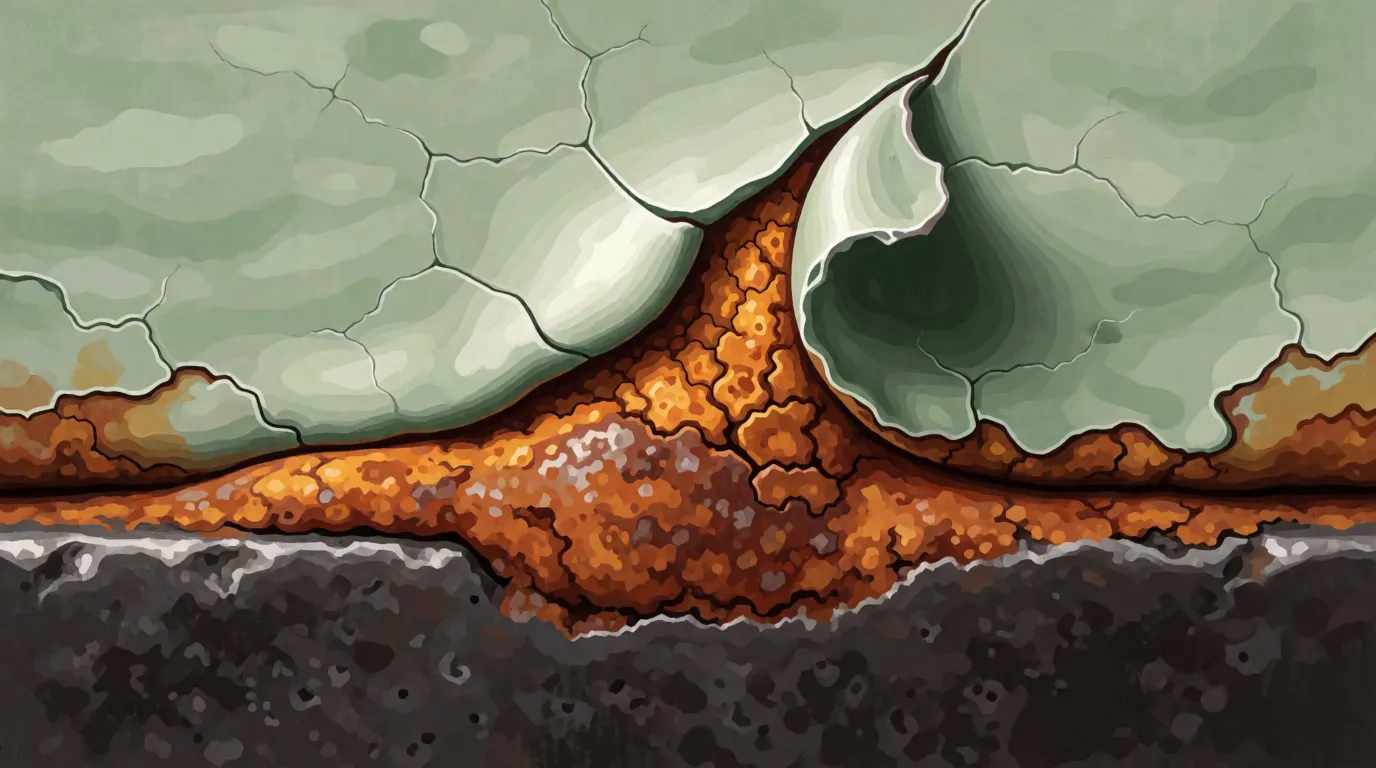
Rust is also porous: riddled with microscopic holes that let water seep through to the metal below. So a rust patch never settles down. The flake curls away, clean iron is uncovered, another shower arrives, and it all begins again.
You have probably walked past that first stage a hundred times. On a gate, a railing or an abandoned bike frame, the paint around an orange patch is lifted into a low dome that crackles under a fingernail. It was pushed up from below.
Iron’s skin cannot protect iron, because it will not stay on. Where it is trapped, something else must give.
A push strong enough to split concrete
Reinforced concrete is concrete with steel bars buried inside it. Concrete cracks when stretched and steel does not, so builders lay bars roughly 12 mm(½ in) thick through the slabs. Almost every road bridge you have crossed is built this way.
Fresh concrete is strongly alkaline, the opposite of acidic, and that chemistry alone protects the bars from corroding for several decades. Then salt spread on the road each winter gradually soaks down, and the protection fails.
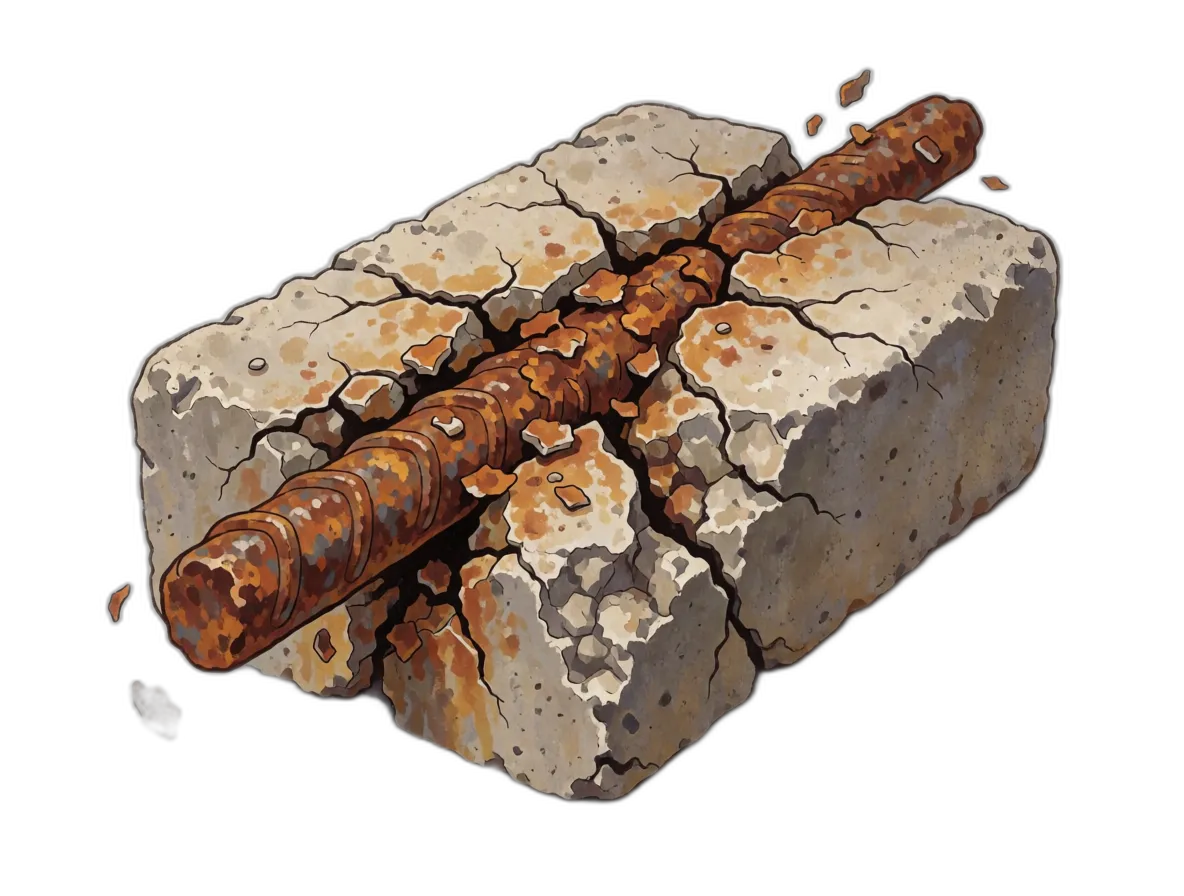
Now the bars corrode, and rust demands twice the room. There is none. Eventually the surrounding concrete surrenders, and flat plates of it drop off the underside of the bridge, leaving orange bars dangling. Engineers call this oxide jacking: iron levering a structure apart by sheer expansion.
A bar you cannot see, expanding by a couple of millimeters, can break the stone around it. People keep rediscovering that while looking after something old.
The iron that cracked the Parthenon
The Parthenon is the ancient marble temple above Athens, and it has stood there, in various states of ruin, for two and a half thousand years. Between 1894 and 1939, nearly half a century, the Greek architect Nikolaos Balanos hauled its fallen blocks back into position.
To pin them together he used iron clamps. Iron in a monument like that is normally sealed inside a casing of lead, which keeps water off it permanently. Balanos left the lead out, setting his clamps in concrete.
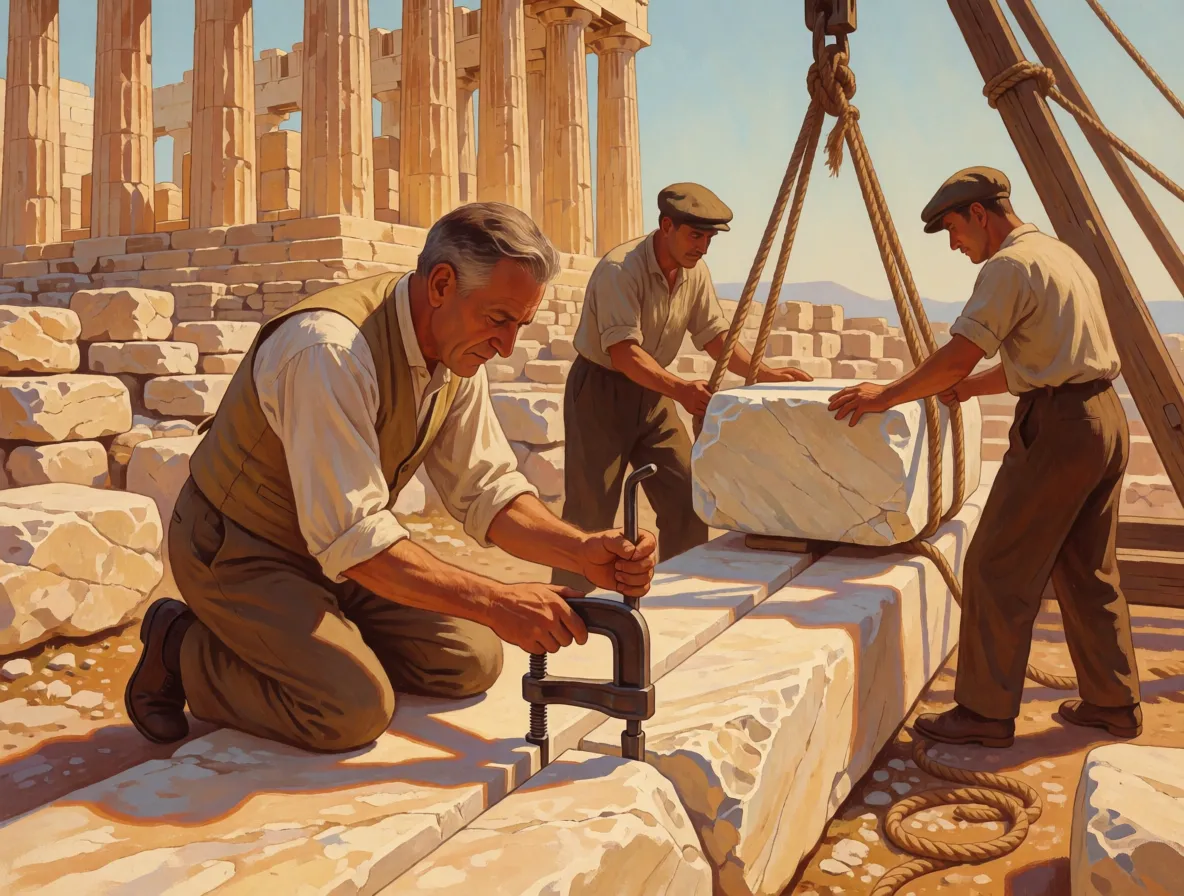
Rain reached the iron anyway. The clamps corroded and swelled, and marble that had survived twenty-five centuries began cracking from within. Since the 1980s a Greek team has been dismantling his restoration, extracting the iron and replacing it with titanium.
Titanium’s ratio is 1.73, comfortably under the line, so its oxide skin fits. The iron was far stronger than the marble, and that is exactly why the marble lost.
Aluminum’s skin fits, so it stays on
Aluminum is the softer metal, soft enough to dent a can with your thumb. Yet an ordinary aluminum ladder stands in a garden for twenty years and comes indoors with nothing worse than a dull grey bloom.
Aluminum is not refusing to react. It is more reactive than iron. A freshly cut surface starts oxidizing almost instantly, and within moments wears a complete skin, so thin that it is invisible.
That skin is a passive layer: an oxide coating tight enough to seal the metal beneath and halt the corrosion entirely. Aluminum’s ratio is 1.28. Its oxide needs about a quarter more room than the metal it replaced, and a skin absorbs that difference by stretching. So it grips and seals, and the aluminum underneath never meets the air again.
Aluminum is not the tougher metal. It is the one whose rust happens to be the right size.
Scratch through the layer and the scratch does not last, because a fresh one seals the gap immediately. Iron cannot manage this, however. Iron’s skin is too big from the moment it forms, and a skin that does not fit comes off.
Watch iron pull the air out of a glass
Everything above rests on iron taking oxygen out of the air. About a fifth of the air is oxygen, so iron rusting inside a sealed container ought to consume that fifth. You can watch it disappear.
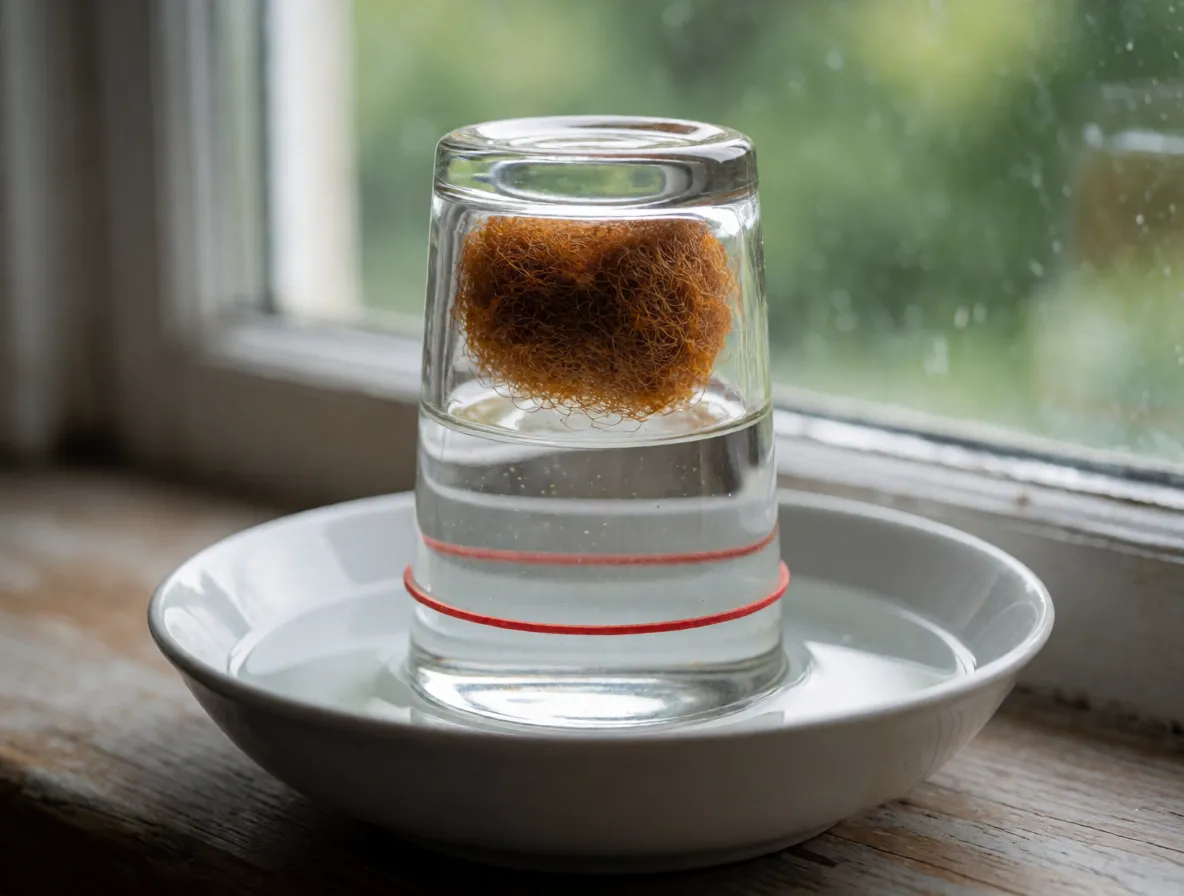
The damp glass is already orange within a day. Over the week the water inside climbs steadily, then stops. In a glass 12 cm(5 in) tall it finishes near the mark below. The dry glass does absolutely nothing.
How far the water should climb in a glass this tall.
The water rose because there is less air in the glass than there was originally. The iron took it. Every oxygen atom missing from that glass now sits between two iron atoms in the crust.
Back to the blistered gate
Look once more at the blister. Underneath it is iron that has pulled oxygen from the atmosphere and water from the rain, and assembled something needing twice the space it started with. The paint had to move, so it went up.
The aluminum window frames on the same building will still be sound in fifty years, wearing a skin they grew in their first second. Iron grows a skin too, every time it rains. Iron’s is simply the wrong size.