Why can hot water freeze faster than cold?
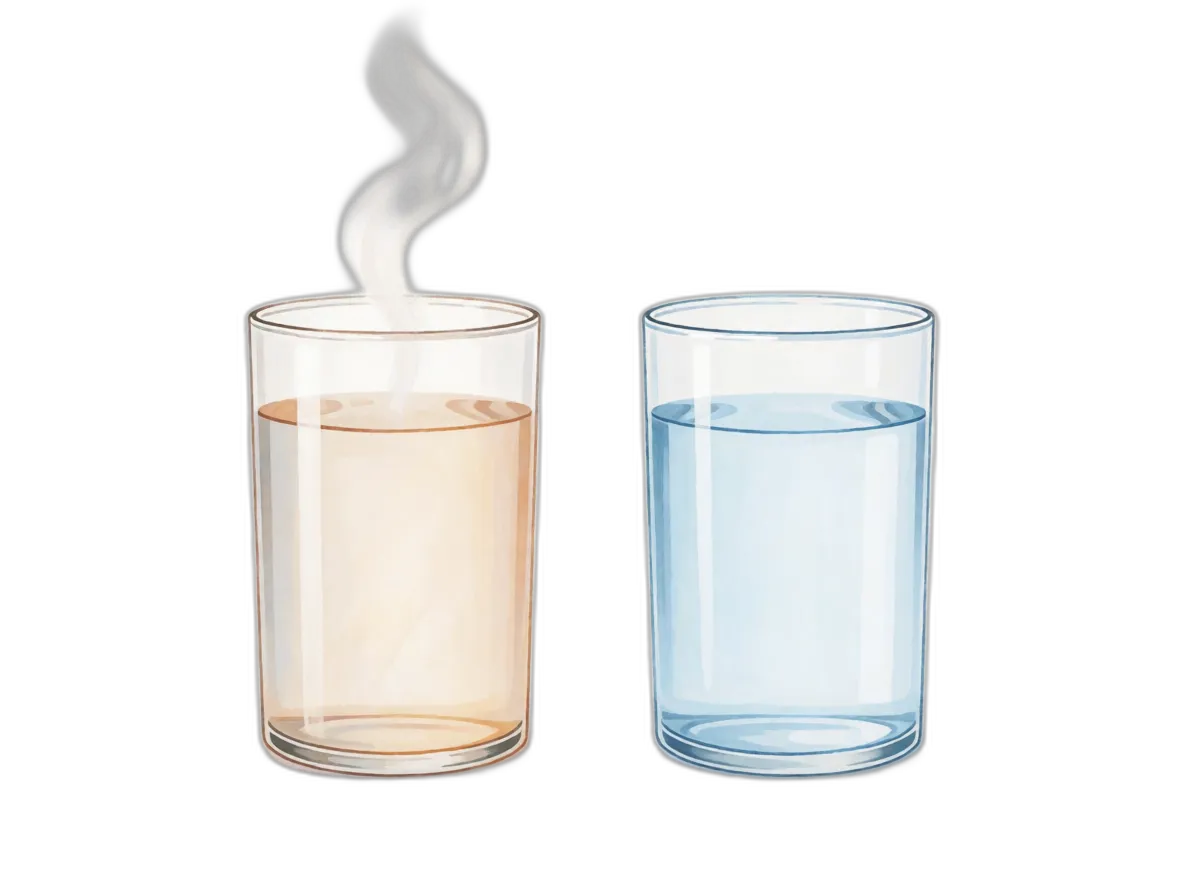
Hot water has further to go. It has to cool all the way down through the temperature the cold water started at, and then keep going, so it obviously cannot get there first. Except that people have been reporting exactly that for two thousand years, and one of them was a fifteen-year-old making ice cream who was told he was imagining it. He was not, quite. Neither was everybody who cannot reproduce it.
Sometimes hot water really does win, and after sixty years of careful work nobody can reliably say when, or why.
Freezing is more complicated than cooling
Start with the objection, because it is a good one. Cool two identical containers of water, one at 35 °C(95 °F) and one at 5 °C(41 °F), and the hot one must pass through five degrees on its way down.
If freezing were purely a matter of losing heat, the race would be settled there. The hot water arrives at the cold water’s starting temperature later, and everything afterward is identical.
Two things spoil that tidy argument. The first is that the two containers do not stay identical. Heating water changes it: some evaporates away, dissolved gases escape, and it stirs itself far more vigorously.
The second is that reaching zero degrees is not the same as freezing. Water often sits well below zero as a liquid, waiting for something to start the first ice crystal, a state called supercooling. Two samples that reach zero together can still turn solid minutes apart.
So the race has at least two finish lines, and which one you choose changes who wins.
Four suspects, none of them convicted
The first suspect is evaporation: water escaping as vapor from the surface. Hot water evaporates faster, so it loses mass, and a smaller amount of water freezes sooner.
A hot beaker losing water while it cools, out of the amount it started with.
Three percent is not nothing, and it is nowhere near enough to explain a difference of several minutes. Evaporation is real and it is too small to be the answer on its own.
The second suspect is convection: the circulation you get when warm water rises, cools at the surface and sinks again. Hot water stirs itself vigorously, delivering its heat to the surface quickly, and it may continue cooling faster than expected even after the temperatures match.
The third is dissolved gas. Warm water holds less air, and boiling drives most of it out, which changes how the liquid moves and where ice can start.
The fourth is the freezer itself. A hot container melts the frost underneath it and settles into direct contact with the cold shelf, while a cold container sits on a layer of frost that insulates it.
Every explanation on the list is real. Not one of them is big enough, and stacking them up is not the same as proving them.
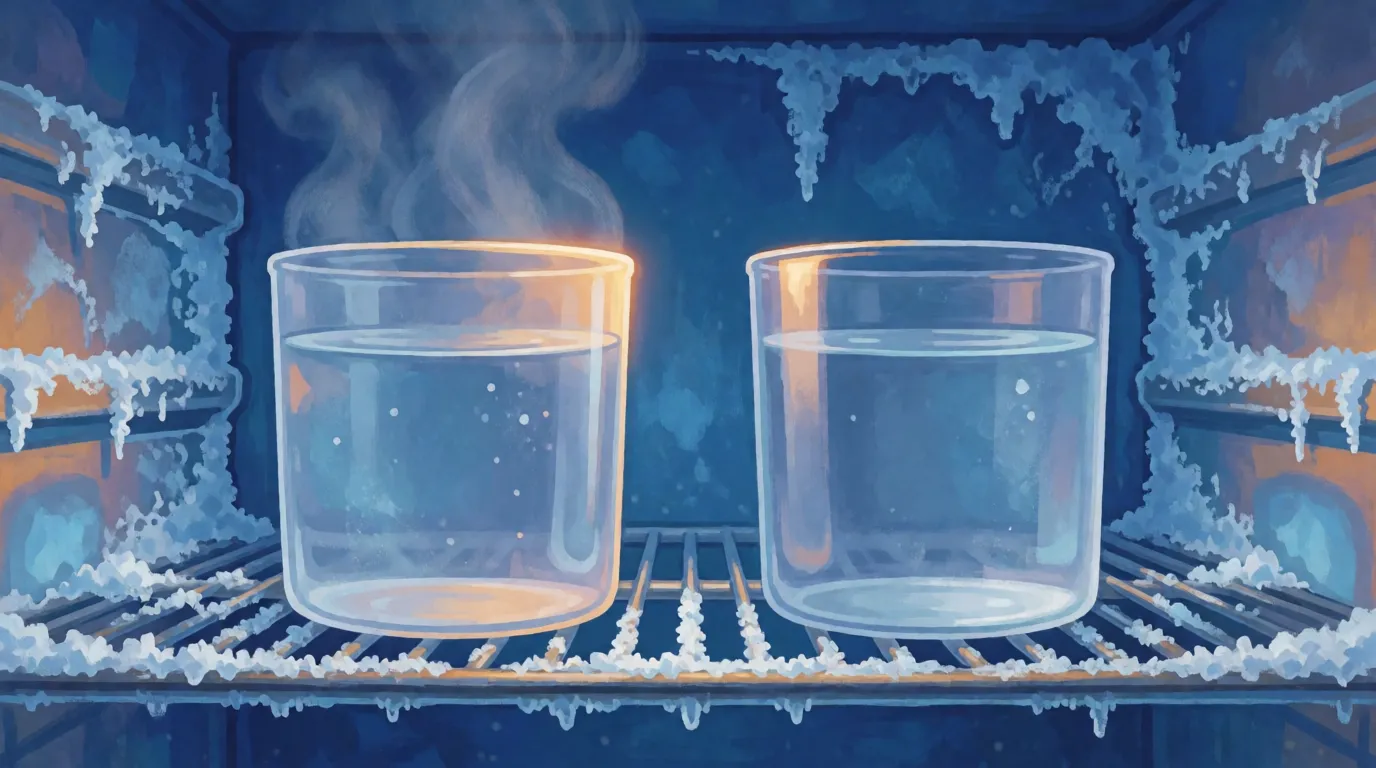
The schoolboy who was told to stop being silly

In 1963, about when your grandparents were at school, a Tanzanian schoolboy named Erasto Mpemba was making ice cream in a cookery class. The rule was to cool your mixture before freezing it. The freezer was filling up, so he pushed his in while it was still hot.
His froze first. He asked his teacher why, and was told he had made a mistake, because that is not what water does. He kept asking anyway.
In 1966 a visiting physicist, Denis Osborne, gave a talk at his school, and Mpemba stood up and asked him. The rest of the hall laughed. What happened next is the reason anybody remembers this.
Osborne did not laugh. He returned to his laboratory, ran the experiment properly, and observed the effect. In 1969 the two of them published a paper together in a physics teaching journal, with the schoolboy’s name first.
They were not the first to notice it. Aristotle wrote in the fourth century BCE that water previously heated freezes more quickly, and Francis Bacon and René Descartes both said something similar two thousand years later. Every one of them was ignored.
The most popular explanation is not enough
The result that will not sit still
Here is where this article stops being about water and starts being about science. A finding only counts once other people can obtain it too, which is called reproducibility, and the Mpemba effect has an awkward record.
Plenty of careful attempts observe nothing whatever. Others see it strongly. An identical laboratory can obtain it one week and lose it the next, and the outcome depends on the containers, the refrigerator, the thermometer, and precisely where the thermometer sits.
In 2016 Henry Burridge and a colleague in England attacked that directly. They abandoned the messy business of timing when a container turns solid. Instead they timed something clean: how long each sample took to reach the freezing point, the zero degrees at which water can begin turning to ice.
Measured that way, the effect vanished. Hot water never got there first, and the apparent result depended on precisely where the thermometer sat in the container.
That is not the end of it either. Other teams have since reported the effect in carefully controlled setups, and physicists have found related behavior in completely different systems. The argument is live, and being live is not the same as being nonsense.
Run the race in your own freezer
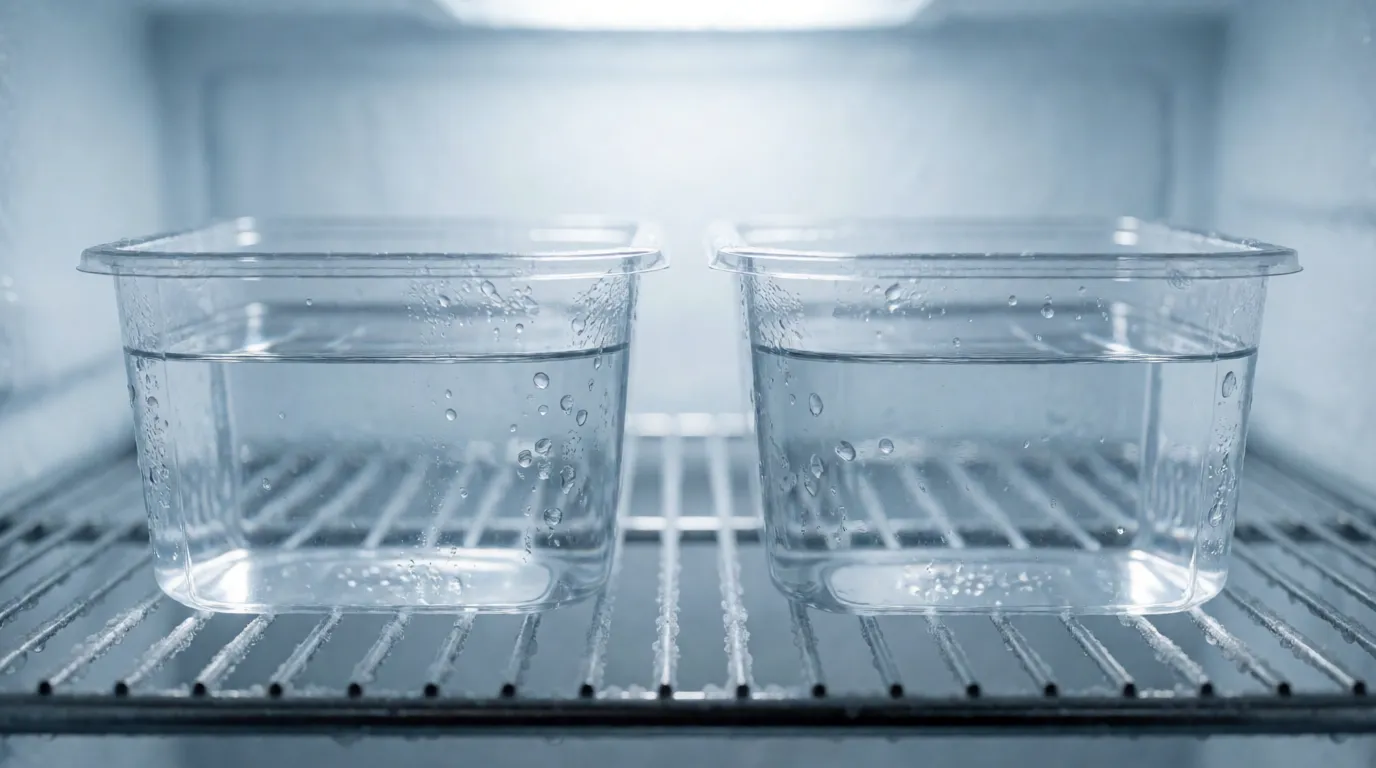
Most people discover that the cold water wins most of the time, which is the sensible answer. Occasional runs emerge the other way, and those deserve close inspection: check whether the hot container melted its way into the shelf.
Five runs is the part that matters. One run tells you almost nothing, because a single race can be decided by a draught, a frost patch or where you happened to put the containers.
A question you are allowed to lose
Most articles end by telling you the answer. This one cannot, and that is worth more than a tidy ending.
What is certain is small and useful. Freezing is several events rather than one. Hot water differs from cold water in more ways than temperature. And the innocent question “which froze first” conceals a decision about what counts as frozen.
What is not certain is whether there is a single effect here at all, or a collection of accidents that sometimes line up. Sixty years of work has not settled it.
Erasto Mpemba became a wildlife expert and worked in Tanzania for the remainder of his career. He said afterward that the argument had mostly taught him not to be put off. That is the part worth keeping. He was fifteen, he was contradicting a textbook, and the correct response from that hall was never laughter — it was somebody going away and checking.