Why does a cut apple turn brown?
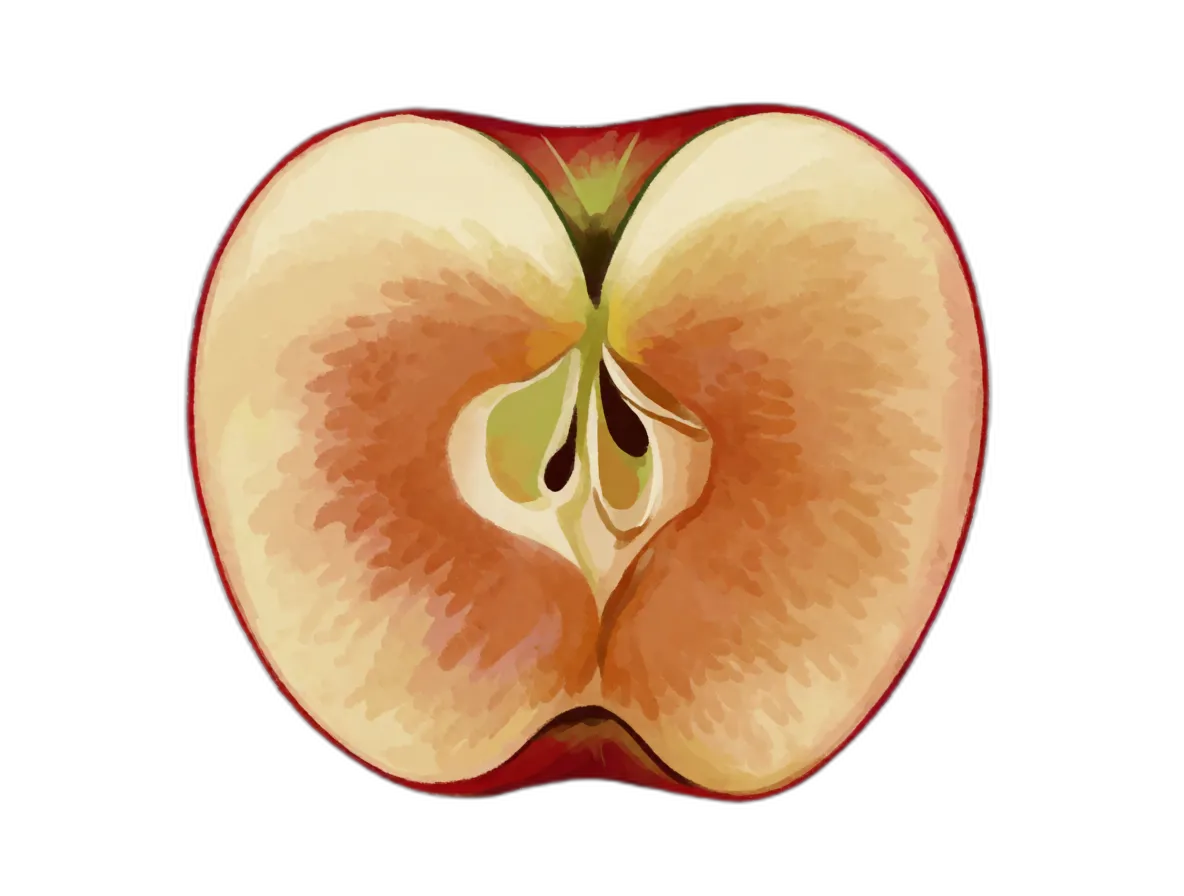
A whole apple can sit in the fruit bowl all week and look the same on Sunday as it did on Monday. Cut one in half at breakfast and by lunchtime the flat face has gone the color of weak tea. Nothing was added to it, and the uncut apple beside it is still perfect. So what did the knife start?
The knife adds nothing at all. It breaks a wall. An apple spends its entire life keeping two substances apart, never further apart than the width of a hair.
An apple is already full of air
Apple flesh looks solid and is not. It is assembled from cells, closed bags of liquid packed together like bubbles in foam. Apple cells are unusually large, roughly 0.2 mm(0.008 in) across, so five laid side by side measure a millimeter.
A square millimeter of apple flesh — about the area of the letter o in this line — holds twenty-five cells.
Cells pack no better than bubbles, and the gaps between them are full of air. Researchers who X-rayed Jonagold apples measured a quarter of the flesh as empty space, which is much of why apples float.
So oxygen reached every cell in that apple all along. A knife does not let air into an apple. It lets something out.
Two rooms in every cell
Most of the interior of an apple cell is one gigantic inner bag called the vacuole. Call it the store room.
An apple keeps its store rooms loaded with phenols, small bitter molecules. A molecule is a fixed group of chemical building blocks, locked permanently into one arrangement. Phenols are why an unripe apple leaves your mouth feeling dry and puckered.
Somewhere else in the same cell, sealed inside its own packages, sits an enzyme: a machine a cell manufactures to make one particular change happen, repeatedly, and nothing else. This one is polyphenol oxidase, so from here on call it the browning enzyme.
Its only occupation is attacking phenols, and in an uncut apple it never gets the opportunity. Machine and fuel spend the fruit’s whole life inside one cell, closer than the thickness of a hair, doing nothing to each other.
A knife cuts through cells, not between them
A blade cannot slide between apple cells. They are microscopic and the blade is not, so it drives through them, tearing open every one it meets. A single stroke empties tens of thousands of store rooms.
You do not even need a blade. Drop an apple on a hard floor, leave it a day, then cut it open. A brown patch sits under the skin exactly where it landed, with the skin above unbroken. The impact demolished cells without breaking anything.
So the wall is gone and the contents are mixed. Mixing alone still turns nothing brown. The third ingredient was waiting in the air gaps.
Oxygen makes the phenols sticky
Buried in the middle of the browning enzyme sit two atoms of copper. An atom is the smallest possible piece of a chemical element, and these two grip the oxygen.
Holding a phenol on one side and oxygen on the other, the enzyme pulls two hydrogen atoms off the phenol and delivers them to the oxygen, which departs as a droplet of water. What remains of the phenol is a quinone, and the important property of a quinone is stickiness.
Sticky is no figure of speech. A phenol is a comfortable molecule that will sit quietly in a store room for months. Remove two hydrogens and it becomes desperate to fasten onto anything with a spare hook.
One enzyme performs that operation thousands of times a minute, and a freshly cut face carries millions of them. Sticky, however, is still not brown.
Brown is what a big tangle looks like
Sticky molecules do what sticky objects do: they find each other. Two quinones fasten together, a third attaches to the pair, and the clumps keep growing with nothing to stop them.
Size then determines the color. An individual phenol is far too small to interfere with light and is practically colorless. A growing clump swallows light instead, and it is not fussy about which: some of every color, most of the blue. What escapes is a weak, muddy remainder, and that is brown.
Tangles take time to build, which is why browning creeps across a slice instead of appearing instantly. Scrape an old brown slice with the edge of a teaspoon: the color lifts away as a thin film, and the flesh underneath is white.
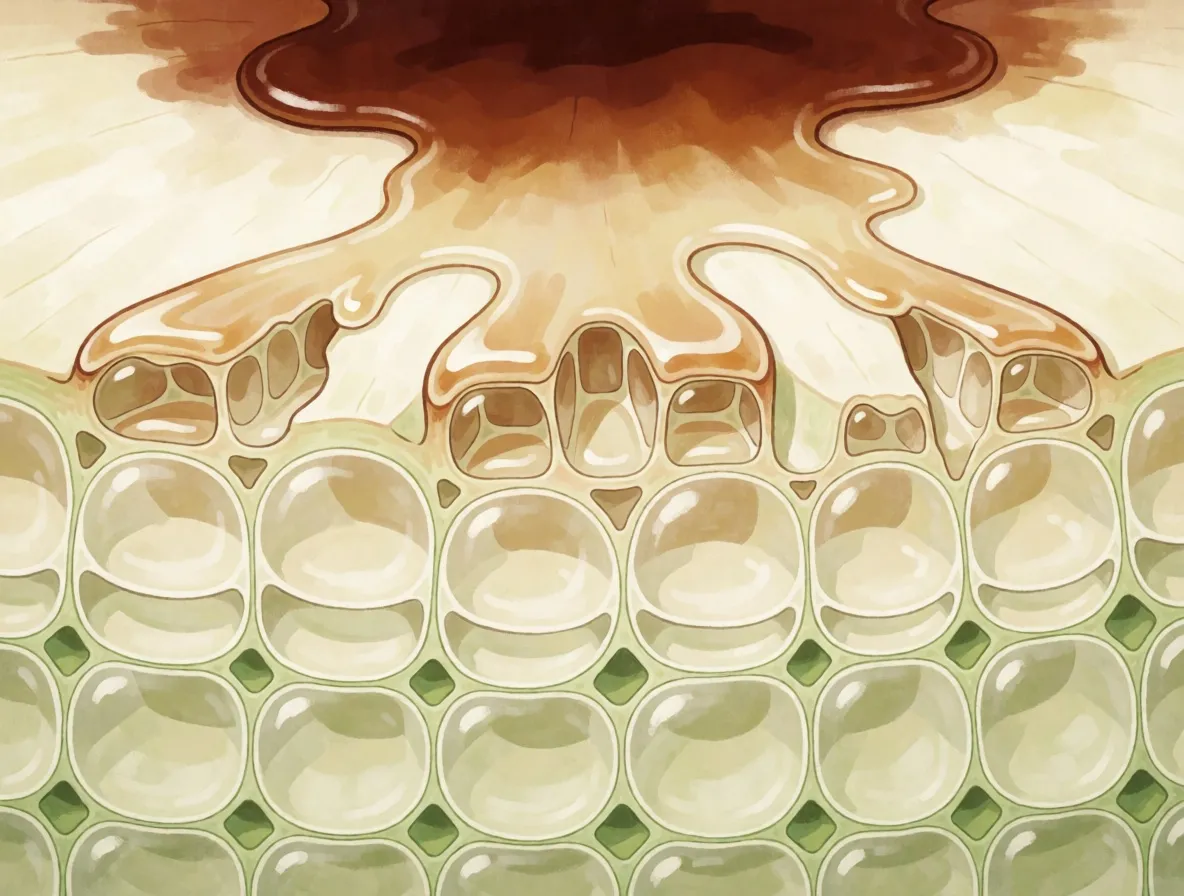
So the brown is a heap of the apple’s own phenols, glued together at the wound and nowhere else. Which leaves the strangest part unexplained. Why carry a machine that ruins your own flesh?
The brown layer is a scab
The heap is not damage. It is a dressing.
Bacteria are living things far too small to see, and, with molds, they are what genuinely rots a fruit. Both are built largely from proteins, enormous folded molecules that only work while they hold their shape.
Quinones are precisely the substance that ruins a protein: they fasten onto it, lock it rigid and leave it useless. A bacterium arriving at a fresh cut walks into a spreading antiseptic layer that glues its own proteins shut.
The tangles are tough and barely dissolve, so they also set over the torn cells as a plug, much as a scab hardens over a scraped knee.
The brown therefore ought to be a defense, manufactured the moment the fruit is injured. Ought to be is not the same as demonstrated, and for a century nobody had.
Nobody could say what the machine was for
Almost everybody investigating the browning enzyme was trying to defeat it. Food companies wanted apple slices that stayed white inside a bag. That work revealed a great deal about stopping the enzyme and nothing about why an apple has one.
The evidence arrived from tomatoes. In 2004, before you were born, Piyada Thipyapong, Michelle Hunt and John Steffens grew tomato plants at Cornell University with the browning enzyme switched almost entirely off. Then they infected them with a bacterium that ordinarily spots tomato leaves.
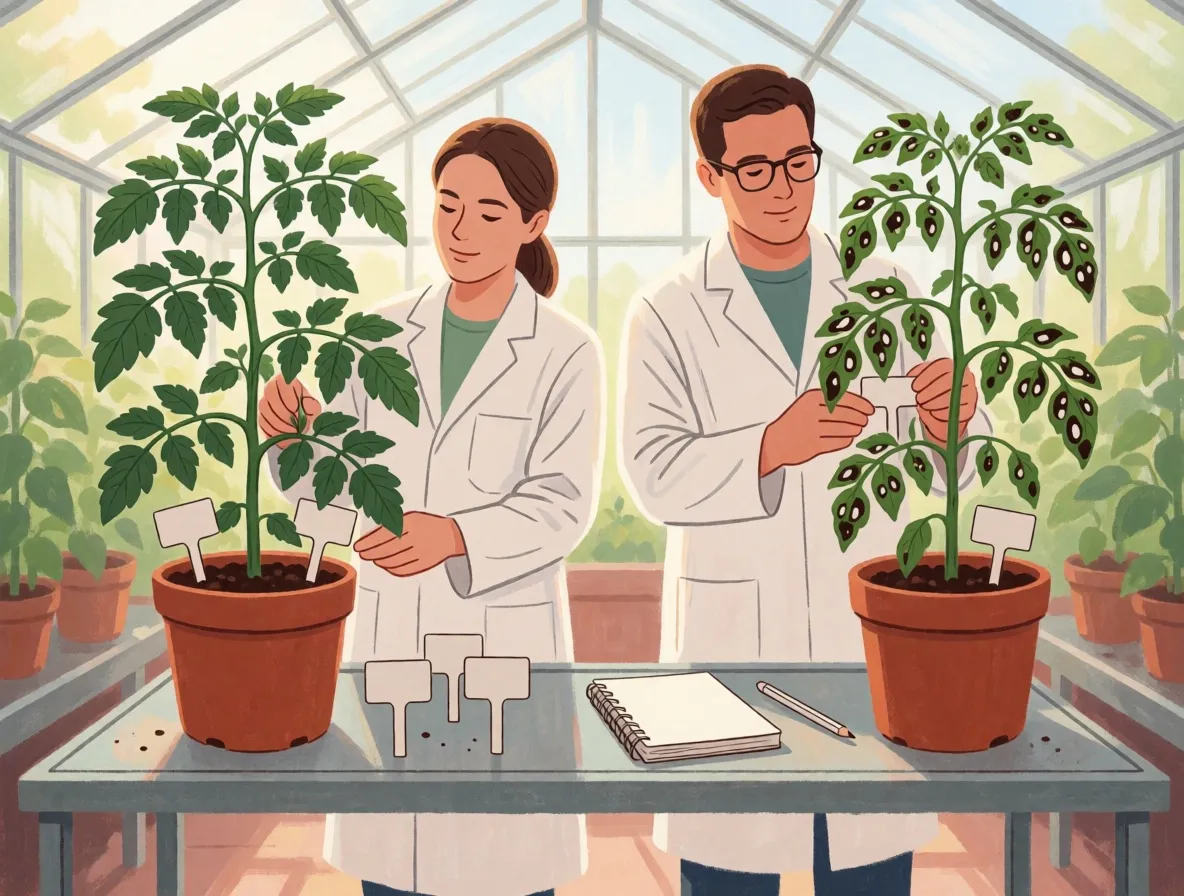
The plants without the enzyme grew up to a hundred times more bacteria, and carried ten times as many spots on every leaf.
Switch the enzyme off and a tomato admits a hundred times more bacteria. The brown had been doing something all along.
Take the brown away and a plant that could look after itself no longer can. It is a defense — and somebody had already found a use for switching it off.
An apple that manufactures almost no enzyme
That somebody was not hunting for defenses. In 1996 Neal Carter, an engineer and fruit grower in British Columbia, established a company to develop an apple that would not brown.
His trees keep their store rooms and their phenols. They simply manufacture less than a tenth of the usual browning enzyme. American regulators cleared the fruit in 2015, and packets of slices reached shops in 2017, twenty-one years after he began.
The loudest objections came from other apple growers, who were not worried the fruit was unsafe. They were worried shoppers would stop trusting apples.
Deleting the enzyme takes a laboratory and two decades. Removing the other ingredients takes a kitchen and one apple.
Take away one ingredient at a time
Each slice is missing exactly one thing the brown needs.
Which slice stayed white
The control browns first, being the only slice still holding everything it needs. The refrigerated slice does the same thing far more gradually: at 4 °C(39 °F) every molecule moves more sluggishly, so a cold machine works at a crawl. The underwater slice stays pale while submerged, because water has filled the air gaps and left hardly any oxygen for the copper to grip.
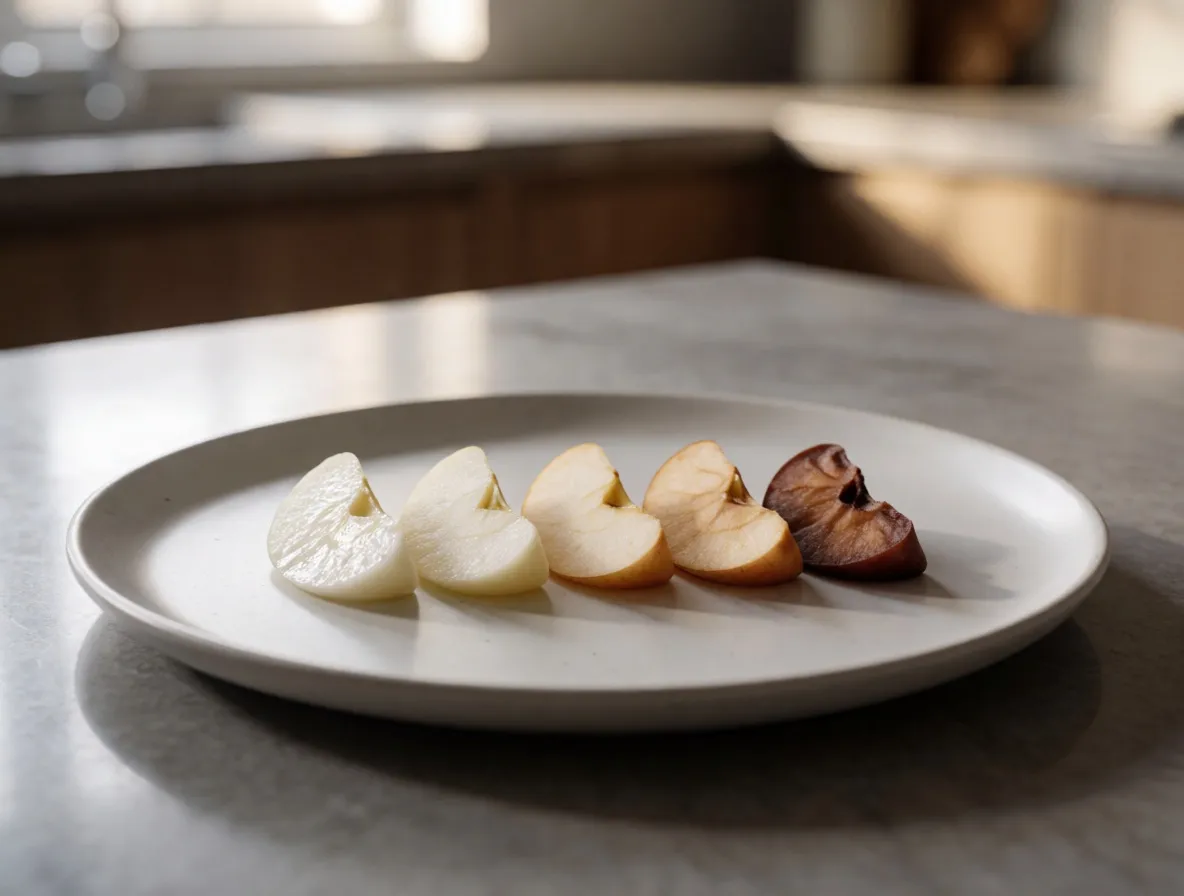
The boiled slice is the remarkable one. Water at 100 °C(212 °F) knocks an enzyme permanently out of shape, and a misshapen enzyme never operates again. That slice can sit in open air all day and stay white.
Lemon juice is the cunning one. It seals nothing and breaks nothing. Lemon juice is loaded with vitamin C, which hands hydrogen atoms back, converting sticky quinones into ordinary phenols as fast as the enzyme manufactures them. When the vitamin C is exhausted, browning begins.
The same brown as your own skin
Those tangles have a name. Chemists call this family of brown pigments melanin, and melanin is equally the word for the color of your own skin, hair and eyes.
The machine assembling it inside you is a close relative of the one in the apple. It carries two atoms of copper in the same arrangement and removes hydrogens from small molecules in the same way. Roughly one person in twenty thousand is born without a working copy, and makes no brown at all: no tan, no dark hair, no color in the eyes.
Both machines run for the same reason. Sunlight damages skin, a knife damages apple, and the repair on offer either way is a tough brown layer across the injury. Your version takes a summer. The apple manages it before you have finished putting the knife down.