How does a tree lift water to its highest leaf?
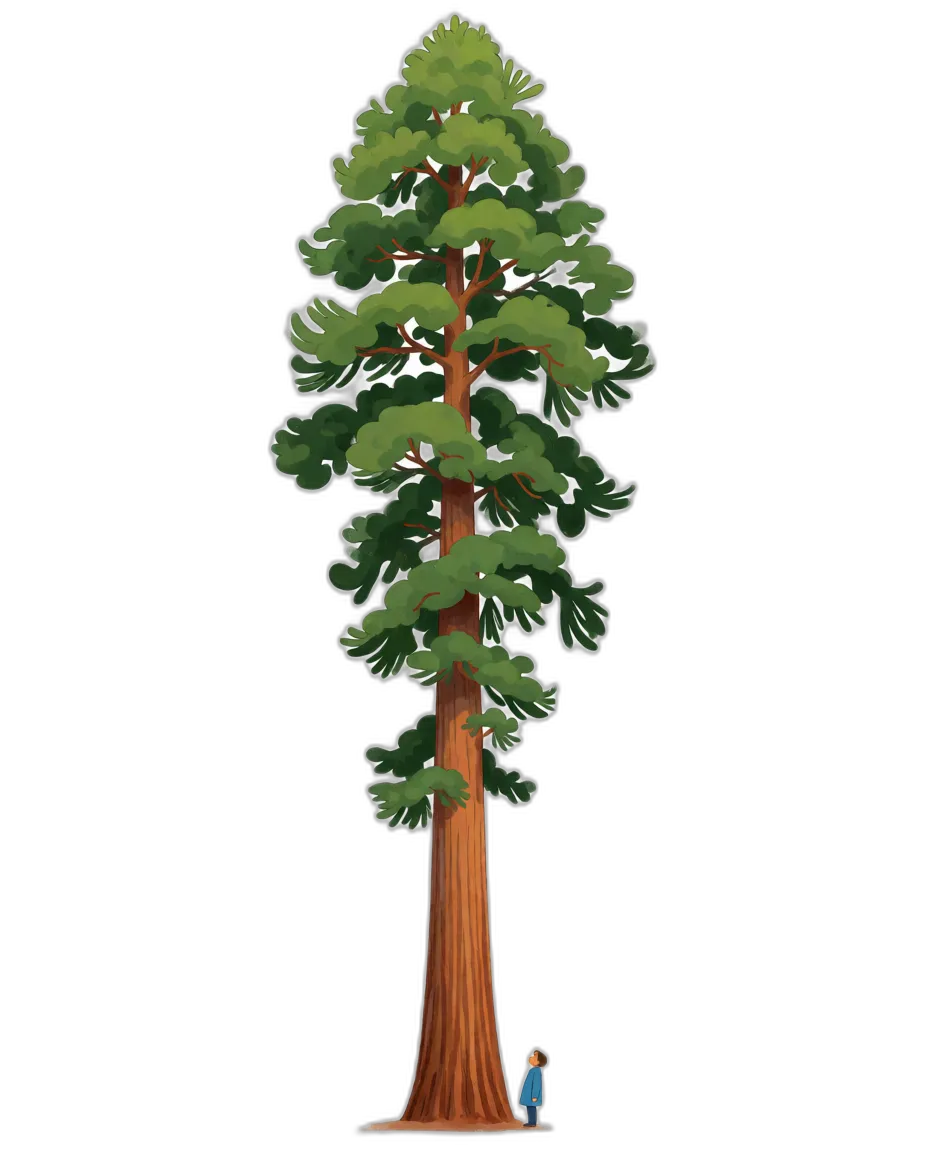
Put a straw in a glass of water and suck. The water climbs, and you barely notice the effort. Now make that straw as tall as a thirty-story building, with a redwood’s topmost leaf on the end. No pump ever built could fill it: they all quit at around ten meters, and have done for four hundred years. A tree manages it anyway, all day, with nothing inside that moves. So what does a tree have that a pump does not?
Nothing inside a tree pushes water upward. The roots do not pump, and the trunk has no moving parts. Water is hauled from above by leaves that are quietly evaporating, and the rope it hangs on is made of water.
Why every pump quits at ten meters
Start with the straw, because everybody has that part backwards. Sucking never grips the water; it removes air from the straw.
Air has weight. The whole atmosphere rests on your drink and presses down, and that press is air pressure. The atmosphere, not you, shoves the drink up your emptied straw.
So the atmosphere sets the limit, and it is low. Air pressure holds up a column of water about 10.3 m(34 ft) tall, roughly a three-story house. Empty the straw completely and the water stops.
In 1638 Galileo Galilei described a cistern pump that kept failing, and the repairman who insisted the machinery was fine. Raising water past eighteen arm-lengths was impossible, he said, for any pump on Earth. Galileo blamed the water itself, snapping under its own weight. The right explanation came in 1644, two years after he died, when Evangelista Torricelli weighed the atmosphere with a sealed tube of mercury, the first barometer. The air had run out of push.
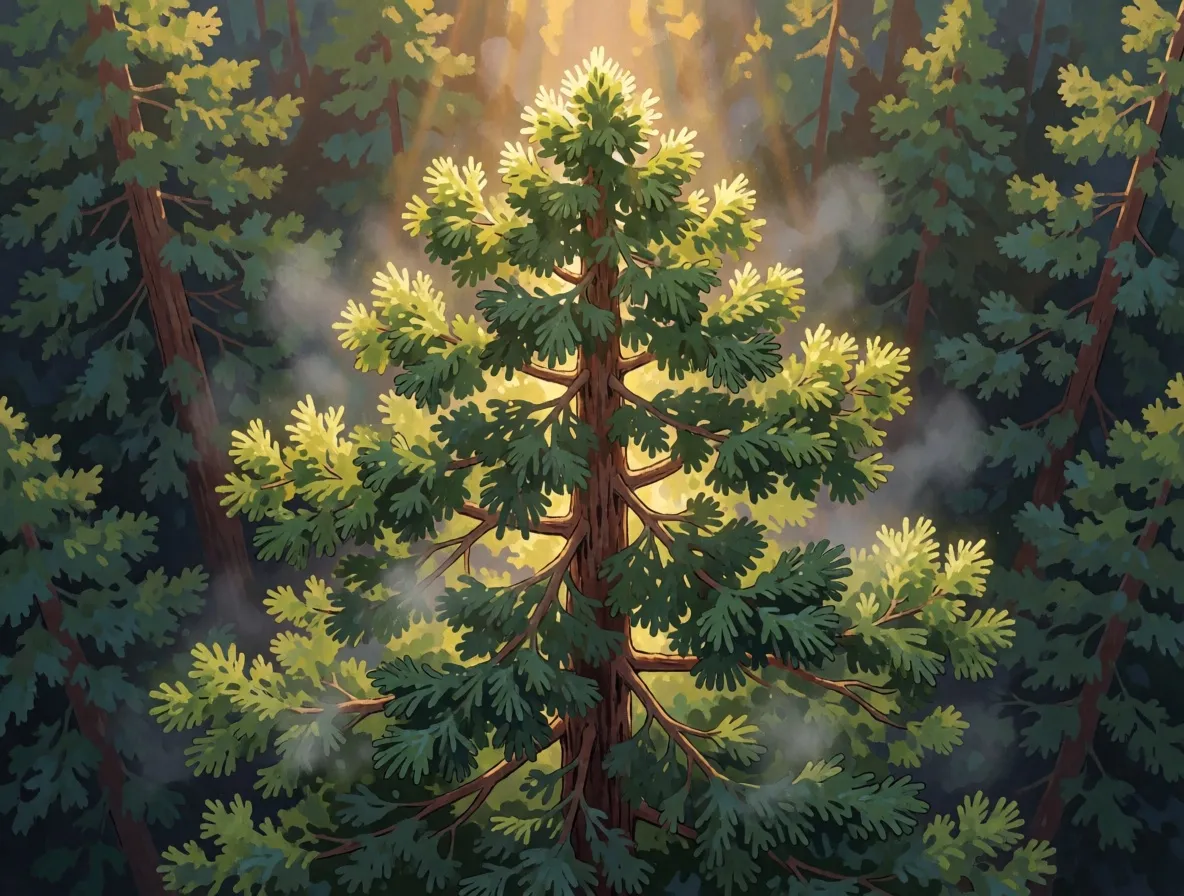
Now stand a tree beside them. Hyperion, a coast redwood discovered in California in 2006, was measured at 115.5 m(379 ft).
How far past the pump ceiling the tallest tree reaches.
Eleven times higher, with no pump inside it. So something is pulling that water, and pulling on water is a strange idea.
Water that will not let go of water
A pull needs something worth pulling. Grab one end of a rope and the whole rope follows. Grab one end of a bucket of sand and you get a handful.
Water behaves like the rope, because of its shape. A water molecule is the smallest piece of water there is: two hydrogen atoms fastened to one oxygen atom, bent into a shallow V. That bend leaves one end of the molecule slightly positive, the other slightly negative.
Opposite electrical charges attract, so every molecule clings to its neighbors while they cling back. That attraction is called cohesion.
You can feel it from your chair. Wet two fingertips, press them together, then draw them slowly apart. A thread of water stretches between them for a moment before it lets go. You were pulling on water, and it pulled back.
Anything hauled apart like that is under tension, including the molecules on your fingertips.
So water can be hauled on, like a rope. Something inside a tree must be hauling.
The leaf is drying out on purpose
A leaf looks like a solid green sheet. Inside, it is a damp sponge.
Slice one and put it under a microscope. Loosely stacked green cells, the tiny building blocks every living thing is made of, sit with permanently wet walls. Air spaces wind between them and open to the sky through pores called stomata.
Water evaporates off those walls and drifts out as vapor. That loss is called transpiration, and a big oak on a hot day breathes out 200 liters(50 gal).
Now magnify one wet wall until the cellulose fibers show. The gaps between them are around twenty nanometers wide. Three thousand would fit side by side across one hair.
As evaporation empties a gap, the water behind retreats and its surface curves downward between the fibers. That curve is a meniscus, the same dip you see where water meets a glass.
Cohesion does the rest. Molecules at that curving surface still grip the ones underneath, so the retreating surface drags them after it. The narrower the gap, the harder the drag, and in gaps this small it is ferocious, beating anything the atmosphere can push.
So a drying leaf does more than lose water. Every gap it dries into hauls on the water behind it, and that water leads down the tree.
A rope of water from leaf to root
Cut across a green twig and a pale ring shows inside the bark. Under the microscope that ring is a bundle of pipes.
Each pipe is built from xylem cells, which grow, hollow themselves out, die, and leave a stiff empty tube. Stacked end to end with the walls between them dissolved away, they form one continuous channel from every leaf down to the finest root hair underground.
Fill those channels and you have your rope. Every meniscus in the leaf pulls at the top, and cohesion carries the pull downward. Each molecule in the trunk is tugged upward by the one above while tugging on the one below.
The rope reaches every leaf and every root hair, and the leaves haul on it all day. What that does to the water between is stranger than it sounds.
Pressure below zero
Push on water and its pressure climbs above zero, the ordinary sort inside a squeezed hose.
Pull on water and the pressure travels the other way, below zero. On a sunny afternoon the water in a tall trunk sits below zero the entire way down, stretched like the thread between your fingertips.
No pump can reach below zero: it only removes air, and zero is what is left once the air is gone. That is precisely where the ten-meter ceiling came from. The trunk is not a pipe under pressure, it is a rope under tension, and that difference is everything.
A hundred meters of water, hanging from a leaf, stretched the whole way down.
So the roots are the far end of the rope, and the hauling happens overhead, powered by evaporation. Stretched water, though, sounds like something that ought to snap. So people went looking for a pump instead.
Two centuries of hunting for the pump
In 1727, roughly ten generations before you were born, an English clergyman called Stephen Hales began weighing his plants. His measurements showed sap pushing out of a cut stump far too feebly for a tall tree.
For the next century and a half, botanists assumed the trunk hid an undiscovered pump, with living cells passing water up hand to hand. A fair guess: living things do that constantly.
A professor in Germany, Eduard Strasburger, ended the idea in 1891. He felled tall trees and stood their sawn ends in tubs of a poisonous chemical. The poison climbed a beech 20 m(66 ft) tall to its topmost leaves, killing every living cell on the way. One spruce drank seven more liters after its death had been confirmed.
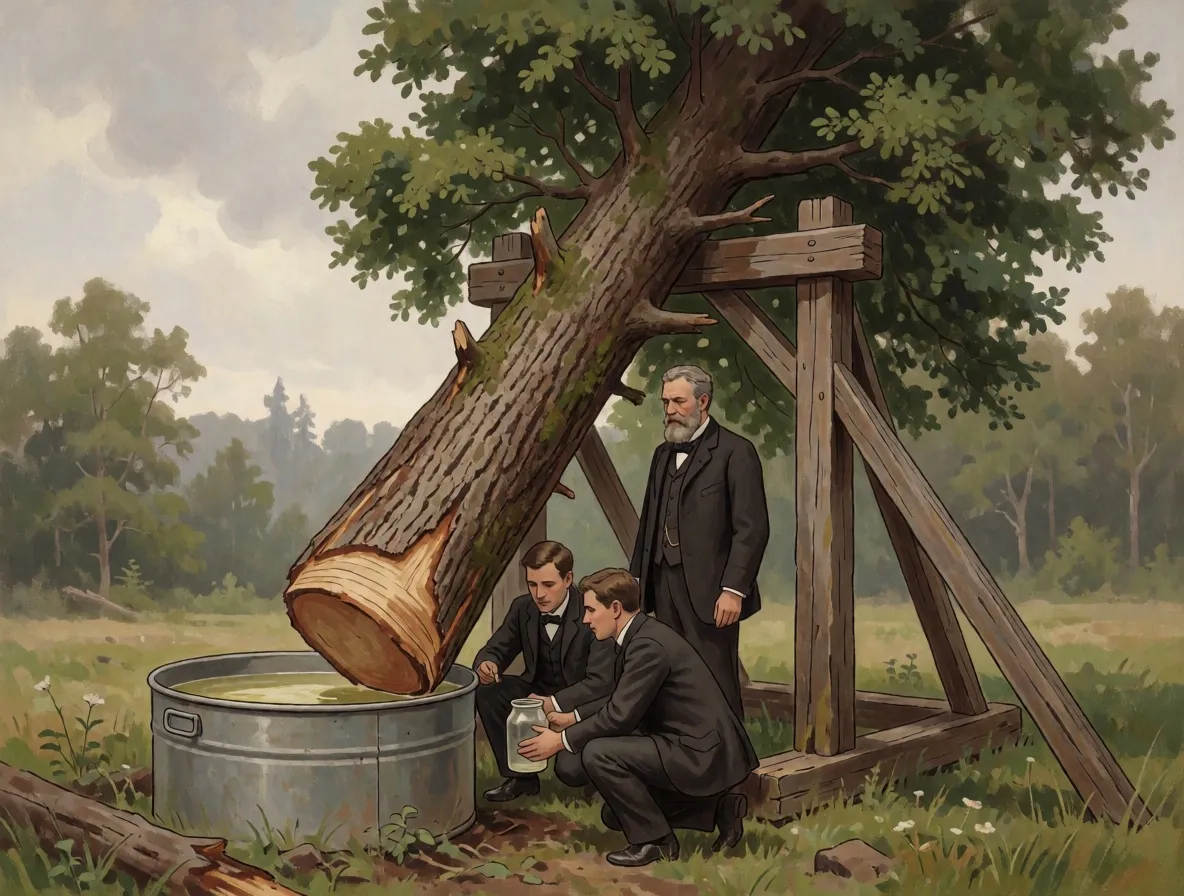
So there was no pump, and none needed. In 1894 two men from the university in Dublin described the rope to the Royal Society: Henry Dixon, a botanist, and John Joly, a physicist. Hardly anybody believed them.
The picture had been in print since 1638. Galileo, watching that cistern pump fail, decided the water column had snapped like a rope under its own weight. He was wrong about the pump. He had accidentally described a tree.
The leaves do the drinking
Those doubters were wrong, and you can settle it on a windowsill. A cut twig has no roots whatsoever, so if the leaves pull it should still drink.
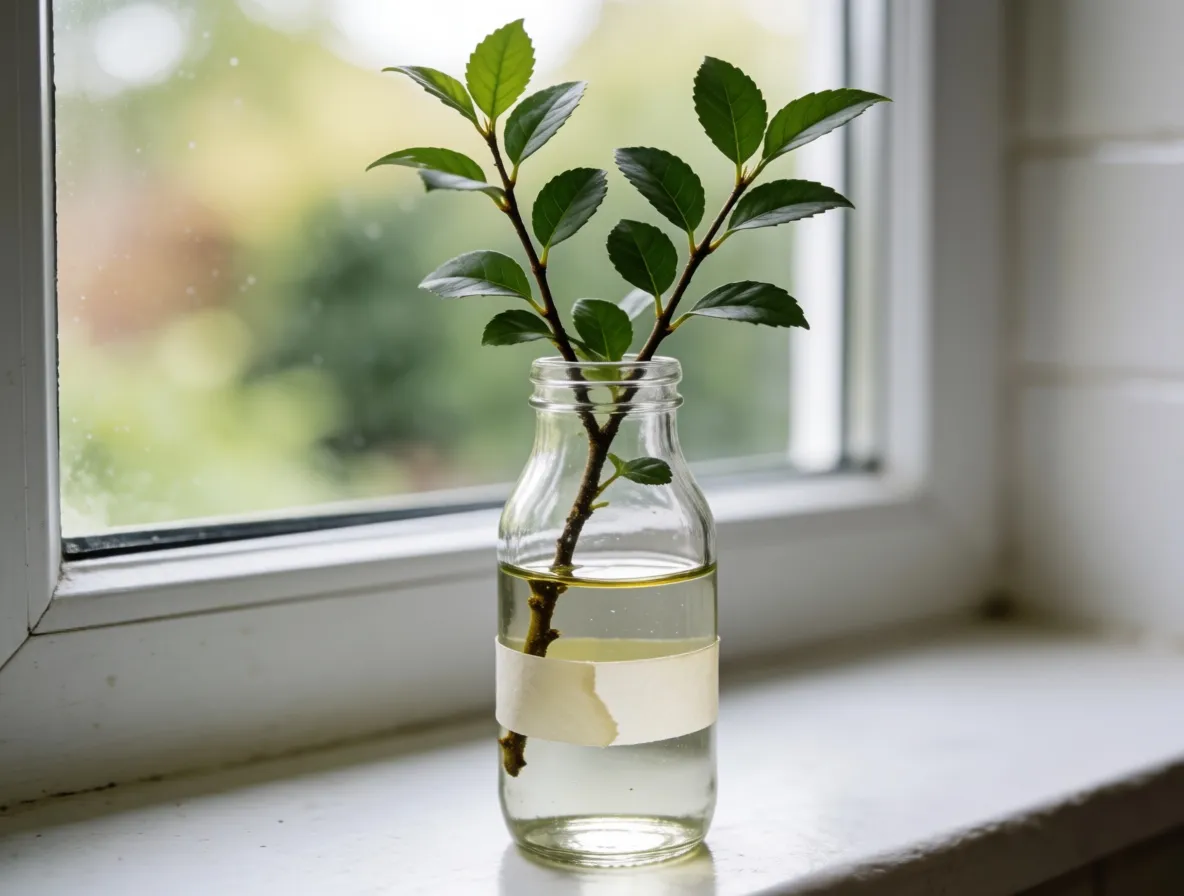
The evidence arrives overnight: the plain bottle barely shifts, because the oil has sealed it, and the stripped twig hardly shifts either. Only the leafy twig drops, several millimeters, with no roots.
So how tall can a tree get?
The doubters were wrong about the rope, too. In 1950 Lyman Briggs spun water inside a bent glass tube until the thread tore in half. Water let go at a pull 270 times stronger than the atmosphere can push. Holding Hyperion’s column against gravity needs about eleven, so a tree asks roughly a twenty-fifth of what water can bear.
The rope is not the ceiling, then. The leaves are. In 2004 a team led by George Koch climbed the tallest redwoods in California, sampling leaves at every reachable height. The higher the leaf, the smaller and stiffer and drier it was, because the water reaching it was under a fiercer pull. Following that trend upward, a leaf eventually cannot take up enough water to inflate at all, somewhere between 122 m(400 ft) and 130 m(425 ft).
Notice what a tree never does. It spends no energy lifting. Sunshine evaporates water off a leaf exactly as it dries a puddle in the playground, and every escaping molecule tugs the rope up behind it. The sun does the hauling. All a redwood has to do is keep the rope unbroken, from wet soil to the last leaf in the light.