Why do some leaves turn red before they fall?
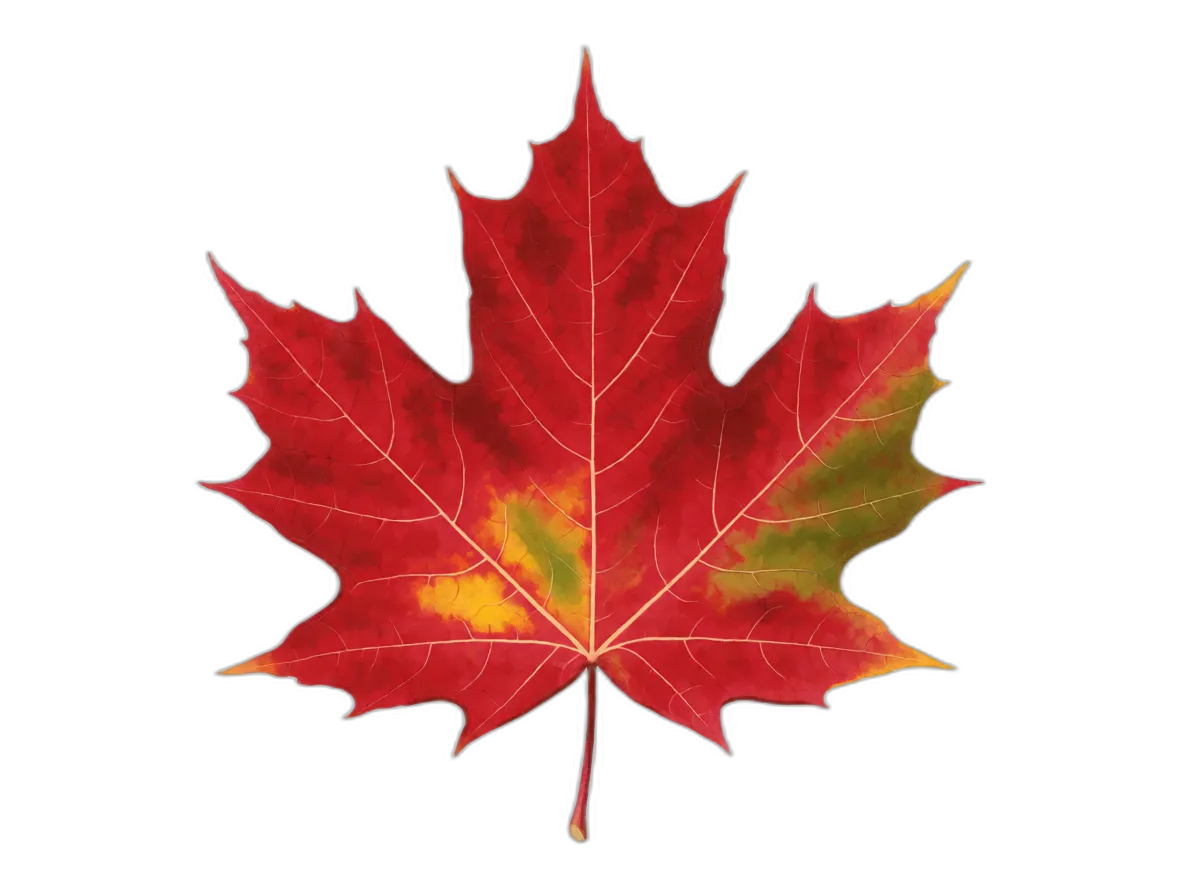
A maple leaf lands on the sidewalk in front of you, and it is scarlet. Not brown, not faded. It is brighter than that leaf ever managed in July. The tree grew that red on purpose, in the last two weeks of the leaf’s life, then let it drop. So what was the red for?
The yellow in an autumn leaf was there all summer, waiting under the green. The red was not. A tree builds red out of the last sugar its leaf will ever make, for a reason nothing to do with looking pretty.
The yellow was there all summer
Every green leaf is stuffed with chlorophyll, the pigment that catches sunlight and uses it to build sugar. A pigment is anything that gives a thing its color.
Hold a leaf from any houseplant up against a bright window. The light coming through is green. Chlorophyll has taken the blue and the red out of it and let the green pass, because green is the part of sunlight it is worst at using.
Beside it sit the carotenoids, a family of yellow and orange pigments, the same ones that color a carrot. You never see them: green is a loud color, and there is far more chlorophyll.
An evergreen keeps its leaves. A deciduous tree drops everything each fall, and before it does, it takes its chlorophyll apart. The green drains away gradually, the yellow underneath stops being shouted over, and the leaf turns gold. Nothing was manufactured. Something was removed.
So a gold leaf is an uncovering. A red leaf ought to work the same way, and everybody assumed for a long time that it did.
The red is built from scratch
Take a red maple leaf in October, then go hunting for its red pigment in a leaf off the same branch in July. There is none to find. The pigment is anthocyanin, and in most trees it does not exist until fall.
You have met anthocyanins before. They are the molecules that make blueberries purple and red cabbage red.
The tree manufactures it out of the leaf’s own last sugar, in the two or three weeks before it drops. Building any chemical costs a plant sugar, spent very late.
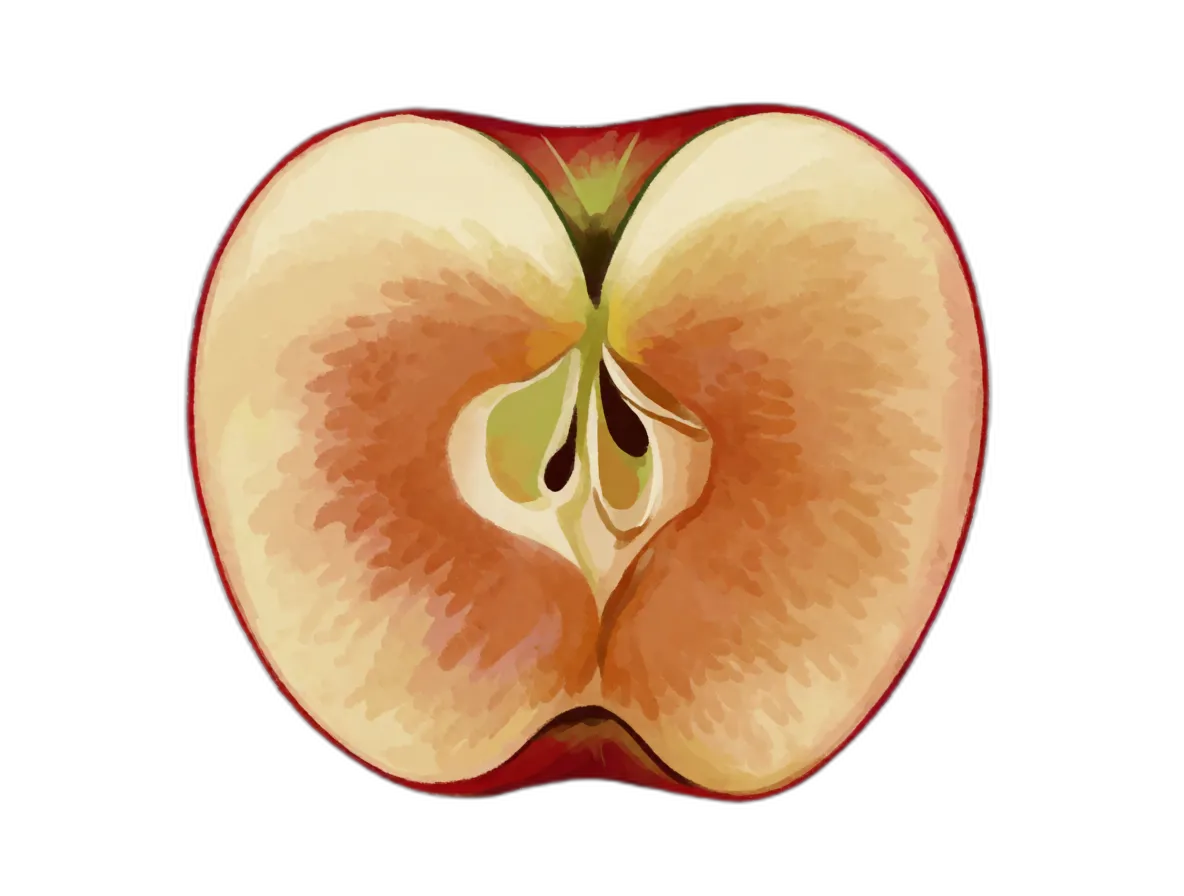
Nor does it get built just anywhere. Anthocyanin collects in a thin layer of cells, the tiny sealed boxes every living thing is built from, packed directly beneath the epidermis, the leaf’s upper skin. That puts the new red above the chloroplasts, the little green packets where chlorophyll lives.
So a tree spends on a leaf it has already decided to lose, which makes sense only if the leaf still holds something it badly wants.
A leaf is emptied before it is dropped
Take a LEGO model apart and you are not throwing it out. You are getting the bricks back. A tree recycles a leaf the same way, and letting it fall is the last step.
The most valuable brick is nitrogen, the nutrient every living thing needs to build itself. Almost nothing can grab it out of the air, so a tree collects it from the soil slowly, in tiny amounts, all year.
Nitrogen makes up most of the air you are breathing right now, and a tree cannot touch a bit of it.Chlorophyll is built around nitrogen, with a single magnesium atom at its heart, and so is most of the machinery beside it. A leaf that falls green carries a serious share of the tree’s whole supply to the ground.
So the tree dismantles the leaf first. It breaks the chlorophyll down, ships the pieces back into the branch, and recovers roughly half the leaf’s nitrogen before letting go.
That recycling takes weeks. For every one of those weeks the leaf hangs in full sun with its light-catching machinery half in pieces.
Sunlight wrecks a leaf that is half taken apart
Catching light is only the first move. Chlorophyll grabs the energy in sunlight and hands it down a line of parts that finish the job. The job is photosynthesis: building sugar out of water and carbon dioxide, with oxygen left over. The catching never switches itself off.
Now start dismantling that line. Catching still works, but there is less and less below it to take what keeps arriving, and energy does not politely disappear. It goes loose inside the cell and tears at whatever it touches, starting with the delicate parts that caught it. Plant scientists call this photoinhibition: light damaging the very thing that collected it. Call it the overload.
Cells that overload die, and enough dead cells kill the leaf. It comes off the twig with the nitrogen still inside, and the whole slow harvest is wasted.
So the tree needs the light turned down for a few weeks. It cannot move the leaf, and it cannot dim the sun.
A red filter over the green
The anthocyanin sits in a red layer above the green, so daylight from the sky has to cross it first.
Sunlight is a mixture of colors, and anthocyanin does not treat them equally. It soaks up green most strongly, around 530 nanometers from one crest of the wave to the next. That is exactly the color chlorophyll is worst at using: the green you watched come through the leaf at your window.
Green light is a tiny wave. One hair is about 130 of them across.
Follow that through. Blue and red get grabbed by the first chlorophyll they meet, near the top. Green slides past and travels deepest of all. Anthocyanin catches it there, and the energy it absorbs is handed on to nobody. It drains away as a little warmth.
Less light reaches the half-dismantled chloroplasts below. Not none. Enough.
And the color you see is the leftover, the light anthocyanin is still reflecting back. Whether a tree builds this filter at all comes down to the weather.
A street of red maples in October is a street of trees quietly pulling their own bricks back out.
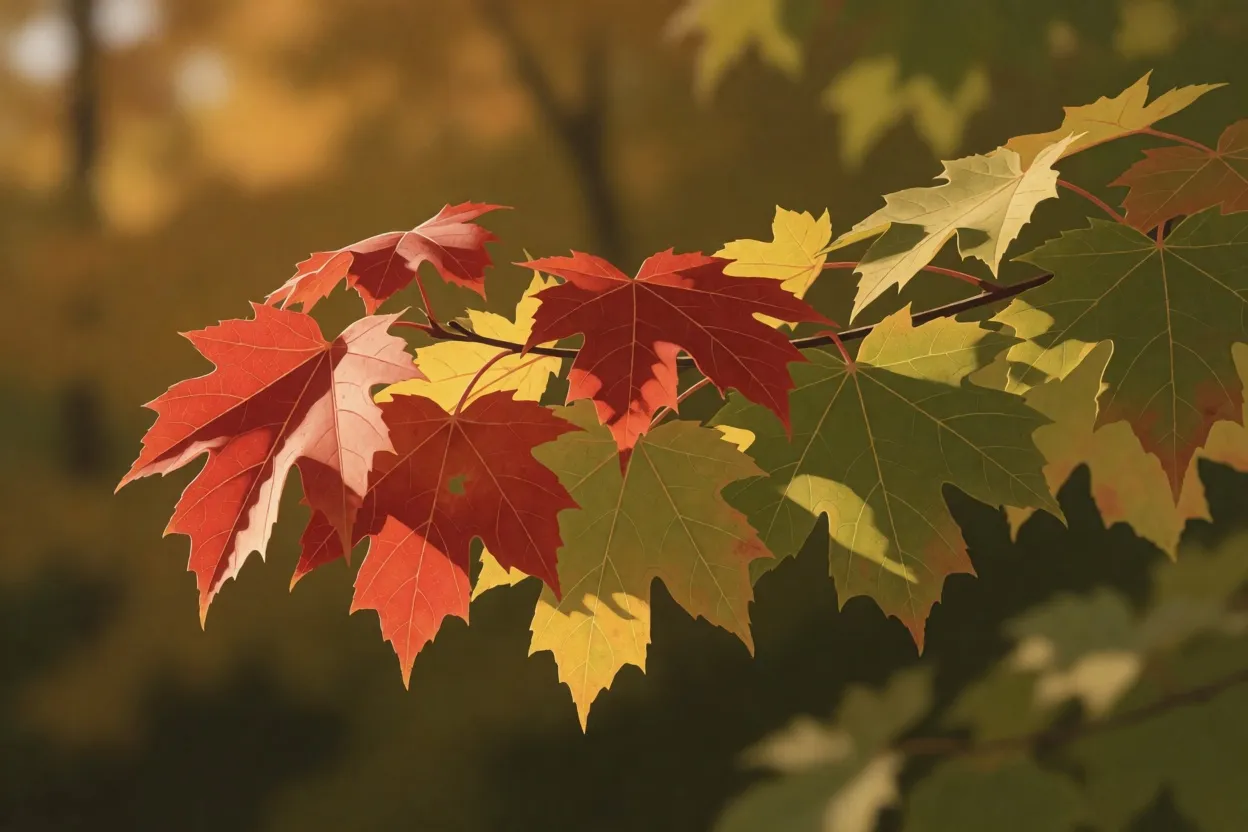
Warm days, cold nights, and no frost
Every step in that mechanism puts conditions on the weather, which is why some autumns are spectacular and some are a disappointment. Sugar comes from bright days, and sunny afternoons stock a leaf up nicely.
Cold nights matter for a different reason. As the temperature falls toward 7 °C(45 °F), the veins carrying sugar out of the leaf slow to a crawl. Sugar made that day stays where it was made. Bright day, cold night, over and over, and the leaf fills with the raw material for red.
Gold is weatherproof, because gold only has to be uncovered. Red is fussy, because red has to be built, and that difference sat in plain sight for a hundred and sixty-six years.
Named in 1835, tested in 2001
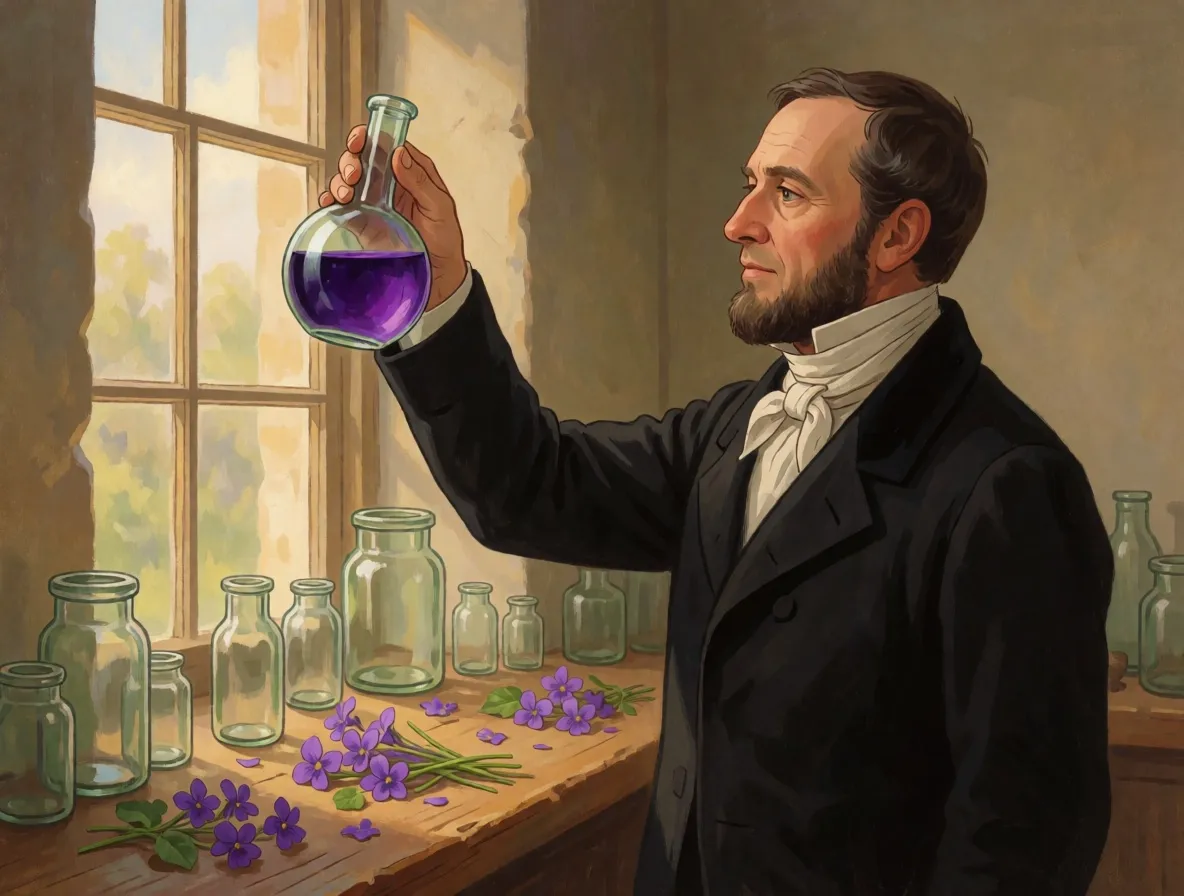
In 1835, six generations ago, a German pharmacist named Ludwig Marquart gave the red plant pigment its name. He assembled it out of two Greek words, one meaning flower and one meaning blue.
He was studying flowers, and so was nearly everyone else for the next century and a half. In a flower or a berry, a bright color has an obvious job: be noticed, get eaten, spread your seeds. What red was for already looked answered.
So autumn got one line in the textbooks: the green breaks down and the colors underneath show through, with yellow, orange and red under one explanation. David Lee and Kevin Gould, the botanists who eventually took that line apart, wrote in 2002 that it was precisely what their own schoolbooks had told them.
Researchers finally ran the experiment in 2001. Taylor Feild, a graduate student at Harvard University, worked with Lee and Noelle Holbrook. They gathered dogwood leaves turning red and leaves turning yellow, hit both with fierce light, then watched for recovery in the dark. The red ones recovered. Six hours later, the yellow ones still had not.
Print the proof on a leaf
You can settle this yourself, on one leaf.
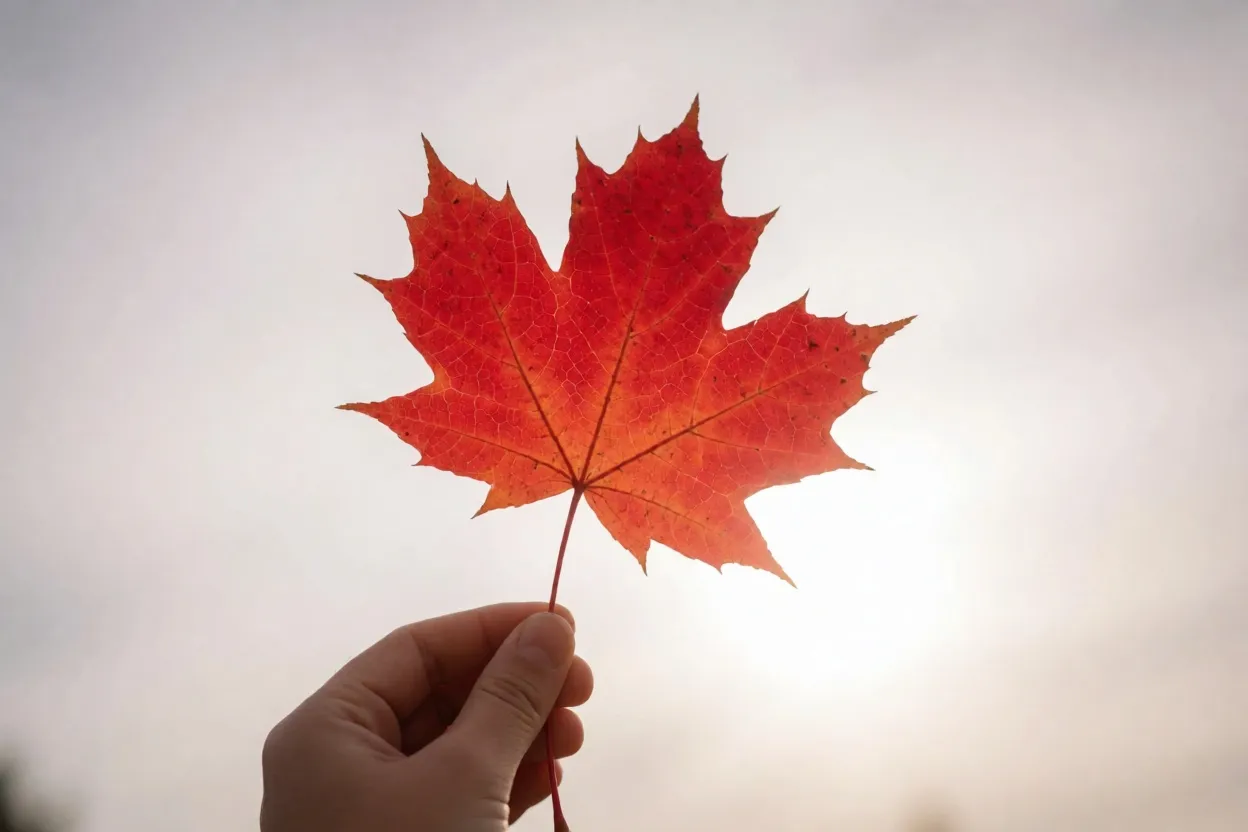
What comes off that twig is a red leaf with a yellow shape printed on it. The yellow is the carotenoids, which sat there all summer and never needed light. The red went everywhere the sun could reach, and nowhere else.
Every red leaf is yellow underneath
The green light you sent through a houseplant leaf at the start is the missing piece. It is the part of sunlight chlorophyll cannot use, so it travels deepest into a leaf, and it is exactly what anthocyanin is built to swallow. A tree grows a filter for the one color its own factory always let through.
That filter is the leading hypothesis, and the evidence is not finished. A 2023 study of Norway maples found no clear protection from their red. Paper birches make none at all and recover their nitrogen perfectly well. What nobody argues about any more is the red being manufactured.
Pick up a fallen red leaf in November and turn it over. Very often a patch along one edge never went red, where a neighbor shaded it through October. The tree has taken what it came for. What is lying on the sidewalk is a filter nothing needs any more.