Why is the sea salty when the rivers filling it are not?
Swallow a mouthful of river water and it tastes of almost nothing. Swallow a mouthful at the beach and you are still spitting a minute later. Yet nearly every drop in the sea got there down a river. Nobody stands on the coast tipping salt in. So where is all of it coming from?
From the rivers, as it happens. They carry salt the whole way, in a dose so small your tongue cannot find it. What the sea has, and a river does not, is a door that only water is allowed through.
Rivers are salty too, just barely
Rain is not quite pure water. Coming down it collects carbon dioxide from the air, which turns it into a very weak acid. Weak is enough. Given a few thousand years, rainwater works into stone and takes it apart grain by grain.
The loosened pieces dissolve. They separate into microscopic particles and spread evenly through the water, the way sugar disappears into tea. Water gradually destroying rock like this is called weathering, and it is happening on every hillside above you.
So a river is never plain water. Every liter carries roughly 0.12 grams of dissolved minerals, about a fiftieth of a teaspoon. Your tongue has no chance. Salt must reach three or four times that concentration before you notice it.
Rivers deliver that trace to the sea every second of every day. It explains nothing on its own, because the same weak trickle runs through the river itself and the river stays fresh. Something must happen at the coast that never happens upstream.
A door that only water can walk through
At the coast the water leaves and the minerals stay.
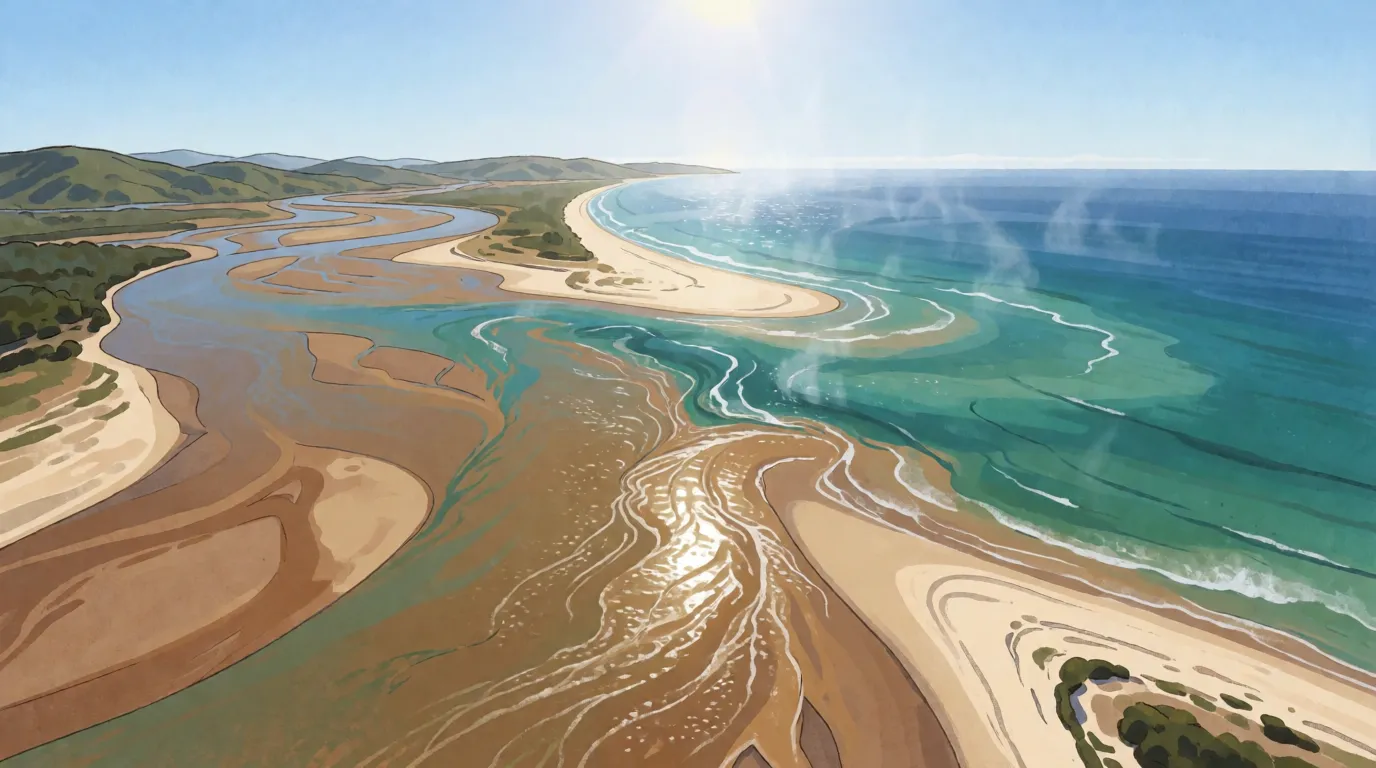
Water is built from tiny units called molecules. The warmer they are the harder they jostle, and now and then one near the surface is knocked hard enough to fly off alone. That one-at-a-time escape is evaporation. It needs no boiling, and a puddle evaporates at any temperature.
For salt the same jump is impossible. Dissolved salt has come apart into separate pieces, and the surrounding water grips each piece hard. Tearing one loose would mean heating the sea to 1,465 °C(2,669 °F), hotter than flowing lava. Sunshine on a bay is nowhere near.
Your kitchen shows the split. Look inside a kettle that has boiled a few hundred times. That chalky deposit on the bottom is calcium carbonate, a mineral the tap water was carrying. The water left. The mineral did not.
Now run the loop. The invisible vapor becomes cloud, the cloud returns as rain, and the rain runs back down to the river, collecting a fresh trace on the way.
The sea is the one place in that circuit where water gets out and salt cannot. Every liter arriving drops what it carried and leaves without it. The heap is easy enough to taste, which raises the obvious question of how big it has actually become.
Six teaspoons in every bottle
Fill a one-liter bottle with clean water and stir in six level teaspoons of table salt. You have made seawater. The ocean carries about 35 grams(1.2 oz) of dissolved salt in every liter, and six teaspoons lands close to that.
The figure has a name. The salinity of water is how much dissolved salt it holds for a given quantity of water, and the answer is much the same in the Atlantic or the Pacific.
One bottle of seawater holds as much dissolved salt as about 290 bottles of river water.
The rivers have not changed. The sea has kept what they brought and let the water go.
That thought is hard to put down. If salt only ever goes in, the sea must be a shade saltier this year than last. Measure the difference carefully and you are holding a clock.
The clock that gave the wrong answer
Edmond Halley, the astronomer with the comet named after him, got there first. In 1715 he read a short paper to the Royal Society in London. Measure the saltiness of the sea now, he suggested, and have somebody measure it again centuries later. The difference would give the age of the world. Halley had no way of doing it, so he left it as homework.
On 17 May 1899, nearly two centuries later and when your great-great-grandparents were small, an Irish physicist named John Joly read a paper to the Royal Dublin Society. Sodium is one of the two parts of table salt. Using measurements of river water gathered worldwide, he calculated how much of it the rivers deliver in a year, weighed that against the sodium already in the ocean, and divided. His answer: the sea was between 80 and 100 million years old.

The Earth is about 4.5 billion years old, which makes Joly’s answer roughly fifty times too short. His arithmetic was fine. His assumption was not.
Joly had assumed that every grain of salt ever delivered to the sea was still in it. The clock only ticks if salt goes in and never comes out, and salt does come out. It leaves by a slower door.
Where the salt goes
Sometimes a piece of the sea gets shut in. A strip of land rises, or the water level drops, and an arm of ocean is cut off. The sun carries on working. The remaining water grows saltier until it can hold no more, and then the salt begins to crystallize on the floor. Bury that under mud and sediment for several million years and it becomes rock, in deposits geologists call evaporite, or salt beds in plainer words.
In the summer of 1970 the drilling ship Glomar Challenger spent two months boring holes in the floor of the Mediterranean. Three scientists led that 1970 expedition: William Ryan, Kenneth Hsü and Maria Cita. They kept hauling up cores of pale banded rock, buried underneath ordinary seabed mud.
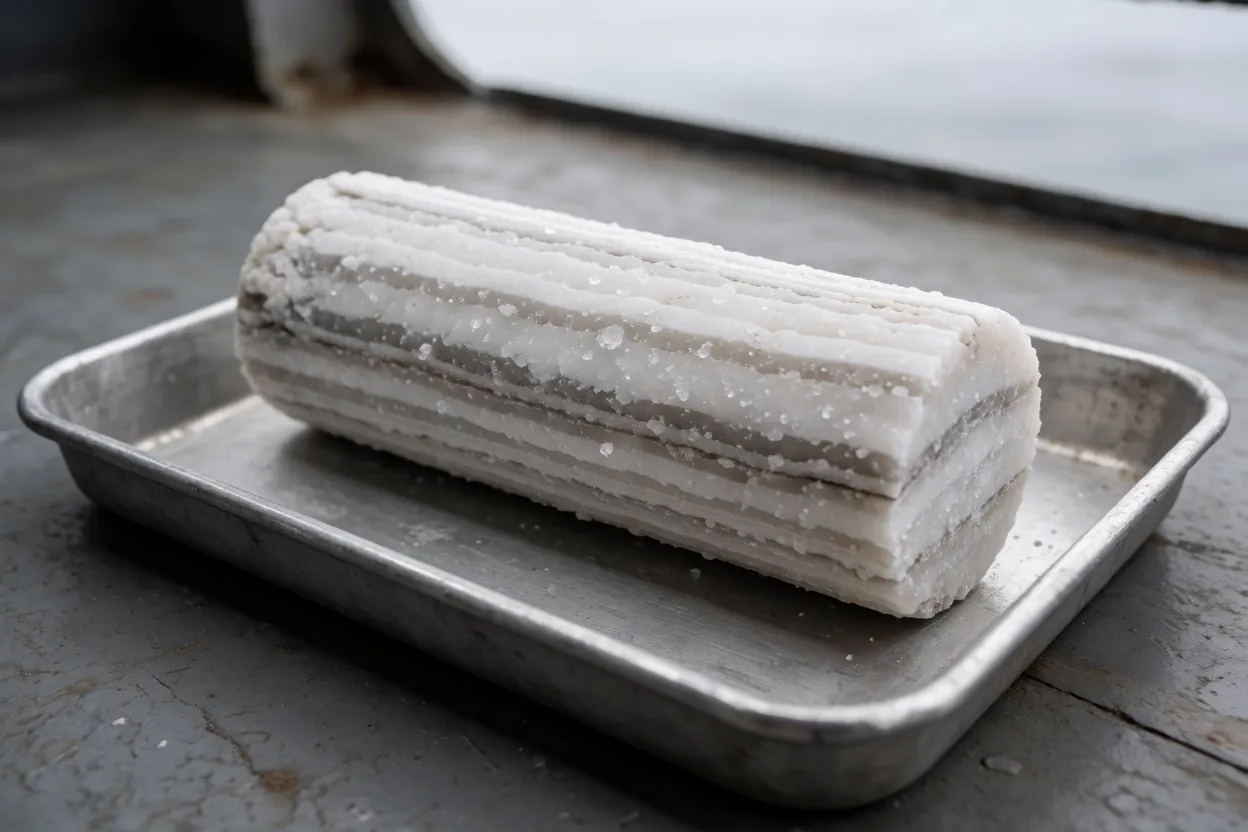
That sea, it turned out, had almost completely dried up, beginning 5.96 million years ago. Roughly a million cubic kilometers of salt was left on its floor: one twentieth of all the salt dissolved in all the world’s oceans, parked underground.
Salt beds lie buried on every continent, and each one is salt the sea handed back. That exit is dramatic, though, and dramatic events are rare. The steady one is running right now, in the dark.
As much going out as coming in
The floor of the ocean is cracked. Seawater seeps down into the cracks and meets hot rock a kilometer or two below. It returns through a hydrothermal vent, an opening in the seabed where heated water comes back. On the way through it swaps chemicals with the stone, changing the chemistry of both. Magnesium shows the trade most clearly: water going down carries magnesium and water coming back has none, every bit locked into the rock.
That would hardly matter if it happened to a bucketful. It happens to the ocean. A volume of water equal to every sea on Earth circulates through those underwater cracks about once every ten to twenty million years.
Water leaves the sea by the front door, in an afternoon. Salt leaves by the back, and takes ten million years over it.
Add up the exits — salt beds, hot cracks, and the spray that breaking waves throw inland — and the total is close to what the rivers deliver. When a thing fills and empties at the same rate, scientists call it a steady state. The level holds even though nothing is still.
So the sea is not quietly filling with salt. It has stayed near its present saltiness for hundreds of millions of years, drifting a little, never running away. Which leaves one loose end: where does the handed-back salt go?
Build a sea on a saucer
The saucer never got fuller. It dried out every time and went back to being empty. Yet by the end of the week there is a crust you can scrape up with a fingernail. Ten tablespoons of a river nobody could taste have become a heap you can see.
The sea that ended up in your kitchen
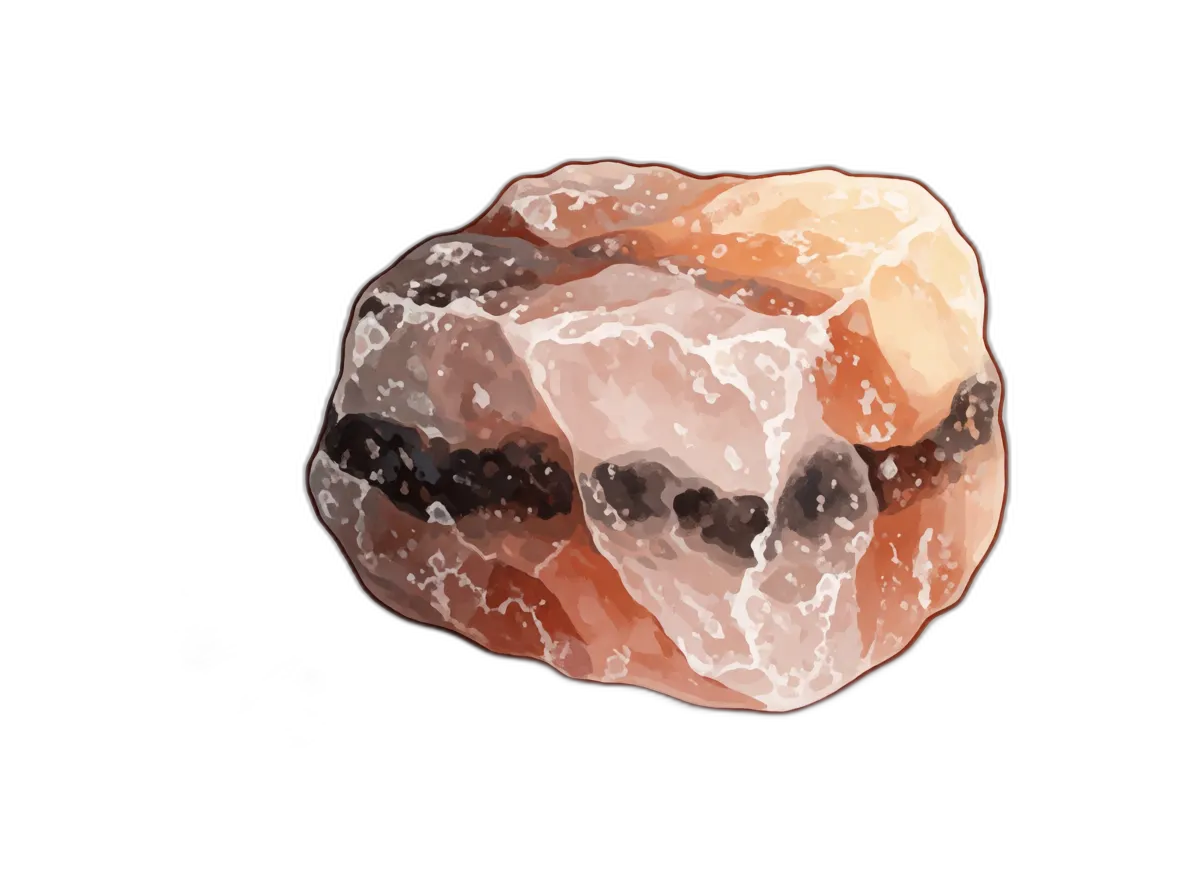
Go and look at the salt in your kitchen. About a third of the world’s salt is mined, and mined salt is a piece of sea that dried out, exactly like the saucer.
The mines under Cheshire, in the north-west of England, cut salt left by shallow seas that evaporated about 220 million years ago. That was the Triassic, when the first dinosaurs were new and there were no birds or flowers. The salt lay underground as rock until somebody dug it out, ground it up and put it in a shaker on your table.
So the mouthful at the beach has an answer, and the answer is a loop. Rain takes a hillside apart, rivers carry the pieces down, and the sea keeps the pieces and hands the water back. Every so often a corner of it dries out and returns the salt to the ground, where somebody eventually digs it up for dinner. What you taste in a mouthful of seawater is a hillside on its way through.