Why do sunglasses turn a screen black?
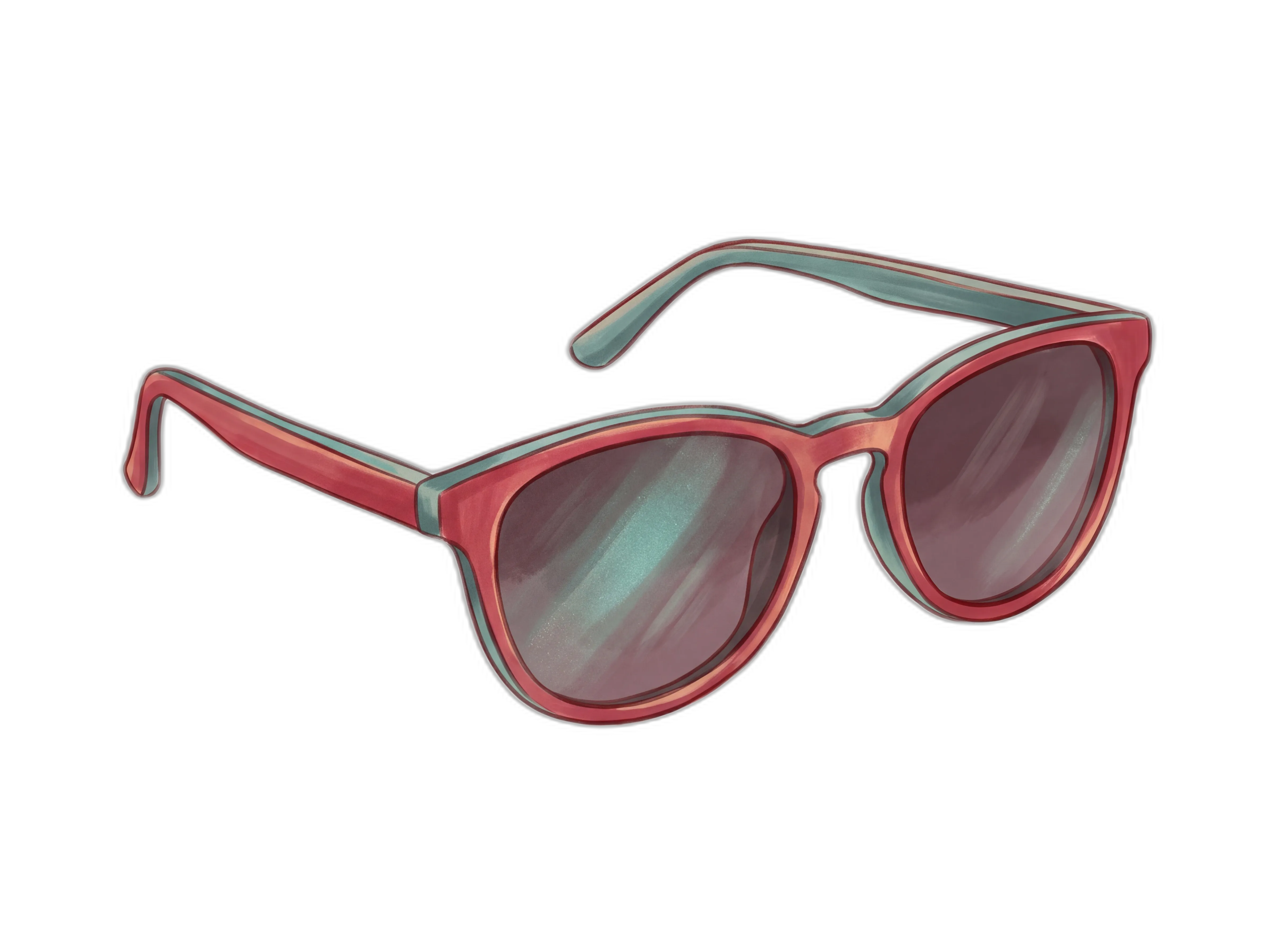
Put on a good pair of sunglasses and look at a laptop. Now tip your head slowly over toward one shoulder. Somewhere around halfway the picture dims, and then it is gone: a black rectangle where a bright one was a second ago. The laptop is fine. Take the sunglasses away and it comes straight back. So what is that screen doing to its light that a pair of sunglasses can undo?
It is filtering it. A screen of this kind is built out of two filters facing each other, and their natural state is total darkness. The picture is made by sneaking light past them, one tiny square at a time.
Two filters that cancel each other out
Light travels as a wave, and the wave vibrates from side to side as it goes. In ordinary daylight those vibrations point every which way at once: vertical, horizontal, and every diagonal in between.
A polarizing filter is a sheet that passes only the light vibrating in one chosen direction and absorbs the rest. Point its direction vertically, and vertical light travels through while horizontal light is stopped. Good sunglasses carry one of these sheets in each lens, which is why the label says polarized.
Now put a second sheet behind the first and turn it a quarter circle, so the two directions are perpendicular. Everything that survived the first sheet is vibrating vertically, which is exactly what the second sheet absorbs. Nothing comes out. Two polarizing filters, crossed, make a black so complete that a lamp behind them looks unplugged.
Every screen in this article begins there: two crossed filters with a lamp behind. As it stands the arrangement is useless: you cannot draw a picture on a rectangle that is permanently black. Something in the middle has to get light past that second filter.
A staircase between the filters
Something does. The two filters are not pressed together. A gap holds them apart, about ten micrometers wide, and a micrometer is a thousandth of a millimeter.
A human hair is around seventy micrometers thick. Seven of these gaps would stack across one hair.
That gap is filled with a liquid crystal. It is a substance built from rod-shaped molecules that flow around one another like a liquid. At the same time they stay lined up in one direction, like the atoms in a crystal. Each rod is a single molecule, and left alone every rod would lie parallel to its neighbors.
They are not left alone. The inner face of each glass plate is rubbed in one direction with a cloth, leaving microscopic grooves, and the rods take their alignment from them. The two plates are rubbed a quarter circle apart. So the rods against the back plate point one way and those against the front plate lie across them, with every layer in between turned a little further than the one below. The rods spiral through the gap like a staircase.
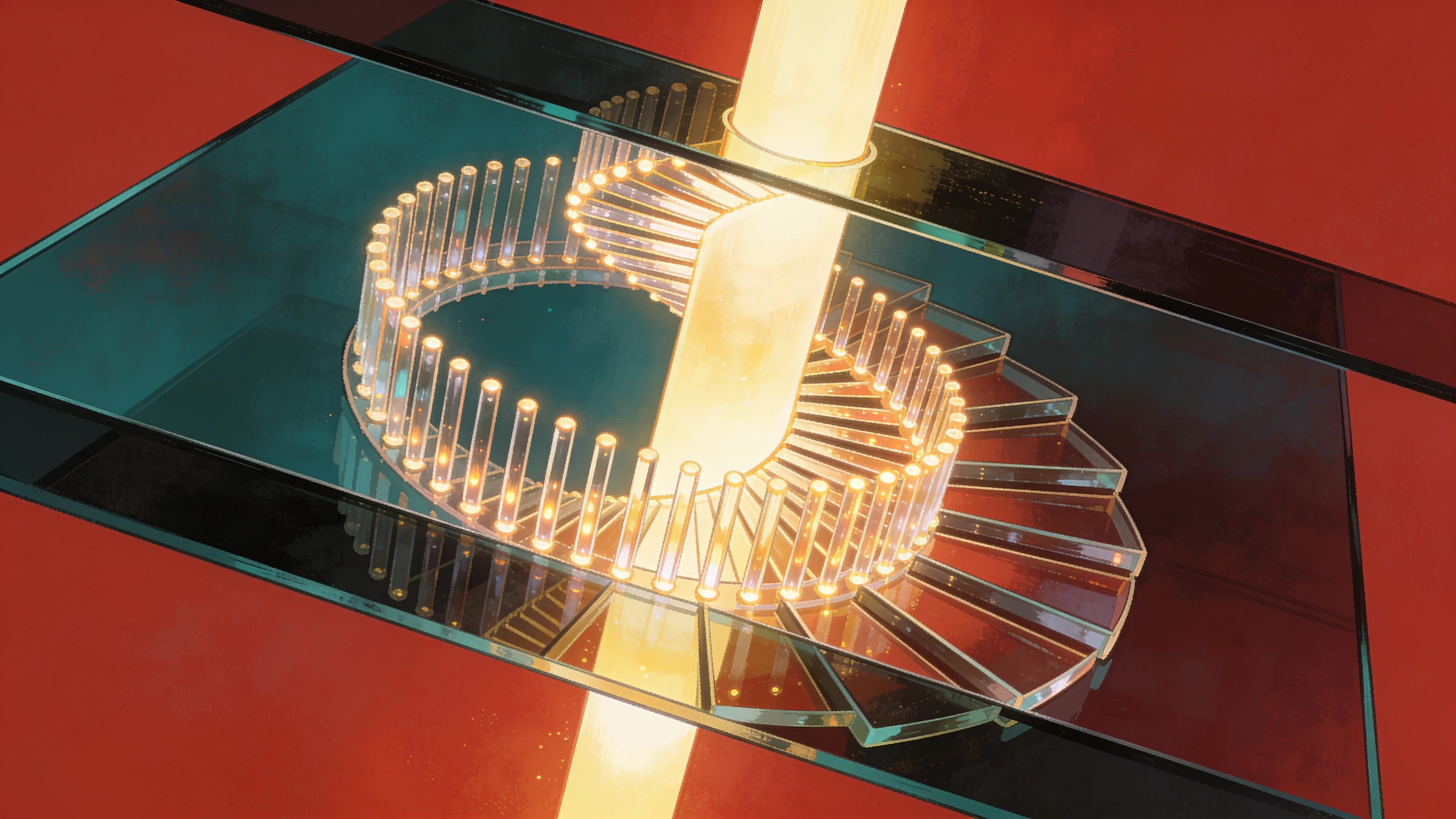
Light entering at the bottom follows that spiral around. It leaves the top vibrating a quarter circle from where it started, precisely the direction the front filter allows through. The staircase has rescued the light, and that square of screen is bright.
Electricity flattens the staircase
A bright square is only half a picture. To go dark again, the screen takes the staircase apart with electricity.
Each square of screen carries transparent metal electrodes: a coating on the glass in front and another behind. Send a voltage between them, meaning an electrical push from one to the other, and every rod in the gap feels a pull straight across it. The rods swivel until they line up with that pull, pointing back to front. They no longer spiral.
Now light crossing the gap receives no rotation. It arrives at the front filter still vibrating the way it started, and the front filter stops it dead. The square goes black.
That square is one pixel, a single dot of the picture. A laptop screen holds roughly two million of them, and every one has its own switch. Screens built this way are called liquid crystal displays, or LCDs. Every photograph, game and video you have ever watched on one was that same gate, opened and shut, two million times over.
The screen never makes a dark thing. It only ever decides what to stop.
The lamp behind it never goes out
Which means something strange about the lamp. Behind the back filter sits the backlight, a panel of white light shining through the whole screen. It has one brightness, chosen by you, and keeps it whatever appears in front of it.
Tilt a laptop lid slowly away from you and watch the dark parts turn pale. The spiraling rods only rotate light a clean quarter circle when it passes straight through. Off to one side the rotation is wrong, and light leaks.
That also explains why black on these screens is never quite black. A little light always leaks past a closed gate, as you can see during a dark scene in a dark room. Odder still, nobody designed any of this deliberately. It began with a substance that refused to melt properly.
A cloudy liquid nobody could explain
In 1888, when your great-great-grandparents were small, an Austrian scientist named Friedrich Reinitzer heated a compound he had made while studying the cholesterol in carrots. It melted at 145.5 °C(294 °F) into a cloudy liquid, which was odd. Heated further, at 178.5 °C(353 °F) the cloudiness suddenly cleared. Nothing was supposed to melt twice.
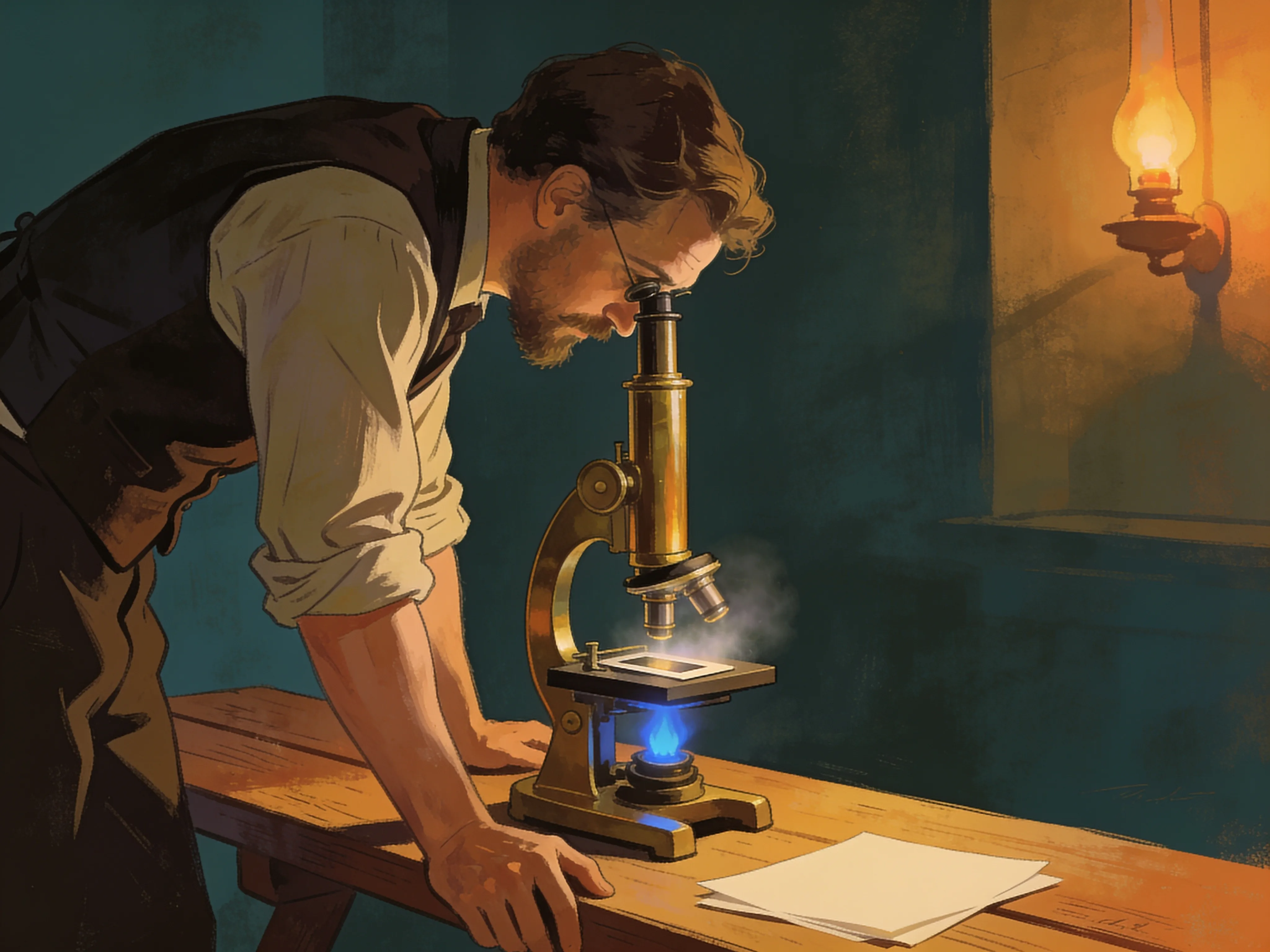
Reinitzer could not see inside a cloudy liquid. On 14 March 1888 he mailed a sample and a long letter to Otto Lehmann. Lehmann was a physicist who owned a microscope that could be heated while you watched through it. He found the cloudy stage doing both jobs at once. It poured like a liquid and bent light like a crystal. In October 1889 he presented a paper on what he called flowing crystals.
Then, for eighty years, almost nothing. Flowing crystals were a curiosity that chemists and physicists argued about politely and nobody could use, partly because they only behaved that way when hot. The first sample anyone pushed electricity through, in 1962, had to be held at 125 °C(257 °F), hotter than boiling water, on a heated stand.
The idea that was turned down
Screens arrived before anybody thought of the staircase. On 28 May 1968 the American electronics company RCA called a press conference and unveiled prototype displays made of liquid crystal, developed by a team under George Heilmeier. Their method was cruder. A voltage stirred the liquid until it churned, and churning liquid scatters light, so the screen turned milky white. It worked, though a milky screen is a poor substitute for a black one. The announcement still sent engineers off to build digital watches and pocket calculators.
Wolfgang Helfrich, a physicist on that same team, worked out the twisting idea in the summer of 1969 and took it to Heilmeier. Heilmeier was not interested. The new arrangement needed two polarizing filters, and the display RCA already had needed none. The better idea was two sheets of plastic more expensive than the thing it replaced.
Helfrich left. In October 1970 he joined Martin Schadt in Basel, Switzerland, and asked him to build it. Within a few weeks it worked. They filed the patent on 4 December 1970 and sent off the paper four days later. Its title named the arrangement: a twisted nematic liquid crystal.
An idea that sat unwanted for over a year took a couple of weeks once somebody wired it up. Crossed filters and one quarter turn is little enough that you can assemble the whole thing yourself at a kitchen table.
Build the gate yourself
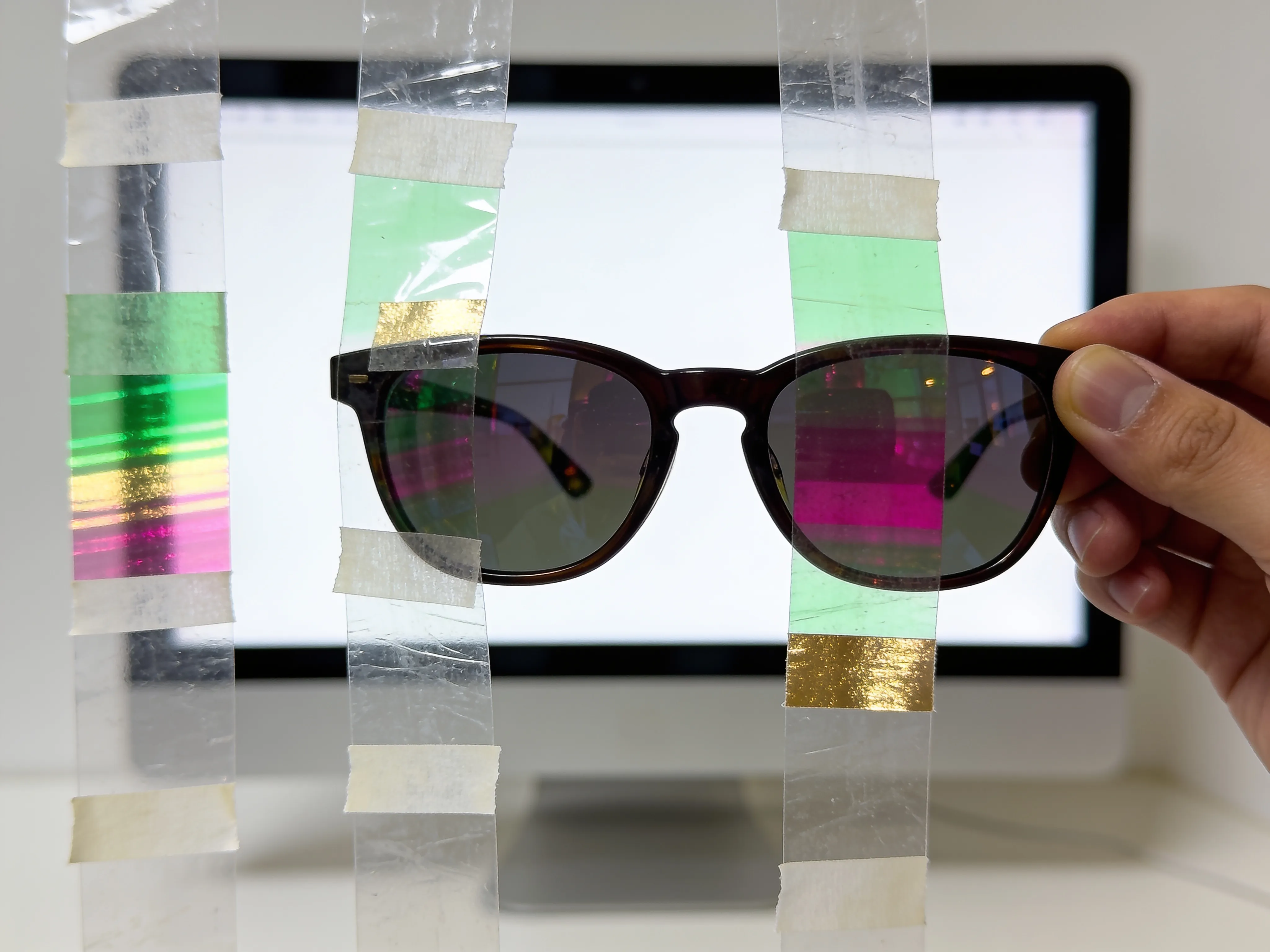
Colorless tape on a colorless bag arrives in bands of color, and the colors swap as you rotate the lens. Stretched tape twists the vibration of light the way the staircase does, and it twists each color by a slightly different amount. So at any one angle some colors escape past your sunglasses and others are absorbed. Count the layers and you can predict which patch changes next.
The filter you were wearing all along
So go back to that tilted head. The last thing the light meets on its way out is the front filter. Every scrap of light leaving a screen like this is therefore already lined up one particular way. That is how the picture was assembled.
Your sunglasses are polarizers too, doing the identical job to the filter on the front of the screen. Tipping your head rotates them. Somewhere around a quarter circle you cross them against the screen, and crossed filters pass nothing. The screen has not gone dark. You have rebuilt its own shutter around it, using your face, and left out the only part that could have rescued you. The staircase is still in there, quietly rotating the light a quarter circle so it can get out.