How does a touchscreen tell your finger from your glove?
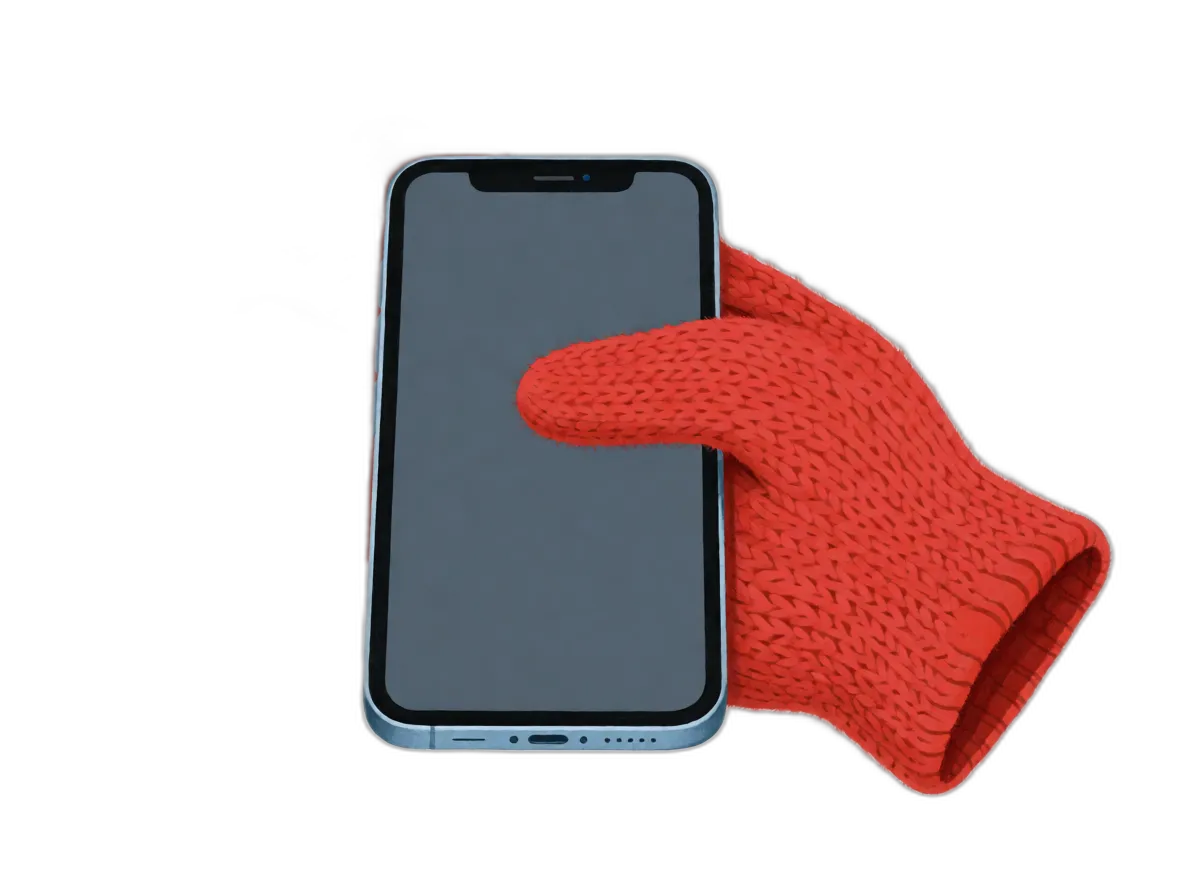
It is cold, your phone buzzes, and you swipe at it with a gloved thumb. Nothing. You swipe harder, which also achieves nothing. So you drag the glove off with your teeth and tap once with a bare finger, and the phone wakes instantly. The glass got the same shove both times. What is the screen looking for, if it is not the shove?
It is looking for electricity that goes missing. The screen pushes a tiny helping of charge across itself, over and over, and counts what arrives. Your finger takes some of it. Wool takes none.
Your finger is a bag of salt water
You are roughly two thirds water, and none of it is pure. Salts are dissolved all the way through, and a dissolved salt breaks into tiny particles that each carry an electrical charge. Those particles can move, which is why charge moves through you.
Anything charge can travel through is a conductor, and you are a perfectly good one. Anything charge cannot travel through is an insulator: wool, cotton, leather, dry wood, plastic, glass.
Test that on yourself now. Tap your screen with the tip of a fingernail, keeping the skin clear of the glass. Nothing happens. Roll your finger forward until the pad lands, and the screen answers instantly.
A fingernail is keratin, the hard dead material that hair and claws are built from. Dead and dry means no salty water, and no salty water means no path for charge. You wear a small insulator on the end of every conductor you own.
So the screen sorts the world into two piles. Working out which pile is lying on it, and where, is the harder half.
A grid you can see through
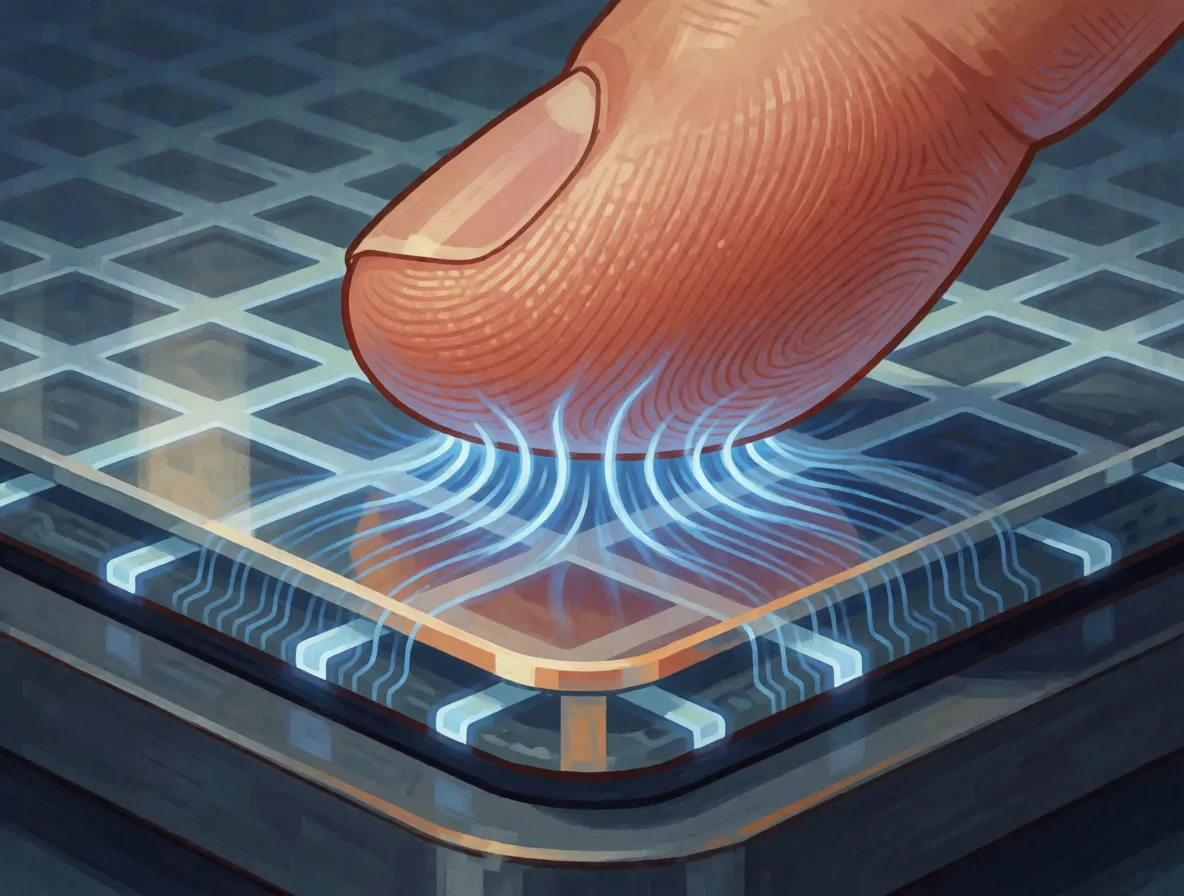
Underneath the glass lie two layers of microscopically thin metal strips. One runs across in rows, the other down in columns. They cross without ever touching, and every crossing is kept apart by a whisker of clear plastic.
Strips laid down to carry charge into a device are called electrodes. Yours are indium tin oxide, a hard transparent coating that conducts charge and passes light when spread thinly enough. Call it the clear metal.
The electrodes sit about 5 mm(0.2 in) apart, and that spacing is deliberate. A fingertip pressed flat makes a patch roughly 8 mm(0.3 in) across, so your finger always covers two electrodes of each kind. The screen compares them and places you between electrodes rather than on one.
Fourteen columns across, thirty rows down. That is the entire map your phone has of you.
Nothing in that arrangement senses anything yet. The crossings have to be asked a question.
Every crossing is asked the same question
The question is a pulse of charge. A chip at the edge of the glass, the touch controller, fires one along a row. Wherever that row passes a column, a small fixed helping of the charge crosses the gap and lands on the column. The controller counts what turns up.
Why should charge cross a gap at all? Because it will not sit quietly inside its own electrode. It reaches out into the space around it, and that invisible reach is an electric field. The field of a loaded row bulges up through the glass and a whisker into the air, then curves back down onto the column.
With nobody touching, the identical helping arrives at every crossing every time. The controller measures those four hundred numbers when the phone starts up, and memorizes them.
Your screen at rest is a grid of expected numbers, rechecked all day long, and something has to come along and make one of them wrong.
What your finger takes away
You do. A fingertip on the glass lands inside the part of the field that bulges above the surface. Charge on its way from row to column suddenly has somewhere better to go.
It goes into you, and it does not come back. You are enormous by comparison: a grown adult holds roughly a hundred times as much charge as one of those crossings.
So the column comes up short. The controller finds the crossing delivering less than it promised, checks its neighbors to see which way the shortfall leans, and drops a dot there. Then it sweeps the whole grid again, about 120 times a second. Between one heartbeat and the next, your phone has measured every crossing roughly ninety times.
Your phone has no idea it is being touched. It knows only that a number it was expecting came back smaller.
The dot lands where the shortfall runs deepest, which is why a gentle brush and a hard jab leave their marks in the same spot.
Nothing in there can feel warmth
Read that chain back and notice what never happened. No step measured a shove, and no step measured heat. There is no thermometer anywhere in a phone screen.
So the whole test has one question in it: is there a conductor close to the glass?
Which makes a glove genuinely strange. Wool is an insulator, certainly, but so is glass, and the field pushes through glass without the slightest difficulty.
The reach runs out in a millimeter
Distance is the answer. An electric field is fiercest against the electrode that made it, and weakens fast in every direction. The bulge above your screen is a low ripple. A millimeter up, there is almost nothing left to take.
The glass across the front of a phone is around 0.5 mm(0.02 in) thick, thinner than the fingernail you tapped with, and even that costs the designers a measurable slice of their signal.
Now stack a knitted glove on top: a millimeter or two of wool, plus trapped air between the wool and your skin. Your finger has not stopped conducting. It is simply parked outside the ripple.
Some phones hide a glove setting in the display menu. It does nothing to the wool. It raises the sensitivity until a fainter theft still shows up.
That explains the exceptions: disposable surgical gloves are a tenth of a millimeter of stretched rubber, and a phone hardly notices them. Gloves sold for winter have conductive thread knitted into the fingertips, carrying the theft down to your skin.
So the glove blocked nothing. It held you a millimeter too far away. Which raises an obvious question: why build a screen this fussy, when one that answers a glove is easier?
The screen that lost for thirty-five years
Screens that measure charge this way are capacitive, named after capacitance, the amount of charge a thing can hold. In 1965, about when your grandparents were born, Eric Johnson announced one at the Royal Radar Establishment in Malvern, England. He built it for air traffic controllers, whose hands are full and whose eyes cannot leave the display.

Six years later Sam Hurst built something completely different. He was a physicist from Oak Ridge National Laboratory, teaching at the University of Kentucky and buried in paper charts. In 1971 he founded a company to sell his answer: two thin sheets held a hair apart by tiny spacers, which touch wherever you press. Screens like it are resistive, named after resistance, and it answers a shove rather than a theft. So it answers anything at all: a pencil, a fingernail, a gloved hand in the snow.
His first machine was solid, and his company needed the rest of the decade to make a see-through one. After that the pressed sheets won everywhere and kept winning for thirty-five years, in ticket machines, supermarket checkouts and handheld games that all asked you to push until you felt them give way.
What beat them was multi-touch, the trick of following two fingertips at once. In 1999 Wayne Westerman finished a doctorate at the University of Delaware on precisely that problem, and Apple acquired his company six years later. Two presses on a pair of squashed sheets average into one muddled answer. Four hundred crossings, counted separately, give four hundred answers.
Find the thickness where you disappear
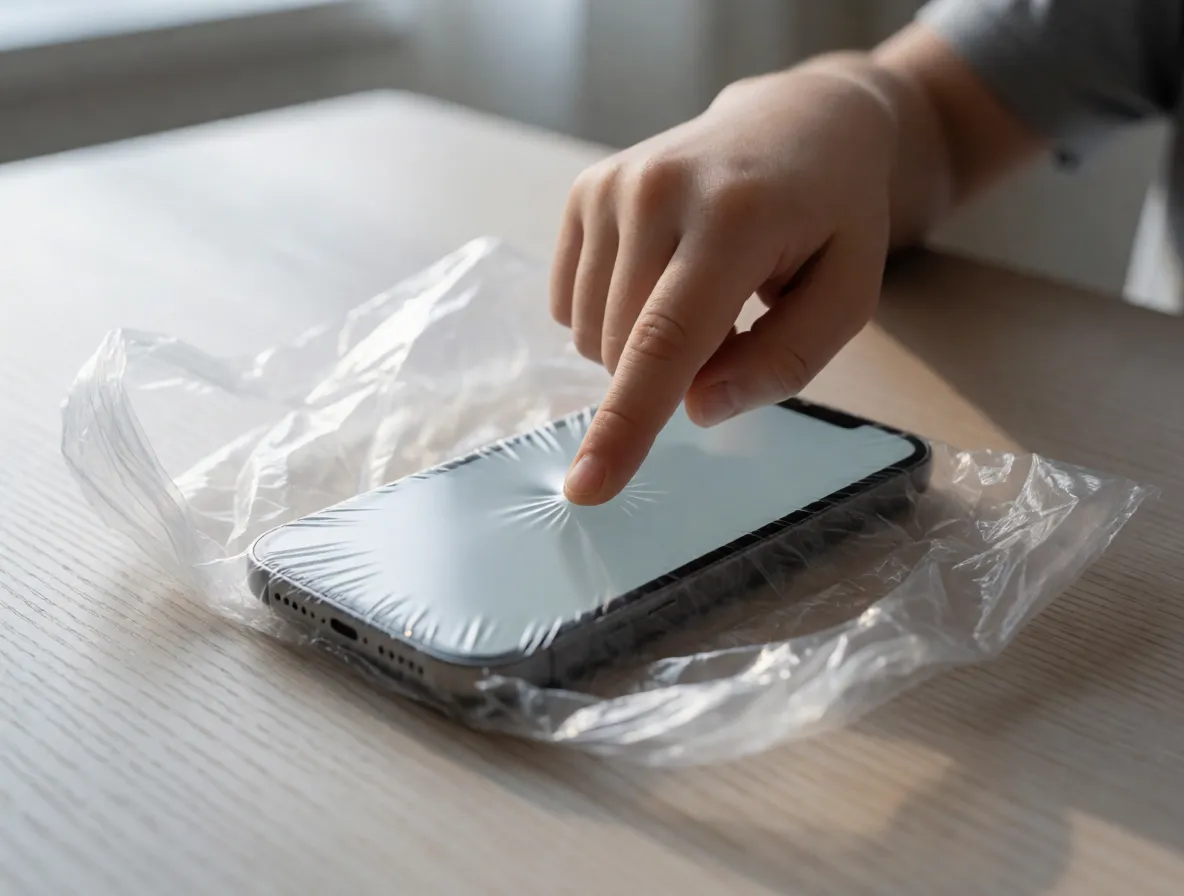
Most phones give up around the third or fourth fold, or eight to sixteen layers. The foil pencil works on the first try, and it is nothing like a finger: hard, cold, dry and not remotely alive. What it has is an unbroken path from the glass to a hand full of salt water.
The screen never actually touches you
Go back to the cold street and the buzzing phone in your gloved hand. The screen had not frozen and it was not ignoring you. It was reading four hundred numbers ninety times a heartbeat, and finding every one as expected.
The part that hides in plain sight is this: those clear metal electrodes are sealed underneath the glass. No part of the screen has ever met your skin, on this phone or any other. Everything your phone knows about your finger, it worked out across a gap that only the field can cross. A glove is one millimeter more of that gap than the field can spare.