Why does bread go stale faster in the fridge?
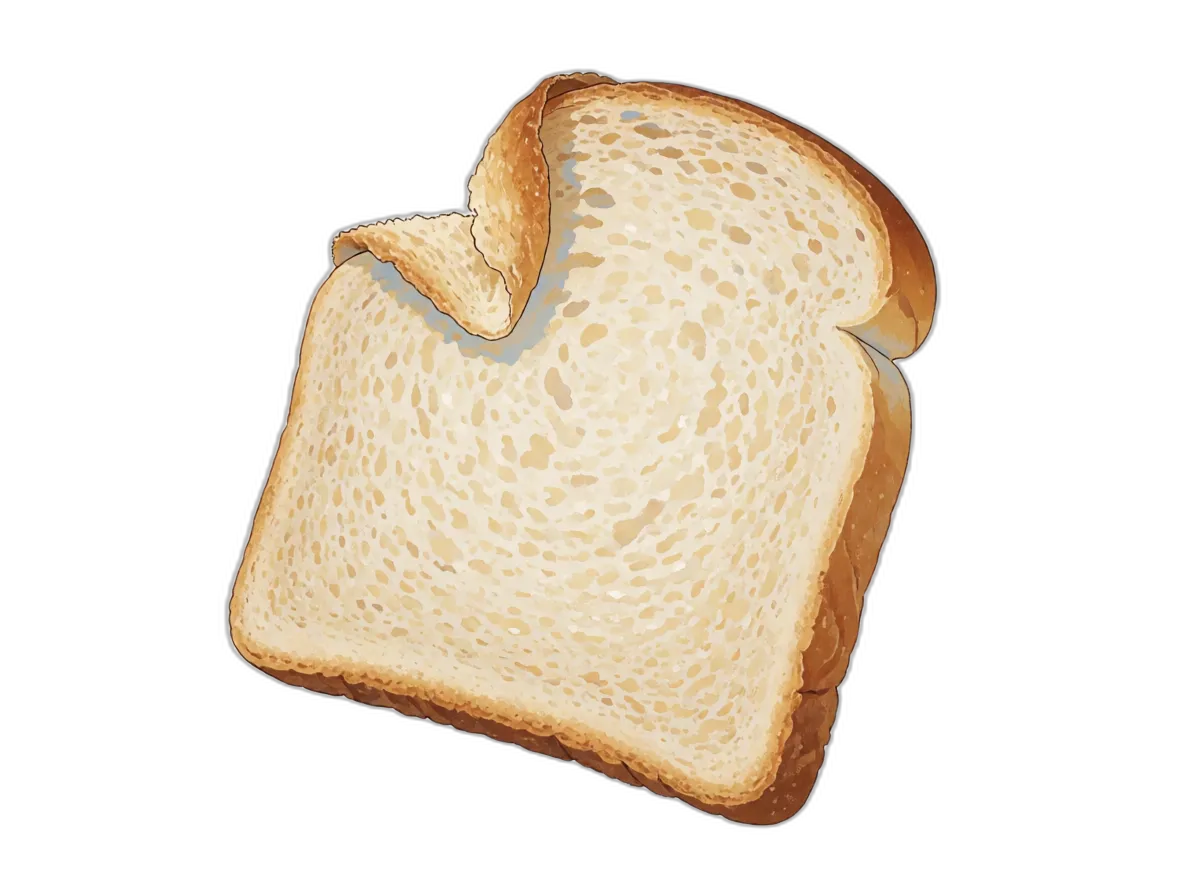
The fridge is where food goes to survive. Milk lasts a week in there and cheese lasts a month, so a loaf ought to be perfectly safe overnight. Put one in and by the second morning it is hard, crumbly and slightly leathery, while the loaf left out on the counter is still fine. Weigh both and the fridge loaf has lost nothing at all. So what has gone wrong inside it?
Bread does not go stale by drying out. It goes stale because something inside it is quietly rebuilding itself, and it rebuilds fastest at almost exactly fridge temperature.
Baking unwinds the flour and traps water inside it
Roughly seven-tenths of a loaf, once you ignore the water, is starch: the carbohydrate plants manufacture to store food away for later. Potatoes, rice and wheat are all mostly starch.
Starch is built from glucose, a small sugar molecule — a molecule being the smallest complete piece a substance can be divided into. Thousands of glucose units are joined end to end into enormously long chains. In raw flour those chains are packed into microscopic grains, in a neat repeating structure.
Baking demolishes that structure. Water plus heat forces the grains to swell, burst and unwind. The liberated chains immediately sprawl outward into a soft disorderly tangle, with water trapped everywhere between them.
Squeeze a piece of fresh bread and it springs back. You are feeling chains lying in a shape they were forced into, holding water they were forced to absorb.
The chains gradually stack themselves back up
That soft tangle is the crumb, the springy inside of a loaf, and it is the part that goes wrong.
Nothing is holding the tangle open. The chains are perfectly capable of sliding past one another, gradually, and they have a powerful preference for lining up alongside their neighbors in orderly stacks.
Given hours, that is exactly what they do. Sections of neighboring chains find each other, straighten, and lock into a rigid repeating pattern. Chemists call such a pattern a crystal, and this particular rebuilding has its own name: retrogradation. Restacking is a clearer word for it.
Two things follow immediately. Stacked chains are stiff, so the crumb loses its spring and turns firm. And stacked chains have no room between them, so the water they were holding gets squeezed out into other parts of the loaf.
Nothing left the loaf. The water merely stopped being anywhere you could feel it.
So staling is a rearrangement rather than a loss, and rearranging takes time. Which raises the question the fridge answers: what decides how fast the chains manage it?
Restacking has a favorite temperature, and your fridge is sitting on it
For a chain to join a stack it has to shuffle into position. That requires a particular amount of movement: too little and it never arrives, too much and it cannot settle.
Warm bread is too lively. At 20 °C(68 °F) on the counter, the chains jiggle enough to keep knocking each other out of alignment, and stacks build slowly.
Frozen bread is too sluggish. At −18 °C(0 °F) the chains barely move, and a loaf that is properly frozen is almost exactly as fresh a month later as it was going in.
Between those extremes sits a speed that suits stacking perfectly, and measurements put it a few degrees above freezing. A fridge runs at about 4 °C(39 °F), which is essentially the worst temperature available for keeping a loaf soft.
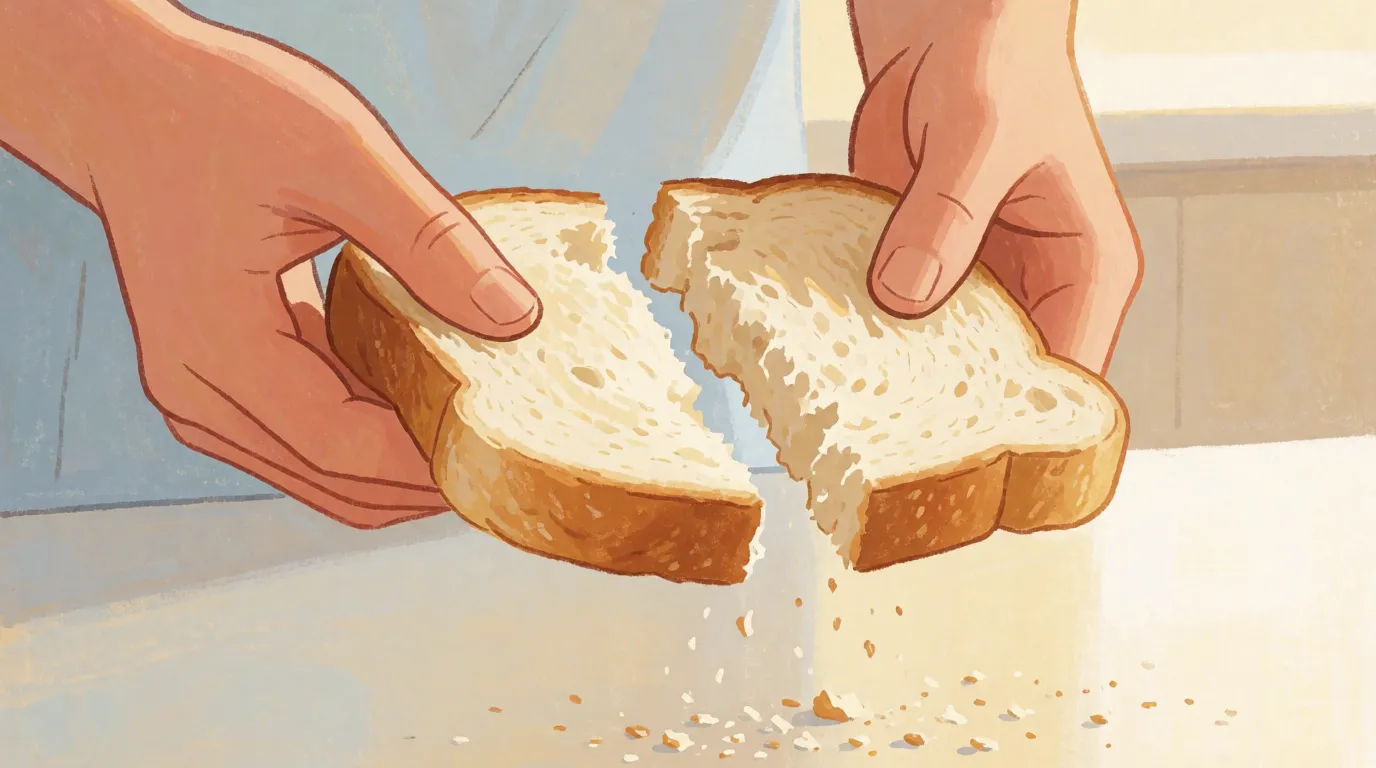
That is the whole apparent contradiction, resolved. A refrigerator slows down the organisms that spoil food, because bacteria and molds are alive and cold makes them sluggish. Restacking is not alive. Cold suits it.
The man who sealed bread in glass to prove it
The drying explanation had been obvious to everybody for centuries, and in 1852 — about six generations before you were born — a French chemist decided to test it properly. Jean-Baptiste Boussingault sealed fresh bread inside glass so that not one drop of water could leave.
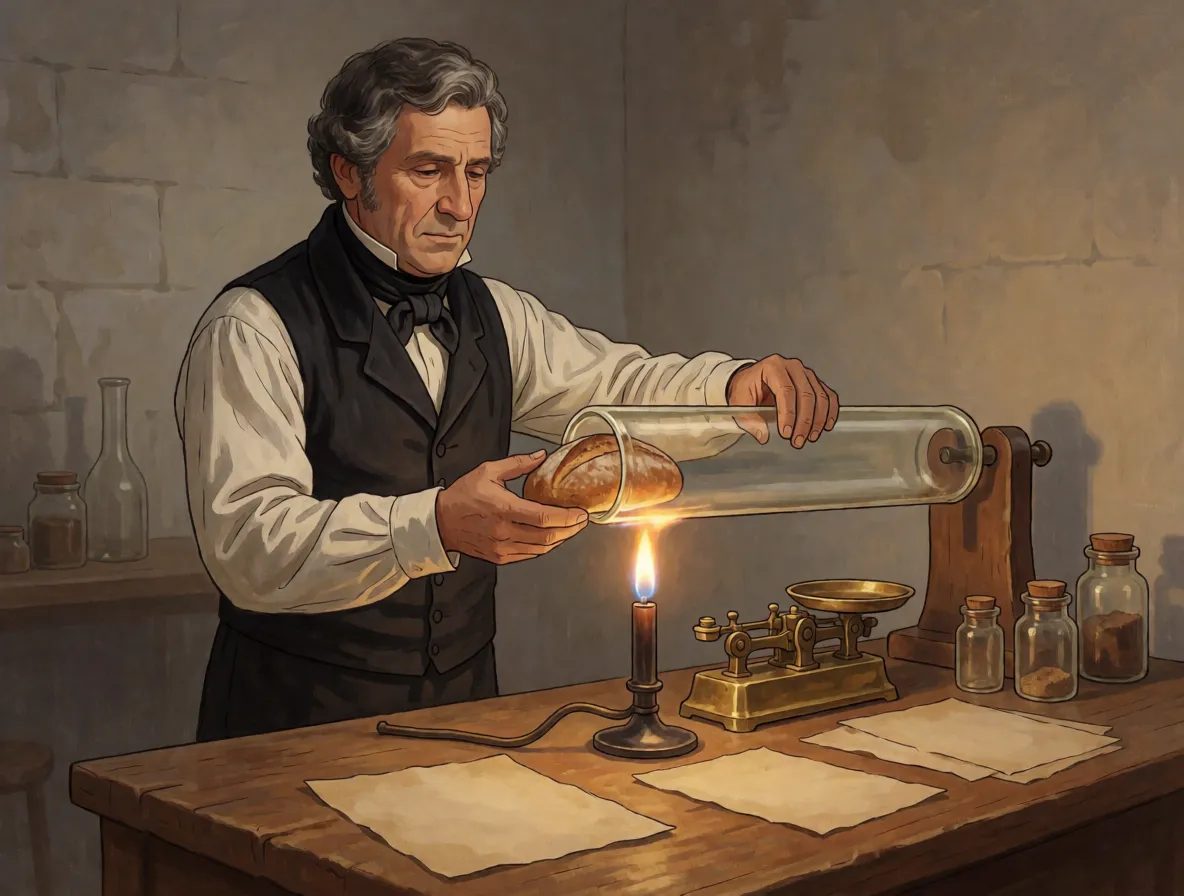
The bread went stale on schedule. He then heated the sealed tube and the same bread came out soft again, with the identical quantity of water it had always contained. Both halves of the modern explanation were sitting in that one experiment.
Nobody could say what was actually moving, because nobody could see inside. The answer waited until 1928, when the Dutch chemist Jacob Katz aimed X-rays at bread. Fresh crumb scattered them into a blur. Stale crumb scattered them into the sharp pattern that only orderly stacks produce.
Even then it took another twenty years to establish which ingredient was responsible. In 1947 Thomas Schoch and a colleague separated the starch from everything else in the loaf, staled each part separately, and demonstrated that starch alone reproduced the firming. Almost a century of chemistry, to explain yesterday’s toast.
Three slices, three temperatures, one scale
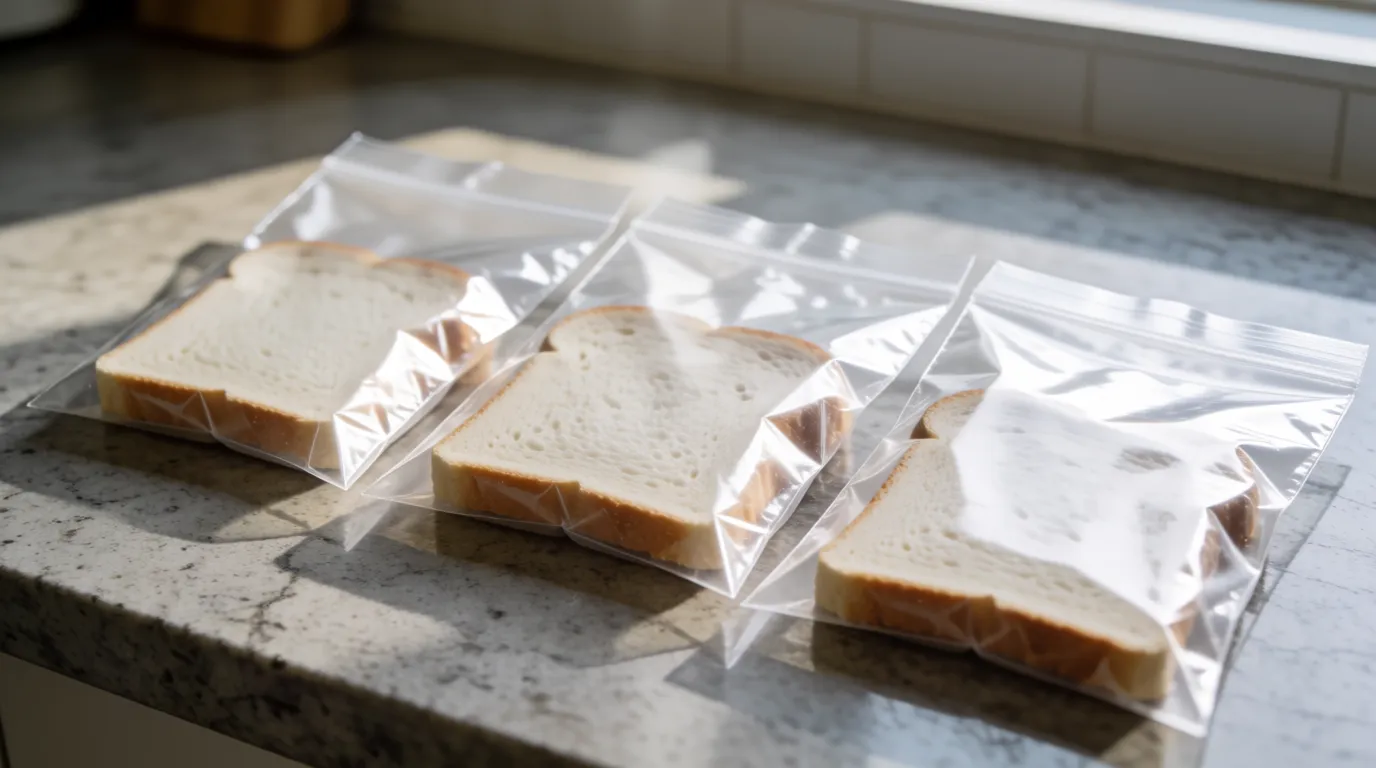
A typical result: the fridge slice is measurably harder and has lost nothing whatsoever.
The weights match. The textures do not. The counter slice is going firm, the fridge slice is noticeably worse, and the frozen slice, once thawed, is close to the loaf you started with.
Then the toaster settles it. Warmth alone brings the fridge slice back, because heat is the one thing that undoes a stack, and no amount of heat has ever undone dryness.
What to do with a loaf, now that you know
Bread on the counter in a paper bag or a bin is going stale slowly, which is why kitchens have always kept it there without knowing the reason.
Bread in the fridge is going stale as fast as bread can. If you were putting it there to protect it, you were handing it to the one process the cold speeds up.
Bread in the freezer is essentially paused, provided you get it in there while it is still fresh. Freezing does not repair a loaf, it merely stops the clock — and a slice put straight from the freezer into a toaster arrives at the table indistinguishable from the day it was baked.