Why does a mirror swap left and right but not up and down?

You stand at the bathroom mirror and raise your right hand. The person in the glass raises a left one. Everybody knows that mirrors do this. But look at that person again: their head is still up and their feet are still down. A mirror that can swap one pair of directions really ought to swap the other. So why does it only ever pick on left and right?
It does not pick on them at all. A mirror reverses one direction only, and that direction runs straight into the glass. The swap you keep seeing is added afterwards, by you, in the half second before you notice.
The glass reverses front and back
Light bounces off you and goes everywhere. Some lands on the mirror, bounces once more, and arrives at your eyes. Your eyes cannot tell the light took a bend, so they read every ray as though it came from straight ahead. What you see is a reflection: a complete copy of you, apparently standing behind the glass.
Every point of you is duplicated at a point directly behind the glass, at exactly the distance you stand in front of it. Your nose is nearest the mirror, so the copied nose is nearest in the copy.
Only one measurement has changed: the distance from the glass. A direction you can measure along is an axis, and this one runs perpendicular to the mirror, straight out of your chest at a right angle to the surface. Your nose sits roughly 20 cm(8 in) in front of the back of your head. In the copy that gap runs the opposite way.
Stand 30 centimeters from a mirror and your reflection stands 30 centimeters behind it, so step back and the gap grows twice as fast as you move.
So the mirror has reversed one axis, the perpendicular one. Your height is untouched and nothing has shifted sideways. So where did left and right come from?
Up is the same for everyone. Left is not.
Try this wherever you are sitting. Reflections in a dark window work as well as a mirror. Raise the hand nearest the window, and your reflection instantly raises the hand nearest the window too, at the same height on the same wall. Nothing crossed over.
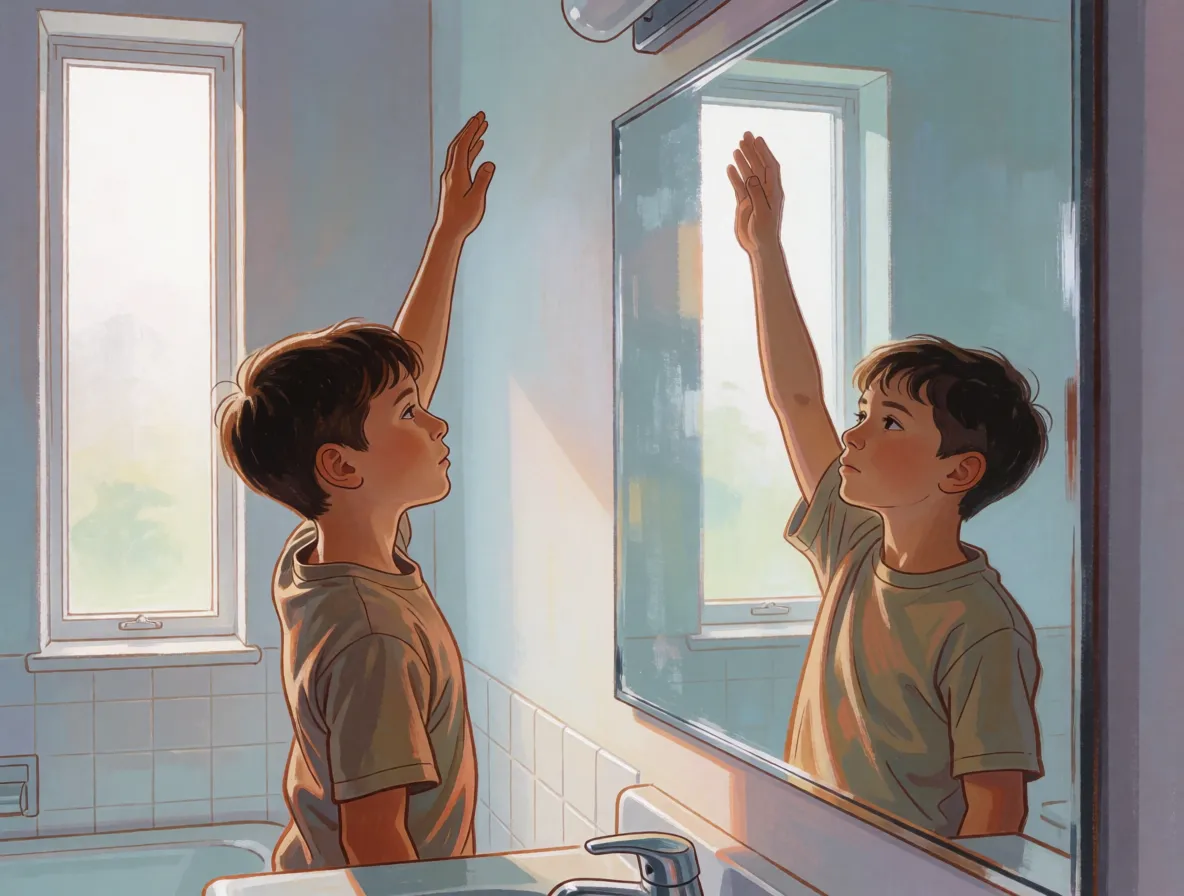
Now think about why up and down never come into it. Down is wherever gravity pulls: the direction everything falls, the direction the floor lies. Gravity reaches the whole room equally, and a mirror cannot interfere with it. Your head is up, the copy’s head is up, and you both agree completely.
Left and right have nothing holding them still. No pull in the room points left. Left is decided by which way a body faces, and it travels with that body when it turns. Ask somebody standing opposite you to raise their left hand: it goes up on the far side of the room from yours. That confusion is familiar, and neither of you is wrong. You face opposite ways, so your lefts point at different walls.
Up belongs to the room and never moves. Left belongs to a body and moves whenever that body turns. So look again at the person in the glass, and ask which way that body is facing.
Your reflection is facing the other way
It is facing you, and the front-back flip is what did that. Your nose is nearest the glass, so the copied nose is nearest the glass too, which points it back out at you while yours points in. Its head is up and its feet are down like yours, but the two of you are aimed in opposite directions.
That single fact does all the damage. Say the window is on your left. The mirror has not moved the window, and it has not moved your raised hand, so in the glass both are still beside the same wall. But the body in the glass is facing you, and for a body facing that way, the window wall is the right-hand side. Same wall, same hand, two different names for it.
So the swap is a change of name, and you are the one making it. You see a person looking back at you, and you sort out their left and right automatically, by imagining yourself rotated around to stand where they are. That imagined rotation puts the window on your other side.
Nothing about the copy moved sideways. You gave one wall two different names, half a second apart, and called the difference a swap.
The face your friends see
That renaming has a consequence you have probably bumped into already. Hardly any face is symmetrical, meaning identical on both sides. The parting in your hair falls one way. Those small asymmetries are most of what makes a face recognizable.
None of this is the glass being clever. It performs one operation, reversing front and back, and hands the result to a brain that has spent ten years reading faces. The asymmetry does the rest. The surprising part is how long it took anybody to understand.
Two thousand years of blaming the glass
For twenty centuries people looked for the answer inside the mirror. Around 360 BC, Plato wrote that seeing worked by a visual fire streaming out of the eye. Where the visual fire met the light coming off your face, on a polished surface, the two streams crossed over. That crossing, he said, was why the right of a face came back as the left. Notice where he put the explanation: in the light, in the glass, anywhere except the person looking.
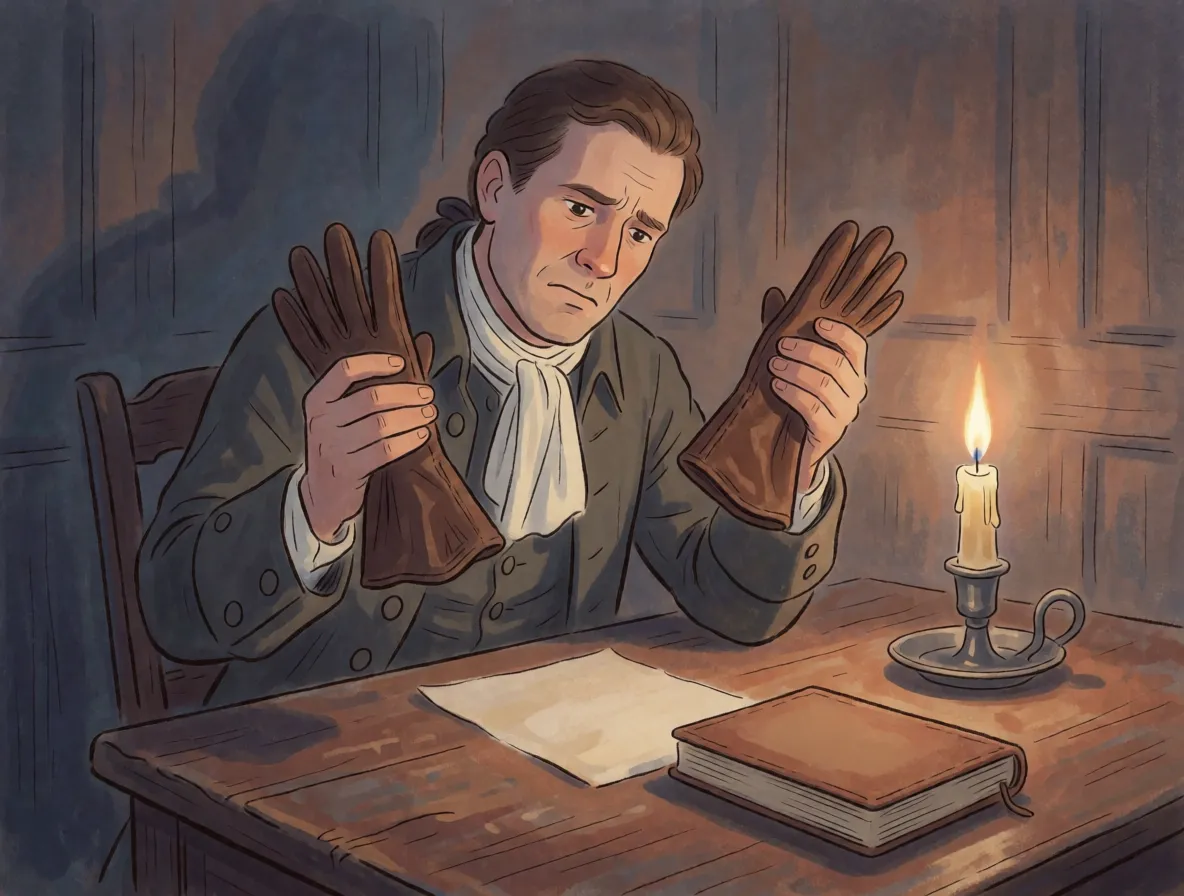
The first crack came from a philosopher not studying mirrors. In 1768, Immanuel Kant pointed at a pair of gloves. A left glove and a right glove have identical parts in identical positions, and the geometry matches throughout. Yet it is impossible to turn a left glove into a right one. Kant called such things incongruent counterparts, a heavy name for a plain property we can call handedness.
The puzzle finally went back to the observer. In 1964, when your grandparents were still at school, Martin Gardner opened a book called The Ambidextrous Universe with this question. In 1983 the physicist Richard Feynman answered it on television, in an episode titled How Mirrors Turn You Inside Out. His whole argument fits into one line. The hand on the east is still the hand on the east, but your nose has changed ends with the back of your head.
The modern answer is a fact about the word left, and paper proves it faster than you can.
Turn the page a different way
Paper has a front and a back, exactly like you do, and it can be flipped end over end without anybody getting hurt.
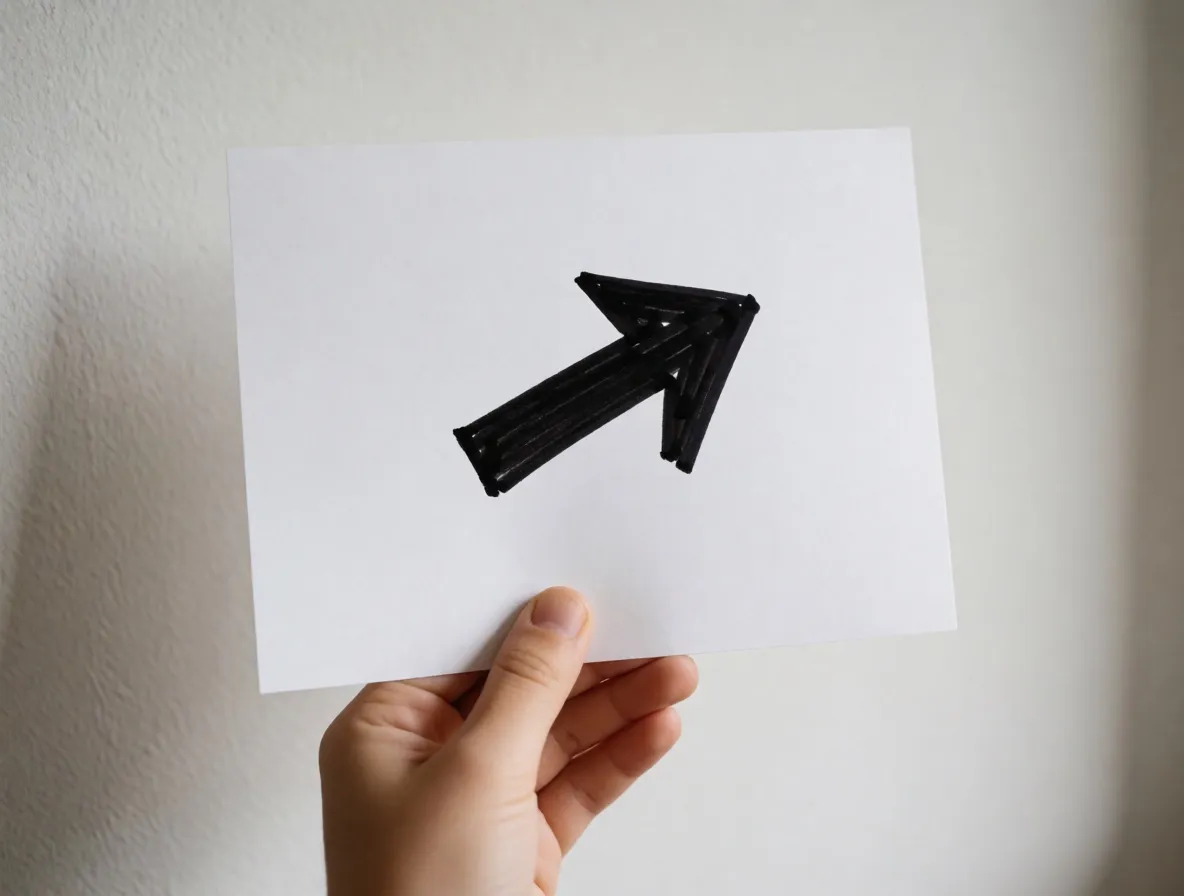
The first flip gives an arrow pointing at the top left. The second gives one pointing at the bottom right. Same mirror, same paper, same position on the floor. Swing the page about a vertical line and the mirror seems to swap left and right; swing it about a horizontal line and it seems to swap up and down.
The mirror never chose. The choice was made by whichever rotation your hands used, and that is exactly what you do with yourself.
The swap you brought with you
When you look at your reflection and decide which hand it raised, you are quietly making a comparison with a picture of yourself turned around to face you. And you always turn yourself the same way: on the spot, about a vertical line from your head down to your feet. Nobody turns around by standing on their head.
That imagined rotation is the only thing that swaps anything. Rotate about a vertical line and left and right are precisely the two things that trade places. Your height sits on that line, so it stays put, exactly as it did when you swung the page like a door. Handedness makes sure you can never really finish the job.
No turn, no twist, no walk around the back of the glass will ever put you where your reflection is standing.
You can watch the swap move. Lie on your side on the floor, facing a long mirror, and raise the hand nearest the ceiling. Your reflection raises the hand nearest the ceiling too. But one of you calls that a left hand and the other calls it a right, and this time the sides trading names are the ceiling and the floor.
So a mirror has never once swapped your left and your right. It was not swapping your hands, it was swapping your nose for the back of your head, the only direction a flat sheet of glass can reach. Next time you raise a hand at the bathroom mirror, look past the hand at your nose. That is the part that really moved.