Why isn’t the earliest sunset on the shortest day?
Everybody knows which day is the shortest, and everybody assumes it is the day the sun goes down earliest. Look up the times for your own town and it is not. In early December the sunsets have already started creeping later, while the days are still getting shorter, and the latest sunrise does not arrive until well into January. Three things that ought to happen together are spread across a month.
A day is not a fixed length. The sun runs a few seconds fast or slow every day, and near midwinter that drift outruns the shrinking daylight.
Sunset depends on two separate things
Write it out as a sum and the puzzle almost solves itself. The moment the sun sets is the middle of the day plus half the daylight.
The middle of the day is solar noon: the instant the sun stands at its highest, exactly halfway between rising and setting. It is not the same thing as twelve o’clock, and that difference is what this entire article is about.
Half the daylight is the other part, and it does what you expect. It shrinks through autumn, reaches its minimum at the solstice — the shortest day — and grows again afterward.
If solar noon stayed put, sunset would follow daylight exactly, and the earliest sunset would land on the solstice. Solar noon does not stay put.
The sun keeps a slightly unreliable clock
Our clocks assume every day is precisely twenty-four hours. Measure from one solar noon to the next and it is not. Some days run a few seconds long and others a few seconds short, and those errors accumulate over weeks.
Two things cause it, and they are unrelated to each other. The first is that Earth’s orbit — its path around the sun — is not a circle but a slightly squashed one.
We are nearest the sun in early January, at about 147 million km(91 million mi), and furthest in July, at about 152 million km(94 million mi). Planets travel faster when they are closer, so Earth is hurrying along in December and dawdling in June.
The second cause is the tilt of Earth’s axis. Because our planet leans over, the sun’s yearly path across the sky is slanted rather than parallel to the equator. A slanted journey does not translate evenly into east-west progress.
Add the two together and you get the equation of time: the running total of how far the sun is ahead of or behind the clock. Across a year it swings between about sixteen minutes early and fourteen minutes late.
In December the drift wins
Now put the two halves of the sum together at midwinter, and the answer falls out.
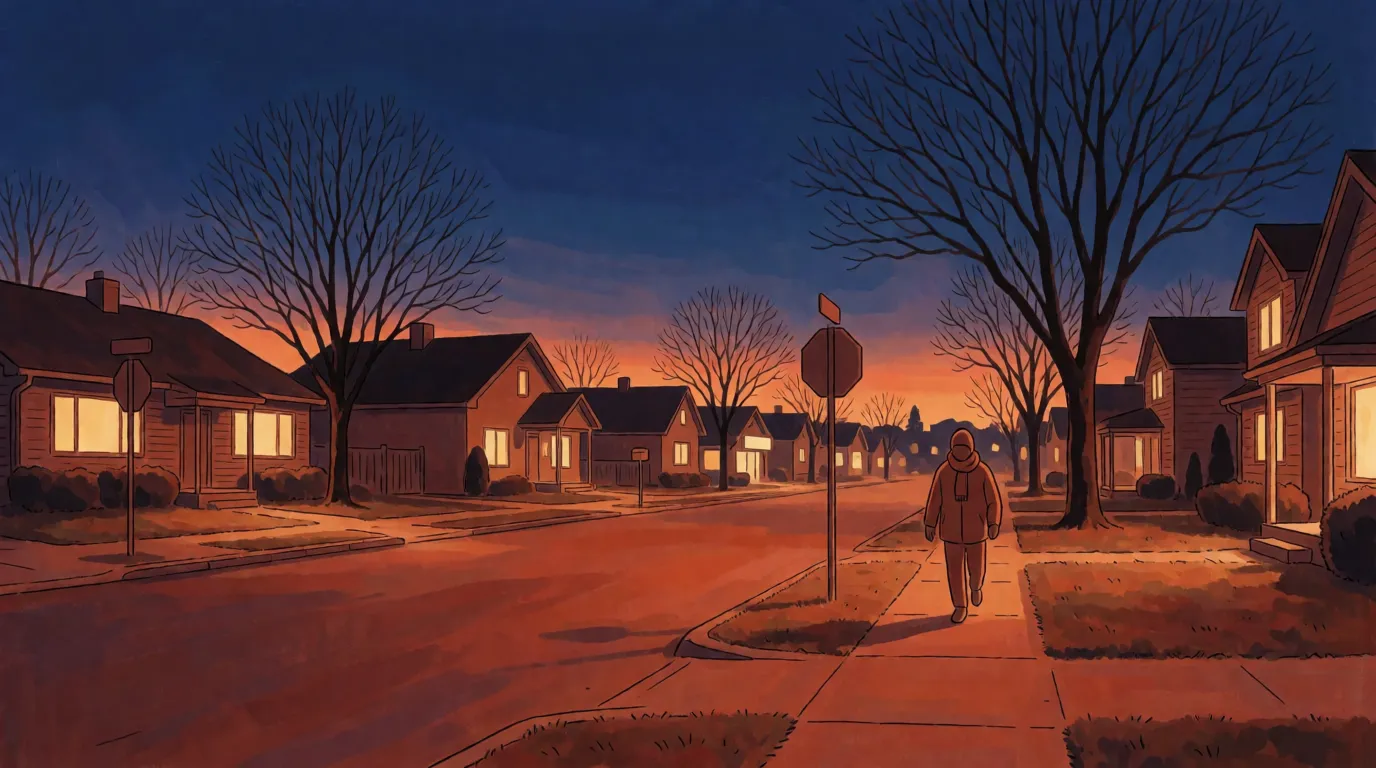
Around the start of December, solar noon is sliding later by roughly thirty seconds a day, and it keeps doing so straight through the solstice into January.
Solar noon drifting later, at about half a minute a day for a fortnight.
Meanwhile the daylight is shrinking, but it is shrinking more and more slowly as the solstice approaches. That is what a minimum means: right at the bottom, the change per day dwindles to nothing.
So in early December you have a steady thirty seconds a day of drift working against a shrinking that has almost stopped. The drift wins, and sunset starts getting later while the day is still getting shorter.
Nothing is wrong with the sun. Our clocks tick at a fixed rate, and the sun never agreed to.
The identical argument, run backward, explains the other end. Sunrise equals solar noon minus half the daylight, so the drift pushes sunrise later as well. The latest sunrise consequently arrives a fortnight after the solstice.
The shortest day is still the shortest day
How far apart they land depends on where you live, which is a good sign that the explanation is right. Near the equator the daylight barely changes from week to week, so the drift dominates completely and the gaps are large. Far north the daylight is changing violently, so it overwhelms the drift and the three dates almost coincide.
When clocks got good enough to argue with the sky
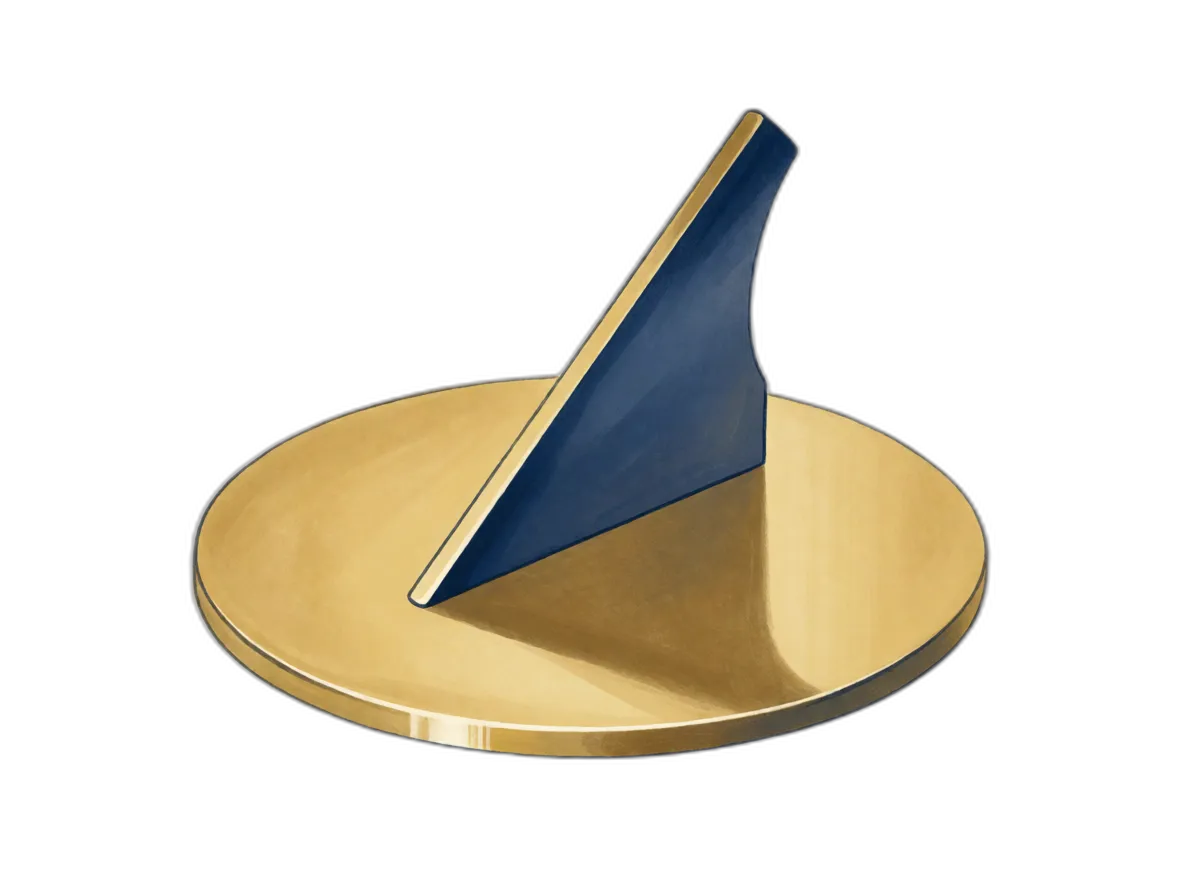
For most of history a sundial was not an approximation of the time. It was the time, and every mechanical clock in Europe was adjusted to match one.
That arrangement survived because early clocks were dreadful, losing a quarter of an hour daily. Then in 1656, about twelve generations before you were born, Christiaan Huygens built a clock controlled by a swinging pendulum. Accuracy improved roughly sixtyfold overnight.
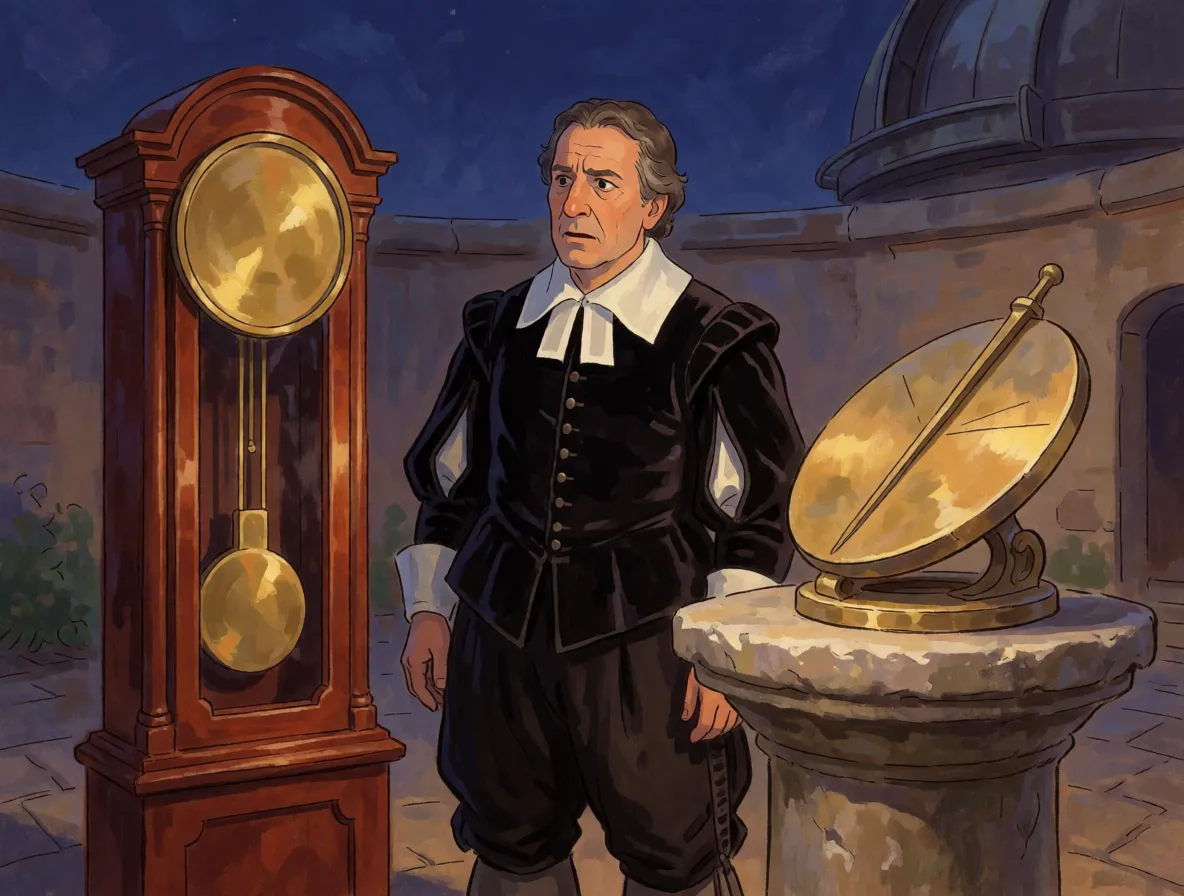
Now there was a problem. A good pendulum clock and a good sundial disagreed, and the disagreement was not random. It grew and shrank through the year and came back to the same value on the same date every time.
The explanation was already available. Johannes Kepler had demonstrated in 1609 that planets travel on squashed orbits and accelerate when nearer the sun. That accounts for half the effect, and the tilt of the axis produces the remainder.
Huygens published the first correction table in 1665. In 1672 the English astronomer John Flamsteed published a superior one, in the arrangement still used today. From then on a sundial reading had to be corrected before it counted as the time.
Almost every ornamental sundial manufactured afterward carries a small engraved table, or a figure-eight curve, supplying the correction. That curve is called an analemma: a plot of where the sun stands at clock noon on every day of the year.
Look it up, then watch it happen
Most people are genuinely surprised by their own table, because the numbers are easy to check and completely contradict what everyone repeats each December.
The comparison between towns is the part worth doing properly. Two locations on the identical date, with the same sun and the same orbit, produce very different separations. The reason is entirely about how rapidly their daylight is changing.
Two clocks that were never going to agree
Underneath all of this is one small decision nobody thinks about. We chose to make every day exactly the same length, because a clock that ticks unevenly is useless for trains, meetings and ovens.
The sun kept the original arrangement, in which a day is however long it takes to travel from one noon to the next, and that genuinely varies. Our tidy version and the sun’s untidy one drift apart and back together annually.
So the earliest sunset is not a mistake in the calendar, and the solstice has not moved. It is the one time of year you can catch two different definitions of a day, quietly disagreeing by seven minutes.