How did one doctor work out that hands were killing his patients?
In 1846 the largest hospital in Vienna had two maternity clinics a few steps apart. Women in labor begged to be sent to the second one, and some delivered in the street rather than enter the first. Behind that door, roughly one mother in nine died within days. Behind the other, one in thirty-six. So what was different?
One doctor worked out the answer in eighteen months. He never saw the thing that was killing them, and he had no idea what it was.
Two doors, a few steps apart
Both clinics did identical work. The First Clinic trained doctors and medical students; the Second trained midwives, women whose profession was delivering babies.
The illness killing the mothers was childbed fever, puerperal fever to the physicians. It arrived a day or two after delivery, with a temperature above 40 °C(104 °F), and most women who caught it died. Doctors in the 1840s blamed bad air, bad luck, or the mother herself.
In 1846 the First Clinic delivered 4,010 babies and 459 mothers died, while the Second delivered 3,754 and lost 105. That is eleven deaths in every hundred against under three, like losing three children from a class of thirty.
What makes those numbers evidence is the admissions rule. A woman could not choose her clinic: the two swapped every twenty-four hours, one day the First taking everybody, the next day the Second.

So the two crowds of women were as similar as crowds ever get, and whatever killed them was living inside one of the clinics.
He tested the answers one at a time
Ignaz Semmelweis joined the First Clinic in July 1846, aged twenty-eight. That year sits seven generations ago: count from you to your parents, from them to theirs, and keep going.
His method is the whole trick of this story: take a suspected cause, remove it, and watch whether the number moves. Overcrowding was the popular explanation, so he counted, and found the Second Clinic the more crowded. Bad air came next, but both clinics occupied one building on one street.
Then a stranger possibility. Whenever a mother was dying, a priest walked the length of the First Clinic to reach her, a boy going ahead ringing a bell. Semmelweis wondered whether the sound frightened the other patients into illness, so he sent the priest by a silent side route. Nothing changed.
One fact refused to fit anything. Women who delivered on the journey to hospital, in a doorway or on the pavement, almost never developed the fever. They had no clean bed, no physician and no medicine.
Every cause he could eliminate, he eliminated, and the gap held. That left one difference he had never considered a cause: the people doing the work.
A cut finger gave him the answer
In March 1847 a colleague died. Jakob Kolletschka taught anatomy, and his daily work was the autopsy: the careful opening of a body after death, to discover what killed it. During one, a student’s scalpel slipped and cut Kolletschka’s finger, and within days he was dead.
Semmelweis read the report on his friend’s body. The damage inside matched what he had seen in mother after mother, yet Kolletschka had never given birth. The only thing he shared with those women was contact with the dead.
Medical students in the 1840s dissected bodies every morning, then climbed the stairs to examine women in labor, rinsing their hands on the way or not at all. The midwives never entered the dissecting room.
In 1843 the American doctor Oliver Wendell Holmes had argued in print that doctors were carrying childbed fever between patients. Nobody acted.A mother who has just delivered carries a wide raw wound inside her, where the afterbirth came away. No scalpel had to slip; the opening was already there.
So something from the dead was travelling into living women on doctors’ hands. Semmelweis could not say what it was, but he could say how to stop it.
The clue was a smell
He began from something everyone in the hospital knew and nobody examined. Hands that had been in the dissecting room smelled of it, and soap and water did not remove the smell. It lingered for hours.
You can check the awkward part yourself in ten seconds. Handle a cut onion, wash with soap, and smell your hands.
That gave Semmelweis one clean piece of reasoning. Something remained on the hands after washing, and the smell proved it. So he wanted a wash that killed the smell.
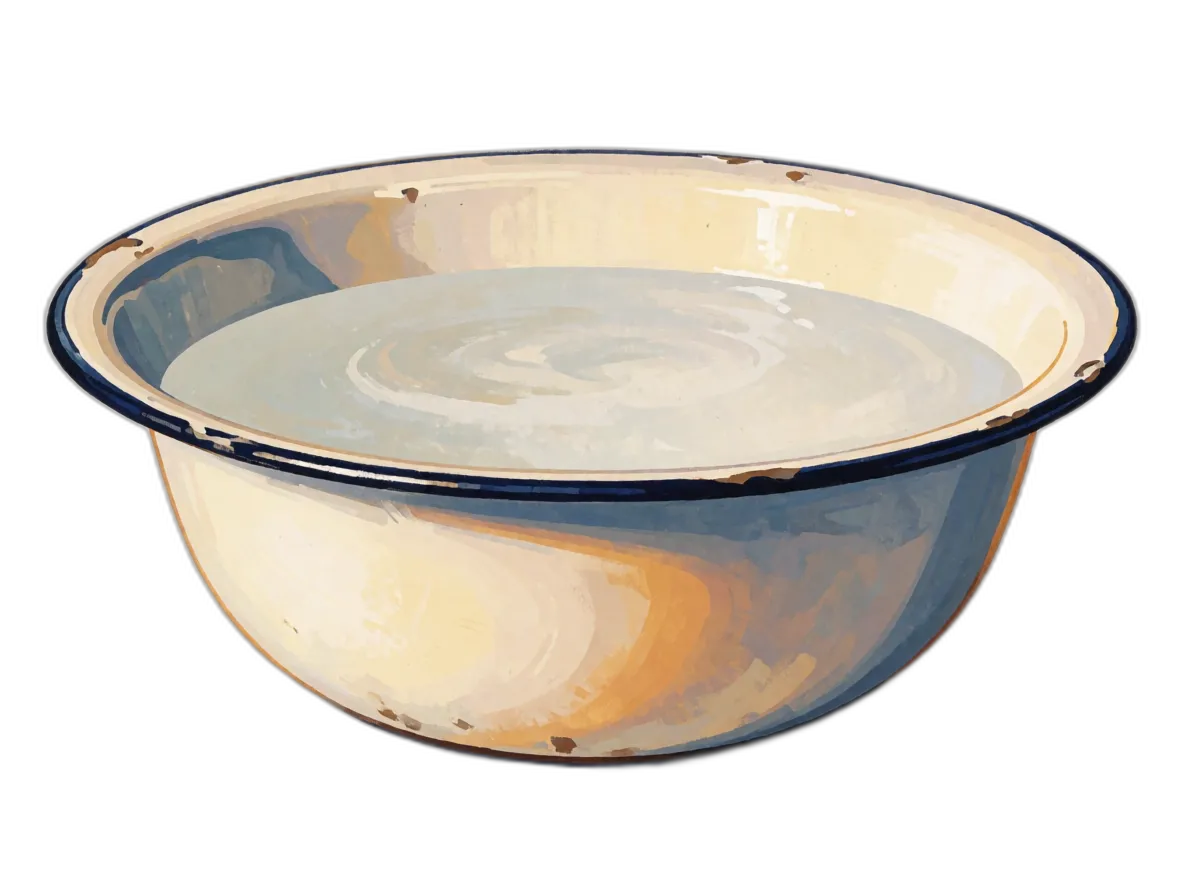
He settled on chlorinated lime, a white powder related to the bleach beneath your sink. Today we would call it a disinfectant; he only knew that a bowl of it strips the smell off skin. From May 1847, everybody entering the First Clinic scrubbed in it until their hands no longer smelled of the room downstairs.
He never pretended to know what he was removing. He called it cadaverous particles, a label rather than an explanation. What he possessed was a rule, and a method for testing it.
The number moved
The bowls appeared in mid-May 1847, and the clinic’s own register shows what followed. In April, eighteen mothers in every hundred had died; in June the figure was 2.2, and in July 1.2.
Across 1848 the First Clinic lost 1.27 mothers in every hundred, and the midwives next door lost 1.33. A difference that had persisted for years disappeared in six weeks, and the only new object in the building was a bowl of white powder.
The First Clinic delivered 4,010 babies in 1846, and the wash cut its death rate by ten in every hundred.
Four hundred mothers a year, in one building, saved by a bowl of powder and two minutes at a door.
The wash worked, and the statistics proved it. Persuading other physicians to copy it turned out to be the difficulty.
Nobody had to believe him
He was asking doctors to accept two things simultaneously. The first was that childbed fever had a single cause, when the medicine of the day taught that every case of illness had its own separate cause. The second was worse: they themselves had been carrying that cause on their hands, for years.
Johann Klein ran the First Clinic, and in March 1849 he refused to renew his young assistant’s post. It went to Carl Braun, who later published a list of thirty possible causes of childbed fever. Semmelweis’s appeared at number twenty-eight.

Semmelweis did not help himself. For fourteen years he published almost nothing, so rumors of what he supposedly claimed travelled instead of what he had demonstrated. His book appeared in 1861, furious in tone and reading more as accusation than argument.
The evidence was as strong in 1849 as in 1861. What was missing had never been proof. It was a reason.
The reason arrived after he did
Semmelweis was taken to an asylum outside Vienna on 30 July 1865, and died there two weeks later, aged forty-seven. The cause was an infected wound on his hand, the same infection he had spent eighteen years trying to prevent. How he received that wound is still disputed, and the most dramatic versions carry the least evidence.
Two years afterwards the British surgeon Joseph Lister published a different way of operating, which he called antiseptic. It meant soaking hands, instruments and wounds in carbolic acid, to kill whatever lived on them. His results in 1867 were remarkable, and this time surgeons imitated him.
Lister had been reading Louis Pasteur. In 1879 Pasteur found the culprit itself, in the blood of a woman with childbed fever. It was a microbe: a living creature far too small for any eye, growing in chains like beads on a string. Roughly seventy side by side would span one of your hairs.
That was the thing on the hands. Semmelweis had been dead fourteen years, and his instruction had been correct throughout.
Run two clinics on your counter
His comparison can be rebuilt in a kitchen in about a week.
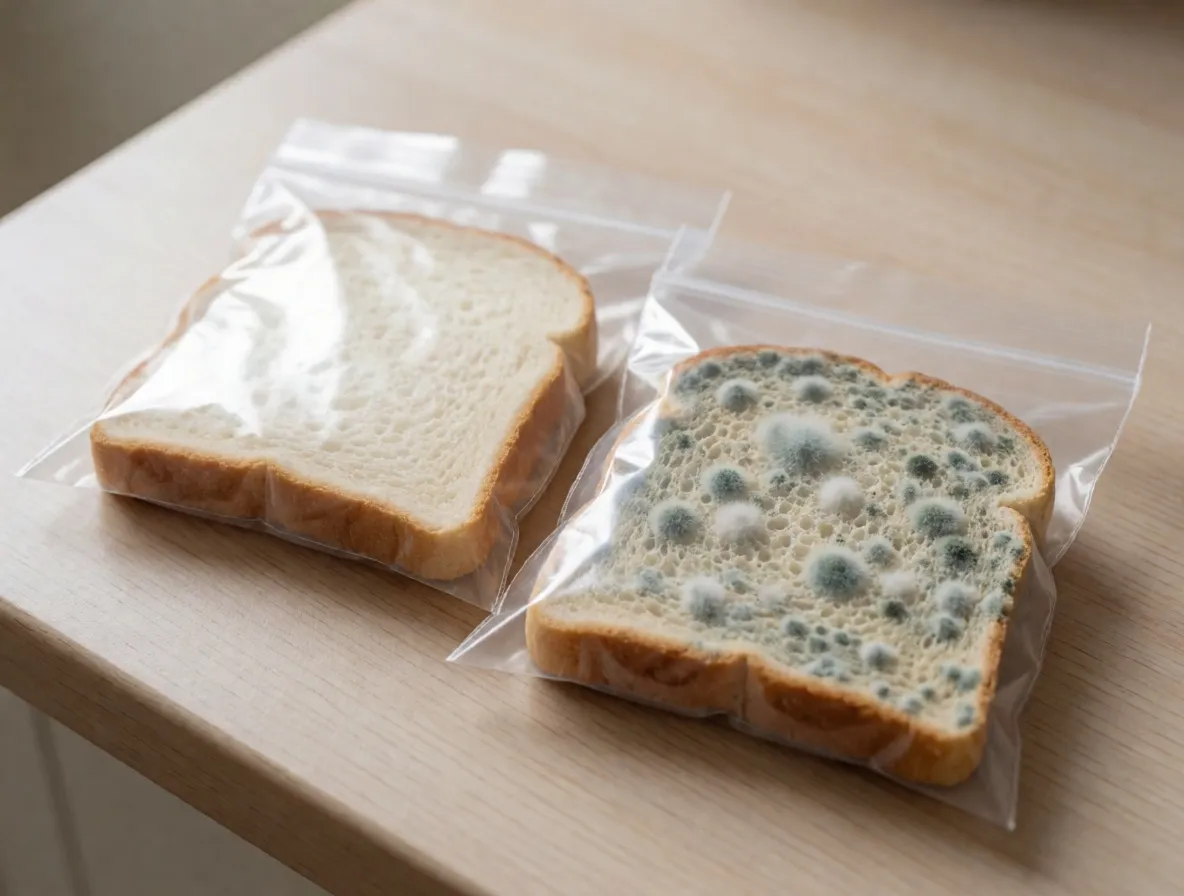
The washed slice is your control: the version where you change nothing, so the other has something to compare against. Count the patches on each, or record the day the first appears. If both spot at once, your hands were no dirtier than the loaf.
You can act before you can explain
Semmelweis never learned what was on those hands, and some details he got wrong: the fever travels from living patients too. But the instruction he gave was correct, and it stayed correct for twenty years before anybody could begin to explain it.
Here is the piece hiding in plain sight. He identified an invisible cause by comparing two groups that differed in one thing, removing that thing, and watching the difference vanish. Every medicine tested today is tested the same way.
So the two doors in Vienna were never really the question. The question was whether a difference between two groups is evidence when you cannot say what lies behind it. Semmelweis answered yes, with a bowl of powder and a table of statistics, and the mothers of the First Clinic stopped dying.