Why does thunder rumble on and on instead of going bang?

The flash lights the whole bedroom for a fraction of a second and vanishes. Then nothing. Then the thunder begins, and refuses to stop. It rolls, sags, swells back louder, and grumbles away for twelve slow seconds before finally giving up. Clap your hands and the sound is finished before you can think about it. So what stretches one instant of light into twelve seconds of noise?
The bang is real, and it is as quick as your clap. It simply does not happen in one place. It happens all along a line several kilometers long, and your ear sits a different distance from every part of it.
The bang is made along the whole bolt
Air is an excellent insulator — it will not carry electricity until something forces it to. Lightning is that force winning. The thin scorched path it burns open is the channel, narrower than your thumb.
Turn a kitchen oven to its highest temperature and it manages about 250 °C(480 °F). Air inside the channel reaches roughly 30,000 °C(54,000 °F), hotter than the surface of the Sun. It gets to that temperature within a few millionths of a second.
Air heated that suddenly cannot possibly stay put. It expands faster than sound itself can travel, crashes into the quiet air surrounding it, and shoves that air aside in one enormous pulse. Anything moving faster than sound is supersonic, and a supersonic shove is a shock wave. Within a few meters the pulse exhausts itself, calms down, and continues onward as ordinary sound.
Here is the piece everybody skips. The entire channel reaches that temperature, not merely one spot on it. Every meter of it explodes outward and produces its own separate bang.
So the bang is never delivered from a single point. It is delivered along a line, and the useful question is exactly how long that line is.
The line is longer than an hour of walking
A cloud-to-ground flash burns a channel more than 5 kilometers(3 mi) long. The brilliant fork you actually see is only the bottom of it. The remainder wanders sideways inside the thundercloud, hidden, occasionally for kilometers.
Five kilometers is roughly an hour of walking. A single bolt is an hour’s walk of scorching air.
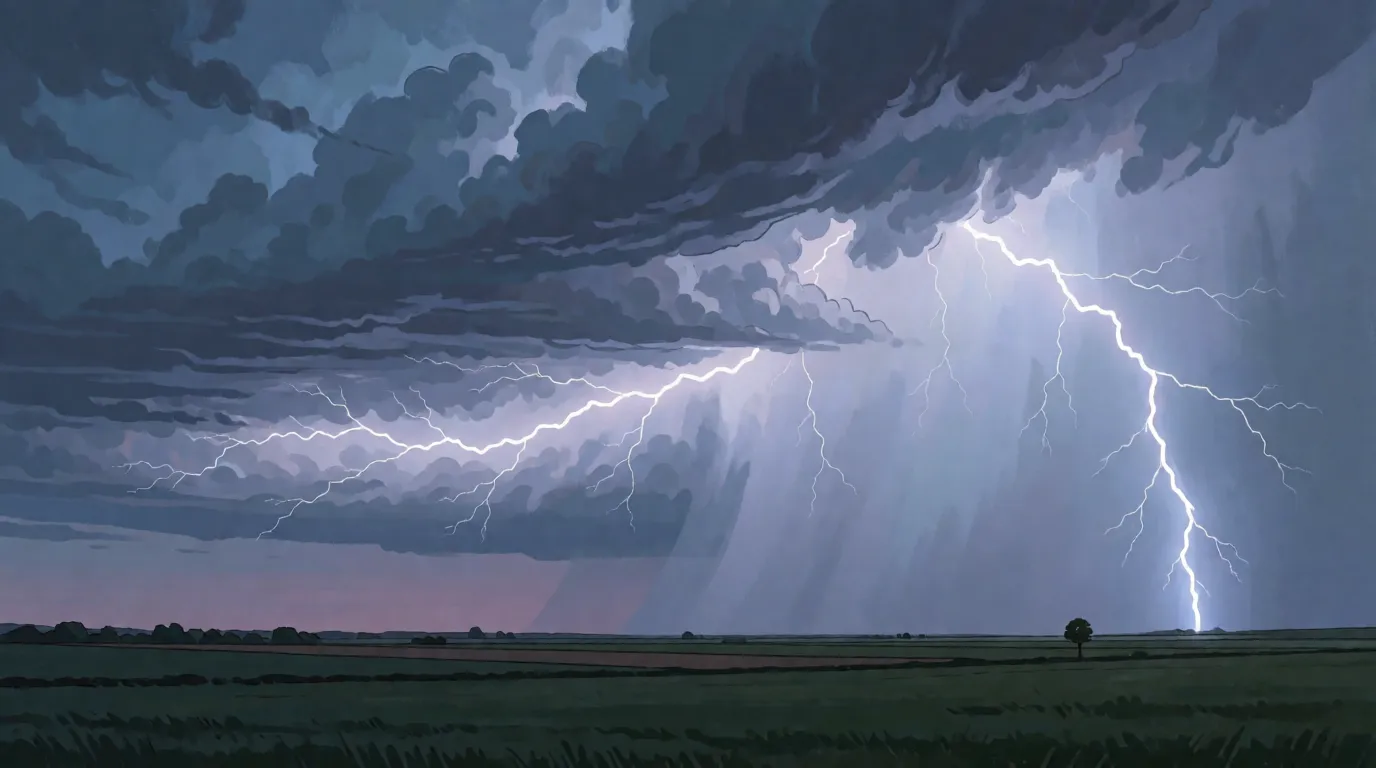
Does that whole line bang together, though, or in order, one piece following another?
The dazzling part of a flash is a surge that begins at the ground and sweeps upward through the channel. It is called the return stroke, and it travels at about a third of the speed of light. It covers all five kilometers in well under a thousandth of a second.
A thousandth of a second is nothing whatever to an ear. Every part of the bolt bangs at precisely the same instant, as far as you are concerned.
So the bolt is not stretching the sound out. Whatever performs that trick is happening during the journey to you.
Sound is slow, so the far end arrives late
Light crosses those five kilometers in about seventeen millionths of a second. Sound is embarrassingly slow by comparison. The speed of sound in ordinary air is about 343 meters(1,125 ft) every second, which works out at one kilometer roughly every three seconds.
Say “one banana, two banana, three banana” aloud, at a steady rhythm. In that time, sound has managed one kilometer.
Now position yourself. Suppose the bolt strikes the ground one kilometer from your window, and its channel travels up and away inside the cloud until the far end is five kilometers off.
The bang from the near end has one kilometer to cover, so it arrives three seconds behind the flash. The far end has five kilometers to cover, and appears at fifteen seconds. Every scrap of channel between them lands somewhere in the middle.
The extra distance to the far end of the bolt, turned into seconds of rolling.
Your ear cannot keep a stream of overlapping bangs separate. Run a thumbnail slowly down the teeth of a comb and you hear individual ticks; run it quickly and they merge into one continuous buzz. Thunder arrives quickly enough to merge.
Twelve seconds of noise out of one instant of light, entirely because the far end of the bolt had four extra kilometers to travel. Which invites an obvious objection. Surely some of that racket is bouncing off something?
Echoes roughen the roll but do not build it
Sound genuinely does bounce. Shout across an empty gym and it returns to you. A storm above a valley or a town has plenty of surfaces to bounce from. Thunder in those places really does arrive with additional bumps and repeats stacked inside it.
But the twelve seconds were already spent before anything bounced.
Give a valley the credit for the bumps, and the bolt the credit for the seconds. That settles how long the roll lasts. It does not yet explain the sound of it: why nearby lightning cracks like a whip, while a distant storm only grumbles.
High notes die first
Pitch means how high or low a sound is. Air is not equally generous to every pitch. As sound travels, high notes are gradually absorbed and turned into a trace of warmth in the air, while low notes continue almost untouched.
You have met this already. When music plays through a bedroom wall, the thump comes through and the words do not. Kilometers of atmosphere perform the same filtering, more gently and over a longer distance.
The near end of the channel sits closest to you, so its bang arrives with its high notes still attached. That is the crack. Everything behind it has traveled further, has been stripped along the way, and lands as a low roll. Move the whole storm ten kilometers away and even the nearest part has been stripped, so grumbling is all that survives.
The crack and the roll are therefore the same bang, heard after two different journeys. Working that out took humanity an unreasonably long time.
The rumble was explained wrongly for two thousand years
In the 300s BC, Aristotle decided that a cooling cloud squeezes out a hot dry breath, which collides with the cloud next door. The collision is the thunder. The lightning is that same breath catching fire immediately afterwards. He knew we see the flash first, and explained why: sight is quicker than hearing. Excellent observation, catastrophic theory.
By 1771, electricity had entered the story. The first edition of the Encyclopaedia Britannica appeared while your great-great-great-grandparents were unborn. It blamed the roll on “the vast length of the vacuum, made by the passage of the electric matter.” Lightning supposedly punched an empty tunnel through the sky, and the air clapped shut along the entire tunnel.
That answer had the right shape and the wrong cause. Length genuinely was doing the work. Nothing, however, was collapsing.
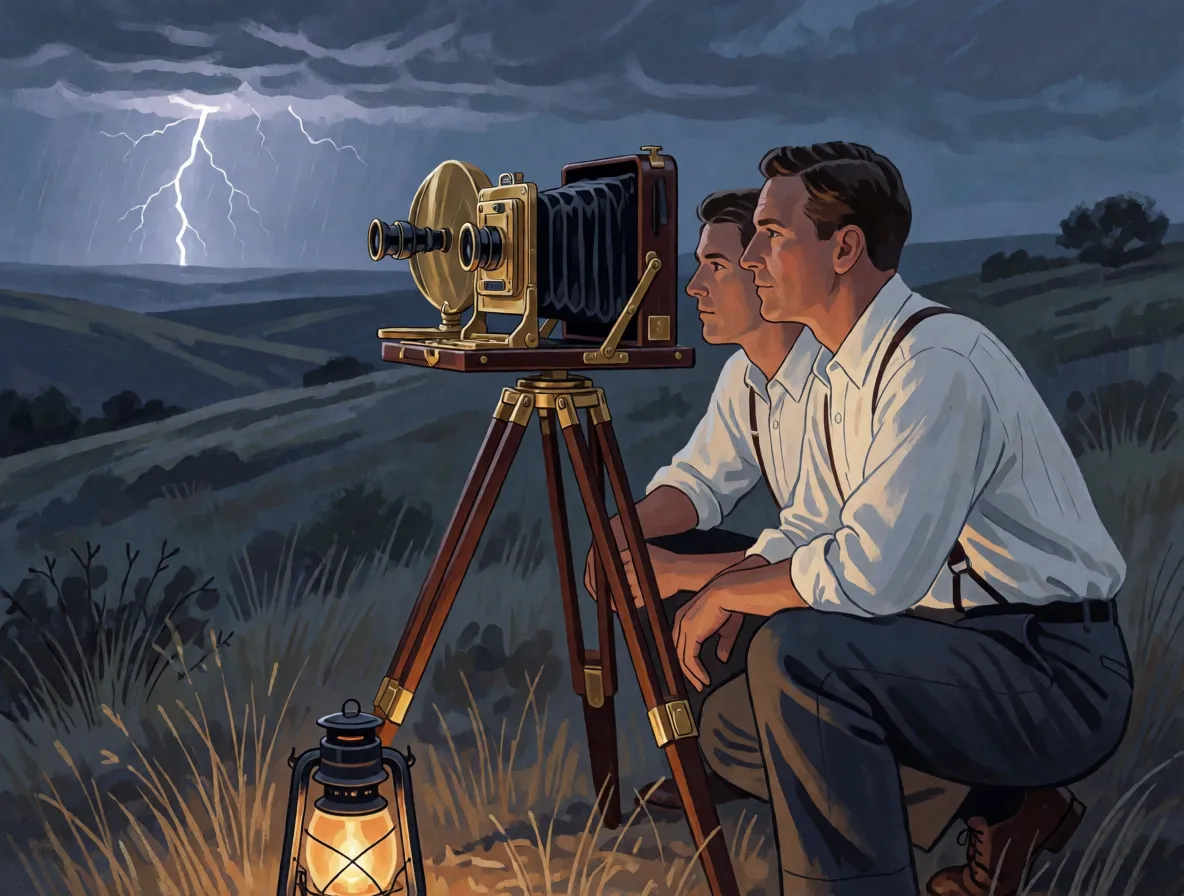
Settling it required photography. In 1934, Basil Schonland and a colleague spent the South African storm season aiming a camera with spinning lenses at the sky. Their photographs showed the flash arriving in two parts: a faint feeler picking its way downward, then a brilliant surge racing back up the identical path. Nothing collapsed. Nothing was a tunnel. The channel simply lit up, all of it, together.
Which means you can measure a bolt yourself, with nothing but counting.
Count a bolt from your own window
The comparison is the interesting part. A sharp crack with barely any roll means a short piece of channel, or one lying sideways across your view, both ends about the same distance from you. A roll lasting twenty seconds means a channel aimed toward you or away from you, one end far behind the other.
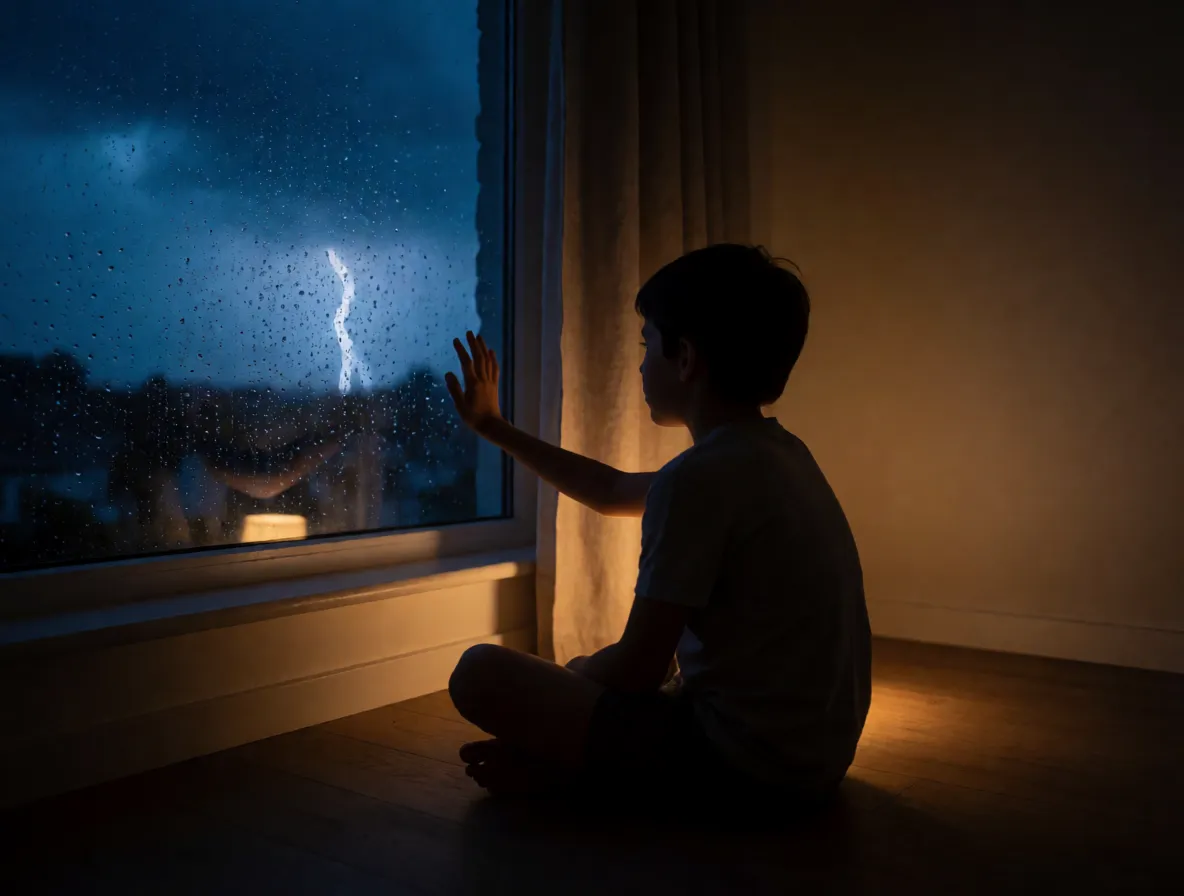
Nobody has ever seen the shape of a bolt buried inside a cloud. You can hear it.
The rumble is the bolt, delivered slowly
In 1970, Arthur Few, a physicist in Texas, carried the counting much further. He spread microphones across the ground and recorded the identical thunder at each one. From the tiny differences in when each bang reached each microphone, he calculated where in the sky that bang originated. Out of the arithmetic came a drawing of the channel, including the crooked portions sealed inside the cloud, which no camera could photograph.
That only works because a roll of thunder is ordered. Nearest first, furthest last, one instant of sound sorted into a queue by distance.
So the next time the room lights up and the noise begins, listen to its shape rather than its loudness. The first crack is the piece of sky closest to you. Everything afterwards is the identical bolt, further off, still on its way. The roll finishes when the last and most distant scrap of channel finally delivers its bang to your window, an hour’s walk behind the first.