Why has no shuffled deck ever come up twice?
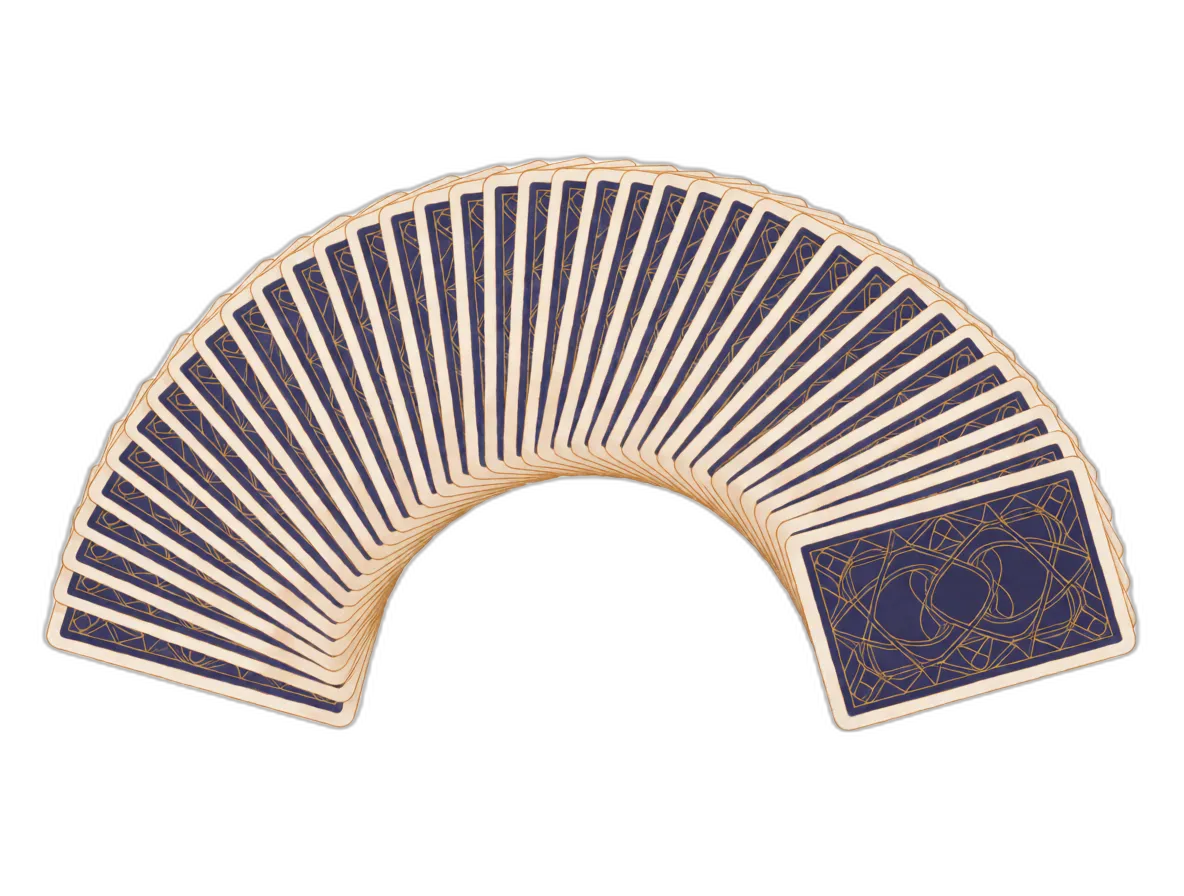
Pick up a deck and shuffle it properly. Spread the cards along the table and look at the order they landed in. People have been shuffling cards for more than six hundred years, in millions of homes, on billions of evenings. Yet almost certainly no deck has ever landed in that exact order before, and none ever will. How can something so ordinary be brand new?
The answer has almost nothing to do with cards. It is about what happens to a count when you multiply it instead of adding to it. Multiplying gets away from you faster than anything you have met, and fifty-two is many more cards than it needs.
One fewer card every time
Forget shuffling for a moment and deal instead. Lay the deck face down, then deal it into a row of fifty-two positions.
The first position is easy: any of the fifty-two cards could land there, so there are fifty-two ways to fill it.
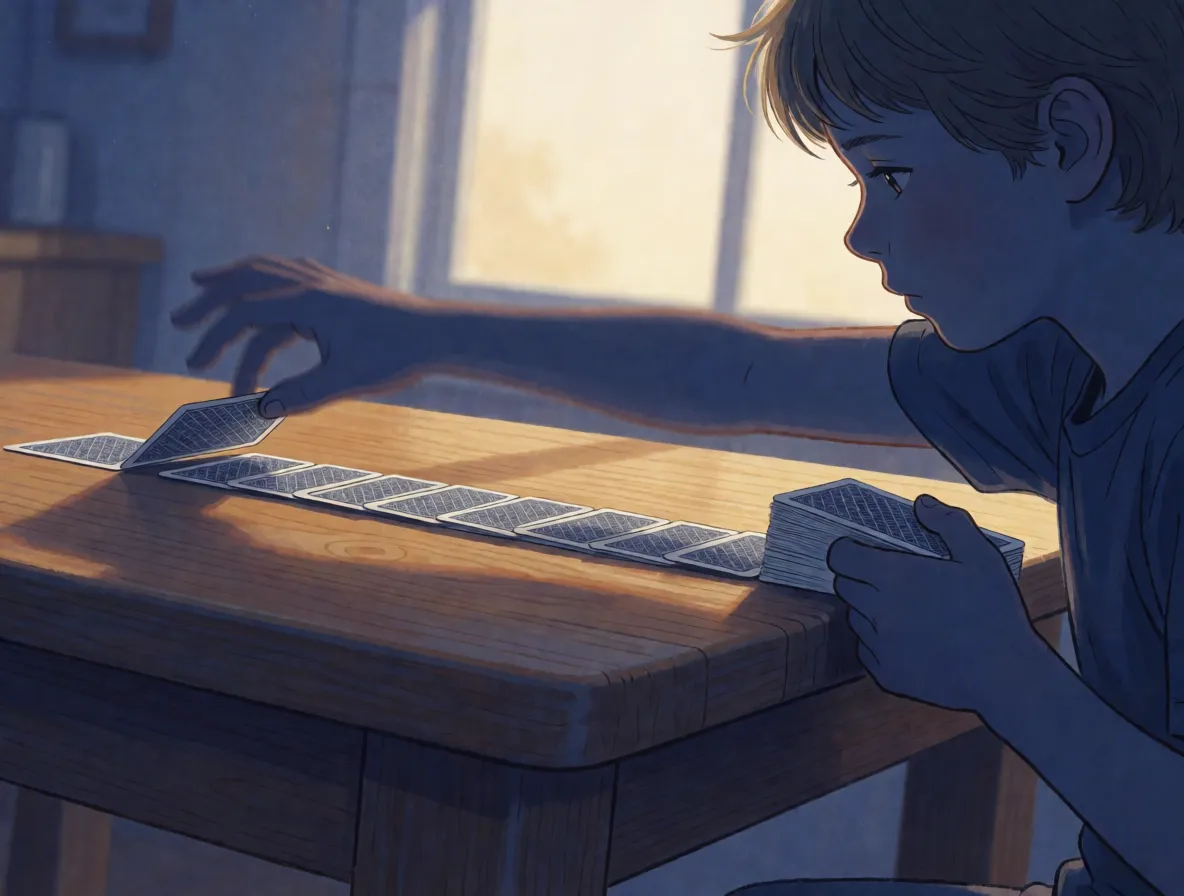
That card is now gone. Only fifty-one are left, so the second position has fifty-one ways to fill it, and the third has fifty. Every card you put down steals a choice from the one after it.
One particular order of the whole deck, top card to bottom card, is called a permutation. The question is how many permutations fifty-two cards have.
Try the small version now, in your chair. Take any three cards, call them 1, 2 and 3, and lay them in a row. Rearrange them and keep a tally. Six orders, and then you are stuck. There is no seventh.
Three cards give six orders. Notice that three plus two plus one makes six as well, which is unlucky for anybody trying to explain this. Add a fourth card and the two ways of combining separate for good.
Multiply, never add
Four cards have twenty-four orders, while four plus three plus two plus one makes ten. So why is multiplying the right move?
Because every choice pairs up with every other choice. Put the ace of spades first, and the second position still has fifty-one possibilities. Put the two of spades there instead, and the second position has fifty-one possibilities again.
So each of the fifty-two openings drags fifty-one endings behind it. Fifty-two lots of fifty-one is 2,652, and that is only two cards deep.
A factorial means multiplying every whole number from your starting number down to 1. Mathematicians mark it with an exclamation point, so the count for a whole deck is 52!, said “fifty-two factorial”.
The exclamation point is doing no shouting. Christian Kramp chose that notation in 1808, about seven generations before you, because he wrote these long products all day and wanted something short. His subject was combinatorics, the mathematics of counting arrangements.Four cards deep, and already more orders than there are seconds in ten weeks. Check it on a calculator.
Adding a card does not add to the total. It multiplies the total. The fiftieth card multiplies by fifty, and the fifty-first multiplies that answer again. That arithmetic leaves everything you can picture behind, far earlier than you would guess.
Twenty cards beat the age of the universe
Walk up the deck a handful at a time and watch where you run out of room.
Ten cards have 3,628,800 orders. Write out one order every second, never stopping to sleep, and you would finish in about six weeks.
Twenty cards have 2,432,902,008,176,640,000 orders. That number has a name, roughly two and a half quintillion, and the name is no help at all, so try it as time instead. Write one order every second beginning at the start of the universe, and today you would be less than a fifth of the way down the list.
Twenty-five cards is where it turns silly. Hand every person alive a set of twenty-five cards. Have all eight billion of them lay out a new order every second, without stopping, starting the day the last dinosaurs died. About now, between them, they would just be finishing.
Twenty-five cards is not even half a deck.
The twenty-seven cards still in your hand each multiply that answer again. Written out in full, 52! runs to sixty-eight digits, and reading it aloud takes half a minute. Picturing it is impossible, and you ran out of pictures back at twenty-five cards with the deck still going.
So every shuffle ever made has barely scratched that list, and two of them landing on the same order was never a risk. Which leaves the one order everybody imagines is different from the rest.
A sorted deck is exactly as rare as yours
Every one of those orders is equally likely when the shuffle is good. That is what random means here: no order is favored over any other, not even slightly.
The probability of something is the number saying how likely it is. For any particular order of a deck, that number is one in 52!, identical for the order you dealt and every order nobody has ever dealt.
That is the engine of the whole thing. There is nothing unusual about the order you shuffled. Every order is that unusual, which is why yours has almost certainly never happened before.
All of it leans on one word: properly. It assumes your shuffle can genuinely reach any of the 52! orders. A real pair of hands might not.
The magician who watched decks remember
Persi Diaconis was fourteen when he walked out of his New York home in 1959, telling nobody. He toured America doing card tricks with the sleight-of-hand master Dai Vernon. He returned to school at twenty-four, and by 1974 had a doctorate in statistics from Harvard.
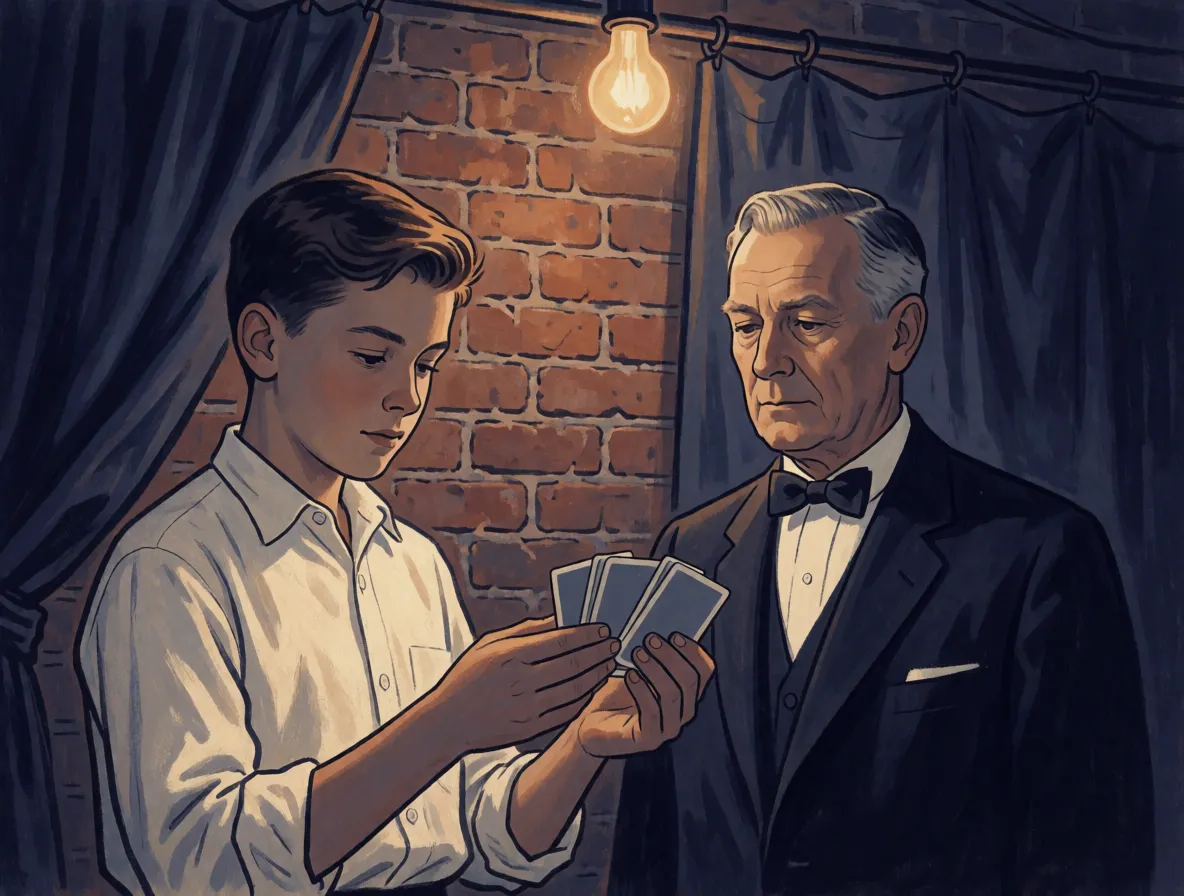
Card magicians know something card players usually miss. A deck looks mixed long before it is mixed. Three or four shuffles produce a thoroughly jumbled spread, so for a century players and casinos felt that three or four was plenty.
The common move is the riffle shuffle: split the deck into two halves, then spring them together so the cards interleave. Riffle a sorted deck once and it arrives as two runs, each still climbing in its original order. Riffle again and there are four such runs. Mathematicians call each run a rising sequence, and the sequences are the deck’s memory of where it came from.
Seven, and not one fewer
In 1992, Diaconis and Dave Bayer counted how fast rising sequences die out, and their answer was seven shuffles. At four, a deck still remembers a great deal about where it started.
Around 2000, a company building automatic shuffling machines hired Diaconis and the statistician Susan Holmes to test a prototype. In a Las Vegas showroom they found several rising sequences surviving in its output. From those they could name nine or ten cards before they came out. The company wrote back that it disliked the answer, believed it anyway, and had hired them for that. The prototype was quietly shelved.
So a proper shuffle takes seven riffles, and most people give a deck three. Do it properly and all 52! orders are genuinely in play. That count is still nothing but multiplication, which is something you can race with a pencil.
Race the multiplying yourself
Most people spend a couple of minutes on the twenty-four and ten on the hundred and twenty. Close to five times as long, exactly as step three predicted. Seven cards would run to 5,040 orders and eat most of a day.
Now push it. One order per second gave ten cards a six-week answer, but nobody writes that fast. At your actual speed, ten cards would swallow most of a year, and you would still be holding forty-two.
Why nobody ever noticed
Go back to the deck on the table. Nothing about it looks new. Same fifty-two cards, same faces, a stack about 1.6 cm(0.6 in) thick, thinner than your little finger. Spread edge to edge they stretch about 3.3 m(11 ft), roughly two grown-ups lying head to toe. A Swiss monk, John of Rheinfelden, wrote the rules for a fifty-two card deck in 1377, and it has barely changed in the six centuries since.
What is new about your shuffle is invisible, because the new thing is the order, and an order has no look. You cannot glance at a spread of cards and see that this arrangement has never existed, because there is nothing to see. That is the only reason the fact sounds unbelievable.
Fifty-two is a small, familiar number. You could line up fifty-two children along a school hall and count them in a minute. Stop counting them, though, and start multiplying their choices. That is when fifty-two turns into something no amount of time and no number of people can reach the end of.
So shuffle it again. Every proper shuffle you make from now on will almost certainly land those fifty-two cards in an order they have never been in, and never will be in again.