Why does a lightbulb blow the moment you switch it on?
The lamp worked perfectly all evening. Next morning you flick the switch and get a flash, a small tink, and darkness, almost every time. Bulbs hardly ever quit while they are quietly glowing; they wait for the switch. So why is the gentlest thing you ever do to a bulb the thing that finally kills it?
Because the wire inside is at its most fragile when it is cold. For a fraction of a second after the switch closes, a bulb is a far wilder object than it will be all evening.
One wire, thinner than your hair
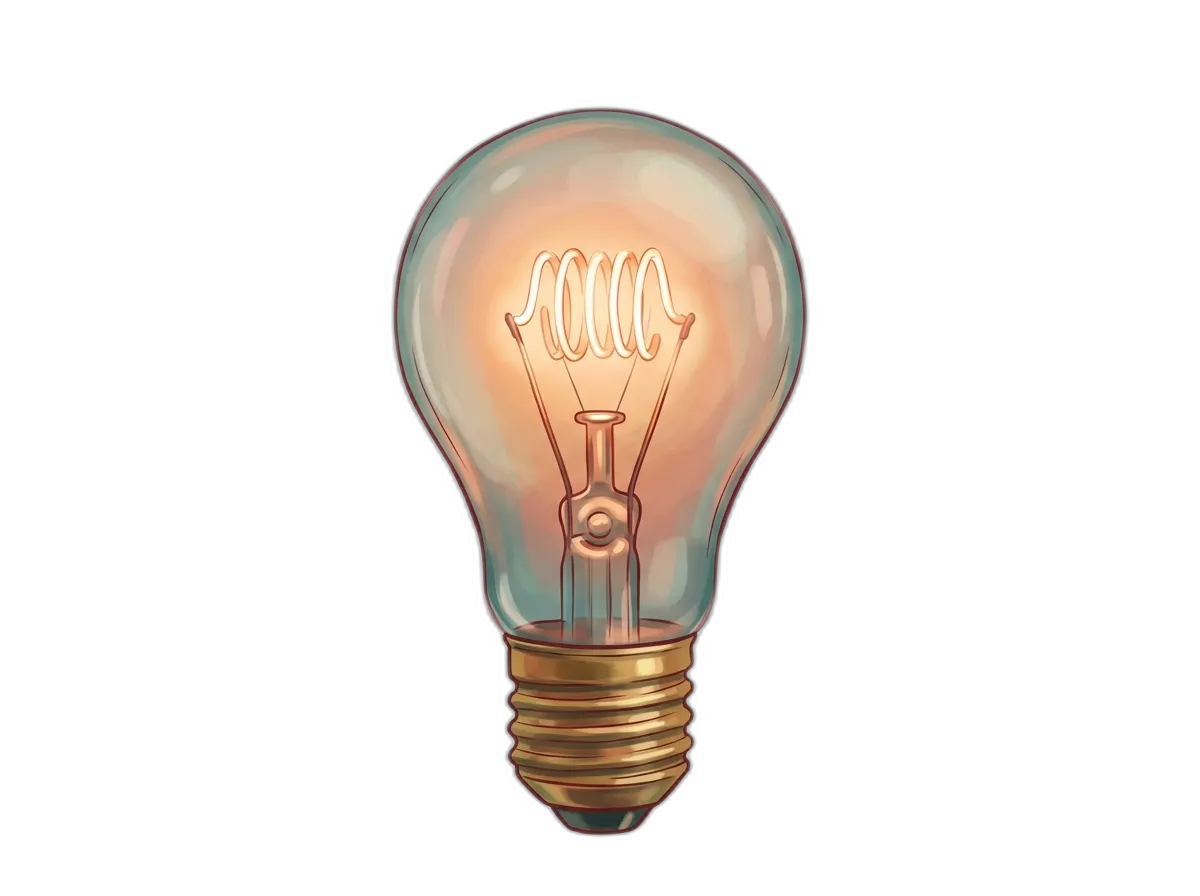
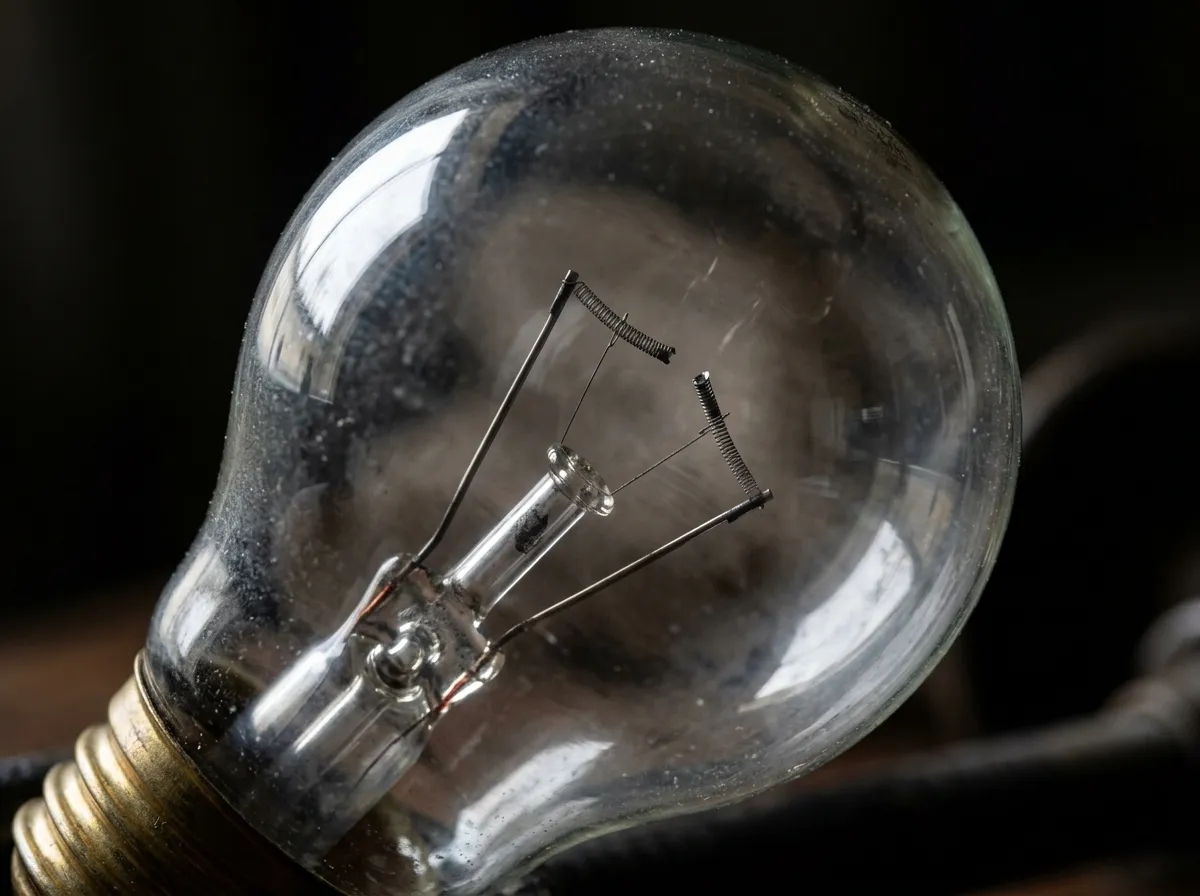
Hold up a clear incandescent bulb, the old-fashioned sort you can see into. Everything that makes the light is a single wire, called the filament, and it is made of tungsten, a hard gray metal.
Its diameter is absurdly small, about 0.04 mm(1/600 in), narrower than one of your own hairs. It is also long: straightened out it would stretch 50 cm(20 in), roughly the length of your arm. Manufacturers wind it into a coil, then wind that coil into a second coil.
Force electricity through a wire so narrow and it heats. This one operates at about 2,500 °C(4,500 °F), and anything that hot radiates light of its own. Glowing purely because you are hot is incandescence, and it is the entire trick of the bulb.
Watch it happen in a kitchen. Switch on a toaster and look inside: the elements travel from gray, to a sullen red, to orange. Anything hot enough to glow runs the same colors in the same order, and the order never varies.
So a bulb is one wire, living permanently at temperatures that would destroy almost anything else. What matters now is the switch.
Hot metal fights back harder
Electricity does not glide through a metal freely. It has to shove past the atoms, the tiny building blocks the metal is assembled from, and atoms are never still. Even in a cold wire they vibrate in place. How hard a material makes electricity work to get through is its resistance, measured in ohms.
Heat the wire and the atoms vibrate harder, interfere more often, and the resistance climbs. Most people guess the opposite, but hot metal is a poorer conductor than cold metal.
Now picture a bulb switched off all night. Its filament sits at room temperature, so its resistance is roughly ten times lower than usual. The switch closes, and electricity floods in about ten times faster than the wire normally carries. That quantity arriving each second is the current, counted in amperes.
The surge is enormous but brief. It hauls the filament up to full brightness in about a fifth of a second, and the rising resistance of the heated wire immediately strangles it.
So every flick of a switch gives that filament one violent shove. A new one shrugs off thousands; an old one does not, because it is no longer the same wire.
The wire loses weight every hour it glows
An old filament is a thinner filament. Examine the glass of a bulb that has lived in a lamp for years: there is often a faint gray deposit, like breath on a window. That deposit is the wire.
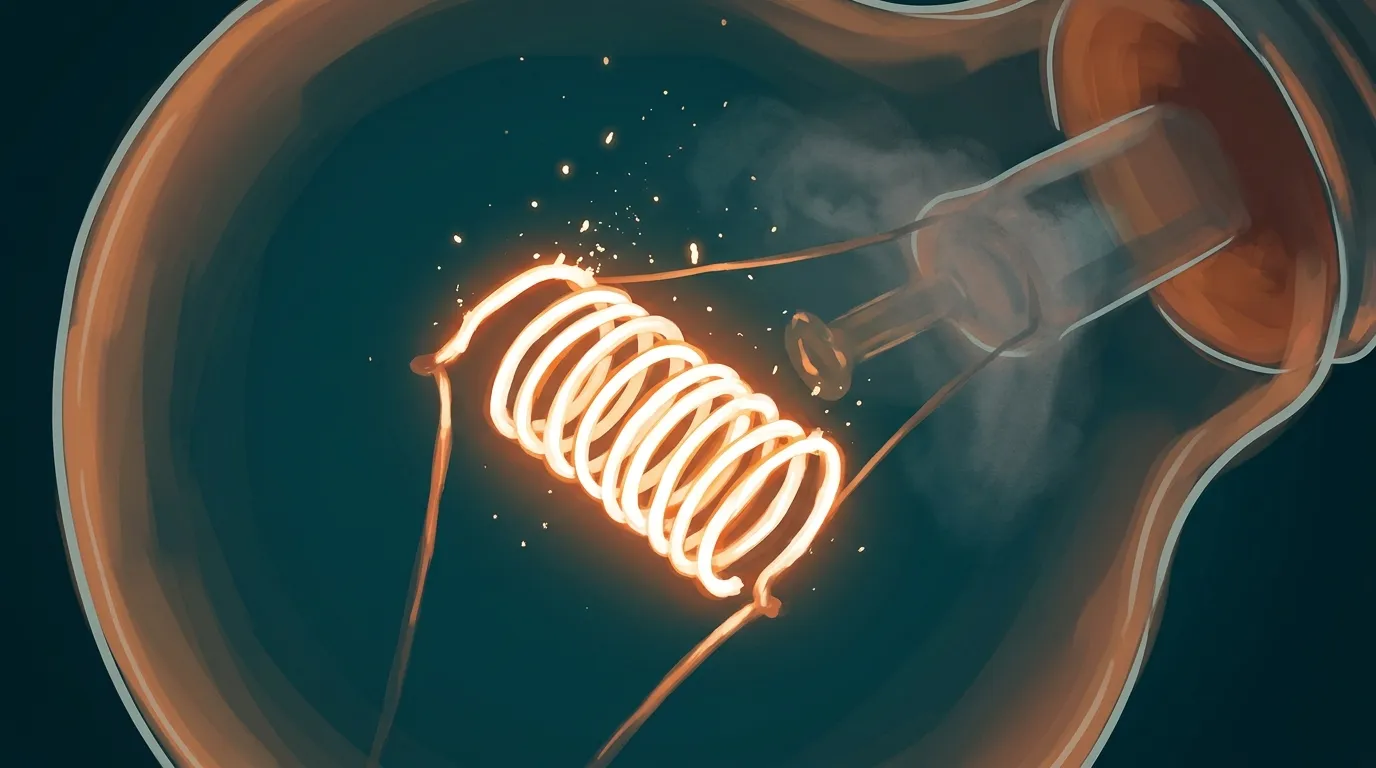
Evaporation means atoms leaving a surface and flying off alone, and water is not the only substance that does it. Solids evaporate too, and tungsten at 2,500 °C evaporates quickly enough to matter. Atoms lift off the glowing coil, cross the empty space, and condense on the cooler glass.
Nothing is burning in there, because burning requires oxygen and a bulb contains none. The glass is sealed around either a vacuum or a little argon, an inert gas that refuses to react with anything. The filament is not being consumed. It is boiling away, one atom at a time.
So a filament gradually thins as it works. But an invisible loss spread evenly along the wire would leave it alive for decades, and bulbs do not. The loss must be concentrated somewhere.
The thinnest spot runs away from the rest
No wire is manufactured perfectly evenly; tiny variations in thickness survive in every coil. Somewhere along this one, a short stretch began life a shade narrower than its neighbors, by a microscopic amount nobody could detect by eye.
That stretch carries slightly more resistance than the rest, because there is less metal for the electricity to travel through. More resistance means more heat, so the stretch runs hotter than the wire on either side. Hotter tungsten evaporates faster, so the stretch sheds atoms more rapidly than its neighbors and grows narrower still, which makes it hotter still.
Once that circle begins turning it only turns one way, and engineers call the result a thermal runaway. The worn place itself is a hot spot, and every incandescent bulb in your house is quietly growing one.
So an old filament is not thin all over. It carries a single weak link that weakens every hour the lamp is lit. Yet it holds, evening after evening. Something has to finish it.
Why it happens at the flick
That something is the surge. When the switch closes, the ten-times current arrives along the entire filament at once, and nearly all of the coil takes it in stride.
The worn stretch does not. Thin metal has less material to absorb the energy, so it heats faster than the thicker metal around it, as a spoonful of water boils long before a saucepan. Tungsten melts at 3,422 °C(6,192 °F), higher than any other metal, which is precisely why bulbs use it. Even so, the worn stretch eventually reaches its melting point while the rest of the coil is still dull orange, and it parts.
The flash follows immediately. Electricity does not halt politely at a gap that narrow: it leaps across as an electrical spark, brighter than the bulb ever was. Bulbs therefore carry a fuse in the base, a deliberately feeble scrap of wire built to melt first and cut the spark off before the glass cracks.
Every flick of a switch is a small test. The wire only has to fail one of them.
None of it works, though, without a metal that will sit at 2,500 °C and stay a wire. That metal took an unreasonably long time to arrive.
The metal that would not bend
For their first three decades, bulbs held a thread of cotton or bamboo, carbonized in a furnace until only the carbon remained. Joseph Swan lit a hall in Newcastle with carbon filaments one evening in February 1879, in front of seven hundred people, when your great-great-great-grandparents were young.
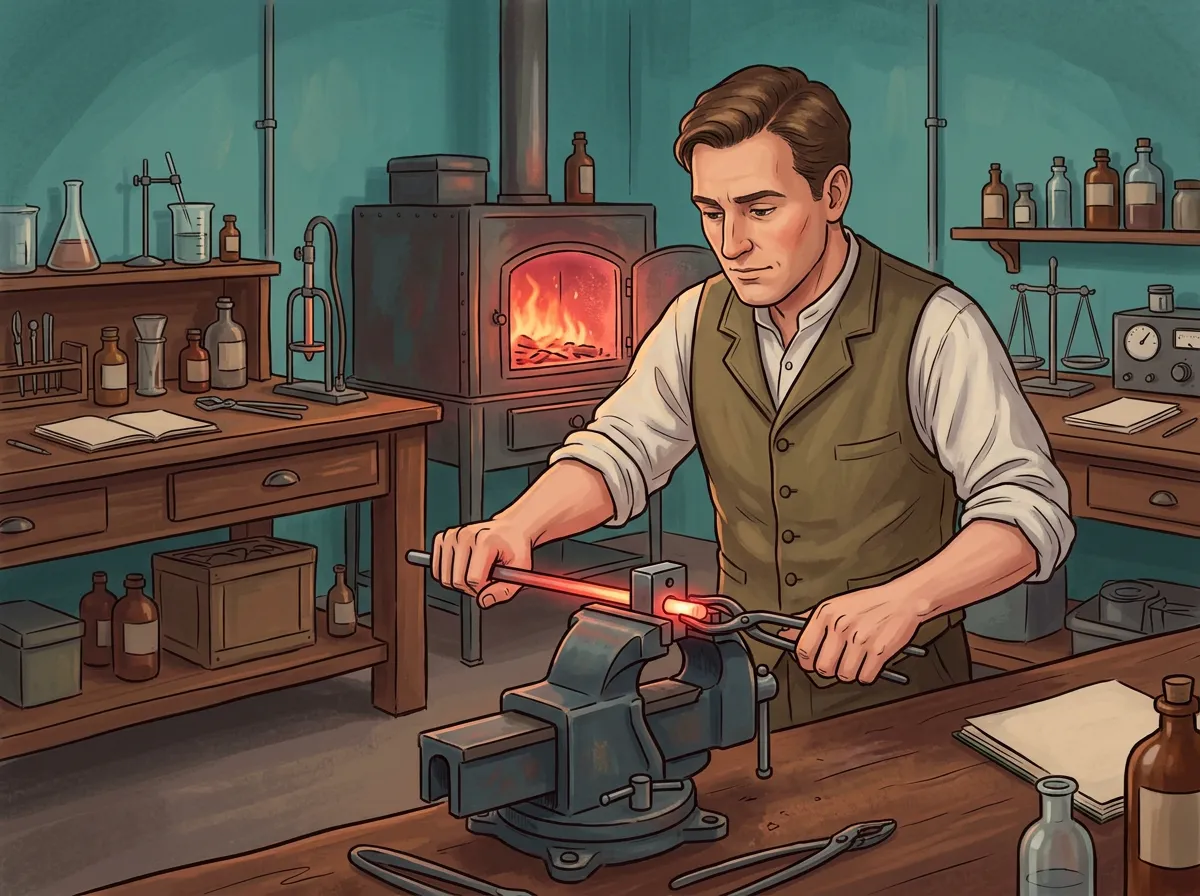
Carbon glows, but it evaporates long before it reaches tungsten temperatures, so carbon lamps were dim and blackened rapidly. Everybody knew tungsten was the answer, and making a wire out of it looked impossible. Tungsten emerged from the furnace as a brittle gray stick that snapped like dry spaghetti.
You have heard that Thomas Edison invented the lightbulb. He did not. Swan’s demonstration came eight months before Edison lit his own in October 1879. What Edison built was everything around the bulb: the generators, the meters, the wires.
In 1906 William Coolidge attacked that brittleness at the General Electric laboratory in Schenectady, New York. It took two years. In the fall of 1908 he discovered that tungsten, squeezed and drawn repeatedly through a hole in a steel plate while it glowed red, stopped snapping. Ductile is the technical word for a metal you can draw into wire. He announced the result in March 1910, and lamps with drawn tungsten went on sale the following year.
The explanation for the gray deposit arrived in 1913, from Irving Langmuir at the same laboratory. It was not a chemical attack on the wire, as everybody had assumed. It was the filament, evaporating. Filling the bulb with argon slowed that loss, and coiling the wire helped further. The wire above your head tonight is Coolidge’s metal in Langmuir’s gas, and you can measure it yourself.
Catch the filament cold
Volts times volts, divided by watts. That is a 60 watt bulb, lit.
A cold 60 watt bulb reads around twenty ohms. Glowing, that identical wire resists more than ten times harder. The only difference between the two measurements is temperature.
A blown bulb gives no reading whatever. The multimeter hunts for a path through it and fails, because none remains.
What the flash actually was
So the flash at the switch was never a bulb burning out. Nothing in there burns.
Here is the part hiding in plain sight. The failure was settled months earlier, in the dark, while the lamp did its job. Every hour it glowed, one patch of that coil grew narrower and hotter than the rest, with no way back around the circle. The switch did not break the bulb; it merely asked one last time.
Turn a blown bulb over in your hand and you can usually find the place. Somewhere in that miniature double coil is a gap the width of a pencil line, with two blunt ends facing each other.