Why is every cell in a honeycomb a hexagon?
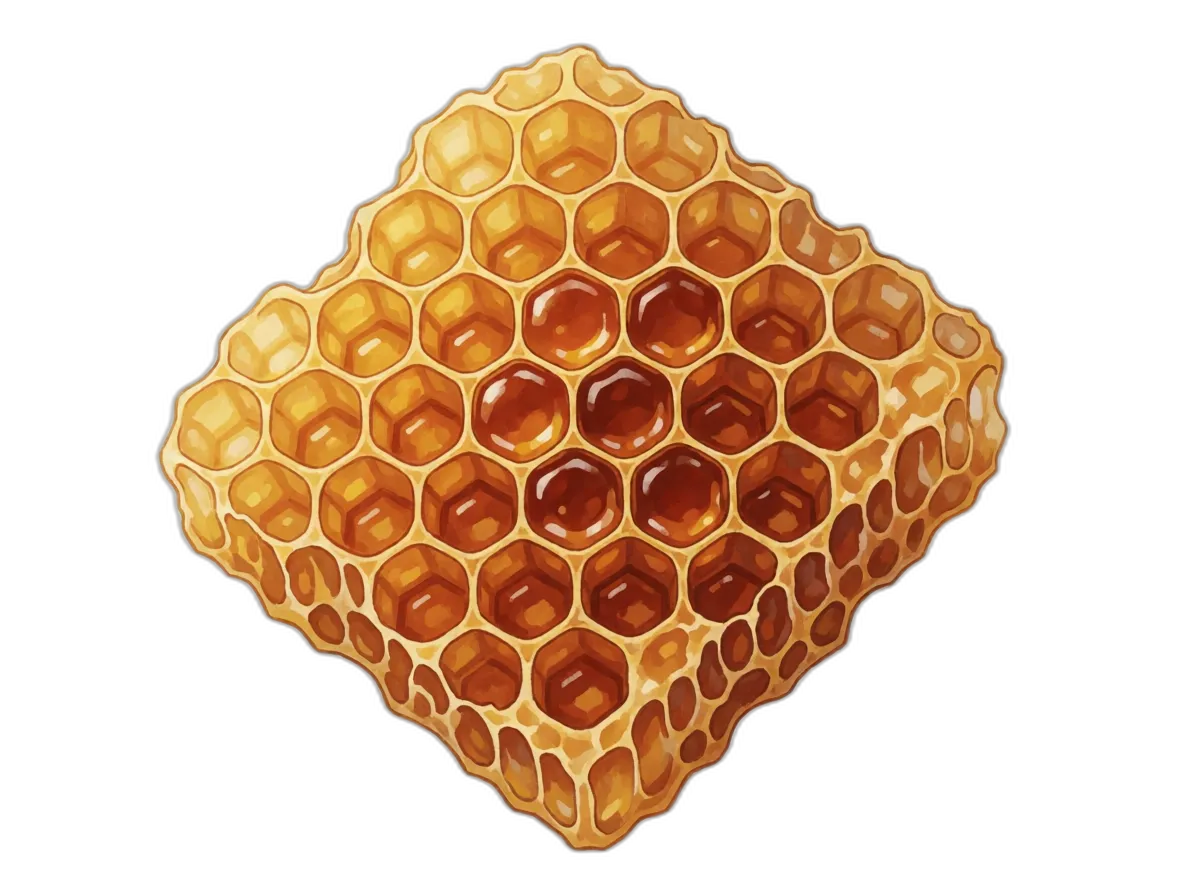
Break a piece of honeycomb off a hive and hold it up to the light. Every little room in it has six flat sides. Not five, not seven, and not one circular room in the entire slab. Thousands of bees built it in total darkness, with nobody supervising, and every one of them agreed. So what settled on six?
Wax is expensive, and a bee pays for it in honey. That single fact decides the shape of the comb, and it decides it before any bee is involved.
Wax is bought with honey
A honeybee does not gather wax. A young worker bee secretes it herself. It seeps from eight glands on her abdomen as pale flakes about 3 mm(⅛ in) across, each the size of a sesame seed.
Secreting them is expensive. To finish with a given weight of wax, a colony of bees eats around eight times that weight in honey.
So every wall in a comb is honey that got eaten instead of stored. Look at a comb face on and you are reading a floor plan: lines of wax, with rooms between the lines. Each room is a cell, a tube sealed at the back and open at the front, about 5.5 mm(0.2 in) in diameter. A drinking straw would drop into one almost exactly.
Wall costs honey. Floor stores it. Everything else about a comb follows from wanting plenty of floor behind very little wall.
Every gap is floor that holds nothing
Press two cells together and the wall between them belongs to both at once. One strip of wax, two rooms. No colony surrenders a saving like that, so cells are packed tight.
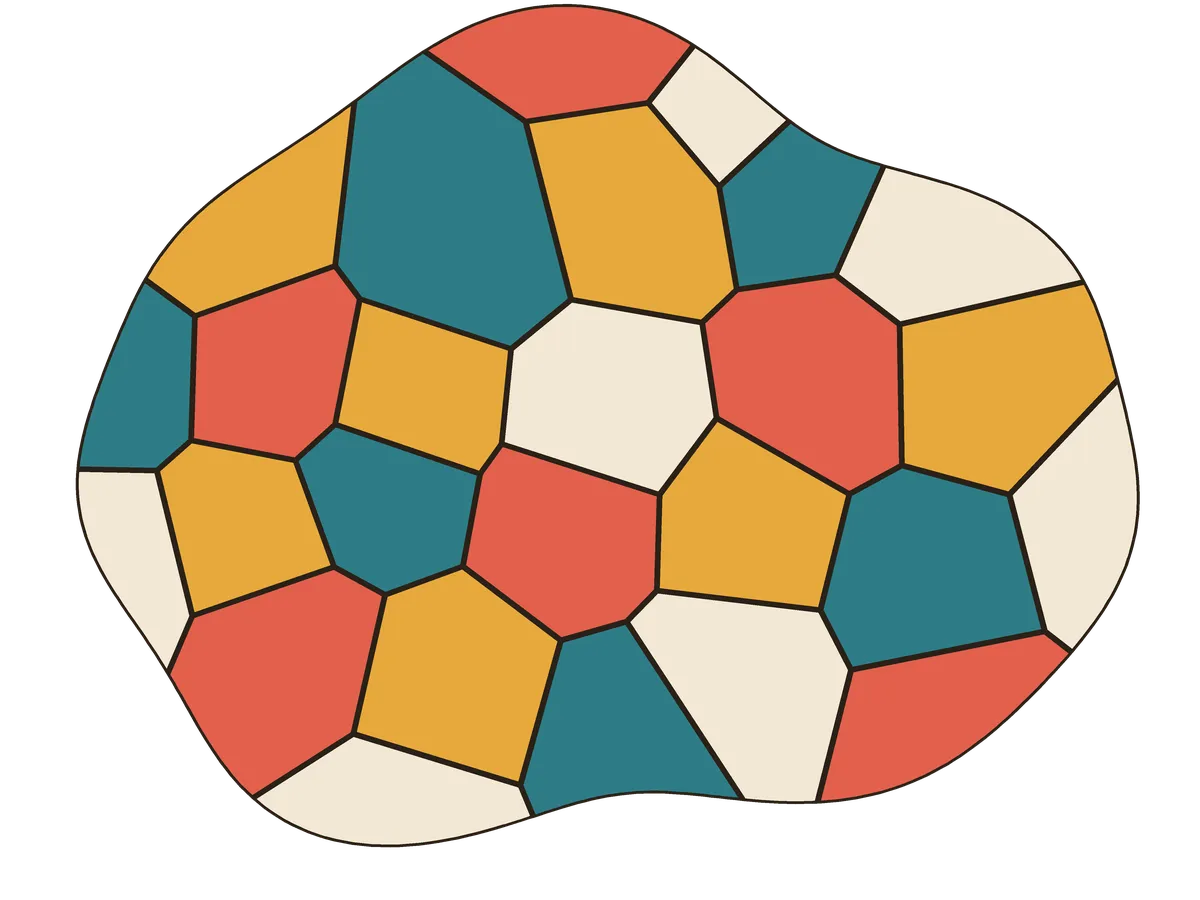
Now imagine leaving a gap. A gap needs walls like any other space and stores nothing. Gaps are the most expensive thing a comb can contain, so a cell must pack with nothing left over. Shapes that manage it are said to tessellate.
A single rule decides which shapes qualify. Go to any point where corners meet and add those corners up. They must total exactly 360 degrees, a complete turn. Anything less leaves a gap. Anything more and the shapes overlap.
Try the regular shapes first, meaning the ones with every side the same length and every corner the same angle. Square corners are 90 degrees, so four squares meet at a point. Triangle corners are 60, so six fit. A six-sided shape with straight edges is a hexagon; its corners are 120 degrees, and three complete the turn precisely. A pentagon has five sides and corners of 108 degrees, and 108 refuses to divide 360.
Three pentagon corners total 324 degrees and leave a wedge. Four total 432 and overlap. A comb of pentagons is impossible.
Every other regular shape fails the same arithmetic. Triangle, square, hexagon: that is the entire menu. Nothing so far says which of the three is cheapest.
Of the three, the hexagon is the roundest
The distance right around the edge of a shape is its perimeter. For a bee, perimeter is the wax bill.
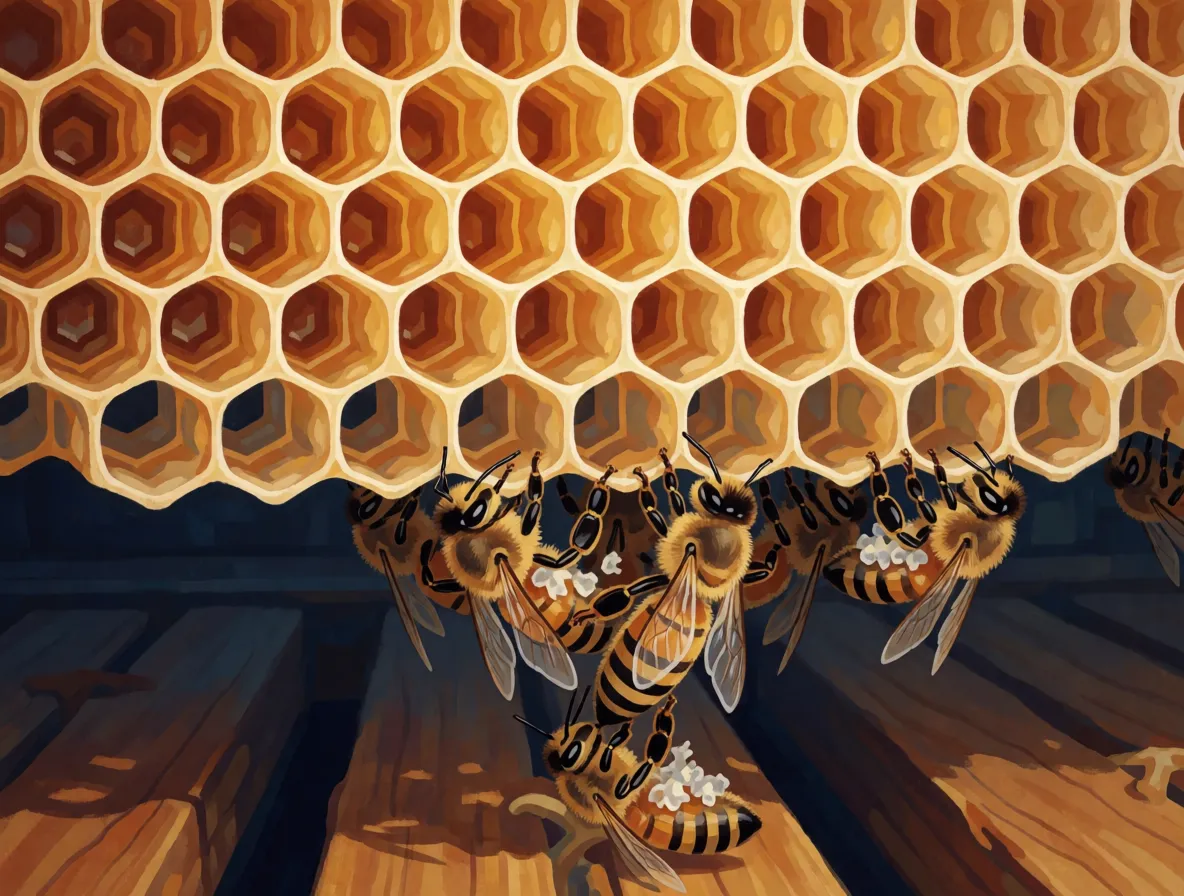
Give all three shapes an identical amount of floor, then measure their perimeters. Triangles are the most extravagant. Squares are an improvement. Hexagons need about 7 percent less wall than squares, and about 18 percent less than triangles.
Seven percent sounds negligible. Remember what wall is made of. A colony builds tens of thousands of cells before winter, and every scrap of wax it avoids is honey it avoids eating.
A plain reason sits behind those numbers: the nearer a shape is to a circle, the less edge it needs for the floor it encloses. Circles are unbeatable.
You can watch the trouble in five seconds. Put seven identical coins on a table and arrange six of them around a seventh. They fit, every coin touching six neighbors, and between them sit small curved gaps. Those gaps are precisely what a bee cannot pay for.
So squeeze. Press the ring inward until each gap closes and every coin surrenders its curve. A circle squashed evenly by six neighbors flattens into six straight sides.
A hexagon is what a circle turns into when it is not allowed to leave a gap.
A hexagonal floor plan therefore wins twice over: no gaps, and the nearest thing to a circle among the shapes that leave none. The cheapest comb anybody could design is the one every colony already builds, which raises a question about the designer.
Nobody in the hive is doing arithmetic
A honeycomb looks like something that was planned on paper first.
That slow sifting has a name. Natural selection means small differences that help a family survive get passed on, while differences that waste get discarded.
Charles Darwin published this argument about combs in 1859, roughly six generations ago, and he was blunt about the currency. The swarm that “wasted least honey in the secretion of wax”, he wrote, succeeded best.
So the shape needs no mathematician. It does still need a builder, and that part is genuinely unsettled.
How a bee builds one is still an argument
Darwin did more than argue. He experimented, in his garden in Kent.
He slid a thin ridge of wax dyed bright scarlet into a hive and watched. The bees began excavating shallow circular hollows from both faces, each keeping a fixed distance from her neighbors and sweeping a hollow the same size. Where two hollows ran into each other, digging stopped and a flat wall rose along the line where they met.
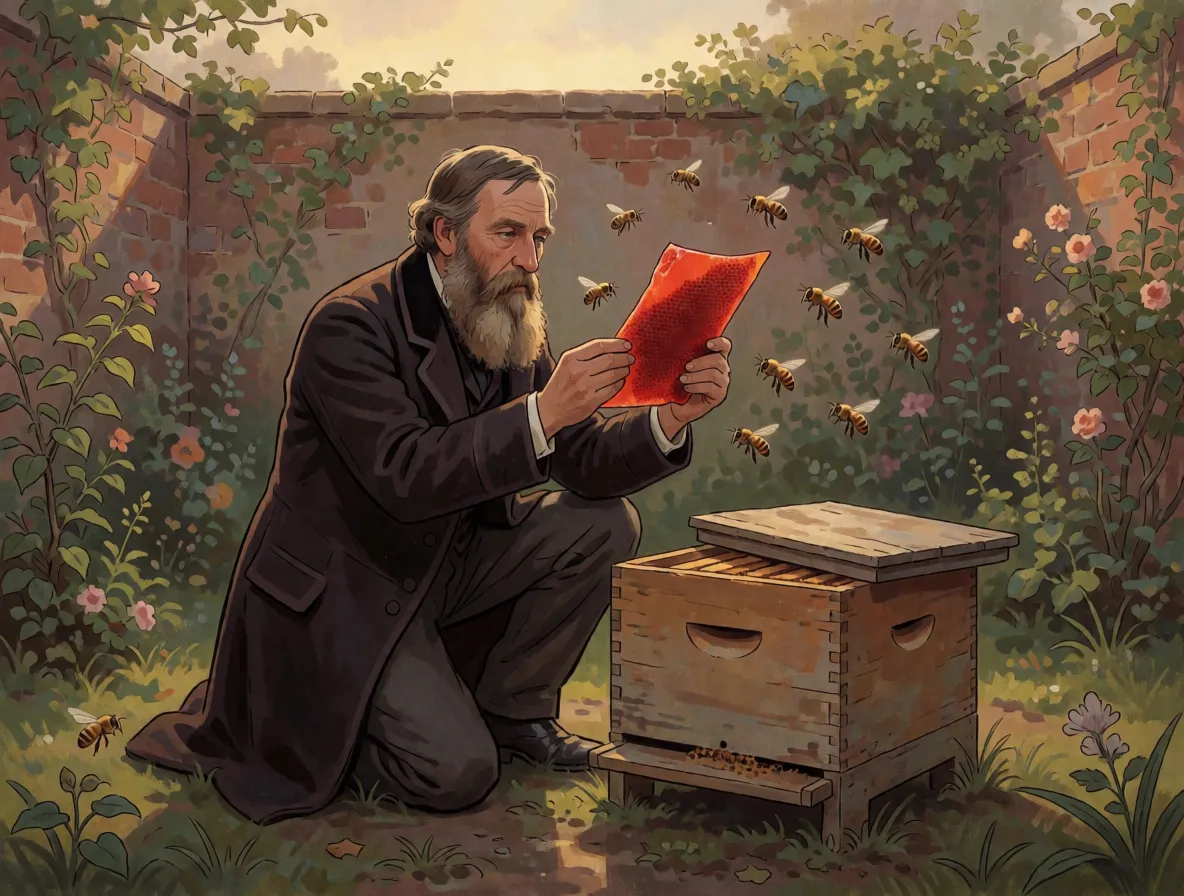
A bee is not aiming at a hexagon at all, Darwin decided. She aims at a circular hollow, and the flat walls are only the seams where hollows collide.
The argument has since moved to the wax. In 2013 a team led by Bhushan Karihaloo in Cardiff argued that bees barely shape the walls. New cells begin as circles, they said, and bees warm the wax with their own bodies until it flows. Surface tension finishes the job: the pull that shrinks a liquid’s surface to the smallest area available. Where three warm circles touch, that pull drags the seam straight.
Also in 2013, Dorothea Bauer and Kaspar Bienefeld filmed German colonies through heat cameras. While hexagons were forming the wax sat between 33.6–37.6 °C(93–100 °F), too cool, they argue, to flow unaided. Their film shows bees deliberately working every wall with jaws, legs and antennae. Paper wasps, they add, build hexagons from chewed wood, where no wax exists to soften.
Neither side has won. Beeswax begins softening close to the temperature those cameras recorded, so the evidence settles nothing.
The proof took two thousand years
A Roman writer called Marcus Terentius Varro recorded the idea in a farming handbook in 36 BC. He set it beside a rival explanation that has aged less well: that cells have six sides because a bee has six feet.
In the fourth century, around 300 AD, Pappus of Alexandria made the case mathematically. He compared the triangle, the square and the hexagon, showed the hexagon holds the most honey for the same expenditure of material, and stopped.
Stopping was the problem. Pappus had examined only regular shapes with straight sides. He never eliminated cells whose walls bow outward, or a comb assembled from several different shapes at once. Nobody else eliminated them either, so the claim survived seventeen centuries as a conjecture: something everybody believed and nobody had proved.
In 1943 László Fejes Tóth closed most of the gap. He proved the hexagon wins as long as every wall is straight, then warned that the curved cases would involve considerable difficulties.
They did. Thomas Hales finished the proof in June 1999, before you were born, in twenty pages. Bowing a wall outward, he showed, never pays. It hands one cell extra floor and removes exactly that floor from its neighbor, while the bowed wall is longer than a straight one.
The bees had the answer long before anybody could prove it was one.
Build a comb out of bubbles
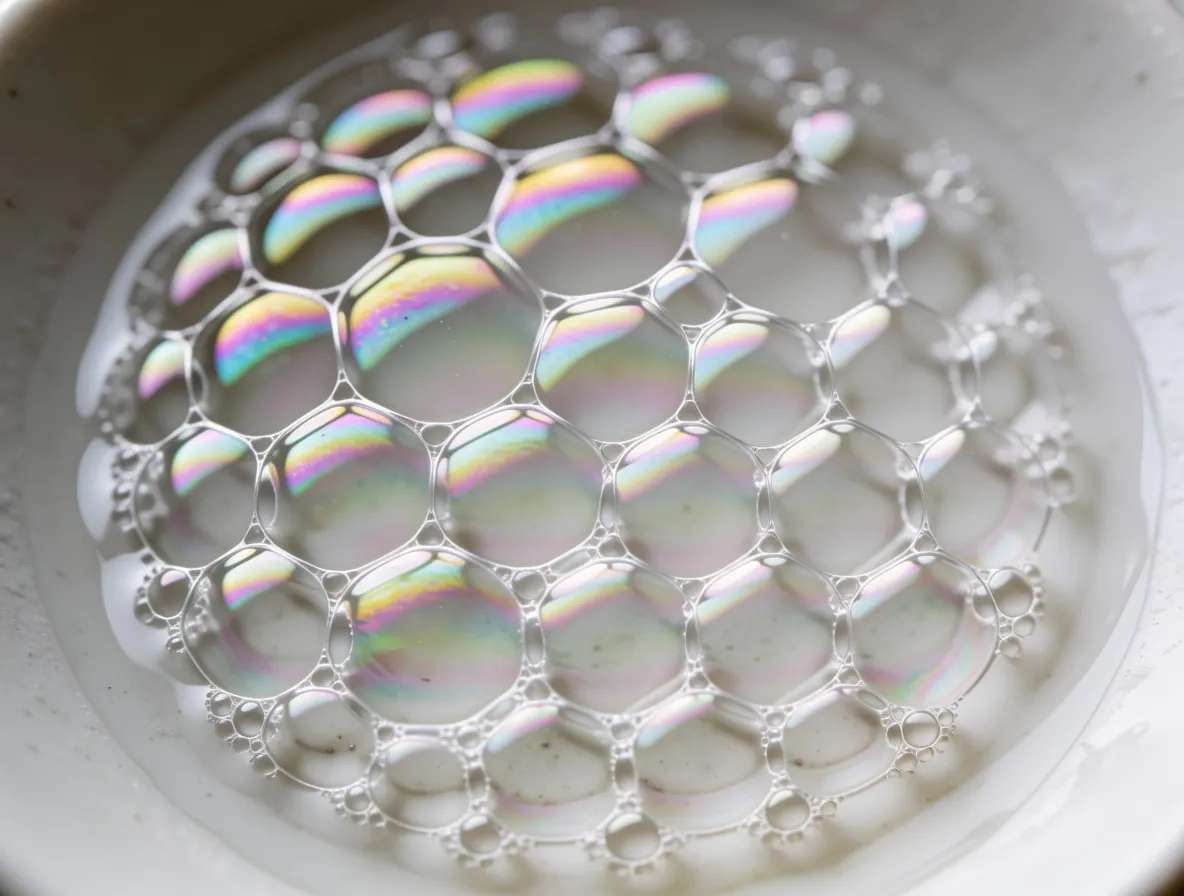
Bubbles at the rim are lopsided, because nothing pushes back on their outer side. The ones in the middle emerge six-sided, with exactly three walls at every corner. No bubble is attempting a hexagon. Equal rooms all pulling short is a honeycomb every time.
What you are actually holding
Go back to the piece of comb in your hand.
Every line in it is a wall two rooms are sharing, so each room pays half. Six sides, because six-sided rooms are the only ones that fill the space completely and still hug the shape that costs least. The bees purchased every line with honey, which is why the design is so mean.
The walls give away where they came from, too. Examine the corners of any genuine comb and you will find them softly rounded, never sharp. A bee begins with a circular hollow. What you are holding is a floor of circles, packed until none of them had anywhere left to bulge.