physics
Why is the sky blue?

Air is invisible. Look across a room and you see straight through it, as if it weren’t there at all. Yet stack up enough of that same invisible air — look up on a clear day — and it glows a rich, unmistakable blue. Nothing up there is painted blue. Nothing blue is being reflected. So where does the color come from?
The blue is made, not reflected — manufactured on the spot, everywhere above your head, by the air itself. To see how, you have to follow a single ray of sunlight into a crowd of molecules.
A crowd of very small obstacles
Sunlight looks white, but it is a mixture of every color, and each color is a wave with its own wavelength — the distance from one crest to the next. Red waves are long, about 700 nanometers crest to crest; blue waves are short, about 450. A 500 nm(1/50,000 in) wave is tiny, but the nitrogen and oxygen molecules that make up air are five thousand times tinier still — about a tenth of a nanometer across.
When a light wave washes over an obstacle that much smaller than itself, something subtle happens. The molecule’s electrons are shaken by the passing wave, and a shaken charge re-broadcasts light in all directions, like a buoy bobbing in a swell and sending out ripples of its own. Physicists call this scattering: a little of the sunlight is plucked out of its straight path and flung sideways.
Here is the part that makes the sky: short waves get scattered far more than long ones. The effect follows a startling rule called Rayleigh scattering — the amount of scattering grows as the fourth power of frequency. Work it through for real colors and blue light at 450 nm scatters almost six times more strongly than red light at 700 nm. Halve the wavelength and you get sixteen times the scatter.
Now look up — anywhere except at the Sun. Every bit of sky in your view is a column of air trillions of molecules deep, and some of those molecules are flinging light toward your eye. Because blue is flung six times more generously than red, the redirected light arriving from every direction is overwhelmingly blue. The sky is not a blue ceiling; it is sunlight taking the scenic route.
The violet question
Wait — violet waves are even shorter than blue, so violet should scatter most of all. Why isn’t the sky purple? Two honest reasons. First, the Sun’s spectrum simply contains less violet than blue to begin with. Second, your retina is a biased instrument: its color sensors respond only weakly to violet, and the mixture of scattered colors lands on them as a pale sky-blue. A bee, with different eyes, may be enjoying a rather different sky.
The sky is not a blue ceiling. It is sunlight taking the scenic route to your eye.
The scientist who built a sky in a tube
In 1869, in the basement laboratory of the Royal Institution in London, John Tyndall built a working model of the sky: a long glass tube for the atmosphere and a bright white beam for the Sun. When he filled the tube with a fine haze, the beam turned blue from the side — and the light that made it out the far end glowed sunset-orange. A sky and a sunset, on a bench.
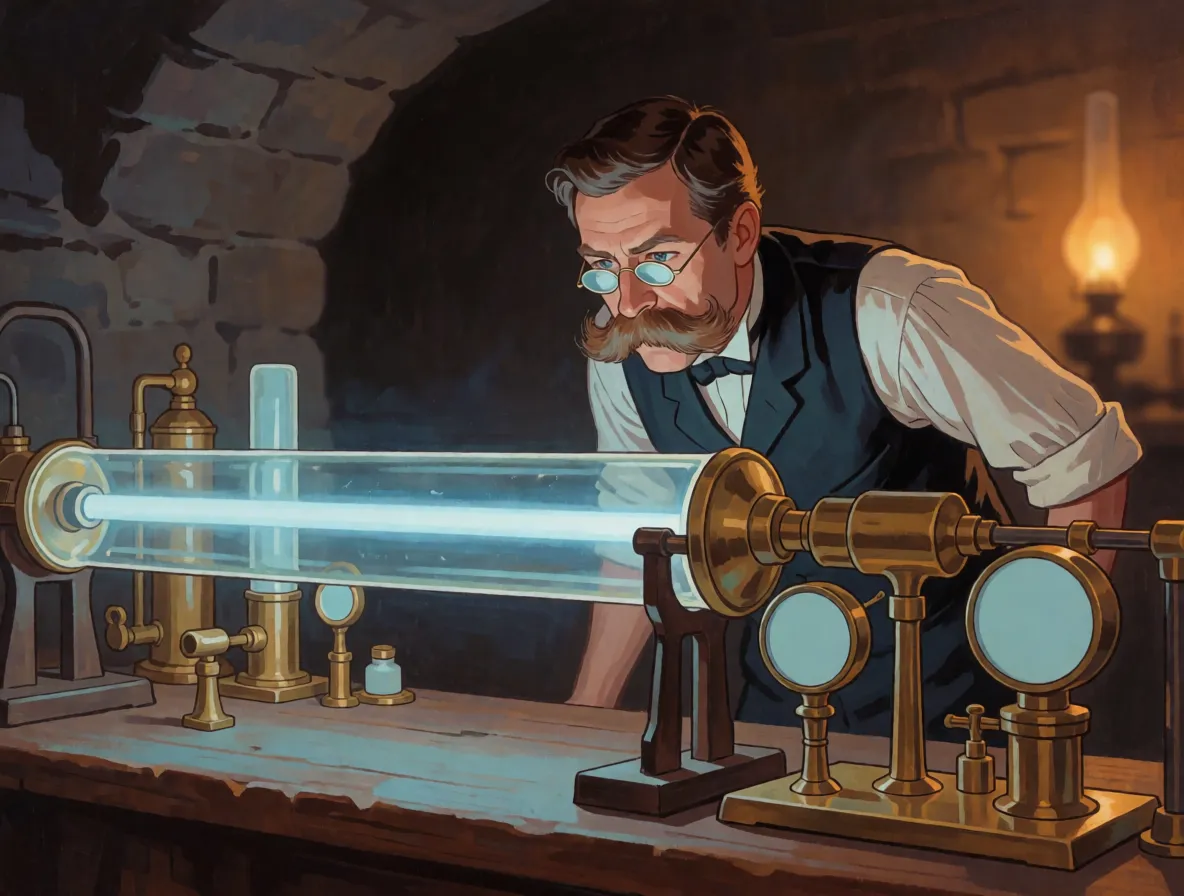
Tyndall drew the natural conclusion — and got it wrong. He decided the real sky’s blue must come from dust and floating particles, as in his tube. In 1871 a quieter physicist, Lord Rayleigh, worked out the mathematics in his home laboratory in Essex and derived the fourth-power law, showing that obstacles as small as molecules would do the job. But was plain air really enough? Doubt lingered for four more decades, until 1910, when Albert Einstein treated the air’s own density flickers — clumps and gaps of molecules forming and dissolving every instant — and calculated the sky’s blueness exactly. The measured glow of the sky even let physicists count how many molecules a jar of air contains. The bluest proof in science: look up, and you can count what you cannot see.
Build a sunset in a glass
Tyndall’s tube is easy to shrink onto your desk. Milk is the trick: its microscopic droplets of fat and protein stand in for a sky’s worth of scattering.
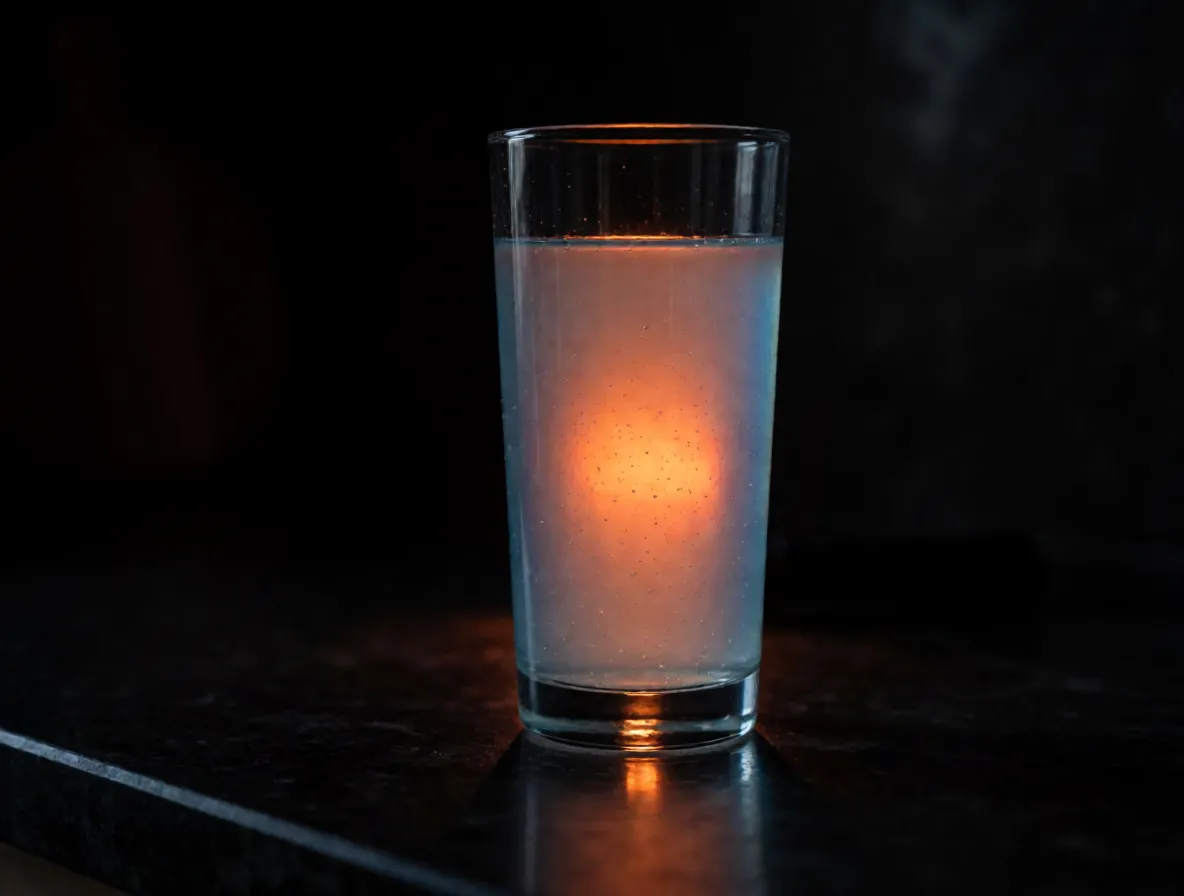
The glass explains evening. At noon, sunlight crosses the thin roof of atmosphere almost straight down. But at sunset the light comes in sideways, grazing along the Earth, and must plow through nearly forty times more air — like the extra-milky glass. By the end of that journey almost all the blue has been scattered away to color other people’s afternoons, and what survives to reach your eye is the leftovers: orange and red.
The sky that got it backwards
So the color of a sky is not a fact about “sky” at all — it is a fact about what the light has to squeeze past. Want proof? Go to Mars. Its thin air is full of rusty dust grains about the same size as a light wave, too big for Rayleigh’s rule, and its daytime sky is butterscotch. But around the setting Sun, the dust forward-scatters short waves into a cool glow — in 2015, NASA’s Curiosity rover photographed it from Gale Crater. On Mars, the day sky is orange and the sunset is blue.

Which answers the question we started with. Nothing above you is painted, and nothing is reflected. The blue is manufactured in flight — short waves flung sideways out of ordinary sunlight by the invisible crowd of the air — and when you watch a sunset burn orange, you are simply seeing the same beam after the blue has been stolen: somewhere to your west, it is the middle of someone else’s brilliant blue day.