astronomy
Why does the Moon always show us the same face?
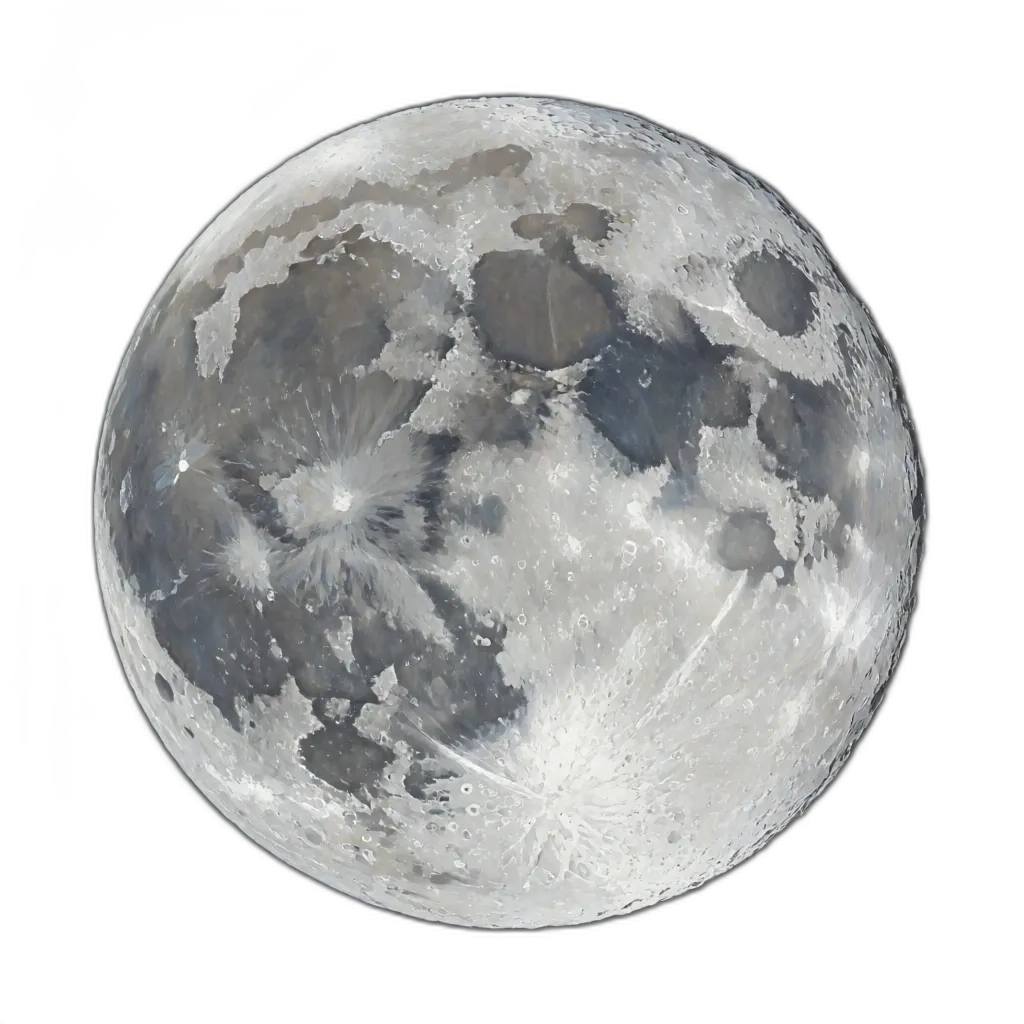
Tonight’s Moon shows the same dark blotches your great-great-grandparents saw, and the same ones Galileo drew. No matter when or where you look, the Moon turns the same face to Earth, as if it were glued in place. The obvious explanation is that it doesn’t spin. But the obvious explanation is exactly backwards.
The Moon is spinning. It rotates once every 27.3 days — which happens to be precisely the time it takes to orbit the Earth once. That perfect match is why you never see its back. The real question is: how did the match get so perfect?
One spin per lap
Picture walking a slow circle around a campfire while always facing the flames. By the time you return to your starting point, your body has turned all the way around once — north, west, south, east, north — even though the fire never saw anything but your face. Anyone standing outside your circle watched the back of your head swing past. That is the Moon’s situation exactly: one rotation per orbit, a state astronomers call synchronous rotation.
Coincidence? Not remotely. The Moon was not born this way — it was braked into it, and the brake was gravity itself. The young Moon spun faster, but Earth’s gravity pulls harder on the Moon’s near side than its far side, and that difference — a tidal force — stretched the Moon slightly out of round. The stretched bulge acted like a handle: every time the Moon’s spin tried to carry the bulge ahead, Earth’s pull hauled it back. Over millions of years the friction of all that hauling drained the spin away until the Moon’s rotation locked step with its orbit — a state called tidal locking — and the braking stopped, because the handle finally pointed straight at the Earth. It is not a fluke; it is a trap that almost every large moon in the solar system has fallen into.
The face nobody had seen
For all of human history, the far side was a genuine blank — not dark, just hidden. That ended on October 7, 1959, when the Soviet probe Luna 3 looped behind the Moon, photographed the hidden hemisphere on film, developed the film onboard in an automatic darkroom, and faxed the pictures back to Earth by radio. The images were foggy and smeared — and sensational.
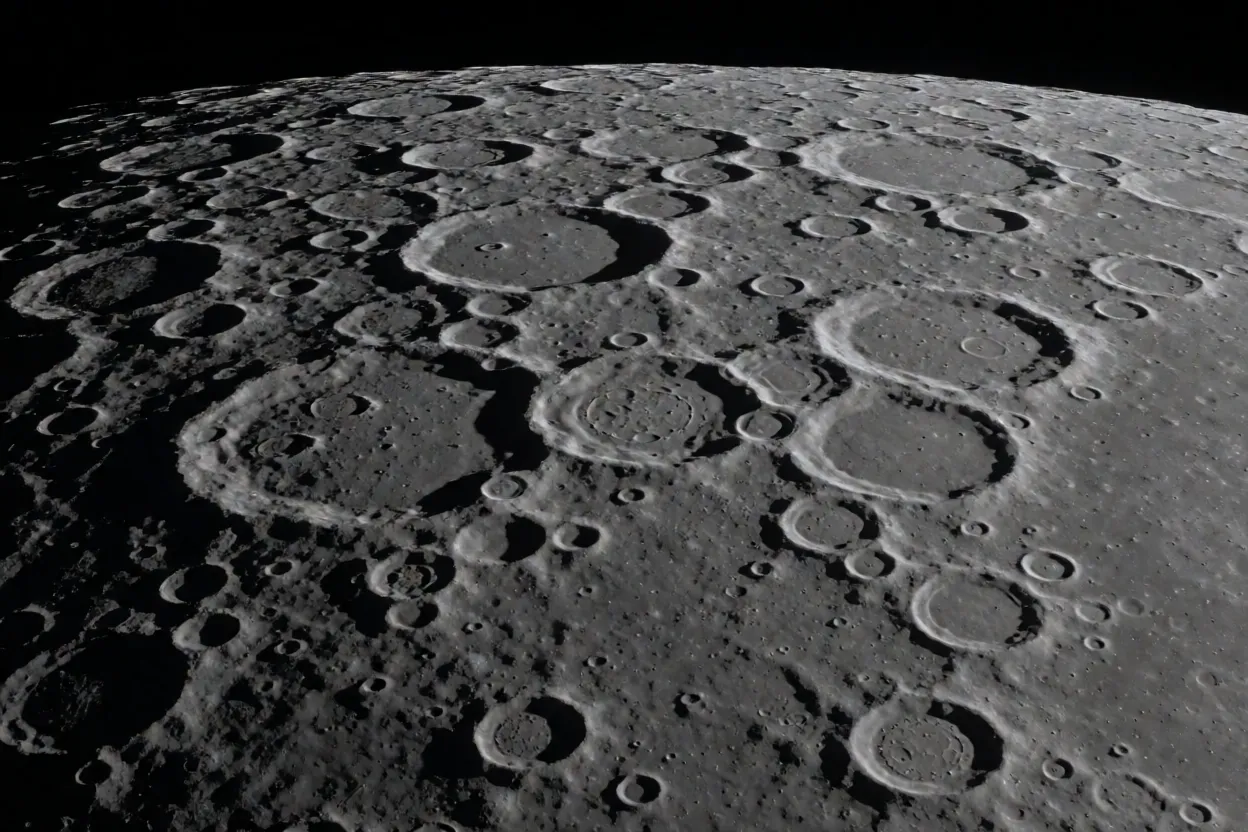
They showed a different Moon. The near side is stamped with the huge dark plains — the maria, ancient floods of lava — that make the familiar face. The far side has almost none: it is a wall-to-wall field of craters. The reason, mapped half a century later by NASA’s GRAIL gravity probes, is that the far side’s crust is roughly 20 km(12 mi) thicker, too thick for most lava to punch through. Why the two sides grew so different is still being argued about today — a plain question you can see with the naked eye that does not yet have a settled answer.
Humans finally saw the far side directly on December 24, 1968, when the crew of Apollo 8 passed behind the Moon. For 34 minutes on each orbit, cut off from all radio contact with Earth, they were the most isolated people in history — the only three humans who could not even in principle be reached.
The experiment you can do with a chair
The locking itself needs no telescope — only a friend and a kitchen chair.
Both observers are right. “Does the Moon spin?” has a different answer from the Earth than from the stars — the same body, seen from inside and outside the dance.
The Moon is not glued in place. It is spinning in perfect step — braked into rhythm by two billion years of gravity.
The brake is still on — and now it’s Earth’s turn
Here is the part almost nobody knows: the same machinery is still running, but now it is working on us. The Moon raises tides in Earth’s oceans; Earth spins those tidal bulges ahead of the Moon; and the bulges’ gravity tugs the Moon forward like a slingshot, boosting it into a slightly higher orbit while stealing spin from the Earth.
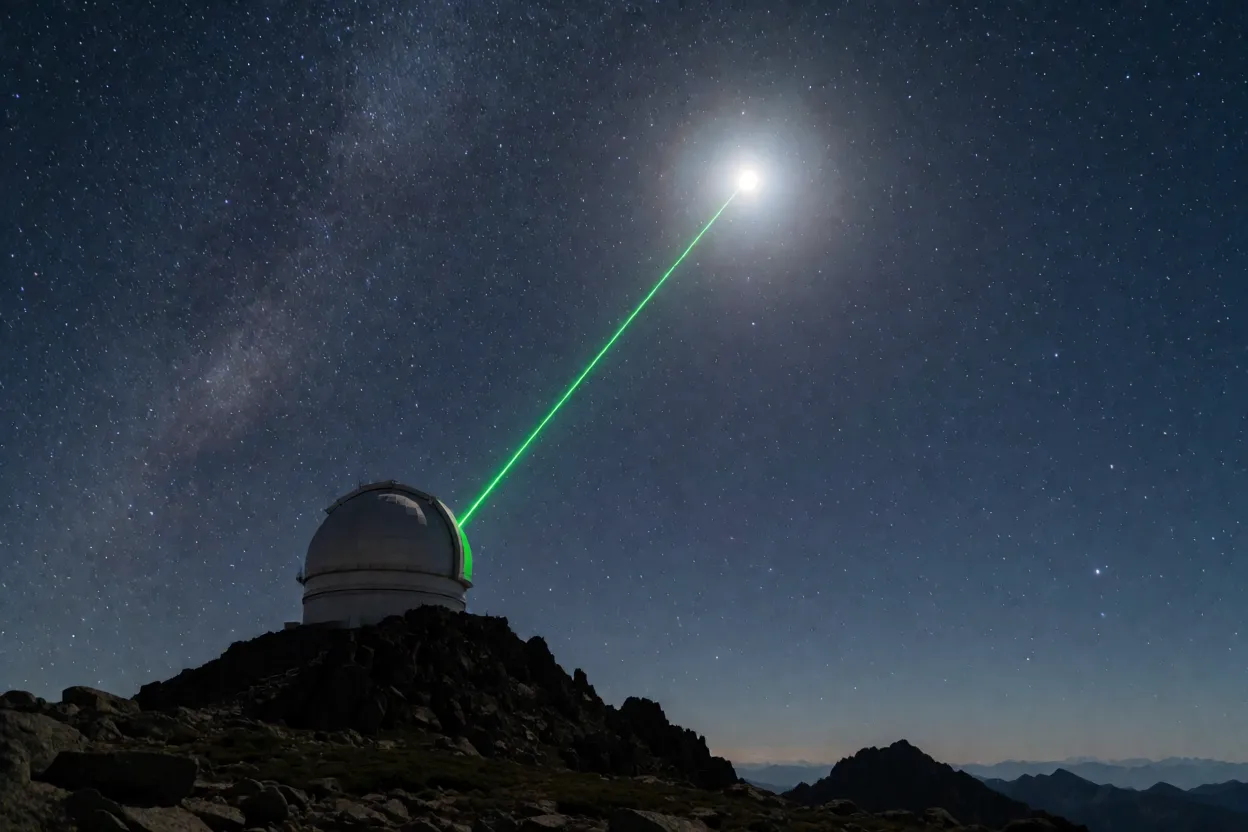
We can watch it happen, to the millimeter. Apollo astronauts left mirrors on the lunar surface in 1969, and observatories still fire lasers at them and time the reflection. The verdict: the Moon retreats 3.8 cm(1.5 in) per year — about the speed your fingernails grow — and Earth’s day stretches by roughly 1.8 milliseconds per century. Small numbers, deep time: tide rhythms recorded in 620-million-year-old rocks show that back then, a full day on Earth lasted only about 22 hours.
Run the film forward billions of years and Earth’s own rotation would slow until our planet, too, always shows one face to the Moon — each world frozen in the other’s sky. It will never finish: the Sun’s own future intervenes first. But out at the solar system’s edge, Pluto and its moon Charon have already completed the whole story — locked face-to-face, circling each other every 6.4 days, each hanging motionless in the other’s sky.
So the Moon’s fixed face is not stillness at all. It is the visible half of a slow, patient gravitational conversation — one that braked the Moon long ago, is lengthening your day right now, and shows you, every clear night, what finished business between two worlds looks like.