biology
How does a falling cat land on its feet?
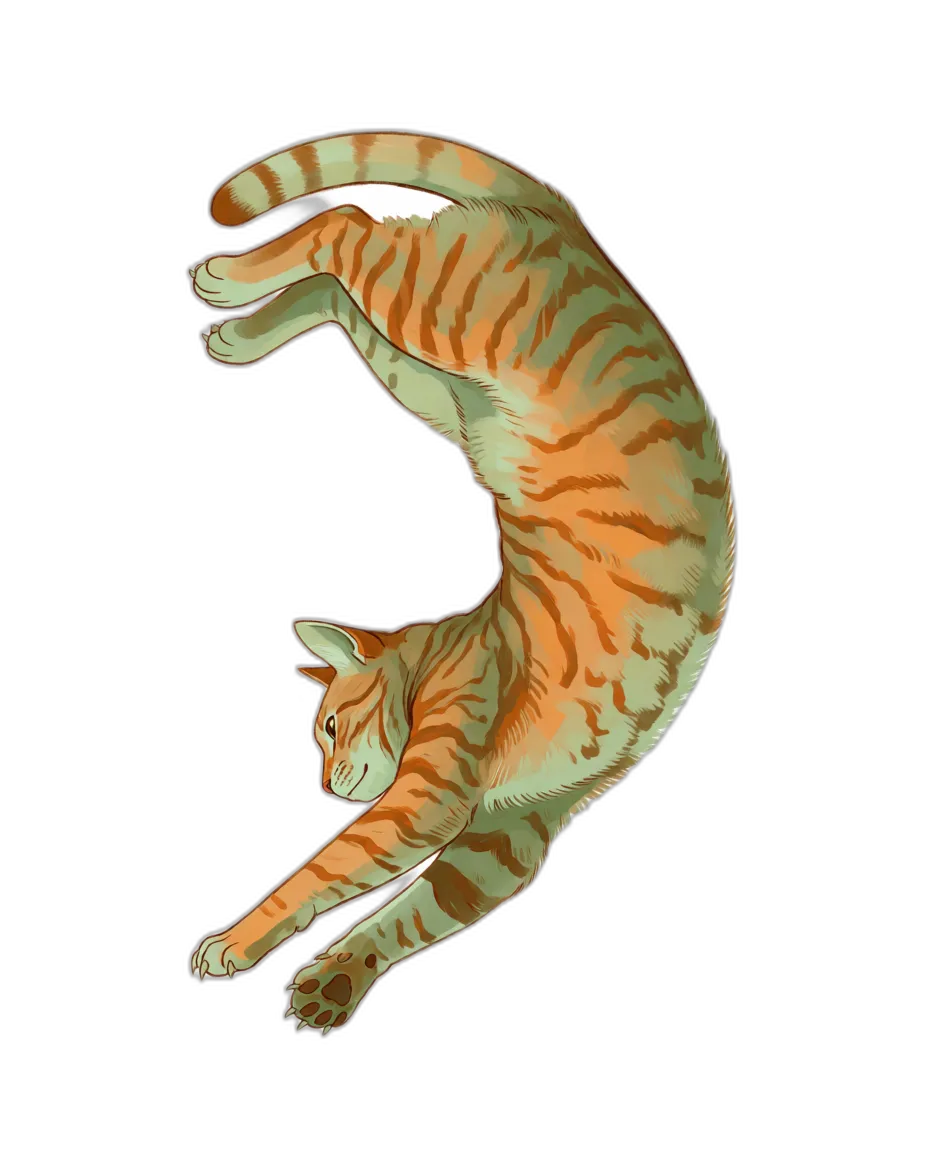
Hold a cat gently on its back and let go — over a cushion, please — and by the time it lands, it is upright. It gets no push from your hands, it has nothing to press against on the way down, and yet it turns a full half-turn in mid-air. Physics has a strict rule that a body’s spin cannot come from nowhere. So where does the cat’s come from?
When science finally looked closely at this trick, the first reaction of some of the smartest people in Europe was that the cat must be cheating. It took physicists 75 years to accept that the cat had simply read the rules more carefully than they had.
The photographs that started an argument
In the autumn of 1894, the French physiologist Étienne-Jules Marey pointed his chronophotographic camera — a machine taking 60 pictures per second, decades before slow-motion film — at a falling cat. The 36 frames showed something disturbing: at the instant of release the cat was not rotating at all. Everyone had assumed it pushed off the dropper’s hand to get its spin. It hadn’t. It began its fall perfectly still, upside down — and landed on its feet anyway.
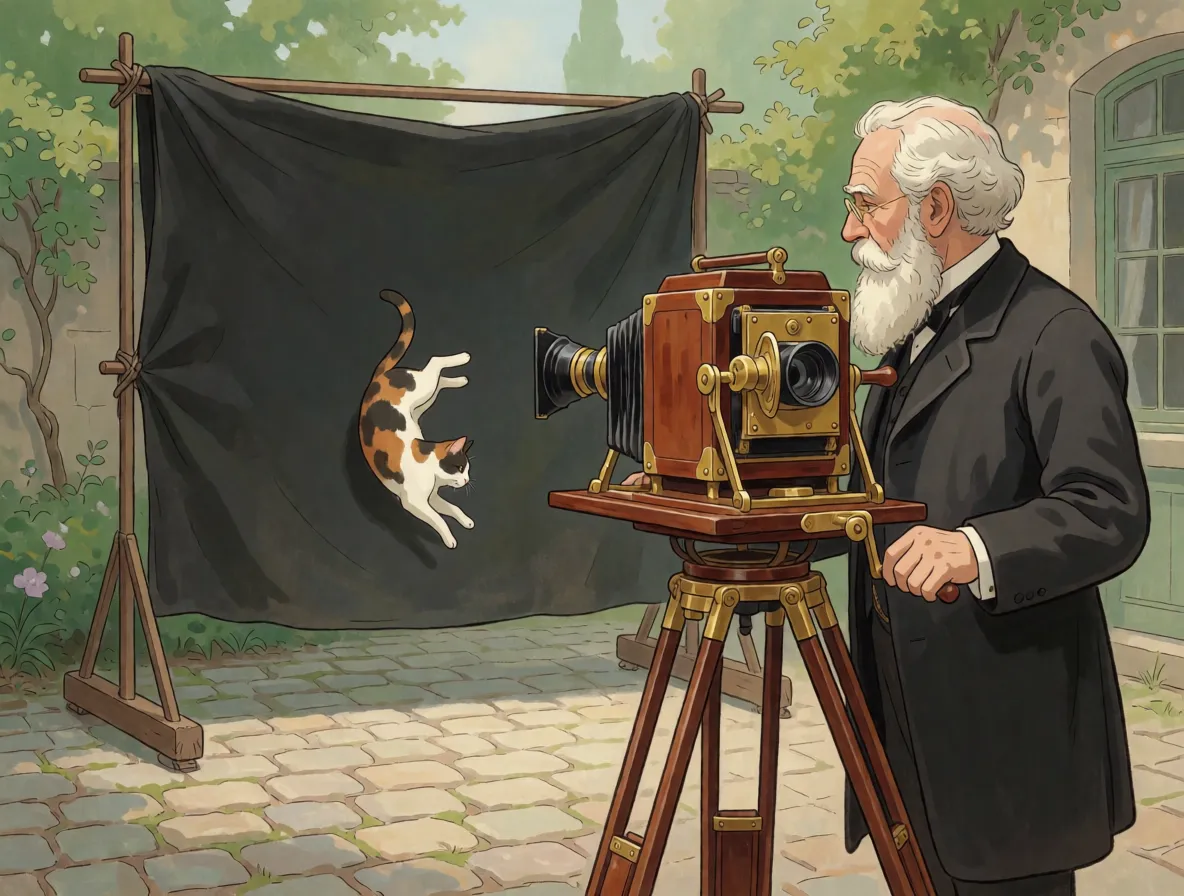
When Marey presented the frames to the Académie des Sciences that October, one member protested that he had shown them a paradox that contradicted the most elementary principles of mechanics. The rule in question is the conservation of angular momentum: the total amount of spin a body carries cannot change unless something outside twists it. The falling cat starts with zero spin. Gravity pulls on its middle and supplies no twist. So the cat must finish with zero — and it does. The scandal was that it finishes with zero facing the other way.
Even James Clerk Maxwell, the greatest physicist of that century, had poked at the puzzle as a student. Cambridge gossip claimed he spent his time flinging cats out of windows; he protested, in an 1870 letter, that the point of his research was to find how little height a cat needs — dropping them about 5 cm(2 in) onto a bed.
The loophole in the law
Here is what the Academy missed, and the cat knew. The law forbids changing your total spin. It says nothing about changing your orientation — if you are allowed to change shape along the way.
The cat’s body is built for shape-changing: a long, extraordinarily flexible spine — measurements published in 2026 found the chest section alone can twist through about 50 degrees with almost no resistance — and collarbones that float free in muscle instead of bracing the shoulders apart. The maneuver stacks two tricks. The first uses moment of inertia — how spread-out a body’s mass is, which sets how hard that body is to rotate. The cat tucks its front legs and stretches out its back legs, then twists its spine: the compact front half swings a long way around while the stretched rear half barely counter-swings. Then it swaps ends and brings the rear around to match. At every instant the two rotations cancel — total spin, still exactly zero.
The second trick is stranger. The cat also bends at the waist, so its front and rear halves rotate around two different, tilted axes — and rotations about tilted axes don’t fully cancel in orientation even when their momenta do. In 1969 — 75 years after Marey — the Stanford engineers Thomas Kane and M. P. Scher proved the bent-spine scheme was sufficient on its own: their mathematical cat was two rigid cylinders joined at a flexible waist, with no legs and no tail, and it turned completely over while obeying every law of mechanics all the way down.
The law says you can’t change how much you’re spinning. It never said you can’t change which way you’re facing.
Be the cat
Every scientist in this story dropped a real cat. You don’t have to — the physics works just as well on a human in a swivel chair, and unlike a cat, you won’t glare at anyone afterwards.
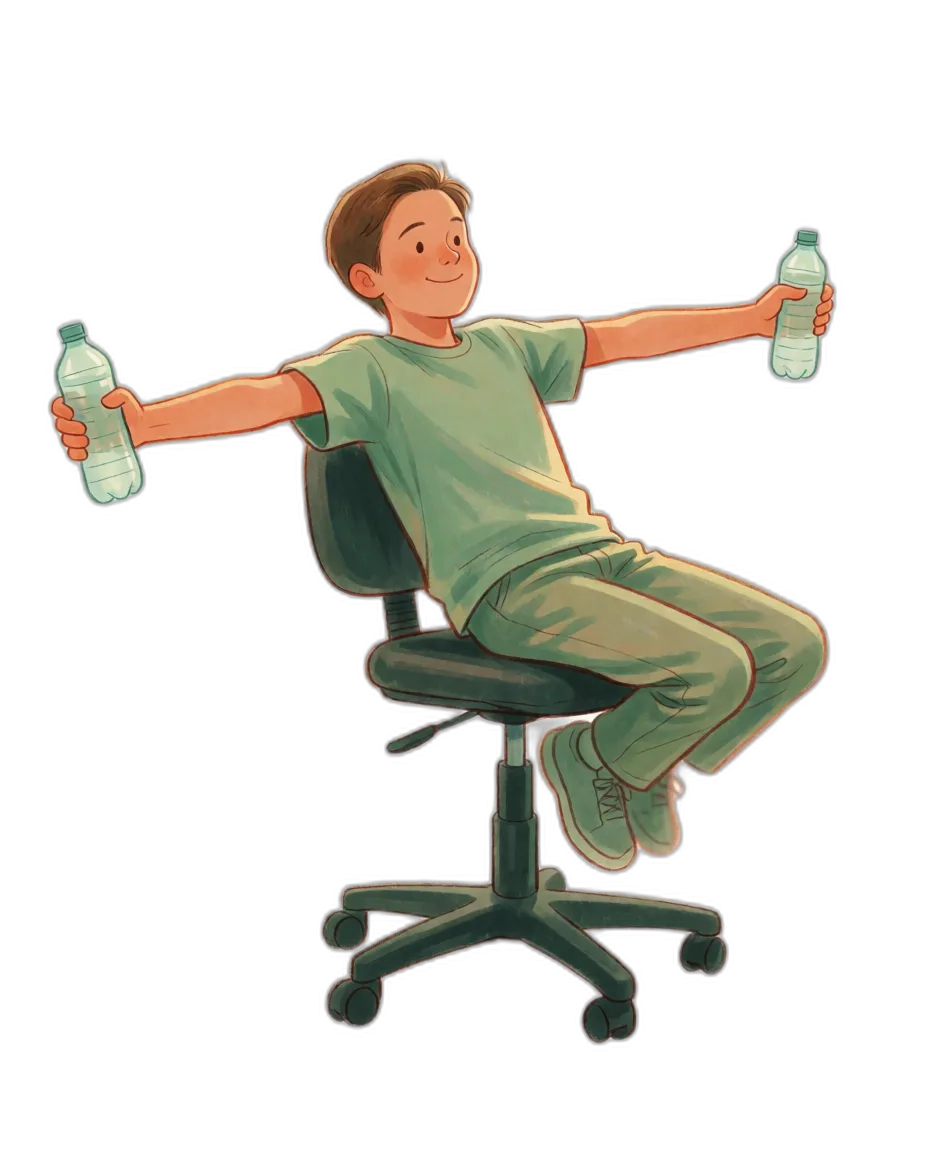
The asymmetry does the work: with arms out you are hard to rotate, so sweeping them drags the chair far around beneath you; with arms in you are easy to rotate, so swinging back costs only a little of the turn you just banked. Each cycle nets a few degrees. That, minus the fur, is the falling cat — and your total spin was zero at every instant.
The cat runs its version in about a third of a second — roughly the time it takes you to blink twice — which is why it needs some airtime to finish. Below about 30 cm(1 ft) there simply isn’t enough fall to complete the turn; give it closer to 90 cm(3 ft) and the maneuver fits comfortably.
From the Académie to orbit
The 1969 cat paper carries a curious line in its footnotes: the research was funded by NASA. The agency’s interest was never cats. An astronaut floating in a space station is exactly Marey’s paradox with a person in it — nothing to push on, zero angular momentum, and a frequent need to face the other way. Kane and Scher followed their cat paper with one showing that a weightless human can re-orient with the same shape-change cycles, and astronauts still demonstrate the maneuver on camera aboard the International Space Station — in 2021, Megan McArthur filmed herself spinning up and slowing down mid-air for schoolkids, arms in, arms out.
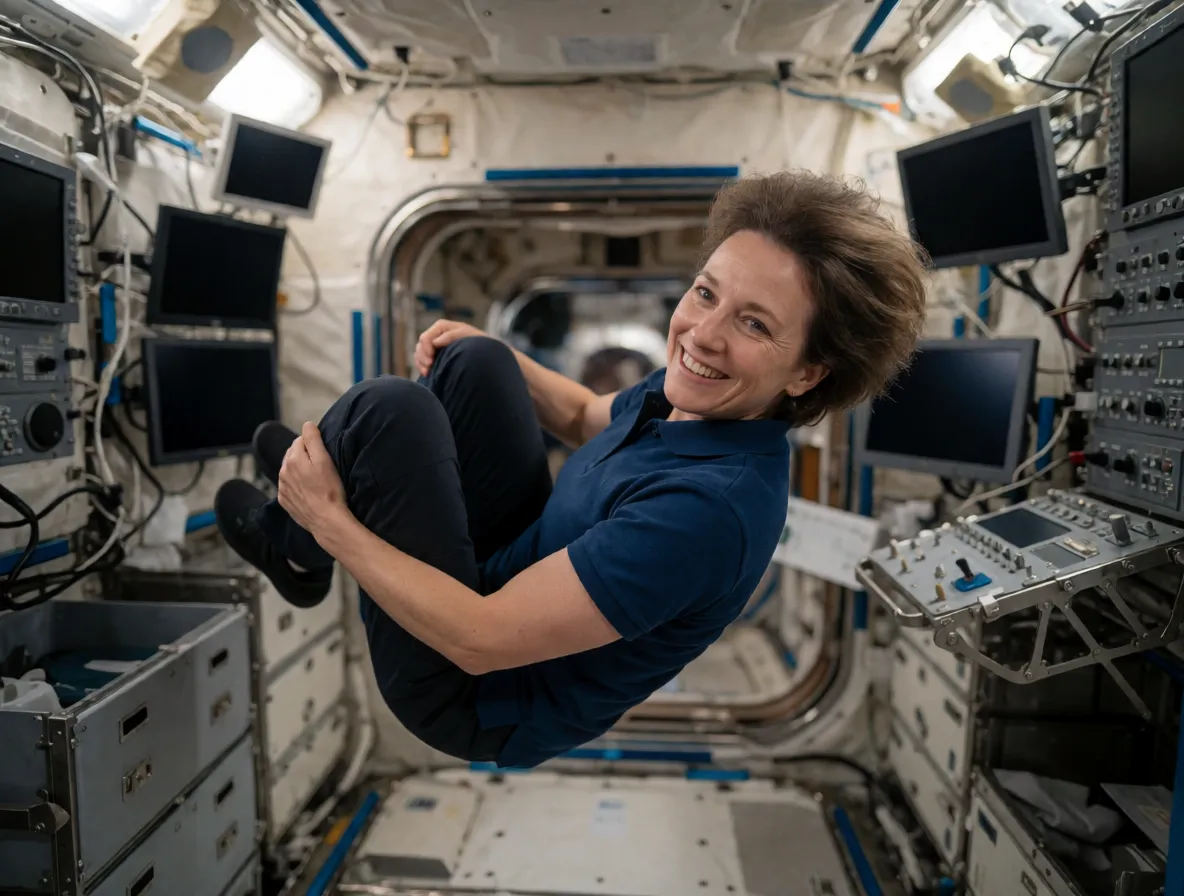
So the answer to the courtroom drama of 1894 is that no law was broken. The cat starts with zero spin and ends with zero spin, exactly as mechanics demands — but in between, it bends, tucks, stretches and swaps, trading shape for orientation in a currency the Academy hadn’t thought to audit. Marey’s own cat, the journal Nature noted at the time, stalked away from the experiment wearing an expression of offended dignity. It had every right: it understood rotation better than its examiners — and it was never once wrong.